Summing Up: Quad Launches Studio Q1
July 27, 2011 by David Weiss
/* Filed under NYC Spotlight, SPARS Feed */
MIDTOWN, MANHATTAN: Blink, and you might miss it. The action in the NYC studio scene right now is raging fast and furious, with noteworthy new rooms opening up at a pace almost too fast to keep track of.
The latest big-time addition to the cityscape: Q1 at Quad Recording Studios. The flagship revision to this storied facility, Q1 represents the latest evolution in NYC’s world-class studio offerings for artists, producers, mixers, and songwriters in search of new creative options and inspiring surroundings.
With its arrival, the fascinating timeline of 723 7th Avenue gets yet another update. The seeds of this new room were sown in Quad’s 2010 sale of its 8th floor — emerging lean and mean, Quad President Ricky Hosn and his staff embarked on a $500,000 overhaul of its remaining territory, the 3500 sq. ft. 10th floor.
Ask Hosn about the current NYC studio climate, and he’ll readily admit that navigating the scene is more challenging than ever. “It’s kept us on our toes,” he says, “and restructuring the place was essential for us. Quad was five floors at one point, but the market won’t sustain that anymore. We had to reinvent ourselves, to move in step with a changing of the times — we feel we have the right formula now.”
Making the Update
The results of the remake are as easy to see as they are to hear. Visitors step off of the elevator directly into the atmospheric Qlounge, complete with a pool table, bar and a carnivorous fish tank (show up for feeding time – if you dare). Those familiar with the powerful audio pod previously known as Studio D – now Q2 – will be happy to know that that room remains intact, although it is equipped with a new lounge that flanks it to the left.
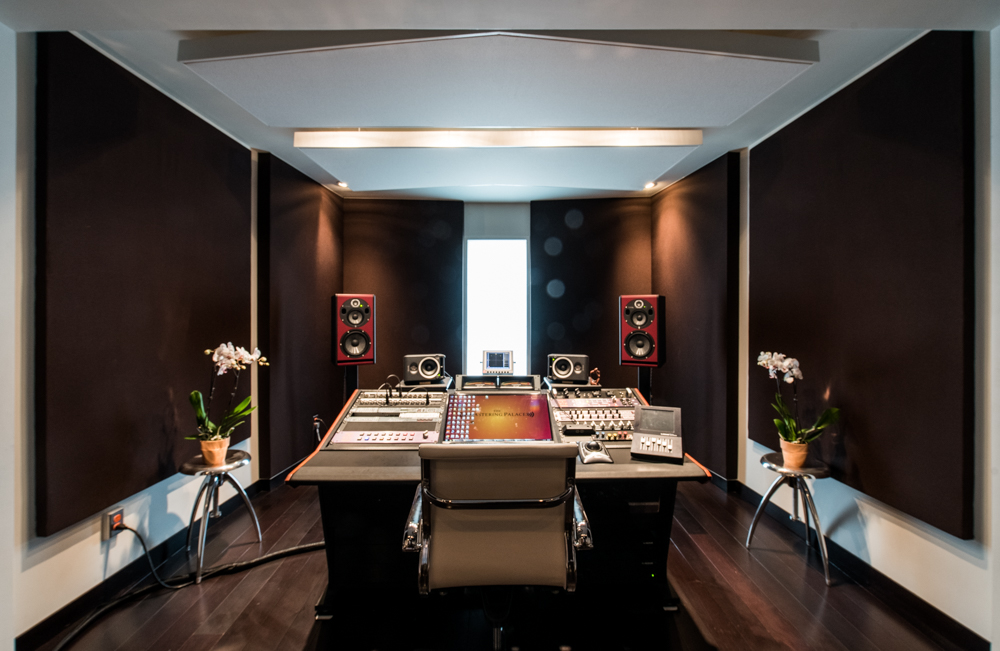
Also with a brand new lounge is the latest addition Q1, a space designed to make all kinds of waves. At 320 sq. ft., the comfortable Larry Swist-designed control room may seem slightly compact, but once the advanced functionality and exhilaratingly loud and accurate acoustics have been experienced, size no longer matters.
To the contrary, Q1 is already making a big impact with its extreme flexibility, both in workflow and capabilities. “In the past a studio would have a mix room, a production room, a tracking room,” Hosn explains. “We said, ‘Let’s put all three together, and make a room where any producer, engineer or artist can walk in and feel at home.
“That’s the approach we took. There’s a producer’s desk in the back where you can sit, listen accurately, and work. The producer or artist is never sitting too far from the controls and the engineer. It’s geared around the artist and production, and that’s the trend we see: A lot of producers are handling the whole project, and we built it around that reality. It’s the same principle we had with creating Studio D five years ago, but we made this a bigger format, with better gear and a much bigger live room, so you really can handle any kind of music project.”
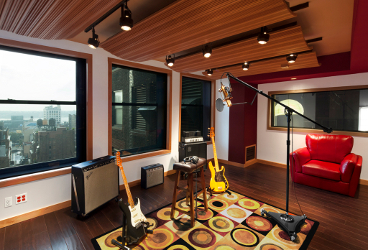
Outfitted with oiled walnut wood appointments, Swist’s pleasing design employs generous views to the outside and the adjacent control room, providing Q1’s users with an expansive experience while they work. “Windows were essential: You’re in Times Square so take advantage of it,” Hosn says. “Both the live room and control room have windows out to Times Square, and the window between the live and control room is bigger than most windows in the city. You feel like you’re right next to the artist — it just feels like one big room between the control and live room.”
Once clients get settled into the welcoming environment, things get increasingly interesting. While the ICON control surface won’t raise any eyebrows, the Pro Tools HD 4 Accel 9.0 system is to be expected, and the comprehensive list of plugins is de rigueur, where the signal can flow from there is unique: three different summing mixers – a Chandler 16 x 2, SSL X Logic 16 Channel, and a Manley 16 x 2 Custom mic/line – flanked by a who’s who of outboard gear.
“We had the opportunity to go with a typical analog desk, but we said, ‘Let’s do something different and get creative with the equipment,’” Hosn says. “We focused on summing, with three summing mixers to give the engineer more of a choice for the sound. This is the best of the summing world: Chandler comes from the old EMI consoles, SSL is the industry standard, and we have something different in the Manley mixer, which is amazing on vocals. As far as outboard gear, we went for — not vintage, but brand new — Chandler, GML, SSL, Manley EQ/compressor, and of course the Universal Audio units like the 1176 and LA-2A.”
For monitoring, a pair of Augspurger Dual 15” main monitors, custom built by Professional Audio Design, supplemented with 2 subwoofers, throws down the gauntlet for mega volume listening in NYC. In a recent visit listening to hip hop, pop and rock through these speakers in the tight, well-tuned room was a sonically exciting experience, revealing extremely high levels of full-frequency detail cleanly across the stereo field. For those who need to craft, check or just feel their mixes at massive SPL’s, Q1 may well become a mandatory stop on the way to the mastering lab.
Design Assignment
According to Swist, whose credits include Tainted Blue, Premier’s Studio E, Eastman School of Music, SUNY Fredonia, and The Lodge, the directive for Q1 was to create a warm but contemporary look and feel. “We used a lot of sharp lines, and the sound has got to be there — the acoustics need to be spot-on because people are going to mix in there,” Swist notes. “The challenge today in an NYC facility is that you don’t have the cubic footage you used to, so you have to spend more time in the design phase ensuring that the room will translate in the outside world, especially with bass response. It also has to have a broad sweet spot. It’s easy to make it work right in the middle, but to make the room work for the producer standing next to you or in the back is a challenge.
“Most live rooms have an idiosyncratic quality to them: The great engineers find its good characteristics, the right places for the drums and mics, and use gobos,” Swist continues. “My approach is to keep it a relatively active room, and then you can come down from there. So Q1’s tracking room sits in a relatively live place: It’s good for drums, but reverb times can be cut down with gobos and more acoustical absorption. I think the live room is larger than most. It’s not huge, but then again most people are just putting in booths in a production suite today. This offers the ability to actually track a band. A lot of those rooms are going away, and this fills that void.
“Overall, the studio is something fresh, and you do have a really good initial emotional reaction to it. It’s positive creatively, and that’s what we were striving for. It’s like, ‘Wow, it feels nice and it sounds nice. We have a good combination there.’”
Under the Hood
Cleanly integrating Q1’s three analog summing mixers and outboard gear with the ICON was no plug ‘n’ play operation. “We wanted to do something focused on an easier workflow, quick mix recalls for engineers and easy accessibility for producers,” states Alessio Casalini Operations Manager and Chief Tech for Quad Studios NYC/Halo Records. “This improves the possibility to change little things fast and maintain top quality in terms of outboard gear and technical components like patchbays, wires, and connectors.
“The wiring of the whole studio and the patchbay’s layout were designed by Glenn Baughmann and myself,” continues Casalini. “We brainstormed in order to find the best result to yield a simple layout, one noted example being: The three summing mixers normalled to the multitrack outs, and the outs of those mixers normalled to the Stereo inputs of the (ICON) XMon (monitoring controller), and dedicated computer output to the XMon. Even the TV is on the bays.
“We started with the best quality wires and connectors, and used only two DB25 patchbays for connections with XMon and audio interfaces. All the other patchbays are soldered by hand and split to DL connectors panels.”
Connectivity in Q1 is obsessive: Every wallplate in the live room, control room and in the lounge are equipped with SpeakON plugs, Ethernet, instrument, MIDI, and BNC. “The goal being,” says Casalini, “to give the engineer every possibility, without trying to find a way around what he has in mind. In this scenario the artist, producer, and/or engineer will have everything accessible in the clearest way possible.
“New York City studios are looking to the future, and retaining our experience from the past. We expect that our careful planning yielded a room ninety percent ready for anything — with the client left only to decide the direction of the last ten percent.”
In Action
Online since June, Quad has quickly been breaking in Q1. Sessions include Engineer/Producer Andros Rodriguez (Shakira, Oh Land), Music Producer Rico Beats (Justin Bieber, Niki Manaj), and Universal Music Artist Stephen Marley. One frequent visitor has been the NYC engineer Stuart White (Alicia Keys, K’Naan), who’s gotten to know the room via mix sessions for the artists Borni, Fumibella, and Sunny.
“The mains are really smooth,” he says. “They sound good and balanced. The ProAc monitors I use a lot and they’re dialed in, very smooth on the top end. Having three different summing boxes gives you three different colors. The Chandler is really punchy, with a lot of transformers in it: It’s got color to it, with some punch when you drive it hard. I typically use that summing bus. The Manley is all tubes, which provides a fat tubey sound, and the SSL is a different color.”
According to Stu, Q1 met Quad’s objectives in smoothing out the NYC studio continuum. “I think in a lot of ways Q1 is bridging the gap between the old-style, large-format console style way of working and the new summing bus-style way,” Stu adds. “There’s not a large format console, but still a plethora of analog gear so you can mix with the speed of what we need today. You have clients that expect you to mix in the box for speed, but at the same time Q1 makes you and the analog purists happy by being able to sum in analog gear.
“I think it’s a new breed of room in that sense. A few years ago, most engineers didn’t want to mix on an ICON, they wanted a large format board. But Tony Maserati is working exactly this way, and he’s the one who kind of inspired me to do it: You’re mixing with faders, and tactile controls, so you can stay creative and not use the mouse so much. But if someone wants to come in and change the song, it’s very easy to pull your mixes back up. It bridges the gap between the older generation rooms and the newer ones that are all digital.”
Cue the Q
As New York production possibilities continue to morph, at least one thing is clear: As previously noted on this site, a subtle sense of cooperation is weaving itself into the intensive competition between NYC studios. Facilities are avoiding blatant duplication in favor of an overall sense of regional integration, where each new room creates a fresh niche, rather than further crowding an existing one. “You don’t want to build what’s already there, and then compete against the same thing,” Hosn says. “The key for us was to make it a top notch room at an affordable price.”
As Ricky Hosn points out, the big winner in the friendly NYC studio arms race are music’s avid listeners, whose insatiable appetite for new sounds are increasing yet again with the availability of Spotify in the U.S. “Who knows what the next big record will sound like?” he says. “There’s a lot of opportunity to come up with something that hasn’t been heard yet.”
– David Weiss
Walter Bianco Mixes New Alicia Keys Documentary at Cutting Room
July 5, 2011 by David Weiss
/* Filed under News */
Walter Bianco of the NYC facility Cutting Room recently mixed the new Alicia Keys documentary, Alicia Keys songs in A minor – Documentary, marking the 10th Anniversary edition of her debut album, songs in A minor.
Bianco worked closely with Director/Producer Earle Sebastian on the project, with an ear for ensuring that Keys’ music was front and center in the storytelling. Dan Saitta was assistant sound engineer.
An up-close and behind the scenes account on the making of Keys’ landmark album, the documentary tells the story of her struggles and triumphs in the making of the record, as well as her inspirational story.
The 10th Anniversary Collection Edition was released on June 28th and includes a 2-CD/1-DVD set containing a CD of the complete original album, a second CD featuring unreleased tracks and a DVD of the documentary.
An artist-owned and operated editorial and post-production facility, Cutting Room, New York is led by Managing Partner Susan Willis, EP Melissa Lubin, and Partners/Editors Chuck Willis and Mike Douglas.
Credits:
Director: Earle Sebastion
DP: Gerald Wenner
Editor: Ross Baldisserotto
Producers: Natalie Galazka, Earle Sebastian
Producer: Planet Dog Films
Executive Producer: Alicia Keys
Executive Producers for Sony Music Entertainment: Adam Block, Tom Corson
Supervising Producer: Richard Alcock
Audio Post: The Cutting Room, NY
Sound Engineer: Walter Bianco
Assistant Sound Engineer: Dan Saitta
Colorist: Sal Malfitano, The MilL
Lady Gaga, T-Pain, Keith Richards Recording at Germano Studios
April 20, 2011 by Janice Brown
/* Filed under News */
Germano Studios has been going non-stop in 2011, between multiple months of lock-out sessions with Lady Gaga, and sessions with a host of other major artists.
Gaga and crew have been working out of both Germano Studio 1 and Studio 2, recording and mixing her upcoming album, Born This Way – due out May 23 – and the title track lead single, released in February.
T-Pain has also been working at Germano Studios, recording vocals in Studio 2 with Levar “LV” Coppin producing and Javier Valverde engineering.
And Kelly Clarkson was in Studio 1 cutting basic tracks with Steve Jordan producing and Dave O’Donnell engineering.
Jordan has also been working with Keith Richards at Germano – the pair have been writing and recording in Studio 1, with O’Donnell engineering on those sessions as well.
The Canadian Tenors tracked vocals recently at Germano with producer Desmond Child, and Christian Baker engineering.
In other recent sessions, Alicia Keys was at Germano recording with engineer Ann Mincieli, and The-Dream has been through working on new material.
For more information on Germano Studios – with its SSL Duality + Pro Tools HD5-equipped Studios with corresponding live tracking rooms – visit www.germanostudios.com.
On Top Of The World: Jungle City Studios Shows NYC In A New Light
February 10, 2011 by Janice Brown
/* Filed under NYC Spotlight */
CHELSEA, MANHATTAN: NYC is quite literally the backdrop to Ann Mincieli’s brand-new Jungle City Studios. One step into the top-of-the-world Studio A, with panoramic views uptown along the High Line and west to the Hudson River, and you’re hitting the Alicia Keys chorus of Jay-Z’s “Empire State of Mind;” it’s a cinematic moment.
This is how Mincieli — Keys’ longtime engineer and studio coordinator — conceived of the deluxe studio facility, incorporating the best of everything she’s encountered in studios around the world to her own vision for a top-of-the-line and uniquely “New York” studio experience.
She’s quick to reference Hit Factory Studio 1 as her all-time favorite live room, but also mentions immersive destination studio experiences in France and Germany, as influential in her designs for Jungle City, located on W. 27th Street.
“I wanted to find the ultimate location that really represented New York City with the views, the art and culture,” Mincieli shares. “This is such an up-and-coming neighborhood — you have the art galleries, the High Line, views of the Empire State building and the water. And there’s a luxury hotel [Hotel Americano] opening right next door which benefits us so much because people will stay there and work here.
Looking at the post-Hit Factory/Sony/Chung King/Clinton NYC studio landscape, Mincieli saw a void. “I wanted to bring something back to NYC, to the industry here, give people something they can be excited about. A real experience. Not just to bring back the clients from NYC, but from around the world.
On the day of our visit, in fact, the Japanese pop band Dreams Come True were recording in Studio A with Ed Tuton. Downstairs, Swizz Beatz had been working out of the Euphonix room, and Keys has been in working on a couple projects, including material for her next album. Like Keys’ Long Island recording studio complex, The Oven, Jungle City was devised by Mincieli with superstar artists in mind, and designed with signature features by John Storyk and Walters-Storyk Design Group (WSDG).
Jungle City Style, Sights, Sounds
Situated on the top two floors of a brand-new building, Jungle City’s three studios provide distinctly different environments, though all feature the custom Augspurger mains with Aura subs — an expensive custom system (painted at a car dealership for extra flash) but a necessary expense as Mincieli sees it.
The "ICON" room, with 32-input Avid D-Control, Pro Tools HD3, and Augspurger Dual 15 mains with Aurasound 18" subs
“The Augspurgers sound incredible,” she notes. “They’re loud, the image on them is great. It’s a no-brainer. People come in and it’s psychological — they’re relieved to see them. You have to give the clients what they want.”
For that matter, Mincieli sourced what she determined was “the best of everything” for every aspect of this facility — that is three impeccably equipped studios, lounges, kitchens, bathrooms, the works. And though she knows her audience well, she did her homework.
“I co-designed the studio with a lot of research, input from artists, labels and producers on what they felt the industry was missing,” she explains. “I’d ask them, ‘What would you like to see in a studio in NYC?’ ‘We want light. We want it to feel like home.’” From the Louis Vuitton wallpaper and fabrics in the control rooms to the tastefully appointed lounges, to the unique acoustic treatments, the Jungle City interior design — coordinated by WSDG’s Beth Walters — lends that opulence of a high-end hotel, or home.
And then there’s the gear. Knowing what her network of top-tier artists and producer/engineers would expect, Mincieli handpicked all the gear with attention to every last detail for different users and workflows.

The "Euphonix" room, with S5 Fusion console, Pro Tools HD3 and Augspurger Dual 15 mains with Aurasound 18" subs
“There are so many ways to work now,” she notes. “Different mixers mix in different ways — some have migrated all in the box, some are half-in half-out, some are SSL, some are Euphonix. So I wanted to give people a few different flavors. The two mix/overdub/production rooms are very versatile with both the retro and cutting-edge technologies.”
And each has its own flavor of console: one with an Avid D-Control, and the other a Euphonix Fusion System 5. Both have Pro Tools HD3 rigs loaded up with plug-ins and corresponding iso booths. Along with the 32-input D-Control, the ICON room highlights include “the newest Avid HD IOs, Dangerous summing and the great [Antelope] OCX-V clocks.” Across the way, the Euphonix room offers a whole ‘nother experience.
“The integration between Avid and Euphonix is just incredible,” Mincieli says of the S5 Fusion.
“They’re taking advantage of the EUCON control so the features and plug-in channels that you see in Pro Tools show up on the desk. It’s a dual-purpose desk and control surface. I have 16 channels of Euphonix mic pre’s, and running at 96K, I can still get 64 channels of EQ and compression. And when you want to be all in the box, you can use the EQs, compressors, the bussing, and it’s all digital — it all converts via the new Avid Digi I/Os and Avid also made a new MADI converter specifically for this desk.”

Jungle City Studio A with 48-input Duality; EMI TGI 12345 (not pictured) sits to the right. (Get a full view of the studio in the video below!)
Mincieli adds, “I love the way it sounds: the EQs, compression, the stereo bus. You can pull a compressor up in Pro Tools and control it without having to look at a monitor. And the 7.1 surround and film panning is insane — I can do a 12.2 mix in here. This is the wave of the future.
Upstairs in Studio A, Mincieli went retro-futuristic with the centerpiece 48-input SSL Duality analog console, Pro Tools HD3 and a rare 1968 EMI TGI 12345 Mark 3 console she’s completely restored. The EMI sits to the right of the SSL, side-car-style. “You can use it in a variety of ways,” Mincieli notes. “The EMI console can be used for mic pre’s, for the EQ/compressors, and it’s a fully patchable console.”
And of the sizeable control room, Mincieli shares, “I wanted one big old-school control room so we could accommodate artists who want to have their four guitar heads, or several keyboards in there with them.”
With the unique clear glass diffusion panels across the back wall windows, the clients are working inside a North and South facing top-floor studio.

Back wall of Studio A control room with clear diffusion panels. Captured during Dreams Come True sessions.
On this, the studio’s ultimate wow factor, John Storyk describes, “To maximize the impact of the studios’ expansive North and South picture windows, we floated the custom Augspurger Dual 15 Vertical main speakers in an outsized glass speaker baffle. This is only the second time we have done this, creating a kind of transparent ‘wall of sound’ between the live and control rooms.
“This provides artists and engineers with the creative advantage of full visual connectivity plus, NYC’s ultimate eye candy, views ranging from The Empire State Building to the Hudson River. The audio sound field is extremely accurate throughout the full frequency range, particularly at the critical low end, necessary for many of Mincieli’s demanding urban music clients.”
Monitoring accuracy is paramount in these environments, as Mincieli points out more than once during our tour. Just prior to opening, in the first week of January, she worked closely with mastering engineer Dave Kutch and WSDG’s Dirk Noy to tune all three Jungle City studios over four days. For an inside look at Jungle City, check out this video documenting that tuning process:
Jungle City’s Studio A live room — with 14’ ceilings, inspiring views and glass-encased iso booth — is tempered by entirely custom acoustic treatments and programmable color LED mood lighting. “Drums sound great in the big room,” Mincieli assures. “And the shades are remote-controllable via the Crestron system. You can close the shades for 40% deadening.”
Clients on both floors can easily access a terrace, and if that’s not enough fresh air, they can hit the 2400-square-foot rooftop deck. Sweet!
Jungle City was an ambitious design/build carried out by an expert team. “Our project manager, Joshua Morris; systems designer Judy Elliot-Brown and studio builder Chris Harmaty of Technical Structures all fully embraced the complexity, and scope of this project,” Storyk notes. “The ultimate goal was to realize Ann’s dream of making Jungle City a significant addition to NY’s recording industry.”
The Future Is Now…
The Jungle City layout provides ample space for the modern artist doubling as producer a la Keys, Kanye West, Jay-Z, in that they can maximize production by running two rooms at once and jumping between projects. And the construction will continue.
When all is said and done, Mincieli reports, Jungle City will encompass five studios, including a second Studio A-style room. Inspired by Jungle City, Keys will build an Oven Manhattan location.
To continually tailor the studios to top-tier clientele, Mincieli draws insight from everyday experience with these artists while always looking ahead. “With a new studio, I’m looking to see what’s next,” she notes.
“What can I do? How can I be out front of everything that’s coming. The record labels didn’t do that, and it hurt everyone. We’re catching up now, but artists [at this level] need to have people in place with that foresight. And the artists and the labels need to be looking to the future.”
In this age of major releases leaking early and often, security is a huge concern, and protocols are in place at Jungle City. “I don’t have any of my rooms networked together,” Mincieli points out.

Another view of the A control room, with diffusion at the back window, and perforated American cherry absorbing diffusers along right wall.
“Artists bring in their own drives and I don’t have copies of anything when they leave. I will have the ability to store anything the labels need me to store (in a fireproof safe) but until then, I have these internal SATA drives on the computers. You can’t pull them out so you are forced to copy your stuff onto an external drive and take it with you when you leave. And then we’ll erase SATA drives. You don’t want to be the studio who leaks someone’s album.”
Leak-proof, airtight and on top of the game, Jungle City has arrived. Records are made to be broken, and elite studios are designed to be outdone. Just don’t be surprised if it takes the world a minute to surpass the new standard that’s been set on West 27th Street.
To book Jungle City, visit www.junglecitystudios.com.
And for more on the Walters-Storyk Design Group, visit www.wsdg.com.
Seth MacFarlane & Norah Jones, Suzanne Vega and All Time Low Recording at Avatar
January 26, 2011 by Janice Brown
/* Filed under News */
Family Guy creator Seth MacFarlane is recording an album of 1940s and 50s-era Broadway standards for Universal Republic Records, working with producer and arranger Joel McNeely.
MacFarlane and McNeely recently recorded for the project in Avatar’s Studio B, joined by Norah Jones, with engineer Frank Fillipetti. Rick Kwan assisted on the recording sessions.
The album is reportedly being produced using recording techniques from the 40s-50s era — MacFarlane singing live backed by an orchestra and big band all in the same room. They’ve been recording at Capitol Records Studios in Hollywood, utilizing the same microphones, mic pre-amps and signal chains (to analog tape) used in recordings made there by Frank Sinatra, Nat King Cole and Rosemary Clooney.
Naturally, when in NYC, they booked time at Avatar where the production could continue in that style with much (if not all) of the same gear.
In other recent sessions at Avatar Studios…
- Alicia Keys recorded in Studio A for an interactive Music Experience project by Sony Wonder Technology Lab with producer Chuck Fishbein, engineer Jeff “Jedi Master” Jones (also assisted by Kwan).
- Randy Travis and Kristin Chenoweth recorded in Studio G with producer/engineer Elliot Scheiner assisted by Bob Mallory.
- Suzanne Vega recorded in Studio A with engineer/producer Joe Blaney.
- All Time Low recorded in Studio C with producer David Kahne, engineer Roy Hendrickson, assisted by Aki Nishimura.
- More music for Glee was mixed in Studio G with producer Tommy Faragher, engineer Bryan Smith, assisted by Charlie Kramsky.
- Tracking sessions for the Mildred Pierce (HBO) score continued in Studio A with composer/producer Carter Burwell and engineer Todd Whitelock assisted by Rick Kwan and Fernando Lodeiro.
- Jazz pianist Cyrus Chestnut recorded in Studio B with producer Todd Barkan, engineer Katherine Miller assisted by Charlie Kramsky.
- Jazz guitarist Steve Khan mixed in Studio C with engineer James Farber assisted by Rick Kwan.
- And The Great Unknown recorded in Studio C with children for an ASCAP and America Scores (a nonprofit group that runs after-school programs) songwriting project produced by Sue Devine and engineered by Rick Kwan.
Rubicon Score, Alicia Keys, Jesse Harris & Punch Brothers Recorded At Avatar
September 23, 2010 by Janice Brown
/* Filed under News */
AMC’s new series Rubicon features a brilliant, subtly-suspenseful original score by Peter Nashel of NYC music production company, Duotone. And the composer/producer has been recording said picture-perfect score at NYC’s Avatar Studios, with engineer Roy Hendrickson assisted by Aki Nishimura. Tune into Rubicon Sundays at 9PM!

Punch Brothers are a Brooklyn-based bluegrass band featuring Chris Thile (mandolin), Gabe Witcher (fiddle/violin), Noam Pikelny (banjo), Chris Eldridge (guitar), and Paul Kowert (bass).
Avatar has been booked by a variety of other artists, film and theater projects of late, including:
Alicia Keys recording with engineer Ann Mincieli, assisted by Rick Kwan; Ricky Martin recording in Studio G with producer Desmond Child and engineer Christian Baker; singer/songwriter Jesse Harris recording and mixing a self-produced project in Studio C with engineer Mark Plati, assisted by Fernando Lodeiro; and Punch Brothers recording a new project for Disney with producer Joel McNeeley and engineer Frank Filipetti.
Filipetti also recently engineered on sessions for producer Phil Ramone with singer/actress Elaine Paige in Avatar’s Studio G.
The cast album for Broadway’s La Cage Aux Folles starring Kelsey Grammer was recorded in Studio A and Studio G with producer (and PS Classics co-founder) Tommy Krasker and engineer Bart Migal assisted by Bob Mallory and David Rowland.
And the score for the upcoming film, The Beaver, was recorded in Studio A with composer / producer Marcelo Zarvos, director Jodie Foster, engineer Richard King assisted by Fernando Lodeiro and Charlie Kramsky.
For more information on Avatar Studios, visit http://www.avatarstudios.net/ and follow them on Twitter — where they are known to announce last-minute deals on studio time — @avatarstudios!
Recording Sweet Spot: KMA Music
July 25, 2010 by David Weiss
/* Filed under NYC Spotlight */
Facility Name: KMA Music
Website: www.kmamusic.com
Location: The Brill Building, Midtown, Manhattan
Neighborhood Advantages: There are amazing views of Times Square here, a great selection of food, and our studio is located in a landmark building.
Date of Birth: 2007
Facility Focus: Tracking and mixing!
Mission Statement: “Bringing the music back to the Brill.”
Clients/Credits: 50 Cent, Alicia Keys, Birdman, Black Thought, Bow Wow, Bravo TV, Britney Spears, Cash Money Records, Claude Kelly, Clipse, DJ Clue, DJ Khaled, DJ Swivel, David Cook, David Foster, Demi Lovato, Duro, Eric Hudson, Estelle, Eve, Fabolous, Fantasia, Flo Rida, G-Unit, G-Unit Records, Geffen Records, George Clinton, Ghostface Killah, Gloria Gaynor, Gym Class Heroes, Honor Society, Ice Cube, Interscope Geffen A&M, Island Def Jam Music Group, J Records, J-Cole, J-Lo, Jamie Foxx, Jay Sean, Jay-Z, Jazmine Sullivan, Jennifer Hudson, Jeremih, John Legend, Jonas Brothers, Jordin Sparks, Joss Stone, Justin Bieber, Kelly Rowland, Kristin Chenoweth, LMFAO, Little Steven, Lil Wayne, Ludacris, Mariah Carey, Mary J. Blige, Michael Jackson, Mos Def, Nas, Nelly, Nick Cannon, Paul Simon, Phil Ramone, Rihanna, Roc Nation, Sean Paul, Sesame Street, Shaggy, Snoop Dogg, Sony Music, Sting, Swizz Beatz, T.I., The Neptunes, Tiesto, Twista, Universal Motown, Universal Republic Records, Warner Bros. Records, Whitney Houston, Wyclef Jean, Yung Joc
Some of our recent credits include: Mixed: “Empire State of Mind” by Jay-Z ft. Alicia Keys from The Blueprint 3, “Do You Remember” by Jay Sean ft. Sean Paul & Lil Jon from All or Nothing, “Throw It In The Bag” & “My Time” by Fabolous from Loso’s Way,”Baby” by Ghostface Killah from Ghostdini: Wizard of Poetry in Emerald City, “Bittersweet” by Fantasia, “Work Hard Play Hard” by DJ Tiesto, “Who Dat” by J. Cole, 12 out of 16 tracks on Fabolous’ Loso’s Ways, 11 out of 14 tracks on Jay Sean’s All or Nothing. Recorded and Produced “Worth It” by Whitney Houston from I Look To You.
Key Personnel: David “Roz” Rosner – Studio Manager , James M. Spano – Asst. Studio Manager, Casey R. Flynn – Chief of Operations
System Highlights: We have a lot on hand, including AKG C12 VR, API 3124, Avalon 737, Digidesign Control 24, Digidesign Icon, Focusrite Red 7, Griffin G 1.5, Griffin LFE 18”, Lexicon 960L, Logic Pro 9, Neumann U87, Pro Tools HD 8.0, SSL XLogic E Signature Channel, SSL XLogic SuperAnalogue, Sony C-800G, Tube-Tech MP-1A, Teletronix LA-2A,, Universal Audio 1176, Yamaha Disclavier 6 Grand Piano
Distinguishing Characteristics: We are a boutique studio with a vibe like no other. Our entire facility has panoramic views of Times Square. KMA was designed by famed studio designer, Fran Manzella (The Palms Studio, The Barber Shop Studios, Sterling Sound) who built our flagship A room around his very own Griffin monitors. This is why clients such as Duro and DJ Swivel (Jay-Z, Jay Sean, Nas, Mariah Carey, Fabolous, Mary J. Blige, T.I., Britney Spears, The Neptunes, Ludacris, The Beastie Boys, Diddy, Ashanti and Will Smith, etc.) choose to record and mix their projects in our extremely quiet and sonically accurate rooms.
The building is on fire, you only have time to grab ONE thing to save, what is it? Our tech, Casey R Flynn haha… and the hard drives!
Rave Reviews: Our sound, our service, our staff, the views of Times Square, the vibe and the stripper pole (always a conversation piece!).
Most Memorable Session Ever: We’ve had many memorable sessions at KMA, but probably the most notable session was with the legendary Paul Simon and Phil Ramone while recording Paul’s single “Questions for the Angels.”
Session You’d Like to Forget: N/A!
Dream Session: We can’t narrow it down, so pick one for us: The Rat Pack, Michael Jackson,
Van Halen, U2, Johnny Cash. [SonicScoop selects ALL OF THE ABOVE laying down a slammin’ version of “We Want the Funk”.]
– David “Roz” Rosner, Studio Manager KMA Studios
ImGiggin.com Opens New Music Biz Networking Portal
September 3, 2009 by Janice Brown
/* Filed under News */
The turning points of many music business success stories hinge on “who you know” or “right-place-at-the-right-time” factors. A new website founded right here in NYC, ImGiggin.com, has been launched to spread out the exposure online, in a specialized social networking portal for the entertainment industry.
Founded by Onree Gill and Ralph Rolle — both music directors, professional musicians and producers who’ve worked with Alicia Keys, Elvis Costello, Gwen Stefani, John Mayer, Missy Elliot, D’Angelo and many more — ImGiggin.com was created to address the challenges they saw facing music business newcomers and industry veterans alike.
Says Rolle and Gill, “We wanted to make it easier for entertainment industry professionals to connect with the right people by building a specialized social network where they can showcase their talent, and access the jobs and resources that can help further their careers, so we created ImGiggin.”
ImGiggin.com features “endorsees,” such as Alicia Keys, Ne-Yo, Jordin Sparks, Marcus Miller, New York Voices, Pharoahe Monch and Angelique Kidjo. Exclusive auditioned-and-approved members will include a mix of name-artists and executives as well as industry newcomers, and ImGiggin.com will provide a forum in which to connect talent with “quality jobs all over the world.”
Talent and industry professionals eligible for membership include actors, dancers, musicians, rappers, and singers to composers, producers, musical directors, artistic directors, engineers, stylists, technical crew and other behind-the-scenes staff. Prospective members go through a vigorous membership process that involves audition videos, resumes and bios that will be reviewed by “entertainment industry veterans.”
Prospective members can submit their auditions for the one-time audition fee of $9.99 for a limited time, while the regular audition fee is $19.99. If accepted for membership, there are four membership levels available where a fee will apply.