“Suite Songs: NYC: Episode 2: ‘Alter Ego’” from Stacie Rose Launches on SonicScoop

August 15, 2011 by  
/* Filed under News */

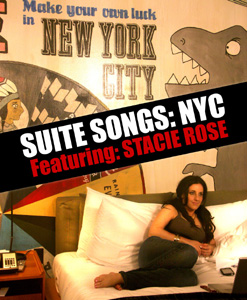
Episode 2 of SUITE SONGS NYC — an original series about the personal and collaborative process of song making featuring songstress/series creator Stacie Rose – has launched exclusively on SonicScoop.

Episode 2 of Suite Songs has just dropped on SonicScoop!

As the day continues with NYC singer/songwriter Stacie Rose and collaborators David Patterson and Mike Harvey, another guest arrives at the same NYC hotel suite where the first episode began, and the road map for the song Alter-Ego comes into focus. The song Alter-Ego and title track from Rose’s most recent release Alter-Ego Ep’s has been featured on Channel One and E!’s Keeping up with the Kardashians.

This is an intimate and vibey musical hang — an insider’s look at crafting pop songs on the fly. The series is presented by Enchanted Records.

Rose is a rising NJ/NYC songwriter who released the well-received Alter Ego EPs in 2010, and whose songs have been frequently licensed by the likes of MTV’s “The Hills”, VH1’s “Tough Love”, Paste Magazine’s “SONGS FOR HAITI” compilation, amc, FX, ABC, Escada fragrance campaign, American Airlines Radio, and FUSE TV.

“Suite Songs” is a series about the personal and collaborative process of song making. Each episode features Stacie Rose as the creator and MC, with a myriad of guest musicians she invites to a New York City hotel suite for some impromptu music making.  Personas are revealed, and lyrics/melody come to life, as viewers enter a secret world of creating songs from the ground up.

The HD series is directed by Patricia Chica, edited by Carol Butrico, and Mixed by Robert L. Smith (Defy Recordings).

CREDITS for SUITE SONGS:

Filmed and directed by Patricia Chica

Produced by Stacie Rose

Edited by Carol Butrico

Mixed by Robert L. Smith at Defy Recordings NYC

Title animation by Paul Gardener

Words & music for Alter-Ego, and Sucking up to the Saints

by Stacie Rose ASCAP 2010 © (P)

Enchanted Records/ BIGPICNIC Publishing

Alter-Ego (DJ Reverend Soul mix) and Standby (Caffeinated-Procrastination mix) produced by Thomas Hutchings & Stacie Rose

Special guest appearances by:

David Patterson

and

Mike Harvey

Field Technician David Deïas

Hair by Monet Moon

Makeup by Alyne Halvajian

Additional makeup and styling by Christine Karantais

Photos by www.angelshots.com

Thanks to Zoom and Michael Joly/OktavaMod

Rob McKeever

Ashley Martorana

Video Exclusive: “Suite Songs: NYC” Featuring Stacie Rose Debuts on SonicScoop

January 23, 2011 by  
/* Filed under NYC Spotlight */

The new video series “Suite Songs: NYC” featuring the artist Stacie Rose and presented by Enchanted Records, is debuting globally on SonicScoop.

Stacie Rose checks into SonicScoop with the world premiere of "Suite Songs".

Rose is a rising NJ/NYC songwriter who released the well-received Alter Ego EPs in 2010, and whose songs have been frequently licensed by the likes of MTV’s “The Hills”, VH1’s “Tough Love”, Paste Magazine’s “SONGS FOR HAITI” compilation, amc, FX, ABC, Escada fragrance campaign, American Airlines Radio, and FUSE TV.

Shot in HD by award-winning film/TV director Patricia Chica, “Suite Songs” is an intimate series about the personal and collaborative process of song making.

The first edition, “Episode 1: Sucking Up to the Saints”, features special guest appearances by vocalist Mike Harvey and guitarist David Patterson. Each episode features Stacie Rose as the creator and MC, with a myriad of guest musicians she invites to a New York City hotel suite for some impromptu music making.  Personas are revealed, and lyrics/melody come to life, as viewers enter a secret world of creating songs from the ground up.

“’Suite Songs’ is a lively hang, a poetic journey that defies the myth that cities are impersonal, while illustrating the cozy, breeding ground a hotel suite can be, for intimate, soulful, collaborations,” Rose says of the inspiration to produce “Suite Songs”. “Each city has its pulse; each hotel suite has its vibe, and every group of musicians bring a unique spirit and sensibility to the process of song making. The party begins in NYC and is destined for other cities.”

Check out “Suite Songs” NOW!

CREDITS for SUITE SONGS:

Filmed and directed by Patricia Chica

Produced by Stacie Rose

Edited by Carol Butrico

Mixed by Robert L. Smith at Defy Recordings NYC

Title animation by Paul Gardener

Words & music for Alter-Ego, and Sucking up to the Saints

by Stacie Rose ASCAP 2010 © (P)

Enchanted Records/ BIGPICNIC Publishing

Alter-Ego (DJ Reverend Soul mix) and Standby (Caffeinated-Procrastination mix) produced by Thomas Hutchings & Stacie Rose

Special guest appearances by:

David Patterson

and

Mike Harvey

Field Technician David Deïas

Hair by Monet Moon

Makeup by Alyne Halvajian

Additional makeup and styling by Christine Karantais

Photos by www.angelshots.com

Thanks to Zoom and Michael Joly/OktavaMod

Rob McKeever

Ashley Martorana

Composer Peter Nashel On Scoring Rubicon, Lie To Me & The New Golden Age of Television

December 9, 2010 by  
/* Filed under NYC Spotlight */

Tribeca, Manhattan: Watching AMC’s serial thriller Rubicon this past Fall, our ears perked up big time. The original score — composed by Peter Nashel — brought the picture to life in such an exhilarating and unexpected way as it advanced an often dialog-free puzzle of a plot, uncovering a secret society and murderous conspiracy. Cool show, amazing music.

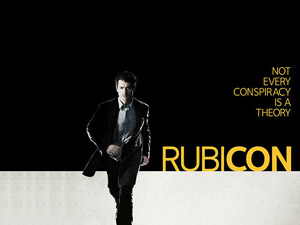
“Rubicon” is a modern-day political conspiracy thriller set (and scored) in NYC.

And what was so amazing about it? For starters, the music was authentic and you could hear it: the live instrumentation and ambient space, the smallish ensembles, the soloing cello and piano, and the surrounding room sounds. Combined with tastefully appointed, undulating and accenting electronics, Nashel created a kind of electro-chamber music and, well, we needed to know more.

We discovered that Nashel, partner at Duotone Audio Group in Tribeca, was composing this music and recording it with small ensembles each week at Avatar. After Rubicon wrapped, we scored an interview with him and when we visited, found him already hard at work on a psychological thriller of another flavor, Fox’s Lie To Me. He’s also scored a couple high-profile documentaries this year: Client 9 and Freakonomics.

Read on for our conversation as Nashel fills us in on his world and the opportunities he’s discovered in the new golden age of television…

You popped up on our radar via Rubicon. The music, especially in the first few episodes, really made the show in my opinion. Well done!

Thanks! I’ve gotten a lot of really great feedback. I’ve been hearing from all kinds of people steadily — fans of the show, composers and even post-production houses who want to use it as temp music. It’s been really great to hear such positive feedback!

I bet. And I know you’ve been at this awhile — co-founding Duotone back in the mid-90s. Tell us a bit about your background: what’s your primary instrument and where are you coming from as a composer stylistically?

I originally started as a jazz saxophone player years ago, and what I got out of my years of study was a working knowledge of the keyboard. I’m not really a piano player, but I have arranger’s chops on the piano. I can kind of piece things together; that’s how I conceive of everything.

The "Rubicon" ensemble tracking in Avatar Studio C.

Stylistically, I’m most interested in music that combines real instruments with electronic elements. There’s so much immediacy that you get from real musicians, and air in a recording, and the breath and vibration that you get from real instruments that you just cannot get from synths, particularly when synths are simulating real instruments like sample libraries. Getting a performance out of real players, there’s still nothing like that.

Combined with electronics — when the electronics are done well — it can really take on a quality that people cannot quite place. They’re not sure what they’re listening to. For instance, a lot of the score of Rubicon would be mixtures of sine waves with real instruments, and I’m not sure that people were necessarily able to separate the two because it just kind of created this cool palette. I love how that sounds.

To me, the overall impression it made was more organic than electronic and yet  hard to describe — modern-classical, electro-chamber music?

Yes, well I’m also really moved by music whose genre you can’t quite figure out. And I think that stems a little from my love of watching actors who I’m unfamiliar with inhabit a role. I felt that when I watched The Wire, Sopranos, Mad Men. These aren’t huge movie stars that I’ve seen a million times so there’s a part of my brain that can really believe in those characters.

Musically, I like that as well…instead of ‘oh, yes this is that thriller movie score,’ you’re thinking ‘what is that music?’ It’s something unique and somewhat new to you.

In the case of Rubicon, what kind of direction were you given? I’m curious because sometimes it’s what the producers or music supervisor think they want musically that pushes a composer into a genre. So what were those initial conversations about?

In my earliest conversation with the music supervisor, Thomas Golubic, he described Rubicon as a smart series a la Three Days of the Condor. It was such an opportunity for me as a composer because it was very British in the way it was made — with these massively long stretches with no dialog and a plot that moved slowly.

And it was kind of a dream job in that it was really talked about in kind of an abstract way – we talked about the fact that the music could almost be a character, but there wasn’t a ton of incidental background music. The music had to telegraph the interior world of the character — what is the struggle and what is going on — because the character wasn’t necessarily doing much in the scene. Maybe he was just looking around, or looking at some papers.

So it had to do a lot of heavy lifting. And we talked a lot about the music fulfilling that role. But we didn’t talk a ton about what the tone of it should be. I was the one who suggested it have a purely modern feel to it but at the same time bridge that gap between the somewhat unglamorous world of information gathering and the excitement of what they were discovering.

So the music really had function beyond underscoring whatever feeling or emotion the scene was conveying.

Oh big time. It had a couple of different roles. There was the interior world for Will – the main character – I had a very high, half-step two-note theme that signaled the conspiracy whenever we witnessed that in action, and there were a couple iterations of that. There was music that pertained directly to Katherine Rhumor’s character and her journey.

Then, there were incidental themes that pertained to the other characters along with some surveillance / conspiracy themes. There were definite themes that occurred throughout the series. It was great to be able to work this way, almost treating each episode like a short movie – but where I had my palette and my themes that I could return to each week. But it was also a TV show in that the music would signify the interior lives of the characters [as they developed over the season].

And I think that’s the main difference between long form serial TV as opposed to feature film or even as opposed to procedural TV. Working in TV in this longer-form, you have 13 hours as opposed to 2 hours to let the story unravel.

Yes indeed: it’s one, long story arc. And I’m curious — what do you think made you the right composer for this gig? Were the producers or music supervisor interested in you from anything in particular that you’d done previously?

They’d known I’d worked on this documentary No End In Sight and I think that, combined with some of the atmospheric music that I came up with for The Deep End or The Night Listener and my most recent feature at that point, Carriers, which was in the vein of 28 Days Later and The Walking Dead but more of a Lord of the Flies where the people become their own worst enemies, a psychological thriller…I think it was that combination of music that made the people who were running the show, the folks at Warner Bros and the music supervisor feel I’d do a good job with Rubicon.

The thing that really struck me about Rubicon was how you could hear the real instruments with the air and space around them. It almost sounded like they were playing it live right there behind the scenes on the set! Did you have to sell the producers on the idea of doing the music this way? And can you tell us about the process?

Engineer/Producer Roy Hendrickson setting up AKG 414 mics in Decca tree formation in Avatar Studio C for "Rubicon" tracking

It was completely my idea to produce the music this way and record each week. I had this idea early on that Will’s main instrument was going to be the cello, and I thought of it like this thinking man’s instrument that I could do a lot of really cool stuff with and I was right. I utilized it and it really stood out.

I figured out that I had the budget to do a small section — we started with 10 string players and went to about 12 — and we recorded them each week in a three or four hour session at Avatar. And incidental overdubs were done down here at Duotone.

Ahead of time, I would get everything sounding the way I wanted it to sound, programmed in Logic, and then once it got to a point where I would play it for [executive producer/writer] Henry Bromell and the folks at AMC and they liked it, I worked primarily with Eric Hachikian who would take down what I’d programmed onto paper and we’d go up to Avatar to record. Christine Kim was the contractor extraordinaire — she put together the players every week for me.

It was an awesome process. We worked mostly in Avatar Studio C, and the recording and mixing duties were split between Roy Hendrickson and Lawrence Manchester, both of whom were incredible to work with.

The show theme is awesome as well. Tell me about that.

That was an interesting process because it was done in conjunction with Imaginary Forces who created the visuals for the title sequence. We bandied about a couple different approaches to it and I wrote 2 or 3 versions of it and one of them just jumped off the screen. When I showed it to Henry it was a no brainer. So I recorded that with 40 pieces in the A room at Avatar. It was a total thrill to be able to do that.

And now you’re working on Lie To Me, which is in its 3rd season, but this is your first season scoring. That right?

Peter Nashel in his 5.1 (JBL LSR 4328P-equipped) control room at Duotone Audio in Tribeca while scoring "Lie To Me."

Yes. I had previously worked with the guys at Fox on Life On Mars, which was a show about this modern day cop that ends up finding himself back in the 1970s NYC and doesn’t know if he’s alive or dreaming or what. A great deal of that music was live as well – a lot of live brass and rhythm section. It was done as this kind of testosteroned-out 70s TV show score. It was really cool. The guys at Fox were impressed and wanted to give me another shot. I’ve done a bunch of pilots for them…

How do you manage to pitch for all this work that I assume is based out of LA? Curious how you make it work!

I think what makes it possible to do the work is two things — one is that I have a setup in a live/work space out in Santa Monica which my main assistant, Dan Morocco, works out of. So when I go out to LA, I can take meetings and park myself there for a couple weeks or however long is necessary.

Lie to Me has been interesting because I only went out for the first spot to meet the team and everything since has been done over the Internet, which I don’t think is that unusual these days. I do spotting sessions via Skype and then we talk down the show over the phone, and the music editor is there taking notes and Dan is there on-site, and then I write and post, and we continue the back and forth. It’s a little unusual, but it totally works.

What’s the music production process like for Lie To Me? This is more programmed stuff?

It’s a lot of programming and then there will be incidental overdubs — guitars, winds, etc. — that I’ll do here at Duotone. If I do drum recording, which I haven’t for Lie To Me so far, it’s done out in LA with Pete Min who I’ve worked with for years. I’ll post a cue for him and he’ll pull it in with the picture and then we’ll have a conversation and he’ll work with 2 or 3 drummers to cut it and send it back.

Life on Mars was done like that, with everyone working remotely. I would write it and send it to everyone and they would send back their parts and Brian Deming, a great writer/engineer/programmer here at Duotone, would put it all together here.

There was just no other way we could have done it that quickly. The process and schedule just sometimes doesn’t allow for it. You’ll be spotting on a certain day, you’ll start writing, you’ll deliver, you’ll spot, comments will come back, etc. and there’s just too many parts of the production chain.

What’s different about writing for Lie To Me vs Rubicon?

"Lie to Me," starring Tim Roth, airs Monday nights on Fox.

With Lie To Me, it’s more gestural music meaning there are no themes for characters because they change every week. It’s more ‘these are the tension gestures, and these are the emotional gestures and this is the palette that we work with when Cal and his daughter are in the room together and this is the palette for when Cal is debunking somebody and seeing through them, catching their lies, etc. So it’s a broader stroke that you’re working with.

Tell us about Duotone. Do you collaborate with other composers here? Do other of the Duotone staff work together? What are you guys working on?

I work really closely with Dan Morocco in LA and Brian Deming here in NYC and the three of us are the team that take down Lie To Me. Brian recently did music for Swamp People on the History Channel and The First 48 on A&E. And Dan just finished his first feature, Brotherhood, which will be coming out beginning of next year.

Jack Livesey, who was my original partner in Duotone, is an incredible writer and he and I collaborated on the transitional music for the film New York, I Love You last year. He is also a fantastic songwriter – he recently collaborated with this artist/writer Jeremy Fisher on a song that just got placed in the upcoming David Frankel movie, The Big Year.

Duotone is a collective. Also in-house is Aaron Mirman who’s written some music that will be used on Bubble Guppies on Nickelodeon. We do a lot of TV. We also do documentaries and features, and about 50 percent of the business is still for advertising. But I really feel like it’s a great time in television, there’s more amazing stuff on TV now than ever.

And do you feel opportunities for composers are getting better and better?

Jack Livesey and Peter Nashel founded Duotone in NYC in 1996

They really are. I originally set out to do film after working for so many years in advertising. And starting in 2000, which was my first feature – The Deep End – there were a lot of great opportunities and I worked on some fantastic features, through this last decade.

But what really happened toward the end of the decade with the economic crisis was that a lot of the money that was funding independent films kind of went away. And so indie film is struggling like crazy to get the movies made, get them distributed. You’ll notice a lot of the majors have folded their specialty divisions. Now it’s not uncommon for an indie film to go straight to video-on-demand. It’s really a brave new world in terms of independent film.

And what, for me as a composer, has replace that, has been television. There’s such great quality TV work out there.

So, you’re based here in NYC and you’ve managed to transition as a composer from doing mostly advertising work to a lot of television and film. A lot of people would assume you’d have to move to LA to make that happen. If you’re enormously talented does it just not matter where you are?

I think it matters. There are more opportunities in LA. In the same way that the finance or publishing world may be in NYC, I think the entertainment biz is in LA. But I think there is an entertainment biz in NYC and there is some great stuff being done here. That said, most of what I have going on emanates from Los Angeles.

I think that what has made it possible is once you get a few credits going, you can take a meeting and you’re legit. And really, it goes by project to project whether people are going to be more comfortable with me being in LA. I think talent trumps everything. If you’re delivering something people really want, I think they’re willing to bend for it.

You said that over the last decade, Duotone has morphed into a 50-50 business of music for advertising and TV/film. Can you fill us in a bit on how the facility is setup for that spectrum of work? You mentioned the Vienna Symphonic Ensemble…

When you work on a commercial, it is :30 or :60, and when you open a sequence, you don’t close the sequence for a long period of time. In a TV show or in a film, you might have 21, 24, 26 or 30 cues in an episode so you’re constantly opening and closing and you need a much more sophisticated setup that can handle opening and closing all those sessions with the sound libraries, so a lot of our stuff is managed offline in these meta frames that the Vienna Ensemble creates.

That network is configured for three systems to have access to it. And then we also have identical setups — all the sessions can be identically run in the different rooms. We have three proper 5.1 writing and mixing control rooms here and then two proper writing rooms.

Is there any other technology that you’d consider indispensable to the way you and the Duotone team work? Do you have favorite sample libraries?

We actually make a bunch of our own libraries — every time we do a recording, we record things wild while we’re there and have the musicians in the room, so we have this massive internal Duotone library. And, every time we do a drum session, we’ll take the recordings and REX them and turn them into Apple Loops for our own drum library. And we’re also always exploring all the new libraries that come out on the market. There really are a lot of incredible libraries out there — I’ve liked the Omnisphere stuff, and the Quantum Leap Piano is unbelievable.

What I can say above all is that I would not be able to do what I do without our server system being setup the way that it is. And the other thing that has been very beneficial to us is WireDrive. We post all of our work for review and then deliver via WireDrive for the music editor. It’s very stable and very user friendly.

For more on Peter Nashel and Duotone Audio Group, visit www.duotoneaudio.com. And tune into Lie To Me Monday nights at 9PM ET on Fox. Unfortunately, Rubicon, was canceled (Boo!), but you should Netflix it like I did!

Stacie Rose: On Fearless Songwriting, Sharp Synch Licensing, and her ALTER EGO

July 5, 2010 by  
/* Filed under Music Biz */

RUTHERFORD, NJ: When an insatiable appetite for songwriting collides with a quest for success, artists like Stacie Rose are the result. You could say this career-focused New Jersey native is fast-emerging, except there’s a lot to suggest she’s already arrived.

A young but oft-licensed songstress with a clear ear for hooks, her cuts have already garnered synch uses from clients including MTV’s “The Hills”, VH1′s “Tough Love”, Paste Magazine’s “SONGS FOR HAITI” compilation, amc, FX, ABC, Escada fragrance campaign, American Airlines Radio, and FUSE TV. Those tracks, several off of her Shotgun Daisy! album, are about to get a run for their money from her dual ALTER EGO EP releases of Raw Sugar and Means to an End (Enchanted Records), going first to her Pledge Music supporters on July 20, and then to the big ole’ world on August 17th.

She’s no calculating bean counter, though. Rose’s approach to creativity and collaboration are what keep her energized, as she revealed in the SonicScoop interview. Listen to what she lays out here — we say this is How to Make it in Music, 2010 style.

You’re a pretty prolific writer. How does a song get started for you?

My approach to songwriting varies a little. It generally starts with a lyric, a gut feeling or story that leads to a lyric, or sometimes I just grab the guitar and start strumming, and humming, and then it’s racing around looking for a pen and something to jot ideas on, like junk mail or the back of a magazine, and then my digital recorder to sing into.

Then, it’s Demo One, followed by Demo Two, many versions, verse and chorus — sometimes days in between, then a bridge might emerge.

Maybe that’s more my process: My approach is really capturing the essence of the moment, or concept, I’m writing about. I try to bring my perspective to things, my metaphors, and create a mood, a picture, or emotional landscape. Sometimes I try to teach myself a lesson, work through a  personal challenge, or celebrate an epiphany.

I used to feel very evolved, but I seem to be going through a new phase where I am suddenly tripping upon survival skills, questioning things, reacquainting myself with my inner strength and writing through it all. Sometimes I don’t try to do anything at all, no goals — and the songs/words pour out.

That lines up with the very thing that I’m trying to relearn this week – that change is GOOD. So how does that songwriting approach reflect how you see yourself as an artist?

I view myself as a unique, pop songwriter, both fiery, and feminine. I’m almost always in motion, even when I am still.

I’m not an anarchist, but certainly do not conform to anything or anybody. I don’t follow the pack. I do take my work/songs very seriously, but don’t take myself tooooo seriously. I have dark comedy tendencies and the deepest love of melody and words. I’ve come to accept my own dichotomies. I can rock out pretty well, but can also turn a shy side. I’m part late-night, acoustic singer-songwriter girl, who sometimes likes to mash and trash it up!

That’s multiple personalities! But at SonicScoop, it’s not a disorder. What’s been your approach or strategy for developing your musical career?

My goals are to continue to create music on my terms with people whom I respect, and enjoy sharing the process with. I always want to give myself the room to grow and experiment. It’s important for me to be true to my heart, my vision and to stay in the moment as much as possible, enjoying, or at least feeling the process even when it’s more difficult.

I really make a grand effort to help these songs out into the world, so that they can have a life, and hopefully work their way into people’s homes, hearts, heads, and iPods.

You’ve built up a great track record all ready with synch placements – MTV, VH1, FX, FUSE TV. How did you get started on this track? What role have music-to-picture placements had in your artist development?

The Orchard managed to place my song “Here’s Looking at You” in an ESCADA “Sunset Heat” Webisode. When I saw the footage, it felt really fitting. The song is up tempo and free-spirited. The episode was summery, sexy, & beachy.

I’ve actually had two songs in racy bathroom scenes, which I think is kind of funny and interesting. My good friend and filmmaker, David Kittredge, used my song “Promised Land (remix)” in his award-winning film, “Pornography: A Thriller”. The song pumps in a club as two guys size each other up in the men’s room. Another song of mine called “Back to Life” made it into an episode of the FX show, “The Riches” (with Minnie Driver and Eddie Izzard). That song played in a bathroom scene in which Minnie got groped at a neighborhood house party by her husband’s colleague. Good stuff!

Then the placements in MTV’s “The Hills” and VH1’s “Tough Love” got a lot of buzz since those hit shows are such guilty pleasures! I had a song called “Find Your Way” in an amc movie spot, and it was wonderful because it aired just before my last record Shotgun Daisy! was released.

The movies being promoted were stellar and stories within the spot really meshed well with the lyrics and melody. The characters in the movies were in fact “finding their way” A really great spot, and good match! And, amc was super cool and artist-friendly, including an artist/song/label credit, which helped with record sales. The spot is on YouTube and gets a lot of love from fans, and made new people aware of my music.

In general, the licensing is a really great way for artists to earn money and to continue creating. The consistent placements have really helped me to build buzz, gain momentum, and get people’s attention.

Licensing PROPS. So does it get hard NOT to think of synch-ability as you continue to write? Do you find yourself wondering if a song is going to work for picture as you write it?

I usually don’t think about synch when I write. I might just have a knack for finding a universal way to convey things. I like being poetic, and crafty in my writing but I also want people to get it — I believe in the power of a good pop song!

It may sound obvious, but why do you think having an understanding of synch licensing is important for emerging artists?

You want to be able to market yourself and bring your songs to the surface, reaching the masses. You’ve got to know the game if you want to play. People are watching TV, webisodes, and films. They won’t always seek you out, so you need to find ways to bring the music to them.

This is a sneaky and savvy way of getting your music to be heard and felt. It’s quick and painless. And, if they dig it, they might come back for more, seek you out, purchase your music, stalk you, blog about you, etc…

Well put. Switching gears, do you have your own studio in NYC, or do you record at other people’s facilities? Where do you like to work?

I demo all my songs at home on a digital Sony mini recorder. If I’m on the run, with no guitar on hand, I will sing into my iphone(recorder ap). If I mean business and am going for a real recording or even a pristine demo, I will work at Defy Recordings with Robert L. Smith. He gets beautiful sounds. I work on a lot of arrangements with Jeff Allen at his place in the Bronx, and often bounce around to various studios (mostly in NYC) to work on various side projects.

When someone works with a variety of producers like you do, how do you decide who to work with?

I guess I mostly work with the people I love and trust the most because it’s like home. Robert and Jeff have really been constant collaborators. Both of them have introduced me to a myriad of amazing singers, musicians, and writers.

David Patterson and Rob McKeever (both guitar players) have consistently helped me find a voice for my songs through the years, so I often turn to them as I write.

I am really loyal to those who have been on board since the get-go and, at the same time, incredibly open to meeting new artists and melding my music with others. I feel as if I’ve been collecting new friends and building momentum mostly because of the exciting energy that comes from good, soulful, collaborating. It’s the key to my success as an artist.

That’s BIG. Did that work go into your new EPs – two different projects — that are about to come out simultaneously?

Alter Ego awaits...

I’m about to release the most exciting project of my musical career thus far: The Alter-Ego EPs, officially due on on August 17th. I raised a good portion of the budget for this through PLEDGE MUSIC.  I have been sharing the process, and progress through PLEDGE, Facebook, my website, Twitter, blogs etc…

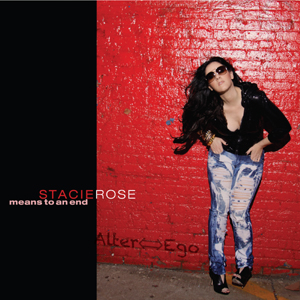
This is really the first of many concept projects for me. The Alter-Ego EP: MEANS TO AN END is a bit more raw than my other records, and veers off on an edgier, live-ish path.

The sound and approach is mostly influenced by some of my classic rock heroes. Jeff Allen ( the producer of this EP) and I got our dream band together, did two long rehearsals and then went right into the studio and recorded six tracks in one long day, so that the ideas would be slightly rough around the edges and possess that raw, unaffected energy that comes with the initial creation of something.

We recorded with Oliver Straus at Mission Sound in Brooklyn. He got stellar sounds, and the day is one of my favorite memories. Since then I’ve been finishing my vocals, and we’ve been adding a few exiting overdubs –The icing! It’s being mixed right now!

The Alter-Ego EP: RAW SUGAR is pretty dancy. It’s pop at its clubbiest for me and has been really exciting to make.

Robert L. Smith has produced this EP with me. It’s been intensely collaborative, constantly evolving and there are so many exciting people involved. It’s a departure for me in a way, but feels totally natural. I’ve worked with Robert to corral and empower the various producers, mixers, programmers and singers involved, to help shape, and make these songs a sensation.

In doing so, I have felt new sides of myself emerge. I see neon, champagne, and many costume changes in my future. So, I guess I would describe the overall project as gritty and pretty, pop and pow, sugary and savory, thunder and lightning. They go together but are totally different.

On another musical side of you — you introduced me to a really interesting project involving the Beatles and some ukuleles…

Well I’m sort of late to the party, but happy to have been invited nonetheless.  This whole thing happened pretty organically. I had the good fortune to have been introduced to the amazing singer-songwriter/vocal producer Mike Harvey. My friend/producer/collaborator Robert L. Smith hooked us up for the ALTER-EP project I am currently working on.

Mike’s soulful voice has become a key ingredient in the dance/pop songs. He introduced me to David Barratt who founded the high-concept art project THE BEATLES COMPLETE ON UKULELE with Roger Greenawalt. It’s like “Where’s Waldo?”, but with ukulele. You’ve got these amazing, intricate, arrangements, and exciting incarnations of beloved Beatles songs, and somewhere within each track there is a UKULELE! How fun is that?!!!

Sometimes the instrument plays a large roll, sometimes it’s a bit more discreet, but it’s the common thread that binds this project together. I loved having the opportunity to pick the song I wanted to approach in my own way. When I got the list of available songs, my eyes raced down the page, searching for I ME MINE (written by George Harrison)… it was free! It was MINE! once I declared it so, David built the most gorgeous, hypnotic track for me to sing to and the rest is history. The track should make its way into the world this summer!  It’s quite a unique and exiting project, with so many amazing artists lending their voices.

The track we heard was indeed awesome — although the latest post (July 2) on the blog makes note of “irreconcilable differences” between Roger and Dave. Intrigue! Anyway, so you’re off to a good start: What advice do you have for songwriters/artists who are just getting started now? And in that vein, what do you know now that you wished you had known a few years ago as you were getting started?

WOW — I wish I had known so many things when I got started and I really knew nothing. It was a blessing in many ways because it taught me to be resourceful, organized and creative.

I made countless mistakes, and made astonishing waves by being fearless, and stepping up to things. I always acted like I had it going on, and this confidence seemed to draw others into my orbit.  Sometimes I wish I possessed the same brand of moxie now.  Ignorance is bliss, to a point. Knowledge is power, always–and some place in between that–if you can remain open, stay focused. learn from mistakes, trials and errors, and hold onto that raw, gutsy, mojo… that’s magic!

I would also tell a newbie, to do things on your own terms. There’s no fast track, no tricks, and no finite way to make or promote music today. Find what works for you. Define your own sense of success. It’s ok if you don’t have all the answers, but you have to be willing to learn, ask, and try.

You don’t know? Draw from your heroes and influences but always try to be unique, authentic and GOOD! Persistence often pays off. Put good energy out into the world, treat others as you wish to be treated, seriously, and don’t do it if you don’t love it and burn for it.

Thanks for some inspirational insights. Lastly, why do this in NYC and not LA, Nashville or Nairobi?

Because NYC is still the best place in the world, with the best pulse, the hottest vibe, and an intangible energy force-field! There will always be a certain artistic history, and edge about NYC that reminds you that you’re alive and that anything is possible. There’s both a toughness and friendliness about it.  There’s an infinite amount of inspiration, beauty and grit, swirling about to draw from!

It might be the BIG apple, but when you’ve done the circuit for a bit and start to see how small certain circles really are, it’s quite a cozy, comfy place to be writing, recording and performing music. And that street cred thing about making it in NYC is still something to shoot for.

– David Weiss