Review: Vertigo VSC-2 Quad Discrete VCA Compressor Plugin from Brainworx
January 2, 2012 by Jason Finkel
/* Filed under Tech & Reviews */
A few months ago I was at my good friend Kevin Blackler’s mastering studio. I noticed this rad-looking piece of gear in his rack and asked him what is was.

The original hardware version of the Vertigo Sound VSC-2 uses four discrete 1979 VCA's in its two channels.
“Oh man”, he said. “That’s the Vertigo compressor…you ever hear this thing? It’s awesome!”Wait…a new compressor that I had never heard of? I needed to know what this thing was about.
Was this the Holy Grail that was going to make all my mixes 10% better just by running through it? Was it some modern technology that amazifies sonics with a newly utilized semi-conductor giving an analog sound of some long-forgotten piece of recording myth?
Well, kinda.
After a few e-mails and phone calls, Joel Morowitz of Ecstatic Electric showed up at my door with a demo unit of the Vertigo VSC-2 for me to try out. I used it on some mixes and to record some guitars and vocals. It had a really, really great sound: smooth and punchy, dimensional, and hi-fi.
It was a gorgeous piece, but at the end of the day $6000+ was a lot to spend on a compressor I did not desperately need. So with a bit of sadness, I returned the unit to Joel.
About a month later I received an email from SonicScoop.com HQ asking me if I wanted to review a new Brainworx plugin…an emulation of the Vertigo VSC-2. I was in.
Meet the Vertigo VSC-2 Quad Discrete Compressor:
The German-built Vertigo VSC-2 is a true stereo peak detecting feed forward compressor design. Unlike, a feedback design (1176LN, LA-2A, LA-3A) the sidechain detector, which sends the control voltage to the gain reduction (e.g photocell,VCA, FET etc…), gets its signal from the audio input and not after the gain reduction VCA. This allows for better control of fast transients.
The VSC-2 utilizes hand-built VCA’s on both the sidechain and the audio path to give it it’s signature “1979” sound.
It’s a modern take on ‘70’s and ‘80’s VCA compressors. The more you push it and the more you use make up gain, the more it colors the sound. It’s really a no-expense spared “Mercedes-Benz of compressors”. Quite simply…it’s the balls.
Game of Clones: Meet the Vertigo VSC-2 by Brainworx
Brainworx worked directly with Vertigo to develop their plugin version, which is compatible with RTAS, AS, VST and AU formats and sells for $331 from their Website.
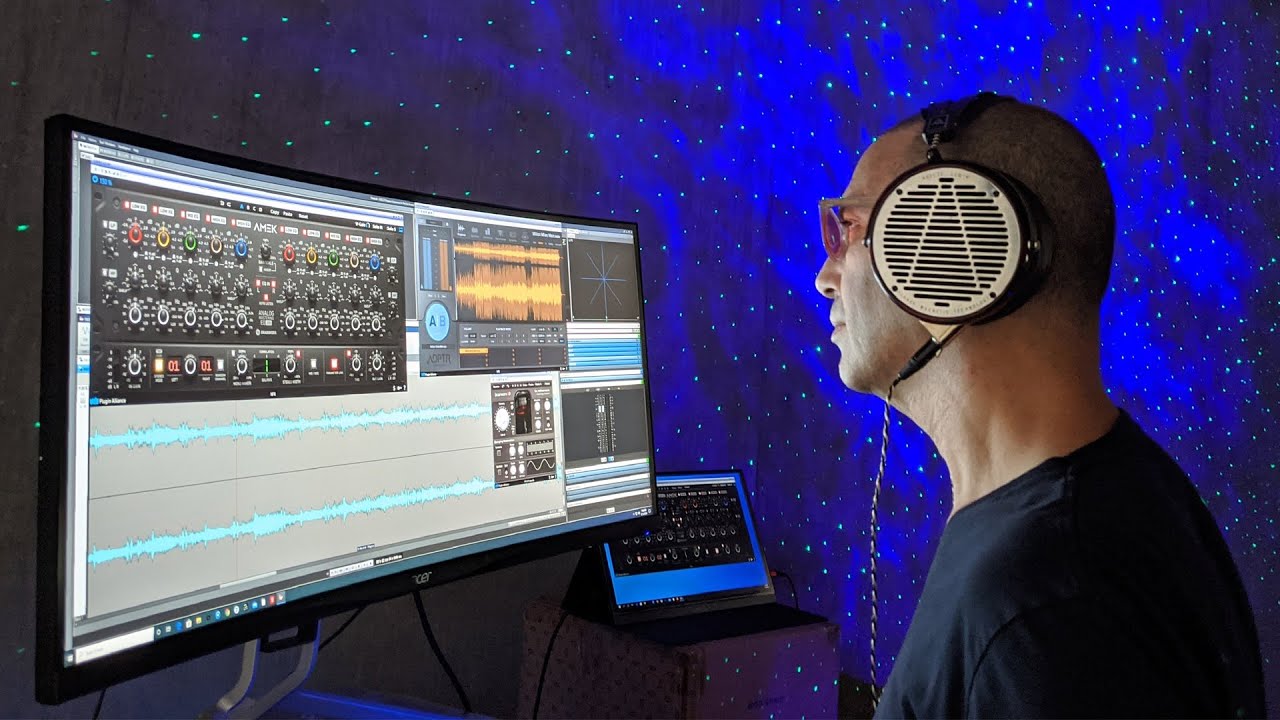
The plugin GUI is identical to the original’s faceplate and sports all of the cool features of the original like a true dual mono path (you can link or unlink a stereo track or use it as a true mono plugin on a mono track) and “Soft mode” which “tip toes” the ratio from 1:1 to 8:1 as the input level increases.
Also included are the low frequency side chain filters. These selectable filters gently attenuate out either 90Hz down or 60 Hz down from the compression detector, making the low end content more audible in a mix as it now less compressed.
Sound Opinions:
Functionalities aside, I want to speak a little about listening to gear. Everybody has their own methods and practices, but I am particularly interested in not relying on my emotions or what I think I think.
I could use a piece of gear in the studio one week and a different piece the next and each could work out great on a bunch of different sources, but to know which sounded better you have to put things head-to-head.
The sonic difference between a lot of pieces of pro gear is just not that dramatic, especially ones that do not use coloration as a strength. A little bit of gain difference on one or the other by even just a few tenths of a dB and most people will begin to ascribe all sorts of false merits to the louder piece.
When care is taken to make sure that you’re listening at equal volumes, the subtle differences of compression detection, attack and release curve variations and tone will be far more apparent.
The Setup:
The way I went about testing the VSC-2 plugin was to get it to sound good on a particular track, and then duplicate the track and bring up any number on plug-ins I normally use for that type of track and see if I could get it to sound better than the VSC-2.
I would try to keep the ratios, attack times, style of detection, input and output gains as close to the VSC-2 as I could. I would then go back and forth to listen for sonic differences.
If there were artifacts produced by the other comp I would back off or change the setting so it sounded nice and then conform the VSC-2 to that plugin. The two main things that I liked most about the VSC-2 are the smoothness of the sound and it’s flexibility.
The Sound:
Like its physical counterpart, the VSC-2 plugin has a good amount of mid-range detail, it never sounds scooped or thin. It’s smooth and present in the high frequency range, as I mentioned before, and it’s very hi-fi and dimensional.
One of the main things I first noticed with the physical unit, and subsequently with the plug-in, was that it always sounded like there was more gain reduction occurring than the meters showed. When I asked Vertigo, they noted their robust metering design and hinted that any difference compared to another compressor may have more to with that comps meter than the VSC-2.
Either way, I put it up against a number of great plugs, and not only did it sound as good as most, but often, it sounded better.
The Flexibility:
Whatever I put the VSC-2 plug-in on, there was always a way to get it to function well. The ability to unlink the stereo controls to widen the image, use the filters to bring up the low end information, and use the Soft Mode to tackle tricky dynamics made each task more manageable.
While most of the other plug-ins would sound great for a particular type of work but not for something else, the VSC-2 dominated on the widest variety of projects and applications because of the flexibility of it’s feature set.
In Use:
Drums
On the drum buss, backing off the attack a bit and using “soft mode” while using the fastest release time gave an amazing hi-fi punchy sound while also bringing the “air” in the room well up front. Even with near -10dB of compression the highs stay intact and no unwanted compression artifact is introduced.
You’re never going to get a sloppy “pumping” sound because of the faithful feed forward modeling. Throw in the sidechain filters and you can get the kick super upfront while not having to readjust what was going on with the rest of the compression.
Acoustic Guitars
Next up were acoustic guitars. This was interesting because unlike most comp plugs, notably feed back designs, I was never able to get a splacky, clipped sound from missing the transient on a fast or not-quite-so-fast attack setting.
The attack setting on the VSC-2 is incredibly musical and again no weird artifact, just precision envelope altering. Even backing off to a 3ms attack time I was able to drop the sharp peaks of the guitar and compress without any weird wobble effect.
Vocals
I got to really enjoy the “Soft Mode” ratio setting on vocals. With popped “P’s” the ratio adjusts to the input level and then returns to a less aggressive ratio for the rest of the line. Not only was I able to reduce the peak of the “P’s” with out getting a smooshed moment, but also because there was only more compression on the “P” moment there was not any overly loud inhale before the “P” or any recovery dip afterward.
Even with a normal 4:1 ratio, the vocal envelope stayed smooth with a 3ms attack and auto release. Unlike a lot of plugs, there were many flavors I could get on the vocals that all sound smooth without artifacts. Being aggressive or staying dynamic, The VSC-2 could handle whatever I needed from the track.
Head-to-head:
While some people may not care if an emulation sounds like the physical unit, I do. I want to know.
I want to put them head to head, run the same material through it at the same time, through the same converters calibrated to the same level and switch back and forth and see if there is a difference, and if so see how big is it. So that’s what I did.
Below you can watch a vid of the plugin vs the physical unit, compressing an unmastered mix I did of the song “Ladies and Gentleman” by the Brooklyn band Cold Blood Club from their forth coming 7”. Watch it first (and LISTEN!), then read on for my thoughts.
Vertigo VSC-2 Plug-in vs Physical Unit from _TMDS_ on Vimeo.
While I was accurately able to set the physical unit to the plug-in using some phase cancellation techniques and a whole bunch of metering, as soon as you change the source material or change any of the attack, release, or ratio settings, the two pieces begin to apply their compression curves in a different manner, no longer behaving the same.
Andy from Vertigo speculated that perhaps the plug-in, or the unit, was at a different point of the compression curve when initially compared to each other. I am not so sure. There are only two continuously variable controls on the VSC-2: threshold and make-up gain. Eliminating the make-up (by not using it) and adjusting the threshold until the physical unit almost completely cancels a 1kHz tone gets them almost sonically identical, and causes both plug-in and physical meters to behave identically.
So what does that mean for me, the user? It means the two work differently — the relationship between how the controls work and the resulting compression are a little different. However, as you can hear in the video, when they are calibrated to each other…they sound nearly identical. The physical unit is a little smoother in the upper midrange and retains a little more dimensionality, but yeah, still pretty amazing. Besides, you’re supposed to be listening to the unit, not relying on the settings, right?
Conclusion:
If you read this far you know I am into the VSC-2 — it’s super-versatile. Whether you’re using it on your vocals, guitars, a drum buss or individual drums, the VSC-2 dominates.
If I had to mix entirely in the box it would be my first choice for 2-buss compression. I know mastering engineers that use it and love the sound.
Brainworx has delivered a professional plug-in that offers an outstanding modern architecture and flexibility. Throw in the fact that it sports a near- identical sonic footprint to one of the coolest hi-fi sounding comps out there — and sells for $331 — and it’s a no-brainer.
Jason Finkel works between speakers all day in his Brooklyn, NYC mix studio, 4A. Check his Website for contact/info and follow his new music blog This Music Doesn’t Suck.
Brainworx Introduces VSC-2 Quad Discrete VCA Compressor Plugin
November 15, 2011 by David Weiss
/* Filed under Deli Feed, Deli NYC Feed, News */
German audio plugin innovators Brainworx has just released its latest product, the VSC-2 Quad Discrete Compressor.
Compatible with RTAS, AS, VST and AU formats, VSC-2 is the first plugin release from the high-end analog boutique Vertigo Sound, and is designed to captures all the nuances of their $6,000 flagship VCA compressor.
List price is $331, although a variety of special offers are available via the Brainworx Website now through November 30.
According to Brainworx, the hardware VSC-2 Quad Discrete Compressor is so named due to the fact that it uses 4 hand-built VCAs using only discrete components, with a design that pays tribute to the best VCA-based compressors of the ’70s and ’80s. Its classic sound is combined with a modern mastering grade signal path, with innovations such as the ratio which increases with level in “Soft” mode.
Its precision makes the VSC-2 suitable for mastering applications and the stereo mix bus. Although the VSC-2 was developed as a Stereo Bus Compressor, each channel provides a complete set of controls which also makes the VSC-2 a dual mono compressor for recording and mix situations.
The VSC-2 plugin offers the same flexibility and precision in the stereo version. To emulate the dual mono approach of the hardware Brainworx has also developed a true mono version of the plugin.
Check out a detailed video right here, and visit the Brainworx Website for a free 14-day demo.
Free Fridays – Fave Freeware Plug-Ins
August 19, 2011 by Gabriel Lamorie
/* Filed under Deli Feed, Deli NYC Feed, Tech & Reviews */
Ah, Friday – the best day of the week for many. How could we possibly make it any better? Let us show you: FREE FRIDAYS. From this day forth, we will be posting great collections of free plugins we find around the world wide web. New or Old? Who cares, they’re free! How often? Keep checking back on Friday and see for yourself!
Without further adieu, feast:
Fresh from Distorque is a pedal distortion emulation plug-in – Plustortion:
Main Menu
These two are the original Distortion+ controls.
Output – Controls the output level.
Distortion – Controls the distortion and some of the filtering.
Tweak Menu
These are controls I’ve added to emulate other factors in the sound of a physical pedal. The default settings emulate a normal Distortion+.
Input level – This is a volume control on the input of the effect. You can adjust this to compensate for different pickups, different input levels, etc.
Oversampling – This turns 2x oversampling on and off
Input Type – ‘Pickup’ adds a resonant low-pass filter on the input to emulate the interaction between the 1nF cap on the input and a guitar pickup. ‘Buffered’ removes this filter.
Op Amp Clipping – This controls the amount of distortion caused by the emulated op amp. See the how it works page (coming soon) for more details on how clipping works in the Distortion+.
Diode Clipping – This controls the hardness of the distortion caused by the emulated diodes. Because of the way the hardness is controlled, the output gets louder as this control is turned up. See the how it works page (coming soon) for more details on how clipping works in the Distortion+ and on the diode source code.
High Cut – This reduces high frequencies on the output. Many distortions use controls like this to reduce harshness.
Low Cut – This reduces low frequencies on the input. Many distortion use controls like this to reduce muddiness and increase clarity.
Note: The default setting for the High Cut and Low Cut controls is at minimum.
TAL – Togu Audio Line: TAL-Filter 2
TAL-Filter-2 is a host synced filter module with different filter types, panorama and volume modulation possibilities. The device includes all 4x oversampled TAL-NoiseMaker filters: LP 24 dB, LP 18dB, LP 12dB, LP 6dB, HP 12 dB, BP 12dB, N 12 dB. Its possible to saturate / distort the input signal by raising the input volume with the input control (only if you use a filter as modulation type).
Its also possible to modulate the panorama or volume of an incoming signal. This can be used for tremolo or trance gate effects. Panorama modulation maybe is useful to pan your percussion, hats or sound effects in the stereo room for more interesting rythms and sounds.
• Create host / beat synced modulations.
• Easy to use graphical editor (double click deletes points, a click adds one).
• 4x oversampled TAL-NoiseMaker filters.
• Different filter types: LP 24 dB, LP 18dB, LP 12dB, LP 6dB, HP 12 dB, BP 12dB, N 12 dB.
• Its possible to saturate / distort the input signal by raising the input volume (only for filters).
• Panorama modulation.
• Volume modulation.
• Different modulation tempo (x1, x2, .. x32).
• Depth control as a simple way to control the modulation intensity.
• Free as always.
TAL home: http://kunz.corrupt.ch/home
Here is an odd freeware program from Soundhack. CornBucket:
“CornBucket is a Csound score generator that creates “clouds” of sonic grains — short snippets of sound that often blur together and are perceived as a single sound. CornBucket allows you to draw functions of time for several different parameters that guide the evolution of a granular cloud. The functions you draw can be one or more cycles of a simple waveform (sine, triangle, etc.), multiplicative combinations of several simple waveforms, or can be hand drawn. Once you are satisfied with your functions, just hit “Go” and CornBucket calculates all of the parameters for each grain and writes a text score to disk.”
Les Productions Zvon and Jason Morin – FREE Baby Piano VSTi
This free VSTi from Les Productions Zvon is Windows ONLY in 32 and 64 bit versions
“Jason Morin contacted me and sent me a beta version of this VSTi he made with the Maize Sampler and he offered me to distribute it. After some tweaks, we are happy to release the version 1. And it’s free!
He used the natural samples of my Baby Piano free sample set. This means that the Baby Piano VST corresponds to the “Real white keys” program of the free set, the real acoustic Baby Piano mapped from G3 to F5 only on white keys. The pitch heard does not match the key pressed except for G3 and it has velocity layers.?”
Bringin’ back 2008! From Brainworx:
“Free! — bx_solo is a nice little tool that we have designed to get you started with and used to the way we approach the M/S technique – be it for recording-, mixing- or mastering purposes. The “heart” of our M/S tools are our unique SOLO BUTTONS that allow you to actually LISTEN to all components of a stereo mix / stereo signal individually.”
Brainworx Announces Public Beta for bx_meter
August 15, 2011 by David Weiss
/* Filed under Deli Feed, Deli NYC Feed, News */
The innovative German audio software developer Brainworx has announced the public beta for its bx_meter. Interested beta testers can download everything need here: installers for the 14 day free demo, PDF manual, and demo video.
According to Brainworx:
“The bx_meter is a sophisticated metering and measurement tool that allows you to visually analyze your audio signal in many useful ways. We believe your mixes will benefit from proper dynamics, especially from a certain range of dynamics your music has. bx_meter is not the tool that will automatically make your mixes sound better, of course, but it will help you mix and master BETTER!”
The plug-in will be officially on sale on August 22nd for $145 (introductory pricing will be announced).
SPL, Brainworx Will Produce Plug-Ins for Universal Audio’s UAD-2 Platform
March 3, 2011 by David Weiss
/* Filed under News */
Universal Audio (UA) has announced an agreement wherein two German-based companies, SPL (Sound Performance Lab) and Brainworx, will become 3rd party audio plug-in developers for the UAD Powered Plug-Ins platform.
In addition, SPL and Brainworx are working with Universal Audio to finalize a software development kit (SDK) that will allow other select developers of professional audio plug-ins to create software for the UAD Powered Plug-Ins platform, and to sell these plug-ins via UA’s online store.
The agreement follows a successful collaboration between UA and Brainworx/SPL Software on the Transient Designer plug-in.
For more on Universal Audio’s UAD-2 Powered Plug-Ins platform, visit http://www.uaudio.com/uad-plug-ins.
Score Free Software In Vintage King’s Holiday Software & Plugin Giveaways
December 8, 2010 by Janice Brown
/* Filed under News */
This holiday season, Vintage King is giving away some of the top Software & Plugins from Avid, Brainworx, Chandler Limited, Eventide, Flux, isotope, Lexicon, Universal Audio and more.

The Ultimate in UAD Powered Plug-Ins, with QUAD Processing Power. Includes Analog Classics Software Bundle.
Just register and select the Software and/or Plugin package that you would like to win. Check out the selections below and register HERE!
Avid Pro Tools 9
Brainworx bx_XL
Chandler Mastering Pack Plug-In (TDM)
Eventide Anthology II
Flux Elemental Pack
iZotope Nectar
Lexicon PCM Native Reverb Plugin Bundle
Nomad Factory Liquid Bundle II
Sonalksis Essentials MK2 Bundle
SPL Passeq Plug-in
Slate Digital Trigger Platinum
Universal Audio UAD-2 Quad
For more information on these software packages and plug-ins, visit http://www.vintageking.com/Holiday-Software-Plugin-Gift-Away.
Review: elysia mpressor Compressor Plug-In, By Geoff Sanoff
January 13, 2010 by Janice Brown
/* Filed under Tech & Reviews */
The mpressor is a digital recreation of elysia’s hardware unit of the same name. The plug-in was developed with the team from Brainworx, a new-ish software company that if you don’t know yet, you will know soon.
In contrast to the last few years of plug-ins focused on emulating the past, the mpressor, models a high-end device that has only been on the market a few years. The hardware mpressor has some innovative circuits including a fast attack mode, filtering EQ, anti-log release, and negative compression. As I’ve never used the real deal, I won’t waste time trying to compare the hardware with the plug-in. But these features have all been incorporated into the plug-in.
I will apologize in advance for not covering them as adequately as they deserve because their utility and complexity would require more space than I have to write this review. Besides, these design innovations are best understood first hand.
First off, among the most notable things about the mpressor is that its controls are all within useful ranges. Some pieces of gear give you a lot of room to work with, but really only are useful within a narrow range of their settings. The mpressor is the opposite. Its controls are useful within their full range, and this gives you a very versatile compressor for shaping both dynamics and tone.
MPRESSOR ON VOCALS FOR RAYMOND & MARIA, PARAMOUNT STYLES

Geoff Sanoff (pictured at left) in Stratosphere Studio A with Raymond & Maria, and producer James Iha (second from right).
As is the case with popular vintage gear, the mpressor is quite capable of imparting pleasant coloration to the signal. When using it on a lead vocal in a mix for Swedish folk pop band, Raymond & Maria, I wanted to add some thickness to singer Maria’s vocal so that it took up more space in a relatively sparse track. The result was a beautiful fullness on her delicate voice. The mpressor was able to bring the life to the party, while effectively controlling the dynamics at the same time.
Using it on male vocalist Scott McLoud on a mix for band Paramount Styles, I attempted the same thing. Scott’s voice was well recorded, but thinner sounding than I would have liked. Trying my often-reliable Fairchild emulator proved to be too dark and squishy so I thought I’d try the mpressor and see how it fared. It certainly brought out more vocal texture, as I’d hoped, but at a certain loss of clarity. I could have just added a little EQ to bring out the detail that was getting lost, but the mpressor has a filter section that seemed perfect to try in this application.
The audio filter section of the plug-in is a Niveau filter. The basic idea is that you can shift the tonality of the signal up or down around a central frequency. So for instance, on Scott’s vocal by shaping it around what looks to be 300hz (!) up 1.5 towards the high end, I was able to re-capture some of the brightness that the compression was eating into. A word of caution however: this filter design is different than any EQ or sidechain I’ve ever used on a compressor, and I found that you really need to play with it a bit before you can make sense of how it works. It’s not super intuitive, but it is useful.
…AS A DRUM BUS COMPRESSOR ON HOODLESS
If you are looking for a drum bus compressor capable of squashing the piss out of an ant, or just lightly dusting the transients, than the mpressor is the best thing to come down your path since coffee. It is really versatile in this application and I can only imagine the cool stuff people will come up with using it. The auto-fast mode is so fast that it basically gets rid of the attacks. (de-essing, hello!) When combining that with the negative ratio mode on drums, I got what can best be described as backwards drums. Used in concert with the sidechain, the possibilities, in particular for dance music producers, seem wide open.
A posting on a popular web forum caught my eye with the observation that because the design of the compressor was feed forward, it would not be a very good choice for bus compression. So I thought I’d put that to the test on some mixes for heavy alt guitar rock band, Hoodless.
I don’t think the mpressor is the right bus compressor for every situation, but I was impressed by the muscle it brought out in this fairly heavy rock music. It definitely added the gel that you expect from bus compression. And it has a link switch so you can have both channels compressing independently if you are shooting for a wider stereo field. One of its most useful features, the gain reduction limiter, shined in this mix bus application.
MORE CREATIVE, MORE COMPLEX
Some newer compressor designs include the ability to mix together the compressed with the uncompressed signal so that you can slam a mix but still maintain the transients of the uncompressed signal. The mpressor approaches this problem a little differently by allowing the user to set a limit as to how much gain reduction will take place.
If you only want to take off 2-3db, you can set it so it’s compressing often on the overall mix, but never actually reducing the signal unreasonably. When that floor tom you forgot to ride down slams in, your whole mix doesn’t shut down like it might with a more conventional compression design. It’s really a great feature and I expect other designers out there to try and imitate it because it makes it easier to get a compressed sound that doesn’t sound too compressed and isn’t based around trying to control a few small moments in a track.
The major drawback to the mpressor is its complexity and depth. The anti-log, negative ratio and auto-fast setting are all fantastic features for creative compression, but they take time to get your head around. The mpressor definitely has a color to it, though it’s a color with many gradations of density and tone, far more than most compressors. While it does transparent reasonably well, it does character much better. Considering that as a plug-in you can have multiple instances of its processor-friendly 32-sample latency design, I’d venture to say that what the distressor has become to modern recording, the mpressor plug-in may well become to in-the-box mixing. — Geoff Sanoff
Elysia’s mpressor plug-in can be purchased via elysia’s online store — http://www.elysiastore.de/mpressor-plugin/en – for $440.00. This is a special, 25% discounted introductory price available only until January 31, 2010.
Geoff Sanoff is a NYC-based producer/engineer and musician who’s worked with Fountains of Wayne, A Camp, Obits, Blk Jks, Keith Urban, Michael Stipe and Green Day (among many others!). And he’s been nominated for a GRAMMY this year, for his work on Stephen Colbert’s A Colbert Christmas: The Greatest Gift of All. Contact Geoff through his management, Just Managing.