Session Buzz: Who’s Recording In & Around NYC — A Monthly Report

May 31, 2011 by  
/* Filed under NYC Spotlight, SonicSearch News, SPARS Feed */

GREATER NYC AREA: As always, there are a number of interesting recording projects underway in studios throughout the NYC area. The following is but a sampling of recent sessions, and works in progress…a snapshot of what’s going on around town:

We’ll start at Great City Productions in Chelsea, where Anand Wilder of Yeasayer has been producing a musical called “Coal Into Diamonds,” an homage to the hard rock and psychedelia-inspired musicals of the 1960′s and 70′s

Co-produced and co-written by Wilder and pianist Max Kardon, “Coal Into Diamonds” features performances by members of Vampire Weekend, MGMT, Dirty Projectors, Chairlift, Man Man, Suckers, and Dragons of Zynth. Engineered by Britt Myers and Geoff Vincent, and mixed by Britt Myers at Great City, the 11-song LP will be released on Secretly Canadian.

Next stop – Fluxivity in Williamsburg, where Brooklyn-based singer/songwriter Colin McGrath recently mixed several songs with producer William Berlind, and engineer Brian Thorn, and Flight of The Conchords’ Jemaine Clement and engineer/producer Matt Shane worked on some new songs for an upcoming film project. John Agnello also visited Fluxivity to overdub and mix songs for an upcoming release for Barton Stanley David. The sessions were mixed to ½” tape on Fluxivity’s Ampex ATR100 recorder.

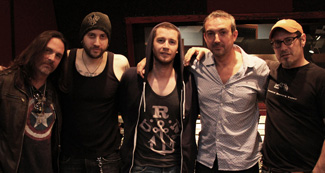
During sessions at Mission Sound (l-r): Jack Daley, Steve Wolf, Jay Picton, Mike Peden and Mission owner/engineer Oliver Straus.

Universal artist Jay Picton was in town from London, recording his debut release at Mission Sound in Williamsburg. Oliver Straus tracked an assortment of New York’s “A” team musicians for this album including Jack Daley, Steve Wolf, James Poyser of The Roots and Clifford Carter. Mike Peden produced.

And at The Buddy Project in Astoria, Julia Nunes tracked a new album with producer/engineer Zach McNees, Pipe Villaran (former lead singer of Los Fuckin Sombreros) recorded his debut solo EP with producer/engineer Kieran Kelly, and Nate Campany recorded some finishing touches for his solo album, with Kelly engineering.

Meanwhile at Vacation Island Recording in East Williamsburg, indie cult hero R. Stevie Moore “and some friends” recorded a song for a benefit compilation. Jorge Elbrecht from Violens produced the tracks and Matt Boynton engineered.

And, bouncing around, up at the Carriage House Studios in Stamford, CT, Johnny Winter has been working on a new record, his first studio album in 7 years. The record was tracked and mixed by engineer Brendan Muldowney on Carriage House’s SSL 4000 E series console and produced by Paul Nelson. Guest guitarists include Warren Haynes, Derek Trucks, Vince Gill, and Sonny Landreth.

Back in town, Avatar Studios has been hosting Ingrid Michaelson recording her upcoming album with producer David Kahne and engineer Roy Hendrickson; VHS or Beta mixing an upcoming release with Martin Brumbach engineering; Vince Giordano & The Nighthawks recording with Regina Spektor for HBO’s Boardwalk Empire, with Stewart Lerman producing/engineering; the Baby It’s You cast album recording with producer Richard Perry and engineer Frank Filipetti; and New York Yankee Nick Swisher recording a kids album with producer Loren Harriet and engineer Danny Bernini.

And as previously reported, Sear Sound hosted Sting composing and recording on the 1973 Steinway “D” grand piano, with Rob Mathes arranging and co-producing; Foreigner tracking with original frontman/producer Mick Jones co-producing, Jeff Pilson, Tom Gimble and Kelly Hansesn completing the band, and Wyn Davis of Total Access Recording engineering; and the Gipsy Kings working with engineer James Farber mixing to RMGI 1/2″ 900 tape using Sear Sound’s ATR 102. Bernard Paganotti produced and supervised the Gipsy Kings mixes from France.

(l-r) Phil Ramone and Jorge Calandrelli collaborate in MCS' Studio 7.

Also previously reported, Manhattan Center Studios hosted the recording of a 52-piece orchestra for Tony Bennett’s Duets Album 2. The all-star team on the sessions included Producer Phil Ramone, Conductor and Orchestrator Jorge Calandrelli and Engineer Dae Bennett.

Renee Fleming was recorded singing live with a  69-piece orchestra in Manhattan Center’s Grand Ballroom and adjacent Studio 7, equipped with the 108-input Neve VR, for Steven Speilberg’s animated film Tintin.

Two video crews were present at the sessions, one for a polycom set up allowing Speilberg and composer John Williams to attend the session from LA. The second crew performed motion capture, which will allow the film’s animators to capture Fleming’s facial expressions exactly for her animated character. Todd Whitelock was the engineer on the session.

Back in Brooklyn — at Grand Street Recording — owner/producer/engineer Ken Rich has been working on new records with NYC singer Deborah Berg and Nashville singer-songwriter David Mead. And S-Curve artist Diane Birch spent a week at Grand Street with English producer Ant Whiting. The pair began production on her next record, with Tomek Miernowski engineering.

Miernowski also produced and engineered “Dress and Tie,” a single for singer/songwriter Charlene Kaye and Darren Criss of Glee. Ken Rich has also been working on The Compulsions’ newest project, with Hugh Pool co-producing. And actor/artist Michael Pitt mixed a live recording from Paris with Miernowski.

And we know there’s so much more going on out there! If you’d like to be featured in “Session Buzz,” please submit your studio news to submissions@sonicscoop.com.

Chris Coady Talks Beach House, Destination Recording and Music Of The Digital Natives

May 4, 2010 by  
/* Filed under NYC Spotlight */

LOWER EAST SIDE: We meet up with producer/engineer Chris Coady as he’s heading into the studio for the day. He’s mixing Abe Vigoda and it’s crunch time so we promise not to keep him too long…

Chris Coady at DNA Downtown

Chris Coady at DNA Downtown

Starting at Quad in the early aughts, Coady’s come up through tumultuous times in the music industry and kept incredibly busy the entire time. Teaming up with David Sitek to build Stay Gold Studios, where he engineered TV on the Radio and Yeah Yeah Yeahs records, along with !!!, Cass McCombs, Blonde Redhead, Architecture in Helsinki, Coady’s been the trusted engineer to some of the most admired and sonically experimental artists in the Brooklyn indie-rock scene.

Since Stay Gold closed, he’s only built on that reputation, flourishing with adventurous electro-pop and rock artists like Lemonade, Telepathe, Islands, …Trail of Dead, ArpLine and Delorean.

Coady recently co-produced and engineered Beach House’s at-once intimate and majestic Teen Dream proving once again an indispensable production partner to the visionary artist.

Inside DNA Downtown — the bunker-like studio he shares with a producer-colleague — Coady points to racks of outboard gear once in the chain at Stay Gold and to the SSL G Series console formerly of Quad. The room is filled with equipment, the urgency of a deadline fast approaching and the promise of this young sonic mastermind. We get right to it…

So this is your studio. Tell me a bit about it. You share it with another engineer?

[Prior to opening DNA,] I had been working a lot at The Carriage House in Connecticut, which is really nice — they also have an SSL E/G series console. I’d been talking to a friend of mine about opening a Pro Tools room. He thought we should be more ambitious, combine our resources and open a [more serious] room. A lot of the outboard gear is mine, and was originally at Stay Gold. The console is his and we share the Pro Tools system and the speakers.

And you can do projects start-to-finish here?

Sure. And I have recorded projects here top-to-bottom, which — even though the space is small — have come out sounding great. I generally don’t use a lot of room reverb. For the most part, the sounds I record are usually pretty tight, so having a small studio is fine for me. I close-mic my sounds and then I create most of the ambiances artificially. So, a lot of times the drum sounds I get will be the same whether I record them here or in a nice big studio.

But with the Beach House record, now that’s a big sounding record…

Yes, and that record, by contrast, is filled with lots of room reverb. When we first got to the studio [Dreamland Recording, near Woodstock], I put up these two Earthworks mics, way on the other side of the church from where the band was set up to play. I’d set out to design the ultimate setup of all their organs and keyboards in the studio — they’d brought their own piano in addition to all these thrift-store 70s organs. I wanted to create this awesome environment for them to play in that would be visually stunning and inspiring.
Within a few days, everything got moved around and it became a free-for-all but the one thing that stayed were these two Earthworks mics setup far away from everything, on stands really high up in the air — left and right, pointing down at them. And these Earthworks mics and the studio’s API mixing board had a really cool marriage.

Beach House. Photo by Jason Nocito

Beach House. Photo by Jason Nocito

So you ended up using those room mics throughout the record?

Yeah, they were used quite a bit, especially on guitars. The record opens up with that sound — Alex’s guitar and Roland Jazz Chorus Amp pointed in the direction of those mics.
Also, we didn’t realize this until later on, but it turns out that outside of the church, right above where those room mics were set up, there was a bird’s nest. So when we went to mix, we found all these baby birds all over the album. And it was impossible to get rid of all the chirping! You can’t exactly hear it all over the record, but it’s definitely there!

Sweet! Was that a problem at all? Or just kind of amazing?

We were psyched! But it was totally consistent through the whole thing. I think at one point we tried to bring it into focus but it wasn’t quite loud enough…

Did you mix the record there? Or here?

Two of the songs were mixed here. We went through the mixing very fast at Dreamland, which made me nervous because I wasn’t used to the monitoring environment. The band wanted me to do it intuitively. And that did work, for the most part. But we did end up remixing two of the songs here, and I’m glad we did because those two songs have a slightly different feeling. The mix for “Norway,” for example, sounds more deliberate, less spontaneous.

Do you end up doing most of your work here at DNA?

I prefer to work here, but I end up traveling a lot. The bands I’m working with seem to not want to record in New York City so much. They want to go out to the country because it adds to the story — they find it inspiring and like the idea of living there during the recording. They don’t want to be getting texts about some party going on down the street.
And I appreciate that — going out to the middle of nowhere and shutting off your cell phone and not having Internet. But, I do this all year long. So it starts to get a little crazy when I haven’t checked my Internet in three days because that’s my only connection to normal life! Three isolated sessions in a row and that’s half my year that I’ve been sort of off the grid.

But has that approach helped get better results? When you and the band encamp somewhere, away from all the distractions?

If the band wants no distractions, that’s what we’re going to do. Because if the band’s not getting what they want, you’re going to hear that on the album.
Beach House is a band that knew what they wanted: they wanted to go out to the middle of nowhere and record, they wanted to record on tape and they wanted a co-producer, not a producer, because they wanted to be hands-on on the production side. They came with the most complete set of demos that I’ve ever gotten. The album was completely mapped out, from the beginning. All we had to do was do a really good job recording it.
There are a lot of bands who don’t know what they want and they hire a producer to help them figure it out. This time, we did it totally based on what the artist wanted and I’m really happy with how it turned out.

delorean-subiza_webAwesome, it is an amazing record. And you also recently engineered on the Delorean record, Subiza. Did you just mix, or have any hand in the recording as well?

Delorean was an interesting project because they recorded it themselves and had me mix it, but they were in another country [Spain] in a different time zone. So we mixed it over podcast. So, the mixing board was going into the computer and being sent over NiceCast.

And this was happening in real time?

Yes, and so they would listen and give me direction. It was an insane amount of tracks. One song had nearly 300 voices in Pro Tools. They’d say “Can you turn up that shaker?” and you’d go in and there’d be 20 shakers! And so…it was daunting.

Seems like that process would take a lot longer – did it?

It took a really long time and we did it over a long period of time — a week here, a week there. I’d love to work with them again, but I think I’d prefer to work with them in person.

Do you see any trends in music that you find inspiring from an engineering/production perspective, i.e. artists taking a more experimental approach to music?

Well, there’s definitely that. And also, I think there’s a new wave that’s happening right now, of young artists who are making music I find really imaginative.
But one thing I’m not really into is the way that Internet culture has influenced music culture. People are always thinking about how they’re going to be perceived on the Internet. And I really find that tragic. That music blog culture has such an impact on a band’s success to the point where with younger bands who’ve never consciously lived in a world without the Internet, I sometimes feel when I’m watching them perform that they’re performing thinking of the Internet, the bloggers. What are they going to say?

Zola Jesus. Photo by Indra Dunis.

Zola Jesus. Photo by Indra Dunis.

Do you think that’s affecting what kind of music is being made? Like a band going for a noisier, more distorted sound because they think bloggers will favor that?

Well I’m really lucky to work with bands like Beach House who don’t give a fuck what anybody thinks about their music. And I think that’s great. But then there’s the other half of bands that may have just come off a terrible tour and they’re in the studio thinking: if we don’t get a good blog acceptance, then we may as well not make music anymore. And I guess those people shouldn’t be making music in the first place. But in the 90s, it definitely didn’t seem like critical acceptance was nearly as much of a factor for bands.
But back to what I’m psyched about: I feel like there is a new wave of kids who are around 20 years old, making music that’s so wildly imaginative. I’ll hear some of these bands and just think ‘wow, that is a wild, forward-thinking sound.’ And then you find out they’re only 20.

Can you mention any artist in particular?

Yeah, lately I’ve been listening to Zola Jesus. And I read an interview with her, where she was citing her influences and she mentioned Morton Subotnick. And you wonder, how did she even come across Morton Subotnick? And I guess that’s definitely one of the positive effects of the Internet on music! I remember when I was younger, going to the library to research music. And now, these kids have grown up having access to absolutely everything.

For more on Chris Coady, visit http://justmanaging.com/producers/chris-coady/ and get in touch through his manager, Dan Backhaus.

Fountains of Wayne’s Jody Porter to Release Solo Album on Engine Room Recordings

April 28, 2010 by  
/* Filed under News */

scoop_porter_webJody Porter, guitarist/keyboardist for Fountains of Wayne, will release his new solo album Close to the Sun via Engine Room Recordings, on May 11, 2010.

Recorded at various studios in the NYC-area — including TMF Studios in Manhattan and The Carriage House in Stamford, CT — Close to the Sun was produced by Porter and Michael Tudor (Ryan Adams, Moby), with Chris Feinstein, producer Gordon Raphael (The Strokes, Regina Spektor) and engineering by Mark Owen and Peter Block (Porter Block).

Mark Christensen mastered Close to the Sun at Engine Room Audio.

Check out the first single from the album, “Aurora,” below:

Audio clip: Adobe Flash Player (version 9 or above) is required to play this audio clip. Download the latest version here. You also need to have JavaScript enabled in your browser.

Engine Room Recordings is the NYC-based independent record label behind artists such as The Bloodsugars, Middle Distance Runner, Locas in Love and Tracy Bonham among others.

In-Session: Phil Palazzolo With Nicole Atkins & The Black Sea

January 27, 2010 by  
/* Filed under NYC Spotlight */

PARK SLOPE, BROOKLYN — We recently caught up with Brooklyn-based producer/engineer Phil Palazzolo who’s been working on the new Nicole Atkins record. “I think this is her time,” he says of the New Jersey songstress and her new material. “She’s definitely due.”

Phil Palazzolo in Seaside Lounge with Tony Chick (left), bass player for Nicole Atkins & The Black Sea.

Phil Palazzolo in Seaside Lounge with Tony Chick (left), bass player for Nicole Atkins & The Black Sea.

The same could be said of Palazzolo. He’s been in-the-trenches working with bands for over a decade — producing, engineering, playing guitar/bass, touring, mixing FOH, etc — most notably engineering on Radio 4’s Gotham, Stealing of a Nation and Enemies Like This. And over the last few years, his star’s been rising.

He produced/engineered on The New Pornographers Challengers and A.C. Newman’s Get Guilty, and has been working through a whirlwind of back-to-back projects ever since, with Neko Case, Okkervil River, The Bogmen, Bird of Youth, Ted Leo and the new New Pornographers.

Early in 2010, Palazzolo started sessions with the newly formed Nicole Atkins & The Black Sea at Seaside Lounge Recording in Park Slope to make the full-length follow-up her ’07 debut LP, Neptune City. Atkins has a new band in the Black Sea, a new producer in Palazzolo, and a new sound is emerging. Read all about it:

So, how did you and Nicole Atkins come to work together?
About two years ago, she sang with a choir that backed up Feist on David Letterman. A.C. Newman from The New Pornographers was also part of that choir and got to talking to Nicole Atkins and had her come sing on the sessions for what would become his solo album, which I produced. Then, I played guitar in the A.C. Newman band and Nicole came and did backup vocals live, so I got to know her even better.
We’ve been talking about working together for a while now. She got a ton of songs together, and called me saying she wanted to get going right away. I’d just finished the Ted Leo record, and was just wrapping up mixes for the next New Pornographers record, so it was perfect timing to do the record in January and February.

Nicole Atkins & The Black Sea drummer Christopher Donofrio tracking at Seaside

Nicole Atkins & The Black Sea drummer Christopher Donofrio tracking at Seaside

How’d you get started and where are you working?
We did a week of pre-production in Seaside Lounge’s B Room. Pre-production involved finding the strongest parts of the songs and bringing them out. Sometimes that meant changing the feel and the pace of things. Then we started on basic tracks in Seaside’s A room. We just finished four days of basics and actually got to some overdubs and vocals. It’s starting to really sound like a record — we’re in that exciting phase where you can really hear it coming together.

Her last record was really lush and orchestrated, and kind of dark/melancholy. How does this record compare to that, and what would you say she’s trying to accomplish in the studio?
After getting a chance to live with her other record, I thought — yes, it is lush and it’s beautiful, but it’s also a bit disjointed. It kind of feels like it took two years to make, maybe with a little too much time passing between sessions. The new record is a little bit more fun in spots. There are some lighter and more upbeat numbers that she didn’t really have on the last record. I really want to showcase what she can do beyond the brooding Dusty Springfield-revamp type of sound.

So, is it more of a band record?
Yes, I’d say so. And she has a new band. Most of the guys are from New Jersey and play together in this other band [Sikamor Rooney]. They’re hometown guys and they’ve all known each other for a long time, whereas her other record was largely session players. Working with session players can be awesome, and we’re definitely going to bring in guests for specialty parts, but on the whole, there’s a real band making up the foundation.

So how would you say you’re working with her to realize the sound / direction for this album. Are you trying different things to figure out what it is?
Well, first I tried to get a sense of what she didn’t like about the last record and the recording experience overall. And then I listened to the songs, which were largely just fairly simple demos, some of them were actually produced in a way that sounded like a band, but not exactly what she was after.
In listening to the demos, I tried to find what I thought would tie them together and how to make them feel more like a whole record rather than a year and a half’s worth of writing and demoing in different places.

Nicole Atkins signs into "the Motown mic" - a Neumann KM86 - at Seaside Lounge.

Nicole Atkins signs into "the Motown mic" - a Neumann KM86 - at Seaside Lounge.

Is there anything different or noteworthy about how you’re recording any of the elements — vocals, drums, etc…?
Well, I’m using a lot of different approaches, song by song. I think it’s so easy to make someone like her sound incredible that sometimes you just have to have the balls to say ‘I’m going to put this through a bullhorn.” No matter what you do, she’s this incredible singer, and it doesn’t always have to be pretty. There are moments on this record where her vocal will be totally brash, like Karen O, but she’s still this amazing singer underneath and it sounds really cool.

So, you’re gritting up the sound a bit, cool. And how have you been recording her vocals?
We’ve recorded her in the booth on some songs, but on others, I plan on using the big live room space a lot more. On some tracks, you’ll picture a girl standing on a stage in a huge room when you hear her vocal.
So far I’ve been using what I call the Motown mic on her, which is a Neumann KM 86. In the first few years of Motown’s existence, they only owned KM86s because Berry Gordy got a deal on them, so everything you hear — drums, bass, vocals, guitars, strings, etc… — all were recorded with the same type of microphone.

Sidenote: All of Motown’s KM86s are now at Avatar. When they dismantled the first facility and built the “real Motown studio,” the guy who built Power Station bought everything from Motown and stored it until he built Power Station. He also faithfully recreated (in dimensions and materials) the Motown studio in one of their upstairs rooms.

That’s awesome, I didn’t realize they had all the original Motown mics. Now, will you produce this entire record at Seaside? Or will you go elsewhere for mixing?
We’ll do all the recording at Seaside and then I think we’ll mix at The Carriage House in Stamford, CT. That place has a great history [The Pixies’ Doolittle was made there] and the SSL (4048 E/G) is a great mix disk. Plus, you live there for the duration, so you’re not chained to a console thinking of all the work you have to get done in the next 10 hours, because you’re not leaving. You have time to walk away and come back with fresh ears. That’s really helpful.
If I was working in a comparably-equipped room in NYC, it would be very expensive and so we’d be pressed for time. In the last few months, I mixed The New Pornographers and the Ted Leo records at The Carriage House.

Check out Nicole Atkins & The Black Sea at http://www.myspace.com/nicoleatkins and Phil Palazzolo at http://www.myspace.com/drywallofsound.