Stadium Red Expands: Just Blaze and the Science of NYC Studios

December 15, 2010 by  
/* Filed under NYC Spotlight */

HARLEM, MANHATTAN: As artistic as the purpose of New York City recording studios may be, it’s fair to compare these houses of sound to modern-day warriors. Every one goes into battle with the belief that they’re invincible. Many fall – but some grow stronger.

A legendary SSL G+ and Augspurgers are just the beginning of the Stadium Red expansion.

Uptown, the facility known as Stadium Red became convinced that there was only one sure strategy for thriving in the battle-scarred landscape of NYC: expand, and you’ll be in demand. Marking steady gains since its inception in 2007, when Stadium Red owner Claude Zdanow took over the highly respected but troubled former studio of jazz legend Ornette Coleman at 125th and Park, 2010 sees Stadium Red placing a bold bet that bigger really is better – even when paying NYC prices for your real estate.

The result is a recently completed 2,500 sq. ft. Frank Comentale-designed expansion that sees big names and powerful new capabilities added to the facility. A focused new B-Room is home to hip hop super producer Just Blaze (Jay-Z, Eminem, Saigon, Fabolous, Jamie Foxx, Talib Kweil, Kanye West) and an SSL AWS 900, Augspurger mains, and a digital/analog hybrid production/mix approach. A world-class mastering suite has also been added to house Herb Powers-protégé Ricardo Gutierrez (Justin Timberlake, Usher, John Legend, Jill Scott).

Meanwhile, Stadium Red’s accommodating A-room has gotten its own facelift, swapping in the classic SSL G+ board from Baseline Studios (RIP). Another pair of Augspurger mains with dual 18” subs, a custom Dangerous designed 7.1 surround monitoring system, 24-track tape machine and more are all in there. Mix engineer Tom Lazarus (Ray Charles, Bjork, Yo-Yo Ma, Chicago Symphony), mix engineer Ariel Borujow (T.I., Black Eyed Peas, Puffy, Kanye West), engineer Joseph Pedulla (Thursday, The Mighty Mighty Bosstones, Mos Def, Kid Cudi) and producer Sid “Omen” Brown (Ludacris, Mya, Drake, Fabolus) also maintain their respective residencies throughout the studio. A host of old skool elite amenities – from upgraded lounge to private chef/spa services – are in the mix for good measure.

Claude Zdnaow's got a secret: How to successfully navigate NYC's intense studio scene.

While the idea of an all-encompassing studio environment of writing/tracking/mixing/mastering is not new, Zdanow believes that it’s the rare human resources he’s gathered – and what they’re on board to do – that will make the Stadium Red expansion stand out. “The idea is that more heads are better than one,” he says. “In studios it can become a stale environment, where the engineer is just a button pusher. What we take pride in is something the artists and labels don’t offer anymore, which is artist development.

“Artists come in here, and when they walk out our brand is attached to them. It’s about letting them know that all these ears are around, whether it’s Yo-Yo Ma, Eminem, or the emerging people we work with. We want to make records here that matter, and the idea is to bring back that creative community — we’re a growing team of NYC engineers and producers that care about NYC and the music scene.”

Zdanow’s energy – driven equally by his spirit of adventure and copious amounts of caffeine – was enough to convince Just Blaze to relocate to Stadium Red after closing his beloved Baseline. “I had known Ariel from before, and he said, ‘You should come look at this space and have a conversation with Claude,’” Blaze relates. “Claude explained his vision, what he wanted to build, and I said, ‘Maybe we can make something work.’ It made sense: The overall vision of the place and the appeal is that it’s a one-stop, end-to-end solution, from recording to mixing to mastering, even doing surround 5.1-7.1.

“So he physically expanded the space, and we combined our resources. It’s a win/win I get a little bit of the stress off my shoulders from running the day-to-day. That allows me to be more creative, but at the same time I have my own space.”

Whether for intensive writing sessions or serious mixing, the new B-room that Just Blaze inhabits was designed to be distinctively accommodating. “It’s gotta be something special — if it’s going to be this meeting of the minds, then it’s got to be something worthwhile,” he emphasizes. “It can’t just be a Pro Tools setup. The way I work, I need all the resources available all the time – I couldn’t go from a G+ to a writing room. And if we’re talking about partnering up and joining our resources to build a business, there’s no point in building something that’s just a production room. That’s something people can put in their houses these days. So you’ve got to take a step further and make it a destination.

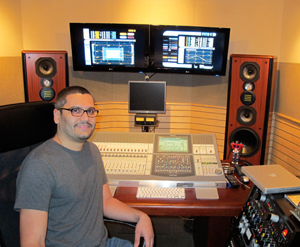
Just Blaze made the move uptown to the ferocious Studio B.

“My room is the best of both worlds. If you want to walk in and get down to business in the box, you can do so: We have every plug-in, plus Augspurgers and other monitors. But if you’re a little more old school, you have the SSL and all the gear to go out of the box. Or you can go the third route, in that the AWS can go in and out of the digital world.

“By keeping it smaller we could keep it more affordable. Clients have the SSL, a full suite of plug-ins, Augspurgers – everything that would usually cost you $2500 or more a day, at the fraction of the cost. I think we really hit that sweet spot in terms of sizing. Sometimes you just need a room for production, with a controller or a laptop, but if you’re in this big huge room that’s a waste of money. Or it’s the other way around, and you’re feeling cramped. This place is small enough to feel like a production room, but big enough to feel like a room you can mix comfortably in.”

Arguably, the Stadium Red formula was working already: The studio and its personnel had a part in ten 2010 GRAMMY-nominated projects including Eminem’s Recovery (Album of the Year, Best Rap Album), Drake’s Thank Me Later, (Best Rap Album, Best New Artist), and Steven Mackey’s Dreamhouse (Best Classical Album, Best Orchestral Performance, and Best Engineered Album, Classical).

A good year, all right, but that’s already in the past. Although he’s young – still just in his early 20’s – Zdanow understands that part of moving forward is understanding what didn’t work before, and making adjustments. In that regard, the difficult decision to swap out the A-room’s ICON for the SSL G+ dovetailed with the concept of adding new faces, spaces and capabilities at Stadium Red.

Just Blaze: He is officially on board.

“We’re in an ever-changing industry,” he observes. “When we started out I had a very strong opinion about being versatile and trying to do it all in one room. People appreciated the ICON, but over time we weren’t doing anything as good as we could have been doing it.

“By adding these two rooms, we’ve come to critical mass. People want a lot of options. The ‘A’ room has a big live room where people can track through the console, and mix with tons of outboard gear. Just Blaze’s ‘B’ room is its own environment for production, with the SSL AWS. If you want a powerful controller-based system, you have that in the ‘C4’ room where Ariel Borujow works. So what we realized was that it wasn’t just about one room. There are certain things that need to be in place to do everything — and do it well.”

– David Weiss

Stadium Red Expands II: Mastering Completes the Picture

December 15, 2010 by  
/* Filed under NYC Spotlight */

HARLEM, MANHATTAN: Everything old is new again for Ricardo Gutierrez, the Chief Mastering Engineer at Stadium Red’s new mastering facility. A disciple of the legendary Herb Powers, Gutierrez honed his ears and technical chops at The Hit Factory, where mastering studios and recording facilities worked harmoniously together under one roof.

Ricardo Gutierrez has two plasma screens, but just one mastering suite.

Now he’s back into that classic workflow, where a record can get tracked, mixed and mastered without leaving the floor. Doing his listening in a new 5.1-ready room designed by Frank Comentale (The Hit Factory, Chung King, Daddy’s House), Gutierrez is more than down with the comprehensive Stadium Red scenario.

“I had been looking for opportunities to set up a studio, but it never felt like the right situation,” he says. “When Claude asked me if I wanted to be on board, I knew the energy was right. We were all of like mind about how we want the music to sound, and how we defined our jobs. The concept is for Stadium Red to be a destination. This is a creative place you can come to and enjoy, but you can also come here and you don’t have to leave. Someone like Just Blaze or Omen can produce here, then record with Tom Lazarus or Ariel Borujow in the live room, and finally master here as well.”

According to Gutierrez, security and enhanced efficiency are solid arguments for having mastering in the house. “A lot of people, especially high-profile artists, don’t want to have to send a file over the Internet, because leaks still happen. People feel 100% more confident in having it mastered in the same place, and we’re not ‘mastering’ in the B-room with plug-ins. We have a dedicated room with an experienced mastering engineer, and that appeals to our clients.

“Another scenario that happens is that an artist starts it in their personal studio, and then they bring it to us for us mixing. Or they record their music in the A-room and mix it at Stadium Red. Now they’re saying, ‘You guys already have the music there, why don’t you master it?’ It’s the end piece of the puzzle.”

Tech heads will take notice of Gutierrez’ uncommon center of operations: a Sony DMX-R100 “Baby Oxford” console that feeds a pair of Legacy Audio speakers and his tight collection of digital/analog processors. “That’s actually what Herb uses,” he says of the classic Sony board. “At first he used a Neve DTC console, 20-bit, but when went back to the Hit Factory, he needed a new digital console and went with a Baby Oxford. As a result, I knew it inside out. It gives me some workflow advantages, and when we switch the room to Surround I’m set up for it.”

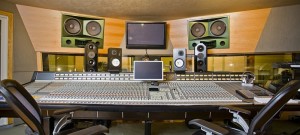
The super sweet pro shot of Stadium Red mastering.

The Stadium Red setup is ideal for a mastering engineer who wants to be involved in the creative process, and not just the last stop on the way to iTunes. “The mentality of a typical mastering studio is, ‘These are our hours. We’re opened and closed then, and we don’t go beyond that,’” notes Gutierrez. “But I’m already here in the studio with the mindset that you’re there as late as you need to be. We need to be here so we can listen in on a project in any of the environments here, hear the master back where it’s mixed, and then decide what needs to be tweaked next, if anything.”

– David Weiss

Party Pics! Stadiumred Celebrates Expansion in Style

October 1, 2010 by  
/* Filed under News */

The multi-room expansion of uptown sound complex Stadiumred became official on Thursday night. The studio welcomed super producer Just Blaze and mastering engineer Ricardo Gutierrez to the fold, joining an already strong cast of players including recording and mixing engineers, Ariel Borujow, Tom Lazarus, and Joseph Pedulla, as well as producer Sid “Omen” Brown.

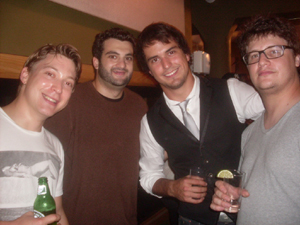
Stadiumred founder Claude Zdanow (in vest) hosted a slammin' Thursday soiree.

An upbeat and glamorous crowd was on hand to take in the famed SSL G+ Console from Baseline in the A-Room, paired with a custom Augspurger monitoring system, as well as the SSL AW900/Augspurger-equipped mix/production room and new mastering suite. Studio designer Frank Comentale oversaw the designs for the 2000 sq. ft. expansion, bringing Stadiumred up to a full 6,000 sq. ft.

Stadiumred & Just Blaze Announce Exclusive Partnership

February 4, 2010 by  
/* Filed under News */

Super producer Justin “Just Blaze” Smith (Jay-Z, Rihanna, Eminem, Usher) is joining the ranks of NYC recording facility, Stadiumred, bringing additional staff, equipment and newly constructed rooms to the multi-studio complex.

Just Blaze

Just Blaze

On his latest move, since closing Baseline Studios last week, Just Blaze stated, “I’m looking forward to setting up shop with the guys at Stadiumred. I’ve been in this business for 13 years and their vision and drive are the perfect compliment to what I look to build during the next phase of my career. I’m looking forward to creating something great with them.”

Stadiumred has got to be NYC’s fastest-growing studio complex. Since opening in ’07, Stadiumred has doubled in size, twice. And, founder Claude Zdanow has been all about dream-team-building from the start.

The facility, located at 125th Street/Park Ave in Harlem, currently houses multiple-Grammy-winning producer/engineers Tom Lazarus (Ray Charles, Bjork, Yo-Yo Ma, Chicago Symphony), Ariel Borujow of Westward Music Group (T.I., Black Eyed Pees, Puffy, Kanye West), Sidney “Omen” Brown (Ludacris, Mya, Drake, Fabolus), and Joseph Pedulla (Thursday, The Mighty Mighty Bosstones, Mos Def, Kid Cudi).

Under the watchful eye of recording studio designer Frank Comentale (The Hit Factory, Chung King Stuudios, & Daddy’s House), construction of a new SSL mix studio and surround sound mastering studio began in early 2010.

Claude Zdanow at Stadiumred

Claude Zdanow at Stadiumred

The additional rooms will round out Stadiumred’s offerings to make it a “one-stop-shop for all things music.”

Stadiumred is a full-service production, mixing and recording facility which started in the space once occupied by Ornette Coleman’s Harmolodic studio and in the few years since, has expanded into four mixing and production rooms, a 1,000-sq. ft. live room with multiple recording rooms, and a mastering suite.

Artists like Drake, Melinda Doolittle, Mos Def, Yo Yo Ma, Thursday, and the San Francisco Symphony, among others, have recorded at Stadiumred. The facility also hosts music/sound-for-picture sessions, including recent audio recording for the 20th Anniversary episode of The Simpsons and the mixing of Oliver Stone’s film, W.