Behind the Release: Duncan Sheik Confesses with “Covers 80s”

June 5, 2011 by  
/* Filed under NYC Spotlight, SPARS Feed */

"Covers 80s" is released on June 7.

GARRISON, NY: When you think about it, a cover song is a love triangle of sorts unfolding before the listener.

There’s the original artist who first brought the tune into to the world; then there’s the influenced musician driven to pay tribute to their achievement; and finally there’s the song itself – the object of both of their deepest creative desires.

In this way, Duncan Sheik’s new collection being released Tuesday, June 7, Covers 80s, is one ménage a trios after another. The first studio album in five years for the landmark NYC-based singer/songwriter/composer/lyricist, Covers 80s delivers exactly what the title says, providing a dozen interpretations of the 1980’s songs that made a major impact on Sheik.

It’s interesting to see what hits influenced him: “Stripped” (Dépêche Mode), “Hold Me Now” (Thompson Twins), “Love Vigilante” (New Order), “Kyoto” (The Cure), “What Is Love” (Howard Jones), “So Alive” (Love & Rockets), Shout (Tears for Fears), “Gentleman Take Pictures” (Japan), “Life’s What You Make It” (Talk Talk), “William It Was Really Nothing” (The Smiths), “Stay” (The Blue Nile), and “The Ghost in You” (Psychedelic Furs). Each of Sheik’s covers are revisits worth visiting – a careful embrace of the original song’s sound and meaning as he experiences them.

Obviously, Sheik has first-hand knowledge of what it means to have a hit. His 1996 single,“Barely Breathing,” broke Billboard records for chart longevity and has arguably joined the Great American Songbook. Since then his folk/pop/theater explorations have seen him release five previous studio albums, score feature films and documentaries, compose the GRAMMY-winning original score for the successful Broadway musical Spring Awakening, and followed that up with composing the music and co-writing the lyrics for the 2010-debuting musical theater production Whisper House.

This was my second interview with Sheik, the first being an informative 2005 interview on film scoring in his downtown home studio. An artist with a musicologist’s mindset who lives to record, Sheik discussed a surprisingly deep journey through Covers 80s. Turn this talk into a threesome by reading on.

Why record/perform a cover song? And why listen to one for that matter? What are the opportunities of doing covers, and what are the potential hazards?

Duncan Sheik balances nature with nurture on his new album.

Well, there’s this funny thing where if you’re a performer and a singer/songwriter, a lot of times you’ll be at a party and someone will hand you a guitar and say, “Play us a song we can sing along to.” After I played one Radiohead and one Oasis song, my repertoire was finished!

So I started to put together a list of old songs that everyone knows, kind of a fake book. But I found it to be tiresome, and there were other people better than me at that. So I said, “Instead of covering the Stones and the Beatles, why not do ‘80’s English bands?” It would be my personal take on the artists who made me who I am as a songwriter.

So I took a dozen or so bands and tried to identify one song that made sense for me to sing, and made an impact on me in some way. It was hard to put my finger on the genre, but there was an almost arty synth pop aesthetic to the bands that were informing me. That was the wheelhouse, with a couple of obvious exceptions, but at that time in my life — when I was 16 or 17 — they were part of a particular set of records that me and my friends were listening to.

How did the idea for actually making this cover album, with its particular angle, come about from there?
First of all, I’m generally more interested in making records than I am in performing. I’m happiest when I’m in the studio writing and/or recording music. I’ve started to enjoy performing more and more because I’ve done it more and more, but the heart of what I do is making records: If I’m going to go through the work of re-imagining these songs, then I was definitely going to record them.

There was the question if they would see the light of day, but I left that in the capable hands of other people. Once I’d done the recording, it was asking my manager and the people at RED if they thought it was something they thought was worth putting out into the world, and they were very, very excited about it.

With so many great ‘80’s hits to choose from, how did you select the lucky 12 to cover? Is there a common thread between them?
I think one of the main briefs that I gave myself was this idea that these songs — despite how they were produced when they were initially recorded — are great songs no matter how you dress them up.

For example, a song like The Thompson Twins’ “Hold Me Now,” you hear it when it comes on the radio, and certainly it evokes its time in an intense way, in the sounds they used and how it’s done. But if you strip all that away, there’s a simple, heartfelt piece of music that still works if you do it with a completely different kind of palette and sound.

Sheik's sanctum: Sneaky Studios.

That was the main criteria: Strip away all the production, bells and whistles of that 80’s sound, and you recreate this new arrangement with acoustic instruments. Does that change the power that it initially had?

The ones I chose were songs where I could pick up an acoustic guitar and figure out an approximation of these chord progressions, and sing songs, and still recognize the songs in some way. Which can’t be said for many pieces of music at that time — they were more about a production aesthetic than songwriting.

So I felt these were really great songs themselves, and they were comfortable for me to sing in my voice. I wasn’t having to jump through all of these hoops to pull it off, although I did end up lowering the key to a number of songs so I wasn’t having to yell into the microphone. “Shout” comes down a minor third, “Ghost in You” also comes down a minor third, “Stay” comes down a fifth or so – it’s significantly lower, I’m maybe singing an octave below him. I love (The Blue Nile’s) Paul Buchanan’s voice, he’s an amazing singer, but in the case of that particular song, I wanted it to feel much more intimate, so I’m singing it kind of down.

What did you learn about the much-discussed, instantly recognizable 80’s “sound” as you immersed yourself in these songs? What makes it great, but also what was the opportunity for you in re-imagining and re-recording these songs?
What I think is the least interesting about that era of production was how they dealt with drum programming and drum sounds at that time. It was kind of like people new to this technology and not knowing what to do with it yet, so they did everything all at once. That’s what makes a lot of these sounds sound silly and dated – what some people think of as kitsch.

I decided early there would be no drums, either electronic or acoustic. I really wanted all of the instruments to be acoustic instruments as well. If one of the ‘80’s artists made a synth sound like a marimba, then I’d actually play it on a marimba. On Depeche Mode songs they had really funny FM synth sounds like a glock and a banjo, so really use a glock and a banjo!

So the fun was, “How can I put these arrangements back together? How can I take the electronic approximation and then use the real instruments they were inspired by?” I really enjoyed that part of the project.

The biorythmic center.

The one exception to that is I’d been using the Fulltone tape echo, which is an issue of the Echoplex, and kind of creating these little landscapes of sound that are very particular to that box — very musical, but very mysterious and enigmatic. They behaved in surprising and mysterious ways when you played with that knob.

I’d create a landscape with acoustic guitar and tape echo, find out the key center of a song, then lay these textures out over the course of the song. For me personally, it was a sound that evokes a sense of nostalgia or memory, and that was really emotionally satisfying when I put these two things together. For the Cure song, “Kyoto”, you have this sense of remembering something dark and maybe disturbing that happened in the past, or in the case of “Stay,” it’s heartache for this person you saw. And “The Ghost in You,” the memory of this person that is so deeply ingrained — those are just three examples.

So, what was your own objective with this album? Is this supposed to sound like “Duncan Sheik sings ‘80’s Hits”? Or something else entirely — what did you want to differently with these songs, and just as important, what did you want to preserve?
(laughs) I think covering a song and procuring it in extremely similar ways to the original thing is kind of silly. All due respect to Gwen Stefani, when she did the song by Talk Talk [No Doubt’s cover version of “It’s My Life” from The Singles 1992-2003], it’s like the track could have been ripped form the original recording.

To me that’s not interesting. It was important to take these songs and dress them up in new clothing. But yet, I wanted people to really recognize the songs and know what they were listening to. There’s all this beautiful stuff on the Peter Gabriel covers album Scratch My Back. Maybe I’m not educated enough on that music, but I don’t recognize a lot of those songs!

I wanted a good balance between songs that were a part of culture — that people would know — and songs that you experience in a different way but very much with a memory of them.

Tell us about the tracking and mixing process for these songs. How did you decide to approach it?

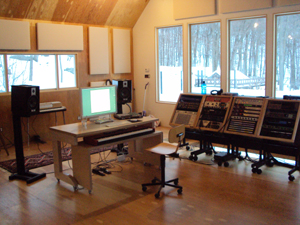
The expansive live room.

It happened up in my studio in Garrison, NY, Sneaky Studios. When you saw my setup in TriBeCa, I was essentially living in my recording studio. I needed a separation of church and state. Upstate, you can have a lot more real estate. I wanted a place where bands could use it, record, stay at the house, and use the pool.

It’s not necessarily a commercial venture, but bands can come up and use it. There are fewer studios in NYC, and fewer places that are residential. It’s a bummer that Allaire closed – this is my own tiny alternative to it. Artists who are interested in it are welcome to visit my site and inquire about it with my manager.

The studio building itself is a 3000 sq. foot, former two-car garage. I had some help converting it into a studio from an architect and Michael Tudor, my longtime engineer. It was a long process, but fun. Construction took a while, and getting everything wired properly was definitely a learning process, but now that Humpty Dumpty is put together, it’s fun.

It’s very beautiful there. You’ve got these huge six-foot windows, and you’re looking up at all the rock formations that leave lead up to the Appalachian Trail, which is in the backyard. It’s a nice calm environment if you want to get out of the city and not get distracted.

What do you have there to record with?
I’m mostly a Logic guy in terms of recording. I have the Dangerous MONITOR ST-SR, the Apogee Symphony system, and I had a bunch of nice mic pres to make this record, some 1072’s, some Manleys, 1176’s, a bunch of Dave Royer mics — the new ones and some very early ones that were Mojave, which is my main vocal mic.

The combination of Logic plus Dangerous is a very streamlined thing, where the Dangerous is the “center section”. We also found a way to get analog synths in there so it comes up in Logic in the page, very fun.

To get going, I put all of the original recordings into Ableton Live. Then I found the key to sing it, then I would slow the song down a sixth, and figure out the arrangements that way. And then I pulled out the harmonium, the dulcimer the marimba, and a lot of ukulele on the record.  Also a nice 19-teens Steinway O, a really nice upright, and I’ve got a nice retooled Rhodes, and a retooled Hammond. That’s the nice thing about being up there. It’s set up, available, and you don’t have to pull it out of the closet all the time.

The sound of the piano especially seems to add its own character, on songs like “Stripped”, “Hold Me Now”, “Shout” and “So Alive”.
The main piano I used on the record is the Steinway upright, 19-teen, and what we did was we got one of those soft pedal attachments. Those pianos don’t necessarily have those — a big piece of felt between the beater and the strings — when you play it and hit it hard, the piano feels very different and antique. It has a prepared piano sound. That was a lot of fun to experiment with. Generally we miked it with a pair of AKG 414s.

To me the other striking characteristic is the ultra-clear, uncolored presence of your own vocals.

Another inspirational option at Sneaky.

It’s that Mojave Audio mic that Dave Royer was building back in the 90’s, going through a Dan Alexander D72 pre, and then an 1176 that’s going straight to the computer. Michael is very clever with his approach to EQ and compression. It is fairly simple, but it’s always been a solid choice.

What unexpected challenges came up when you were putting these songs together?
What’s hard about these songs is that some of these chord progressions and the voicing are strangely more complicated than they sound — a lot of times very odd changes that they’re made up of. With “What is Love,” the Howard Jones song, if you wrote down the chord progression, you’d say, “This doesn’t even make sense!” Making sure I maintained the authenticity of that part of the song took a minute.

How to make a guitar voicing set work for an eccentric keyboard part: That was a little bit of a journey. You don’t really want to copy the song, while imbuing the character of their performance and finding out the right character of how the singer sang the song. That was a process too.

I’d record the song, and realize, “I’m trying to do an impersonation of this song,” and that’s bad. I was trying to find my own voice.

It’s interesting that these are covers of songs that are now part of the pop music “canon”, done by someone who contributed one himself with “Barely Breathing”. The last time I interviewed you, you said to me that you wished you’d never written “Barely Breathing”: Did this experience change your own perspective on what it means to make a hit?
If you ask me about “Barely Breathing”, I’ll give you seven different answers depending on my mood. I’m thrilled that a really wide audience appreciated that song.

But my ambivalence comes from the other artists that were on top 40 Radio at the time: “Barely Breathing” did fit in with them — but the rest of my first record didn’t really! I can say that “Barely Breathing” was a bit of an anomaly for me. I was always trying to do things that were in the tradition of bands I was listening to. These were bands in the import section of the comic shop, not the Top 10 of Sam Goody.

The songs on this album, and the songs on every record that I’ve made — I think it’s pretty obvious I wasn’t always trying to be on Top 40 radio, that my projects were something different. No one would be happier than me to be on the radio all the time, but I wasn’t going to make music for the sake of being on the radio.

So there’s a kinship I felt from these 80’s bands that are on the covers album I made. The Dears, the Doves, were so clearly immersed in listening to Talk Talk. They might admit they listened to Tears for Fears. So for me this is kind of an expression of that experience, and wanting to communicate to my audience that this is where I come from.

So what makes a song a hit? As a hit songwriter yourself, did this exercise deepen your insight on that?
The insight that I leaned is that there doesn’t need to be a rule or formula for how the chord progression moves. Whether you’re clear or enigmatic. All of these songs have their own unique thing. With the exception of the New Order song “Love Vigilantes,” which is I-IV-V, every other song has a unique chord progression.

They have their own quirky arrangements, so in a way it’s kind of freeing. You realize, “I can do things that are harmonically different, melodically risky, and really unique. That can appeal to an incredibly wide audience if it’s done in the right way.”

– David Weiss

Covers 80s comes out on June 7th. Duncan Sheik also kicks off his Spring tour on June 8 at the Highline Ballroom.

In-Session: Bridges and Powerlines at The Buddy Project

May 12, 2010 by  
/* Filed under NYC Spotlight */

ASTORIA, QUEENS: Over the winter, Brooklyn indie-rock band Bridges & Powerlines made their forthcoming record, Eve, with producer/engineer Kieran Kelly at his Astoria studio, The Buddy Project.

Bridges and Powerlines' (l-r) Peter Mucek, Andrew Wood, Keith Sigel and David Boyd

Bridges and Powerlines' (l-r) Peter Mucek, Andrew Wood, Keith Sigel and David Boyd

As fans of Bridges and Powerlines’ debut LP, Ghost Types, with its catchy-cool synth-pop meets indie-rock sound, we jumped at the opportunity to hear all about the making of their new album from Kelly and band bass player/vocalist Keith Sigel while getting the lay of the land at The Buddy Project.

This is the studio where Sufjan Stevens recorded most of his expansive orch-pop opus, Illinoise, a fact of recurring significance to Bridges and Powerlines as they worked through their ambitious recording plans after a year of writing and pre-production.

“The ghost of Illinoise is very palpable here,” says Sigel of The Buddy Project. Kelly adds, “Yeah, there’s something about knowing that the studio is capable of producing that record. It’s safe to say that it happened here once, it can happen again!”

Setting out to make a sprawling rock record of their own, Bridges and Powerlines had plans to build out their sound with varying degrees of orchestration, vocal harmonies and layers of sonic textures. The Buddy Project is not big, so the fact that Sufjan tracked so much of his massively orchestrated record here is not only a reassuring concept, it’s also quite an empowering one to a band on an indie budget.

“Every other day, we’d be like ‘what would Sufjan have done in this situation?”, says Siegel.

And with Kelly co-piloting, The Buddy Project became everything the band needed to produce what Siegel refers to as “the record I’ve been wanting to make my whole life.”

PRE-PRODUCTION, RECORDING & MORE RECORDING

After Bridges and Powerlines had spent several months demo’ing their new songs, they had a couple conditions in getting started with a producer. “We knew we wanted to have more time in the studio than we had on our last album,” says Sigel, “And we wanted a producer that could work with us in pre-production.”

Kelly built in the time to work with Bridges and Powerlines in their rehearsal space, advising on song structure and arrangements.

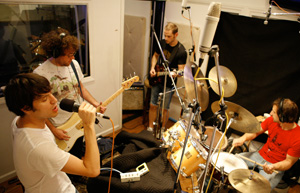
Bridges and Powerlines tracking basics at Soundworks

Bridges and Powerlines tracking basics at Soundworks

“He went over all our demos with us and was really active in pre-production — he blocked off about two months to make the record,” Sigel notes. “It was basically what every band wants and what every producer promises, but Kieran actually delivered.”

When it came time to start tracking, they utilized the studio right next door to The Buddy Project, Soundworks Recording, to cut basics to the studio’s 2” tape machine with engineer Kamilo Kratc. Soundworks, Kelly notes, will soon be directly tied into The Buddy Project and, vice-versa.

After tracking basics, the group thoroughly explored their musical and sonic options inside The Buddy Project. Renting and borrowing instruments (Sigel’s friend, ex-Cult bassist Stephen Harris, leant his Gretsch White Falcon among other guitars), hiring string and horns players and recording multiple tracks of near-everything, Bridges and Powerlines left no stone unturned in satisfying every sonic curiosity.

“At the beginning of the session, I promised myself that if there was an instrument we thought of for the record, we would have it,” says Sigel. “We decided we wanted timpanis and we found this great place, Carroll Music Instrument Rentals, all the way on the west side of Manhattan, that has an amazing inventory — every instrument you can imagine — and allows you to rent for 24 hours. We got two gigantic kettle timpanis, crash cymbals and chimes.”

Kelly adds, “Keith and I were very much of the mind to record everything we wanted, knowing that we’d pare it down later on. A couple of the songs are like 90 tracks.”

Band and crew! Kieran Kelly, second from left, and Soundworks owner/engineer Kamilo Kratc, third from left.

Band and crew! Kieran Kelly, second from left, and Soundworks owner/engineer Kamilo Kratc, third from left.

Accounting for some of that abundance are alternate tracks captured to a cassette tape deck, hand-held digital recorder and Fulltone Tube Tape Echo. “We tracked all the basics to 2” and simultaneously to a cassette deck so that we’d get one really dirty, warm, lo-fi track that we could potentially mix in,” says Sigel.

“It sounded really sweet, we loved it! But the cassette tape drifts; it runs at a different speed than the 2” and there were so many sync problems that ultimately made it too difficult to work with on drums. On grand piano, it was awesome — it gave us this super haunted piano sound that was amazing.

“We also tracked simultaneously to a little hand-held digital recorder because it had this bad-ass compressor on it and you could get that totally blown-out drum sound.”

String and horn sessions, led by Rob Moose (Antony and the Johnsons and Sufjan Stevens’ ensembles), were tracked at The Buddy Project, with singer/songwriter Will Stratton arranging a few of the songs and conducting. In “The Buddy Project” as collaborative studio concept, Stratton is one of the “buddies.” Kelly recently co-produced/mixed Stratton’s introspective folk record, No Wonder, and put it out through his record company, Stunning Models on Display.

The Buddy Project live room

The Buddy Project live room

“Bringing in friends and talented people I’ve worked with is all part of The Buddy Project concept,” says Kelly. “Will is classically trained and wrote some of the arrangements, along with Andrew [Wood], Dave [Boyd] and Keith. When you’re working with high-level players like we were you need to have properly mapped out arrangements and you need to move through sections quickly, so it really helps to have someone conducting.”

The string quartet was “semi-close miked” and the room sound was captured off the upright piano, a unique Buddy Project room-miking technique. “I mic the piano — about 1/8” off the soundboard — and depress the sustain pedal (by jamming a drum stick or something in there),” Kelly reveals. “You run that into a really fast compressor, like an 1176, with a super-fast attack and release. And then, what you essentially have is a wood-plate; a plate reverb. And it gives you these crazy, blown out sounds.”

This room miking technique came in big on Bridges and Powerlines’ guitar and drum sounds captured in The Buddy Project live room, as well as on all the unconventional percussion, i.e. church-stomp sounds.

Bridges and Powerlines' lead singer/keyboardist Andrew Wood

Bridges and Powerlines' lead singer/keyboardist Andrew Wood

“Another big technique we used was tracking all of the vocals through our Fulltone tape machine,” Sigel adds. “We would run a tape echo track that was not intended to be an echo or delay, and then line it right up with whatever we were tracking, and then mix that dirty, tapey sound in with the regular track. It does awesome things to vocals, gives them so much presence. These are the best sounding vocals we’ve ever gotten.”

As for backing vocals, Sigel mentions he tracked about half of them on his own, at home. “Kieran gave me the mic the Illinoise vocals were tracked on [Audio-Technica AT 4033] and the Manley ELOP compressor that Kanye West tracked all of College Dropout with and I went to town,” says Sigel. “I added all kinds of crazy tracks!”

This is not the first time Kelly has furnished his client with the means to record auxiliary tracks at home. His reasoning? “The records I work on are always co-producing arrangements. It’s not dictatorial; it’s not my record, it’s their record,” he explains. “ And I like everyone to be involved in the recording process. There are certain things that as a semi-literate engineer, I just would not do, whereas the artist will do these things that are so wrong that they end up adding a really nice flavor.”

As co-producer, Kelly kept Bridges and Powerlines focused but also let Sigel loose to add tracks to his heart’s content. Then it all went off to Scott Solter in North Carolina for mixing.

As fans of Solter’s work with Spoon and specifically John Vanderslice’s Cellar Door, they readily handed over their multitracks. “Cellar Door is one of my favorite sounding records, and we felt we could trust anyone who can make a record that sounds like that,” says Sigel, noting, “…Although our record sounds nothing like Cellar Door because it just has so much going on!”

Making use of another neighboring audio facility to The Buddy Project, the band went to Andreas Meyer for mastering. A mastering engineer formerly of Sony Studios, Meyer operates Meyer Media out of the same Astoria building.

THE BUDDY PROJECT SOUND

Bridges and Powerlines had 60s sounds in mind when producing Eve. “We were going for 60s, but not totally retro, more like ‘informed by…’” Sigel describes. “The ZombiesOdyssey and Oracle was definitely a reference point. But we also really loved The National’s last record, Boxer. And another big influence was Animal Collective’s Merriweather Post Pavilion, but I wanted it to sound more analog than that.”

Kieran Kelly in The Buddy Project control room.

Kieran Kelly in The Buddy Project control room.

Wherever digital sources were used in the production, for example Reason’s Abbey Road keyboards, Kelly amped them and ran them through the Leslie or the tape machine, or one of the fuzz pedals the band brought in. Plus, The Buddy Project has a lot of hand-built and customized analog equipment used throughout the recording process.

“Almost all of the mic pre’s that I use on this record were hand-built by Jens Jungkurth, of Eisen Audio, which is based in Long Island City with Coral Sound and Exile Recording,” Kelly notes.

“Jens is a genius. He built 10 of my pre-amps and two EQs. He really works with you to give you the tonal character you’re looking for. He’s really young but I think that in 15 years people will be using his name like Rupert Neve.”

The custom analog gear is a big part of the Buddy Project recording philosophy. “Keith and I love classic records like Pet Sounds, Sgt. Pepper’s, Kind of Blue, Odyssey and Oracle, The Kinks records — and on all of those albums, there was a really high level of commitment to the technical side of things, as well as the creative side,” Kelly points out.

“Historically, records were made using custom-built gear, equipment that was built for the studio as opposed to something off the shelf. I think that’s really great and I’m trying to do that here as much as I can. So when you work here, you’re getting a sound that’s unique to The Buddy Project, unique to this time and place.”

Look out for Bridges and Powerlines new record this Fall and in the meantime, check them out at www.bridgesandpowerlines.com. For more information on The Buddy Project, visit www.thebuddyproject.com.