Avid Event at Downtown Music Featuring Pro Tools|HD Native & Jason Goldstein This Wednesday, 5/4
May 2, 2011 by Janice Brown
/* Filed under News */
This Wednesday evening (5/4), we’ll be heading to Downtown Music for an Avid event featuring Pro Tools|HD Native and Grammy-winning engineer Jason Goldstein. See below for full details and reserve your spot today!

Hear about the production process of The Lonely Island's latest from engineer/mixer Jason Goldstein.
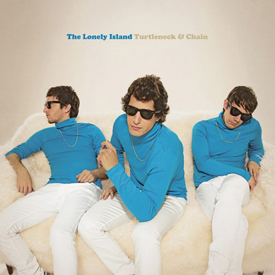
Presented by Avid, Alto Music NYC and Downtown Records, this special event will focus on how Pro Tools|HD Native can help you create better sounding recordings and mixes. As an example, Goldstein will be discussing his latest project with comedy-rap troupe The Lonely Island (featuring SNL’s Adam Samberg) and demonstrating his techniques using Pro Tools|HD Native.
So come down and see Pro Tools|HD Native in action, learn about how Pro Tools 9 facilitated the production of The Lonely Island’s upcoming album Turtleneck & Chain, and mingle with your colleagues over hors d’oeuvres and refreshments.
Space is limited so RSVP TODAY to reserve your spot.
Full Coordinates:
“Hear What You’ve Been Missing: Pro Tools|HD Native”
Wednesday, May 4; 7-9 PM
Downtown Music Studios
485 Broadway, 3rd Floor
New York, NY 10013
www.downtownmusicstudios.com
Hope to see you there!
Redefining NYC Recording: Downtown Music Adds a Neve 8014 Console
March 22, 2011 by David Weiss
/* Filed under NYC Spotlight */
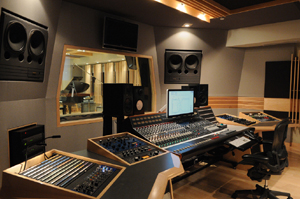
SOHO, MANHATTAN: The studios of NYC are not sitting still. As evidence consider the latest sonic escalation, launched from right below Broome Street and Broadway. There, Downtown Music Studios has upped the Big Apple ante with the installation of a vintage Neve 8014 console into the control room of Studio A.
Extra musically satisfying and aesthetically amazing, this 16-channel board represents more than just a fancy bunch of faders from the year 1970. Its addition provides a focused window on NYC studio economics in 2011, shedding light on the artistic and technical demands of the sector’s current clientele, as well as the informed interplay between facilities striving to be competitive instead of repetitive.
The console has been busy since it arrived earlier this year. Early projects on it include Santigold, David Guetta, Mike Posner, Benny Blanco, and Jason Goldstein mixing SNL-borne rock stars The Lonely Island. Downtown Studios Chief Engineer Zach Hancock explained to SonicScoop exactly why this bold new board has rolled into town.
How long has Downtown Studios been going now?
The studio is approaching our third year. It’s evolved from a production space that we rented at Chung King to the full-fledged, two-room commercial recording facility that it is now.
We initially started this facility with two control surfaces, moving from two Digidesign D-Commands to just one of those, in Studio B. That’s because of the importation of an 8014 Neve into Studio A.
What led Downtown initially to the D-Command for both rooms?
For the longest time we were large format console people, and we fought passionately to prove not only to ourselves, but to the world that mixing in the box was a viable option. The move from SSL desks to mixing with a Pro Control and an HD5 was a revolutionary phase for us in the early 2000′s. Working with Tony Maserati and Vaughn Merrick, they proved that it could really be done. Implementing mixing-in-the-box with a control surface in both rooms was in part an outgrowth of my relationship with Vaughn, and his astute idea that it was the best way to work.
Part of what makes Downtown Music Studios special is that as a record label, and a publishing company. We’re generating content ourselves. We provide a commercial workspace for clients half the time, and the other half we are the client. I wanted artists and the publishing company to be able to use the space as creatively as they could.
Downtown is a brand dedicated to forward-thinking artists, and that comes out intensely in the music. Part of that is having the studio time that they need, therefore a device at the center of the workspace that isn’t proprietary. If we had a large format console that was doing the mixing, I felt that they’d have a hard time translating that at their personal spaces, or in another commercial studio.
I saw other people’s workflows following suit — mixing in the box. So that’s why we equipped studio A to what we previously had. I still believe in it, and it was an amazing opportunity to work that way for two years.
What paved the way for switching to the Neve 8014?
Something happened when Avid acknowledged to the rest of the music community that native processing was just as robust as a small TDM system. When PT9 came out, I realized all at once that so much of our workflow – editing, doing overdubs, mixing – was going to happen in personalized spaces. It was an outgrowth of the music community, an outgrowth of the robust environment the computer now provides.
I saw the opportunity to focus Studio A as a tool to record bands, and handle all the elements of a project’s tracking. I thought that if you’re going to end up doing 30 to 40% of your workflow at home editing, maybe some mixing, etc… that it would free up your budget to work at an “A” level studio to do your recording. So we picked the console that was best for that.
This Neve 8014, working in coordination with PT9 and a EuCon control surface, is the perfect implementation of the modern workflow we’re talking about. It is truly the best of both worlds, a hybrid analog digital environment. It sounds astonishing, everything works in a very elegant workflow, and people are reacting to it very strongly.
What were the criteria going in to the new console search, before you settled on this particular board?
The selection process was laborious, we looked at every option out there: SSLs, APIs, Neves of different variety. Ultimately, the most important things for us were that 1) it was not counterproductive to the way we had worked previously, and 2) that it had had the best sounding mic-pres, the best sounding EQs, and it could really bring something to the table that wasn’t there in the market before.
I’m close to people who, on paper, could be considered to be our competition. It didn’t make a lot of sense for us to be doing what they were doing. I’m really happy to see that the community of studios run by people in NYC are really good people. That wasn’t always the case.
Let’s drill down to this Neve 8014 that’s sitting in front of us. Why did it finally make the cut?
The main reason is that this console is in pristine condition, and it has the best of what we want for tracking, mixing, summing or any other in-the-box permutation of analog and digital equipment.
One of the things that we’re very mindful of is the acoustical installation in this room. It sounds like one of the best rooms I’ve ever worked in, and I’m not the only person who feels that way: Tony Maserati, Jason Goldstein, Vaughn Merrick, Ari Raskin, are serious engineers. We work out of this room for different reasons, but one is that it’s acoustically flat – Pilchner-Schoustal knocked it out of the park.
I didn’t want to get a console that would require us reworking the acoustical or mechanical infrastructure. I didn’t want to have to put in another AC unit or bulkhead, or rip apart the room to get it in, because to me the most important part of the room is the acoustics, and the ergonomics. The equipment is always within reach, and the fact that there’s not a credenza behind you is meaningful. That’s why if we had put in a 72-input console, that would have been counterproductive.
Where did you locate this particular board?
I always said I wanted an 80-series Neve. The difficulty in acquiring an 8068 is that it would have been too big a car to fit in our garage. The 8014 is really the perfect-size console, given the modern integration of the computer, and the way Studio A is layed out. We found this board in Ireland – I sent Joe Russo, who’s an amazing young tech, to Ireland to inspect it, and he spent four or five days there. We did a very thorough inspection, and decided it really was the console. Rock-It Cargo handled the logistics of getting the desk here quickly and safely.
We split a lot of hairs when it came to planning the actual switch from the D Command to the 8014. When the time arrived, we executed the plan and there weren’t a lot of surprises — it went very smoothly. The people at Neve and Geoff Tanner were kind enough to send us some documentation, and Alto Music NYC provided us with a lot of outboard gear and a new Pro Tools rig. Everybody did a really exceptional job.
You’ve been working on this board since January – how has it matched up with your vision of an ideal tracking tool?
I think that there’s an “X-factor” to the sonic architecture of the mic pres and the EQ that make you feel as though you’re listening to a record. Working in the box is transparent, and sometimes indicative of something a little bit lifeless, but this console sounds a little less like real life in a super-natural way. Ergonomically, it’s the best way to work in a tracking situation. All of your mic pres and EQs are there. It’s not arduous. It’s logistically easy to accomplish tracking.
The other thing is that the Class A mic pre really is a cut above. I think these mic pres are the best for pop and rock music. It’s a very clear, robust sound, and it has a harmonic detail in certain frequencies that are very musical. It’s difficult to explain how they sound better, but they’re famous for a reason. Having them inline, directly in front of you and your PT rig is great. You can get what you need really fast.
The artists we’ve been working with on this console have been excited about the sounds that we’ve gotten. That gives you confidence in your ability, and that’s what it comes down to: making sure the artist can create. This console has definitely augmented our ability to do that. That’s a really rewarding feeling after working so hard to acquire it.
How are you’re using the 8014 in the mix phase?

Maintaining the acoustics in the Pilschner-Schoustal designed control room were the top priority in the console switch. (Photo credit: Jung Kim)
The first thing I should note is that it’s not an inline console – it’s a split console. It’s got an interesting set up for monitor returns. We’ve integrated the monitor returns at mixdown to become inputs to the console, but with a flick of a switch they can function, as they would have when they left the Neve factory in 1970. Some engineers prefer this for tracking.
So we have, essentially, 32 inputs to the desk; 16 of those inputs have faders and 1084 mic pres and EQs etc…, and the other 16 inputs allow the room to use some of the other pieces of the installed outboard– the Chandler TG1, the Distressors, 1176, Pultec style EQs, GML EQ, tube limiters. Everything can fold down to the stereo bus.
It’s all new outboard equipment in Studio A that we thought would be the perfect complement to the console, and we made a point not just put in vintage equipment. There’s some incredible new gear, and we’ve adopted a lot of that stuff in the workflow. I think of outboard processing as an opportunity to add different spices to your mix. So we bought valve EQs that would complement the Neve – they have some color that the transistors in the console don’t have, and the dynamics that we have are different than the compressors in the desk. We wanted to have mono tube limiters and compressors that you would use in a tracking environment, and the stereo bus compressors that you would use in a tracking environment or on groups in a mix.
The automation comes from the Euphonix Artist Series Controller with EuCon, integrated into Pro Tools 9, which together works like the D Command. So we were able to get the same level of integration into this amazing analog console as we had before.
Can you explain exactly how that EuCon-to-Neve connection works?
We’ll come out of Pro Tools, and dedicate an analog output to a group of audio i.e. a “stem”, or one analog output per instrument. So that comes from Pro Tools into the desk, and then the desk functions as an analog mixer.
It goes a step beyond a summing mixer, in that you can do inserts on the console that allow you to step away from hardware inserts in Pro Tools. That requires a level of digital-to-analog conversion, then analog-to-digital, so you covert twice while you go out of the box then back in. The beauty of the Neve is that you can use the inserts on the channel fader and avoid all that conversion.
For automation, we modulate parameters in Pro Tools, volume data etc… with the Euphonix control surface. Any volume changes happen before they arrive at the console. It’s an important step in making recalls easier, more convenient for all parties involved. Most people are doing automation in the box so if you open the session the next day, the automation is there. There’s no lengthy recall, and that can save your client money. You can also bring it home, etc…
You said before that you were paying attention to where Downtown fits into the overall scene, in NYC and I guess that goes for nationally as well. Why is that so important?
One of the difficult things about owning or running a studio is that there are so many choices at hand for people. At the same time one of the incredible things about making music is you have so many choices.
For me, the challenge was to live on the side of the debate where you’re making music and loving the choices. I think it’s silly to be doing the same thing that five or six other people are doing. So it was a no-brainer for us to do something a little bit unique. But it’s not just the console – the truth is I feel that we have the best Pro Tools rigs – an HD5 system, an HD Native system and an Avid Symphony system. We take each one seriously, whether its Logic or PT. We can accommodate at a high level of integration. We have almost every plug-in you could want, and a UAD 2 card, which I’ve been raving about.
The bottom line is that the computer has always been the most important thing for us. One of the ways to find a lane is to take our expertise as computer and process people, and combine it with the best hybrid approach which we’ve been developing over the last 10 years. It’s not completely unique, but it’s not run-of-the-mill by any stretch of the imagination. It’s something that people are really excited about – the response that we’ve gotten so far is amazing.
In the last several months we’ve covered some significant console switches in NYC – the ICON was switched out for an SSL G+ at Stadium Red, and prior to that Tainted Blue traded their SSL J9000 for a Euphonix System 5. Why this increased activity?
I think that studios have always changed consoles. I read Stadium Red integrated Just Blaze into their workflow. Not only is that an amazing facility, but he’s one of the greatest producers of all time. Just Blaze has had an indelible mark on hip hop and R&B. His work is amazing. The guys at Tainted Blue I haven’t had the pleasure of meeting, but time to time you hear glowing reports of what they’re doing. I can’t tell you why they switched, but I know the System 5 is the pinnacle of post production consoles. Some people use it for music, and for post it probably is one of the best tools.
I do think that technology is at a place where for the last four or five years there was an identity crisis of how people wanted to work. The expediency of working in the box became really important, because recording budgets have scaled back. The need to make changes at the last minute possible has made a definite impact on our workflow.
Computers have gotten so good that a large-format console isn’t a need, it’s a want, whereas before you had to have one. Whether or not a studio needs an analog console is something you need to look at on a case-to-case basis. But for us, this change is exciting. It makes a lot of sense.
– David Weiss
CMJ + SonicScoop Present Studio Time, Sponsored By The Deli
October 12, 2010 by Janice Brown
/* Filed under NYC Spotlight */
CMJ has announced its full schedule of showcases and panel presentations! There’s a ton going on next week, find it all at http://cmj.thesocialcollective.com events and plan wisely!
Definitely check out our “Studio Time” event — being co-sponsored by The Deli Magazine — happening on Friday, October 22 at NYU’s Kimmel Center. Studio Time will be a unique two-part panel series, providing emerging artists, engineers and producers with recording and mixing insights and inspiration from expert music creators.
Part I (12:30 – 2:30) is “Mix Reconstruction” – Three top mixers take you through their personal mixing process, explaining how they approached and ultimately mixed a song from their discography, playing pre- and post-mix examples to illustrate how they work. Basic techniques and creative solutions will all be examined in this illuminating event.
Featured mixers include: Nicolas Vernhes (Dirty Projectors, Animal Collective), Jason Goldstein (The Roots, Bilal) and Shane Stoneback (Vampire Weekend, Sleigh Bells).
Part II (2:45 – 4:45) is “Rough To Refined: Exploring Recording From Demo to the Finished Product” – In this lively forum, artists and their producers appear together to play rough demos for the audience, explaining how their complex collaborations resulted in the final, polished song that ultimately made it onto their album. Professional workflow concepts and the creative possibilities between producers and artists will come to light in this inside look at modern music production.
Jim Keller and Franz Nicolay, Phil Palazzolo and Nicole Atkins, and Chris Zane (Passion Pit, The Walkmen, Suckers) with guitarist Seth Jabour of Les Savy Fav.
Studio Time sponsor The Deli will be hosting 7 showcases at multiple venues throughout the week, featuring Bear Hands, Keepaway, Deluka, Buke & Gass, Pearl & The Beard, La Strada, Anni Rossi and more. Click for the full schedule!
And here are some highlights from the panel program running at the Kimmel Center next week (Click for full schedule):
Tuesday, 10/19
2PM: American Hardcore and the Rise of Modern Rock, featuring Vic Bondi, Jack Rabid, Michelle Rakshys, Matt Sweeney and Steven Blush
3:30: The 360 Deal Does A 180, featuring David Boxenbaum, Bernard Cahill, Jim Cooperman, Fred Goodman and J. Reid Hunter.
3:30: The Sync Is Clogged, featuring Joe Cuello, Daniel Gross, Elliot A. Resnik, Esq., George Stein and Shayna Zaid.
Wednesday 10/20
2PM: The Who, What, Why and Differences of the Performing Rights World, featuring Gary Adelman, Samantha Cox, Marc Emert-Hutner and Laura Williams
3:30: Labels in the Black and How They Are Succeeding, featuring Craig Balsam, A.J. Benson, Fred Feldman, Dan Goldberg and Steve Savoca
3:30: Start Me Up (Real, first-hand advice on music start-ups), featuring Andrew Dreskin, Chris Fralic, Catherine Radbill and Daniel Zaccagnino
3:30: The Zeros and Ones of Music Creation, featuring Bryan Abreu, Tim O’Heir and Vinny Valentino
Thursday, 10/21
11AM: Times Are Tough; Keep Your Composer: featuring Andrew Hollander, Ryan Shore, T. Griffin and Jonathan Zalben.
12:30: The “What’s Cool” Culture of Indie Placements: featuring Stephanie Diaz-Matos, Tom Eaton, Eric Johnson, Bryan Ray Turcotte and Steve Yanovsky
CMJ also offers mentoring sessions on Music Publishing and Licensing, Music Production, Artist Management, New Media, College Radio and more! For more on CMJ, other panels, artists, shows, etc. and to register, visit http://cmj.com/marathon/register.
CMJ + SonicScoop Present Studio Time, October 22
October 1, 2010 by Janice Brown
/* Filed under News */
We’re excited to announce our partnership with CMJ to present Studio Time during the CMJ 2010 Music Marathon.
On Friday, October 22 at NYU’s Kimmel Center, we will be producing a unique two-part panel series, providing emerging artists, engineers and producers with recording and mixing insights and inspiration from expert music creators. Check it out:
Part I (12:30 – 2:30): Mix Reconstruction
Three top mixers take you through their personal mixing process, explaining how they approached and ultimately mixed a song from their discography, playing pre- and post-mix examples to illustrate how they work. Basic techniques and creative solutions will all be examined in this illuminating event.
Featured mixers include:
Nicolas Vernhes, of Rare Book Room Studios in Brooklyn, who in the last year has mixed Dirty Projectors’ Bitte Orca and Dirty Projectors & Bjork’s Mount Wittenberg Orca, Spoon’s Transference, Small Black’s New Chain, Versus’ On The Ones and Threes, and Animal Collective’s Oddsac movie, among other projects;
Jason Goldstein, a Grammy-winning mixer most recently known for his work with The Roots (How I Got Over), Beyonce (B-Day) and Bilal (Airtight’s Revenge), Jill Scott (“Hate on Me”) and Ludacris (“One More Drink”); and…
Shane Stoneback, of SMT and Treefort Studios, who has recently engineered and mixed records for Vampire Weekend (Vampire Weekend, Contra), Sleigh Bells (Treats) and Magic Kids (Memphis).
Part II (2:45 – 4:45): Rough to Refined: Exploring Recording from Demo to the Finished Product:
In this lively forum, artists and their producers appear together to play rough demos for the audience, explaining how their complex collaborations resulted in the final, polished song that ultimately made it onto their album. Professional workflow concepts and the creative possibilities between producers and artists will come to light in this inside look at modern music production.
The featured guests will be the following producers and artists:
Producer/engineer Jim Keller (Franz Ferdinand, Demander, The Cribs) with artist Franz Nicolay talking about Nicolay’s upcoming album, Luck & Courage.
Producer/engineer Phil Palazzolo (New Pornographers, AC Newman, Okkervil River) and artist Nicole Atkins discussing Atkins’ album — Mondo Amore — due out in January ’11.
Producer/engineer Chris Zane (Passion Pit, The Walkmen, Suckers) with guitarist Seth Jabour of Les Savy Fav talking Root For Ruin, the band’s latest album on Frenchkiss Records.
For more on CMJ, other panels, artists, shows, etc. and to register, visit http://cmj.com/marathon/register.
Artists performing at CMJ 2010 include Phoenix, GZA, UNKLE, Black Sheep, John Vanderslice, Cute Is What We Aim For, Justin Townes Earle, Black Label Society, Corin Tucker Band, Dan Black, Cults, The Bogmen, Clutch, Francis and the Lights, Screaming Females, Franz Nicolay, Small Black, Wild Nothing, Dom, Marit Larsen, Good Old War, Reggie Watts and BRAHMS. Click for the most up-to-date list.
Sonnox Oxford SuprEsser Review By Jason Goldstein
August 31, 2010 by Jason Goldstein
/* Filed under Tech & Reviews */
Unfortunately, poorly recorded vocals and instruments are all too commonplace, given today’s do-it yourself production mentality. Poor microphone choice and placement, over-compression, and room noise can wreak havoc on the quality of a recording. The job of cleaning up after a bad recording can be very tedious.
Enter the SuprEsser from Sonnox: a plug-in aimed at making the modern day mix engineer’s janitorial duties, an easier one.
TECHNICAL STUFF
The SuprEsser is a native only plug-in, that comes in RTAS, AU, and VST formats and is available for both the Mac and PC. It comes in three flavors, each adding a higher degree of resolution but at the cost of higher latency. Anywhere from 500 to an astounding 12,000 samples of delay! Soooo, unless you like doing lots of math, this plug-in should be reserved for use only on systems capable of ADC (automatic delay compensation).
WHAT IT IS/WHAT IT DOES
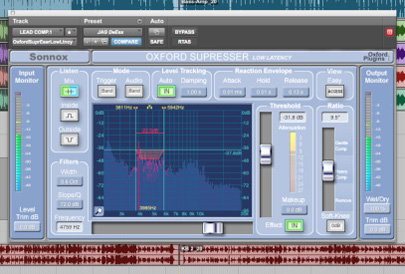
In a nutshell, the SuprEsser is a very sophisticated frequency specific compressor, which allows the user to target only those areas of the audio spectrum where a problem is occurring. This means it can be used as a de-esser, de-popper, or when used in wide band mode, as a more traditional, all-purpose compressor.
THE INTERFACE
In a word, awesome! Although the GUI has a lot going on and may seem confusing at first, in reality it is actually very easy and intuitive to use (there’s even an “easy“ view which simplifies the interface, leaving only the most basic and useful features visible).
The target frequency, threshold and amount of compression are represented both numerically, and visually on an FFT display, making the process of identifying and eliminating unwanted artifacts both quick and simple. Unlike your average de-esser, you will also find controls for attack and release as well as an auto function, which allows the amount of gain reduction to remain consistent regardless of the input level.
As if that weren’t enough you can also choose from two types of “listen” modes. One, called “inside” which is the standard mode found on most de-essers as well as an “outside” mode which allows you to hear which frequencies are NOT being affected by the processing.
SuprEsser IN USE
I was able to test drive the SuprEsser on both Pro Tools native and TDM systems as well as Logic Pro running on my laptop. As a straightforward de-esser, this one ranks among the best I have used. Dialing in just the right amount of compression was quick and easy and there was no dulling of the sound that one normally finds with this type of processor. Plosives, or pops, as they are also called, were also handled with ease.
One of the cooler uses that I have found for a de-esser is for removing unwanted hi hat leakage from snares and toms. I find it sounds much more natural than trying to using a noise gate, which tends to cut off the attack of the drum.
The SuprEsser excelled in this application as well. Being able to vary the attack and release of the compressor and not just the frequency and threshold meant I was able to remove just the right amount of hi-hat without overly affecting the sound of the snare.
Another cool feature found on the SuprEsser is the ability to mix the amount of wet and dry signals being sent to the output. This is similar to parallel compression, allowing you to apply drastic amount of gain reduction to a signal and then blending to taste.
CONCLUSION
The only drawback I could find with this plugin was the aforementioned processing delay. Other than that, the SuprEsser is a veritable Swiss army knife of compression and a welcome addition to my plugin folder.
For more information and to purchase the Sonnox SuprEsser, visit: www.sonnoxplugins.com/supresser.
Jason Goldstein is a NYC-based Grammy-winning mix engineer who’s worked with Beyonce, Jay-Z, The Roots, Ludacris, Jill Scott, R. Kelly, Michael Jackson, Mary J. Blige and more. For more on Goldstein and to get in touch, visit www.jasongoldsteinmixer.com.