The New Music Seminar 2010: “Advertising, Marketing and Media Need to Co-Exist”
July 23, 2010 by Erika Pontes
Filed under News
In a world already teeming with new (often free) music options, where artists are struggling to make a living and where so many names get lost in the throngs of new artists each year, how does a new artist break through?
Earlier this week, the New Music Seminar convened to answer this multifaceted question through seminars and interviews with music marketing, technology, business and production professionals. The Seminar, overall, lived up to its name in its focus on fresh, unknown artists and bands that still have not gotten their ‘break,’ the “new music” we have yet to hear. What are the emerging tools, techniques and channels for getting this music out there? And what can we learn from past success stories and are these examples even relevant anymore?

Discussing "The Future of Media" (l-r) All Things Digital senior editor Peter Kafka and Pandora CEO Joe Kennedy
New Music Seminar was spread over three days, between July 19th-21st, and a program which included Meet the Author sessions, 18-minute intensive presentations and panel discussions, or “Movements” that featured big personalities squaring off on these big-picture topics.
The first day’s Movements got off to a rough start as the mics were not working properly and the musicians in the room were yelling out advice instead of the other way round. However, talks finally got under way for The First Movement — ‘The New Music Business Unveiled’ — with players Michael Doernberg, co-founder of ReverbNation, Jay Frank, Sr. Vice President of Music Strategy at Country Music Television, Eric Garland, Founder and CEO of BigChampagne, and Gwen Lipsky, Chief Strategist at SoundThinking NY. The discussion was led by Ariel Hyatt, founder of Ariel Publicity and Cyber PR.
A number of different topics were raised but the discussion always seemed to wrap around the the theory of ‘1000 true fans.’ As Hyatt explained if an artist can accumulate 1,000 true fans, fans that not only buy music but also concert tickets and merchandise, and if each fan paid at least $100 a year then the artist or band should theoretically be able to support itself for that year. The conversation continued along the lines of obtaining “true fans” as Lipsky put it, although in the 20/80 marketing rule, where 20% of the consumers provide 80% of the revenue, she pointed out, “in music it’s less, it’s more like the 10/90 rule.”
Social media became a hot topic as Hyatt explained that Facebook, Twitter and MySpace were not enough. According to her pie chart (yes there were pie charts), e-mail (30%) and Google (14%) were in fact the best money-makers in terms of getting your name out there and selling music. The players preached regular communication with fans via newsletters or e-mail blasts to nurture a relationship with fans so that they became more than just a fan but rather a “true fan” or even a “superfan.”
Doernberg elaborated, mentioning artists who most of the room had never heard of yet who have been quite successful in financial terms due to their ability to “go deeper than a ‘friend’ relationship.” He said, “you don’t have to have tremendous reach to have high engagement.”
The seminar went on to discuss ‘Click to Content,’ and how artists should not only make their music available but also reduce the number of clicks it takes for a fan to download their music. Frank said, “People will give about 10 seconds to listen to a song,” therefore artists should find the fastest path to their fans even if that means going through different means of reaching different fans.”
Hyatt ended the discussion by answering a few questions from the audience. She added to her previous statement about reaching fans via e-mails saying “personalize the e-mails by splitting them into groups of fans,” but to only include “one call to action in each e-mail” because if there are too many, the fan is most likely to do nothing at all.
The Second Movement ‘The Future of Media’ led by Senior Editor of All Things Digital, Peter Kafka, included Alex Cameron, Senior VP of Market Manager Emmis NY, Courtney Holt, President of MySpace, Richard Yaffa, CEO and President of N. America Group M Entertainment, David Goodman, President of CBS Interactive Music Group, and Joe Kennedy CEO of Pandora.
Although this discussion was meant to focus on how the Internet changes who breaks and how, it seemed to veer into a debate between radio and Internet and which actually breaks artists and which leaves them lingering. When Cameron confessed that, “every medium has its place” and that, “new music is a major risk on radio,” the audience started to rustle and whispering filled the room. Kennedy came to her rescue claiming, “Radio is so essential to the discovery of music.”
The talk hit on some other points such as artist branding, bringing up names like Lady Gaga and her new venture with Polaroid and The Veronicas and their association with Yaz. Goodman explained that a lot of brands now want to affiliate themselves with new music as they earn credit for discovering new artists. In turn, this helps to build the brand’s reputation in the eyes of their consumers.

Photo Op! NMS Day Two "Movement" panelists with conference heads (l-r): Jesse Malin, Swizz Beatz, Little Steven, Tom Silverman, Kelly Cutrone, Nile Rodgers, Vinnie Brown, Margaret Cho, Bill Werde, Dave Lory, Tom Jackson and Alex Suarez.
Cameron went on to say that “originally the currency was money and then time, but today’s currency is trust.” Trust amongst artists, labels and brands as well as fans. Goodman ended the talk on a positive note for all the new musicians in the audience, “stay true to the vision.”
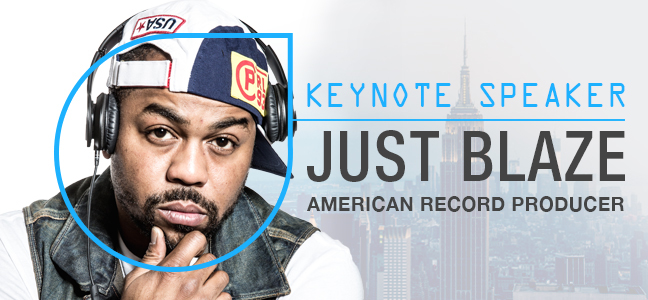
On Day Two of the Seminar, a lively discussion broke out in the Movement titled, “The Creative Conundrum: Increasing Your Odds With Radical Differentiation.” Moderated by Bill Werde, with publicist/personality Kelly Cutrone, Little Steven, Just Blaze and Tom Jackson of OnStageSuccess.com, this panel spoke to the importance of finding one’s self as an artist, finding “your lane,” as Just Blaze put it, and putting 100% into being the best and brightest at that thing, whatever it is.
They all stressed the importance of the artist’s team, the production, presentation and management in honing and executing the artist’s vision. To the artists, producers and other creatives in the audience, Cutrone emphasized, “The team is really important but you have to believe in yourself. You have to live and breathe your brand.”
Stadiumred & Just Blaze Announce Exclusive Partnership
February 4, 2010 by Janice Brown
Filed under News
Super producer Justin “Just Blaze” Smith (Jay-Z, Rihanna, Eminem, Usher) is joining the ranks of NYC recording facility, Stadiumred, bringing additional staff, equipment and newly constructed rooms to the multi-studio complex.
On his latest move, since closing Baseline Studios last week, Just Blaze stated, “I’m looking forward to setting up shop with the guys at Stadiumred. I’ve been in this business for 13 years and their vision and drive are the perfect compliment to what I look to build during the next phase of my career. I’m looking forward to creating something great with them.”
Stadiumred has got to be NYC’s fastest-growing studio complex. Since opening in ’07, Stadiumred has doubled in size, twice. And, founder Claude Zdanow has been all about dream-team-building from the start.
The facility, located at 125th Street/Park Ave in Harlem, currently houses multiple-Grammy-winning producer/engineers Tom Lazarus (Ray Charles, Bjork, Yo-Yo Ma, Chicago Symphony), Ariel Borujow of Westward Music Group (T.I., Black Eyed Pees, Puffy, Kanye West), Sidney “Omen” Brown (Ludacris, Mya, Drake, Fabolus), and Joseph Pedulla (Thursday, The Mighty Mighty Bosstones, Mos Def, Kid Cudi).
Under the watchful eye of recording studio designer Frank Comentale (The Hit Factory, Chung King Stuudios, & Daddy’s House), construction of a new SSL mix studio and surround sound mastering studio began in early 2010.
The additional rooms will round out Stadiumred’s offerings to make it a “one-stop-shop for all things music.”
Stadiumred is a full-service production, mixing and recording facility which started in the space once occupied by Ornette Coleman’s Harmolodic studio and in the few years since, has expanded into four mixing and production rooms, a 1,000-sq. ft. live room with multiple recording rooms, and a mastering suite.
Artists like Drake, Melinda Doolittle, Mos Def, Yo Yo Ma, Thursday, and the San Francisco Symphony, among others, have recorded at Stadiumred. The facility also hosts music/sound-for-picture sessions, including recent audio recording for the 20th Anniversary episode of The Simpsons and the mixing of Oliver Stone’s film, W.
Baseline Studios Closes with an Open House
January 29, 2010 by David Weiss
Filed under News
Baseline Studios, the long-running 26th Street studio most recently operated by star hip hop producer Just Blaze, closed its doors yesterday, January 28. An open house was held to commemorate the last day of the celebrated facility that had been home Roc-A-Fella Records, and was first owned by Jay-Z and O.G. Juan.
The atmosphere was respectful but positive as fans, artists, producers and media paid their last respects to the landmark studio, which had recorded hits for the likes of Kanye West, Saigon and countless others. Baseline Studios was a cornerstone of the NYC hip hop recording scene — its presence will be missed.

Just Blaze at Baseline Studios