NYC Studio Tour: North Brooklyn – Part 1
March 16, 2011 by Justin Colletti
/* Filed under Deli Feed, NYC Spotlight, SPARS Feed */
BROOKLYN, NYC: Brooklyn correspondent Justin Colletti visited with 30-some studio owners for our new neighborhood studio tour series. This first installment takes a closer look at a handful of North Brooklyn’s small to medium-size studios that are affordably-priced for indie artists, friendly to freelance engineers and operate without a traditional console.
Rough Magic
Greenpoint, Brooklyn
www.roughmagicstudios.com
Room Rate: $400/day (House engineer available)

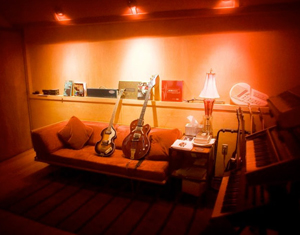
The largest of three isolated tracking environments at Rough Magic features wood floors and 11 ft ceilings.
The Pencil Factory is an epicenter of Greenpoint’s creative culture, and the home of the rehearsal and recording studio, Rough Magic.
This multipurpose facility set up shop alongside a cadre of mastering studios, record labels and artist’s workshops in 2003, and has gone on to play host to a diverse clientele featuring names like Soulive, Talib Kweli, MGMT, The Fiery Furnaces, and Beirut.
In addition to its regular practice spaces, a room-rate as low as $400/day secures a Pro Tools HD-equipped studio capable of capturing 16-tracks of live audio as well as a full suite of instruments and front-end gear from API, Focusrite, Amek/Neve, Neumann and AKG.
–
The Gallery Recording Studio
East Williamsburg Industrial Park, Brooklyn
www.thegalleryrecordingstudio.com
Rates: $40 per hour, $350 for 10 hours (including engineer)
In the fall of 2006, Brian Forbes and Keith Parker began building a suite of handsome, wood-floored live rooms in East Williamsburg’s industrial park. Parker tells us that their new home-base, Gallery Recording aims to create a “warm and relaxed atmosphere that offers amongst the best bang-for-your-buck in NYC.”
To complement its ample live rooms, the Gallery’s DAW-based control room runs an 18-channel Pro Tools system and houses a respectable cache of rack gear, microphones and instruments that might best be described as “contemporary classics.”
These two attentive producer/engineers have built up a promising demo reel that includes sound samples from indie and major label artists As Tall As Lions, Rae 6 and Emily King.
–
Grand Street Recording
Williamsburg, Brooklyn
www.grandstreetrecording.com
Contact for rates.
Grand Street Recording’s Ken Rich has had a long and varied career as producer, engineer, and bass player, working with artists like Joseph Arthur, Julia Darling, The Madison Square Gardeners, Ward White, The Compulsions, Morley, Lucinda Black, Tracy Bonham, and Laurie Anderson. Just as impressive is his studio’s wide variety of vintage instruments, amps and mics.
“We’re certainly affordable to most independent artists”, says Rich, “and the studio is very freelance engineer-friendly since the routing and patchbay are so thoughtfully set up. GSR is also a great mix room. We have a boutique collection of compressors and limiters, two classic spring reverbs, as well as Lexicon and Bricasti multi-effects, and the room itself provides a great and also accurate listening environment.”
More than housing a sizable collection of some of the industry’s most coveted microphones, preamps, and compressors, Grand Street Recording is a playground for musicians, and home to a startling assortment of vintage drums and boutique basses. Rich continues:
“Our mic collection is extensive and we feel that capturing acoustic instruments is one of the things we do best. We seldom record with EQ, but rather select the correct microphone and placement for the instrument. The studio is very musician-centric as we have a huge assortment of vintage instruments that are at the disposal of all of our clients. People often get very inspired when the come in to the studio to try different instrument and amp combinations in order to create new sounds, and it is our job to capture those moments.”
“There are also really good sight-lines between the rooms so that even if people want each instrument isolated, they still feel that everyone is in the same room. The staff at GSR is friendly, knowledgeable, quick, and musical. Usually we can have a band tracking within an hour or so of the time that they walk into the doors, so we can get a lot of recording done in a day.”
–
The Brewery Recording
East Williamsburg, Brooklyn
www.thebreweryrecordingstudio.com
Rates: Studio with Engineer: $70/hr (discounted blocks: $260/4hrs, $500/8hrs, $700/12hrs); Studio with Assistant Engineer: $50/hr (discounted blocks: $180/4hrs, $330/8hrs, $450/12hrs)
The Brewery isn’t the first studio venture for Andrew Krivonos and Oladipo “Dot Da Genius” Omishore. These young producer/engineers outgrew their project studios quickly, with Krivonos sharpening his skills in his private mix room, Southfall studios, and Dot making a name for himself in his home studio by collaborating with Kid Cudi on the breakthrough single “Day N’ Nite.”
Now in a new suite on the East Williamsburg/Bushwick border, everything about The Brewery’s design shows the mark of a 21st century studio. A Control 24 digital board and front-end racks from API, Avalon, Neve, Presonus and Vintech sit in the center of the room, ready to integrate with a Pro Tools HD system or Ampex MM1200 2” 16-track tape machine.
“We strive to set the future model for recording studios in New York,” Krivonos says. ”We understand the limited recording budgets of most and want to provide big-commercial studio service at a realistic price.”
To that end, The Brewery have supplemented their already competitive rates with creative pricing packages like the “Early Bird Special” and a unique “$949 Rock Block,” that promises a whole lot of tracking at a pre-set price.
Fortunately, Krivonos knows running a studio is more than a simple equation: “The most important factor of our studio is our staff engineers. People will come back to you no matter how shitty your studio is if you can give a great product. The product — our mixes — are what keeps our clients coming back, more than anything else.”
When asked if about their emerging specialties, Krivonos says: “We do a lot of pop, rock, R&B, and hip-hop. Producers love our space for the monitoring and freelance engineers love it because of the functionality and affordability.”
Justin Colletti is a Brooklyn-based audio engineer and music producer who’s worked with Hotels, DeLeon, Soundpool, Team Genius and Monocle, as well as clients such as Nintendo, JDub, Blue Note Records, and the Metropolitan Museum of Art. Visit him at www.justincolletti.com.
Return of the Nomad Engineer: The Top NYC Studios of Freelancer Ari Raskin, Part I
February 27, 2011 by David Weiss
/* Filed under Deli Feed, NYC Spotlight, SPARS Feed */
CHELSEA, MANHATTAN: No one can say Ari Raskin hasn’t paid his dues. This in-demand freelancer engineer may regularly make the rounds of NYC’s top studios today, but it’s only after he’s sweated it out for a decade-plus, making a name for himself in the city’s fiercely competitive studio scene.

Ari Raskin in his element: with producers Mysto and Pizzi, and artist Wynter Gordon in Chung King's famed Blue Room (RIP).
Raskin can contribute in many ways to a project – tracking, mixing, editing, drum programming, and even the occasional master – and has done just that for a wide range of artists: Whitney Houston, Wyclef Jean, Meshell N’Degeocello, Black Eyed Peas, Kanye West, Kid Cudi, J.Dilla and Illa J — Yancey Boys, and Justin Timberlake among them. His career got moving after he departed Berklee College of Music with the goal of being the next Brendan O’Brien or Andy Wallace, then went from being an intern at Chung King to House Engineer.
Today, no longer afforded his home base that was Chung King, Raskin makes music all over Manhattan and beyond – a positive vibes traveling man that makes him the perfect subject for the return of our Nomad Engineer series.
How would you describe the ups and downs of a New York City freelance audio engineer in 2011?
The real benefit of freelance engineering and traveling is getting to choose which studio is right for the project — be it the sound of the live room, the sound of the control room, the vibe of the control room, the gear, the rigs’ plugins, the budget, or just how late the staff stays — so that you can comfortably make a great recording that fits the music. Also, having clients agree that you suggested a good studio for them is a nice thing too.
If you’re a staff engineer at a small Pro Tools studio with a 5′ x 8′ live room, and a rock band is introduced to you by the studio manager, you’re never going to be able to tell them, “We should do the rhythm section at Avatar or Skyline. You’re never gonna get real big drum sounds here, and these reissue mic preamps and 414′s just don’t have the real rock-star vibe you’re after.” Although of course most of us now would just shut up and do the modern thing and use Drumagog or SoundReplacer.
I’d like to note, though, that when I first stepped into the major-label part of the recording industry when I moved to New York 10 years ago, there were LOTS of freelance engineers working from studio to studio. It seemed much less common for labels to use house engineers unless it was for a transfer session. Engineers definitely used to be more highly regarded before everyone and their sister had Pro Tools, so I think that’s why hiring the respected freelance guys was much more the norm in the day, whereas now labels just want a house engineer who knows how to use Pro Tools and isn’t expensive.
Lately, whenever I run into former Chung King clients at other studios, I constantly get told “Oh, I didn’t know you were still working since Chung King closed,” or “You work here now?” as if the idea of a tracking engineer being freelance is now an unknown concept.
We’re glad to get the inside track from you on your fave NYC recording spots. What made you say “Yes” to this article, rather than keeping your top studios close to the vest?
Seemed like a fun topic, and I do work around, and do have opinions on a number of various rooms. I just wish there were more large-format rooms in this city, with all the standard vintage outboard gear and mics. Five years ago there were a lot more real-deal pro-studio choices, and 10 years ago a lot more than that. It’s getting hard now, especially when your first choice-room is already booked, and you’re actually trying to do a serious recording and not just track vocals. Therefore…
Downtown Music Studios, Studio A; SoHo, NYC
Many positives about this place. For one, there isn’t a vibe like they are dying for business and need to squeeze every penny they potentially can out of your clients. Also, the ProTools rigs have more plug-ins than any other rigs I’ve seen. Unlike so many rooms, the studios at Downtown were planned and configured by good working engineers, so things make a lot of sense in real world practice.
Studio A there is possibly the most accurate-sounding control room in the city that I’ve worked in, and has no room EQ on the mains. The almost-mint Neve 8014 console they just installed is not only amazing for its sixteen 1084 pres for tracking, it’s also possibly the best summing amp in Manhattan for Pro Tools in-the-box mixing. There’s also a ton of clean vintage and high-quality modern gear — they won’t let someone who doesn’t know what they’re doing assist in sessions.
The live room in Studio A is very clean and neutral-sounding, great for tracking vocals, instrument overdubs, or a live band. You can easily get a dry drum sound, or put up some far room mics, 1176 them, and get a big rock sound. Studio B has a great rig as well, with good external converters, a totally different vibe from Studio A, and is probably the most-equipped room for the money in Manhattan.
Some of my recent sessions there include Sean Paul, Black Thought, Kat Deluna. I’d recommend this studio to any type of client, other than a gigantic orchestra or those craving a huge castle drum sound, or those wanting to mix on an SSL. The Neve console they have has no automation, but for mixing a jazz, acoustic, or a small production, it sounds incredible.
Platinum Sound Recording, Studios J and K; Times Square, NYC
The “sexiest” of the big studios in NYC. I think it’s the only studio I know of — not that I claim to have worked in every studio — that has a designated receptionist and interns always ready for runs, 24 hours a day. That might seem like a minor detail, but for those who have clients who like to work past midnight, it’s a major concern. Very cool vibe, cool staff.
They have a real live K, and a J — and unlike most SSL’s in NYC, they get used for mixing regularly still, so the assistants aren’t new to that: big board mixes with old-school engineers who use lots of gear are often the most demanding type of session for an assistant. Also, I haven’t heard the new Augspurger speakers in studio K, but the J room has the HEAVIEST bass of all time — although Studio C at MSR is quite thumpin’ too.
Some of my recent sessions there include Wyclef, Kat Deluna and Ritz Crackers. This is a good studio for SSL board mixing; good studio for late-night artists/producers; decent-sized live room with some good mic pres, so it’s not a bad choice for producers who like live instruments. The best for those who like it so loud their faces melt and eardrums shred. Great for those who like to vibe and create.
Premier Studios, Times Square, NYC
Premier is the former Studios A and B of Quad, renovated and heavily cleaned up, with two newer, very good Pro Tools “writer’s” rooms, very fairly priced. Studios A and B were both recently tuned and both sound accurate and get quite loud. The live room in B is great for a clean drum sound, and great for any vocal or instrument overdub.
The staff there is eager and friendly and understands the concept of working towards the future — in other words, they don’t take the clients that come in for granted. They have real LA-2A’s in most rooms — which didn’t used to be unusual anyway — and they are maintained.
Another great thing — they have four rooms, all with excellent Pro Tools rigs with all the necessary plugins, so if a room is booked, there’s still likely others open. How many other 3+ room studios are left and commercially-bookable in NYC today? Also, so many other studios are opening now with gear you can also easily get at Guitar Center, and not enough real mic pres or compressors in the room, forcing clients to rent every little thing (which, along with today’s tight budgets, can make a freelance engineer seem needy). Instead, Premier seems to be constantly investing and trying to improve their gear arsenal to impress engineers and producers. The recent addition of two perfect vintage Neve 1073′s and the overhauling of their Studio A Steinway piano are both welcome improvements and important tools for making great recordings.
My recent sessions there include Oh Land, Duane McLaughlin, Rich Hil, Kat Deluna. Premier is great for J9000 mixing, Pro Tools in-the-box mixing, instrument and vocal overdubs, pop songwriting sessions, and jazz and rock bands that want some real isolation but don’t want to pay for one of the city’s massive rooms.
Grand Street Recording, Williamsburg, BKLYN
I only worked there once, but I think it’s by far the best studio for tracking instruments for the money. Amazing selection of vintage mics, pres, keyboards, amps, and drums — nothing I used there seems modded or overly repaired, and none of the current reissue stuff (that doesn’t actually have any magic. I’m a snob about having the real vintage stuff, clearly).
The staff is knowledgeable too. The ceilings aren’t that high and live room isn’t terribly ambient, but for plenty of bands it’s perfect. You can make a real, classic-sounding, proper recording there for not a lot of money. And their vintage mics may be in better shape than any other studios I know of.
I recently did a tracking session there for the jam/rock band Moose Convention. I think Grand Street is great for rock or jazz band tracking — live and overdubs — and vocal tracking.
(Editor’s Note: An earlier version of this article incorrectly referred to this studio as Grand Street Studio. It should have referred to Grand Street Recording.)
jrock Studios, Chelsea, NYC
I saw you guys did a piece on Jamie Siegel and his studio recently, and I will second that it’s a cool spot. Great location, nice dry-sounding live room that has some breathing space so it doesn’t sound like you’re tracking in a closet, some nice pres, and a real chill pleasant vibe, good for getting work done. And of course, not nearly as pricey as the big SSL rooms.
Recently I did some vocal and percussion sessions there with singer/songwriter Erin Barra. Recommended for anyone who wants a relaxed spot to do overdubs, writing, or Pro Tools mix sessions.
Next Week! Return of the Nomad Engineer Part II: More finds, from Midtown to Greenpoint.
You can find Ari Raskin at REThuggz.com and AmIaGoodSinger.com.
The SonicScoop Year in Review: Top NYC Music Business News and Trends of 2010
December 29, 2010 by David Weiss
/* Filed under Music Biz */
THE FIVE BOROUGHS: 2010 has been busy all right. For anyone involved in New York City’s expansive business of music – producer, publisher, entrepreneur, engineer, artist, and many more – the environment remains fast-paced, ultra-competitive and constantly changing.
With 2011 looming, SonicScoop looked for the news, trends and topics that stood out to us over the past 365 days.
In audio post, it was grow or die in the uppermost echelon. The biggest facilities, including hsr|ny, Nutmeg, and Sound Lounge made serious expansions into audio and/or video:
Sound Lounge opened an ADR Stage and multiple studios.
Nutmeg Post added a strong team and facility when it soaked up Soundhound.
The big post house Mega Playground built out audio capabilities.
Northern Lights added a 5.1 audio mixing suite.
Video house Click3X reversed the trend and added their own audio suite.
Large and mid-sized recording/tracking/mixing studios kept making capital improvements and expanding:
Premier Studios took over the 8th floor at 723 7th Avenue.
Engine Room opened up its penthouse studio.
Stadium Red expanded with a new studio for Just Blaze and a mastering suite.
Platinum Studios added Augspurgers to Studio K.
Sear Sound set up the Moog-centric Studio D.
Tainted Blue swapped out its SSL for a Euphonix (nee Avid) System 5.
And props to Electric Lady for marking its 40th Anniversary.
Converse (yes, the shoe company) has an interesting business plan for the Rubber Tracks studio it’s going to open in Williamsburg in 2011: no-cost recording.
Advanced smaller studios – independent and within larger facilities — and producer rooms also opened up at a peppy pace:
Chris Theberge’s Music Works arrived on the Upper West Side.
The former One Point Six in Williamsburg was reborn as Three Egg Studios.
Manhattan Center Studios launched The Fuse Box with Public Enemy’s Brian Hardgroove.
Avatar opened up its Studio W writing room.
Sisko’s Min-Max Studios opened up in midtown.
Guitarist Justin King moved his Vinegar Hill Sound from Portland, OR to DUMBO, Brooklyn.
Avid capped off a furious year of reinvention and new products with the release of Pro Tools 9.
Music houses and composers still had a ton of TV, film and video game work to go after and win:
Joel Beckerman of Man Made Music continued to make NYC a TV music powerhouse.
Composer Peter Nashel turned ears everywhere with his work for shows like Rubicon.
Outfits like Expansion Team scored for networks such as the Biography Channel.
Tom Salta understands how to get chosen to score for games like Prince of Persia and Red Steel 2.
Production music and synch licensing remained a solid business, especially for those who got in at the right time or had a smart approach.
NYC’s Kingsize Music was acquired by 615 Music.
And later on Warner-Chappell (NYC) bought up 615 Music.
NYC’s Videohelper released the “Scenarios” music search tool.
Jingle Punks continued to grow.
Mechanical licensing experts RightsFlow kept progressing.
One of NYC’s most controversial music business plays, peer-to-peer file sharing network Limewire, appeared to be finally finished.
Tracking, mixing and mastering at NYC’s established facilities did a relatively healthy volume of A-level and independent work throughout the year:
The Black Eyed Peas, Rivers Cuomo and Kanye West were at Germano Studios.
Neon Indian, Beach House, Matt and Kim, Bear Hands and more were mastered at The Lodge.
MSR Studios handled Kid Cudi, Evanescence and Broadway Cast recordings.
Lenny Kravitz, The Dirty Pearls, “Glee”, and Vampire Weekend were all at Avatar.
Joe Lambert Mastering worked with Moby and Ninjasonik.
New software and hardware happiness abounded:
Propellerhead released Reason 5.
NYC suffered losses when beloved people and places left us:
Recording icon Walter Sear passed away.
The great hip hop/jazz experimentalist Guru was gone before his time.
Clinton Recording Studios hosted its last session.
Brick and mortar music retail took another hit when Fat Beats shuttered its last stores.
Baseline Studios, home of Just Blaze and countless Jay-Z hits, closed.
Chung King Studios started off 2010 with a bang by suddenly vacating Varick Street.
NYC-based producers, mixers, engineers and artists became businesses in their own right:
People like Allen Farmelo developed their distinctive sound.
Choice songwriter Claude Kelly made a business of hits.
Shane Stoneback’s career took off via work with Sleigh Bells and Vampire Weekend.
Mixer Mark Saunders embraced multiple aspects of the biz from his studio at Beat 360.
Dream Theater’s Jordan Rudess took his iPad/iPhone app MorphWiz all the way to #1.
The studio scene got a lot more socialicious and FUN:

Two fiesta types plus (r) introspective Stadiumred artist Jeremy Carr. SonicScoop says: HAVE FUN AND PROSPER IN 2011!
Digital Music NY was one of many popular business-based meetups.
Stadium Red partied down post-CMJ.
20dot20 mixed advertising and music.
And the Connectors connected a LOT of people.
What big stories would you include? And what do you see next in 2011? Don’t be shy – leave a comment and let us know!
– Janice Brown and David Weiss
Stadium Red Expands: Just Blaze and the Science of NYC Studios
December 15, 2010 by David Weiss
/* Filed under NYC Spotlight */
HARLEM, MANHATTAN: As artistic as the purpose of New York City recording studios may be, it’s fair to compare these houses of sound to modern-day warriors. Every one goes into battle with the belief that they’re invincible. Many fall – but some grow stronger.
Uptown, the facility known as Stadium Red became convinced that there was only one sure strategy for thriving in the battle-scarred landscape of NYC: expand, and you’ll be in demand. Marking steady gains since its inception in 2007, when Stadium Red owner Claude Zdanow took over the highly respected but troubled former studio of jazz legend Ornette Coleman at 125th and Park, 2010 sees Stadium Red placing a bold bet that bigger really is better – even when paying NYC prices for your real estate.
The result is a recently completed 2,500 sq. ft. Frank Comentale-designed expansion that sees big names and powerful new capabilities added to the facility. A focused new B-Room is home to hip hop super producer Just Blaze (Jay-Z, Eminem, Saigon, Fabolous, Jamie Foxx, Talib Kweil, Kanye West) and an SSL AWS 900, Augspurger mains, and a digital/analog hybrid production/mix approach. A world-class mastering suite has also been added to house Herb Powers-protégé Ricardo Gutierrez (Justin Timberlake, Usher, John Legend, Jill Scott).
Meanwhile, Stadium Red’s accommodating A-room has gotten its own facelift, swapping in the classic SSL G+ board from Baseline Studios (RIP). Another pair of Augspurger mains with dual 18” subs, a custom Dangerous designed 7.1 surround monitoring system, 24-track tape machine and more are all in there. Mix engineer Tom Lazarus (Ray Charles, Bjork, Yo-Yo Ma, Chicago Symphony), mix engineer Ariel Borujow (T.I., Black Eyed Peas, Puffy, Kanye West), engineer Joseph Pedulla (Thursday, The Mighty Mighty Bosstones, Mos Def, Kid Cudi) and producer Sid “Omen” Brown (Ludacris, Mya, Drake, Fabolus) also maintain their respective residencies throughout the studio. A host of old skool elite amenities – from upgraded lounge to private chef/spa services – are in the mix for good measure.
While the idea of an all-encompassing studio environment of writing/tracking/mixing/mastering is not new, Zdanow believes that it’s the rare human resources he’s gathered – and what they’re on board to do – that will make the Stadium Red expansion stand out. “The idea is that more heads are better than one,” he says. “In studios it can become a stale environment, where the engineer is just a button pusher. What we take pride in is something the artists and labels don’t offer anymore, which is artist development.
“Artists come in here, and when they walk out our brand is attached to them. It’s about letting them know that all these ears are around, whether it’s Yo-Yo Ma, Eminem, or the emerging people we work with. We want to make records here that matter, and the idea is to bring back that creative community — we’re a growing team of NYC engineers and producers that care about NYC and the music scene.”
Zdanow’s energy – driven equally by his spirit of adventure and copious amounts of caffeine – was enough to convince Just Blaze to relocate to Stadium Red after closing his beloved Baseline. “I had known Ariel from before, and he said, ‘You should come look at this space and have a conversation with Claude,’” Blaze relates. “Claude explained his vision, what he wanted to build, and I said, ‘Maybe we can make something work.’ It made sense: The overall vision of the place and the appeal is that it’s a one-stop, end-to-end solution, from recording to mixing to mastering, even doing surround 5.1-7.1.
“So he physically expanded the space, and we combined our resources. It’s a win/win I get a little bit of the stress off my shoulders from running the day-to-day. That allows me to be more creative, but at the same time I have my own space.”
Whether for intensive writing sessions or serious mixing, the new B-room that Just Blaze inhabits was designed to be distinctively accommodating. “It’s gotta be something special — if it’s going to be this meeting of the minds, then it’s got to be something worthwhile,” he emphasizes. “It can’t just be a Pro Tools setup. The way I work, I need all the resources available all the time – I couldn’t go from a G+ to a writing room. And if we’re talking about partnering up and joining our resources to build a business, there’s no point in building something that’s just a production room. That’s something people can put in their houses these days. So you’ve got to take a step further and make it a destination.
“My room is the best of both worlds. If you want to walk in and get down to business in the box, you can do so: We have every plug-in, plus Augspurgers and other monitors. But if you’re a little more old school, you have the SSL and all the gear to go out of the box. Or you can go the third route, in that the AWS can go in and out of the digital world.
“By keeping it smaller we could keep it more affordable. Clients have the SSL, a full suite of plug-ins, Augspurgers – everything that would usually cost you $2500 or more a day, at the fraction of the cost. I think we really hit that sweet spot in terms of sizing. Sometimes you just need a room for production, with a controller or a laptop, but if you’re in this big huge room that’s a waste of money. Or it’s the other way around, and you’re feeling cramped. This place is small enough to feel like a production room, but big enough to feel like a room you can mix comfortably in.”
Arguably, the Stadium Red formula was working already: The studio and its personnel had a part in ten 2010 GRAMMY-nominated projects including Eminem’s Recovery (Album of the Year, Best Rap Album), Drake’s Thank Me Later, (Best Rap Album, Best New Artist), and Steven Mackey’s Dreamhouse (Best Classical Album, Best Orchestral Performance, and Best Engineered Album, Classical).
A good year, all right, but that’s already in the past. Although he’s young – still just in his early 20’s – Zdanow understands that part of moving forward is understanding what didn’t work before, and making adjustments. In that regard, the difficult decision to swap out the A-room’s ICON for the SSL G+ dovetailed with the concept of adding new faces, spaces and capabilities at Stadium Red.
“We’re in an ever-changing industry,” he observes. “When we started out I had a very strong opinion about being versatile and trying to do it all in one room. People appreciated the ICON, but over time we weren’t doing anything as good as we could have been doing it.
“By adding these two rooms, we’ve come to critical mass. People want a lot of options. The ‘A’ room has a big live room where people can track through the console, and mix with tons of outboard gear. Just Blaze’s ‘B’ room is its own environment for production, with the SSL AWS. If you want a powerful controller-based system, you have that in the ‘C4’ room where Ariel Borujow works. So what we realized was that it wasn’t just about one room. There are certain things that need to be in place to do everything — and do it well.”
– David Weiss
Converse To Open Rubber Tracks, A New Full Service Music Studio In Williamsburg
October 11, 2010 by Janice Brown
/* Filed under News */
As reported by the New York Times last week, Converse is building a recording studio in Williamsburg to open later this year. The studio, Converse Rubber Tracks, will “provide emerging artists with the opportunity to record music in a high-quality studio alongside a team of experienced local engineers at no cost.”
So, to recap: Converse is building a brand-new, “state-of-the-art” recording studio in Brooklyn where it will host (and engineer) sessions for free.
Though it’s not open yet, the studio is already accepting applications for studio time via the Converse Rubber Tracks website converse.com/rubbertracks.
Converse Rubber Tracks will also give bands the means to expose their music to a much larger audience through compelling content captured at the studio, including exclusive in-studio video testimonials, track-of-the-week features, behind-the-scenes footage, and unique rehearsal session clips, all hosted at converse.com/rubbertracks.
And artists will have the option to utilize Converse.com and Converse’s social media channels to promote their content.
The new studio is just one of multiple new initiatives Converse has been rolling out, each sharing the common goal of encouraging creativity.
This past summer, Converse brought Kid Cudi, Rostam Batmanglij of Vampire Weekend, and Bethany Cosentino of Best Coast together for the single “All Summer,” as part of Converse’s Three Artists. One Song collaboration. Also, their “Gone To Governors” free concert series this summer whisked music fans by ferry to Governors Island for performances by Yeasayer, She & Him and Neon Indian (among others) at no cost. And this month, Converse is fusing together a combination of British music legends and emerging artists to salute the British music scene via an integrated marketing program that will continue through 2011.
On Converse Rubber Tracks, Geoff Cottrill, Chief Marketing Officer of Converse, comments: “Converse has a rich history of supporting music and being embraced by the artistic community. We are committed to providing young artists with the ability to have their voices heard. Converse Rubber Tracks enables musicians and bands to really explore and create new music. What they accomplish there sets the bar and tone for everything that follows.”
Musicians can visit www.converse.com/rubbertracks to receive more information about Converse Rubber Tracks studio, details on the registration process and updates.
NYC Hip-Hop’s Next Wave: Brooklyn’s DotDaGenius on Kid Cudi, HeadBanga Muzik, and Genre-Bending Production
August 19, 2010 by Alex Edelstein
/* Filed under Music Biz */
WILLIAMSBURG, BROOKLYN: New York City hip-hop is no longer dominated by the mixtape artist / major label dichotomy. Flourishing in that space between the artist selling tapes out of his trunk and the international corporate superstar are rising multi-hyphenate artists like Brooklyn native DotDaGenius.
A classically trained pianist and obsessive beat-maker with a thirst for new sounds, Dot personifies the industry-wide shift away from the traditional label model. While most well known for his imaginative production on Kid Cudi’s “Day ‘N’ Nite,” to confine Dot to a label such as ‘producer’ would be to severely undermine his impact.
Ranging from television scoring on hit series such as HBO’s Entourage or MTV programming, to the creation of his own label and production company, HeadBanga Muzik, Dot has been able to take advantage of these recent changes. “I feel like the business model is changing in the music industry period,” Dot stated in a recent interview at The Brewery Studio in Williamsburg. “A lot of people won’t really need to go through a major label to do certain things anymore. People can do it by themselves, maybe not on a level that a major label can, but eventually, it’s going to get to that level.”
When an artist walks into The Brewery — the full-service studio Dot owns with engineer/producer Andrew Krivonos, and HeadBanga HQ — the environment is collaborative and consistent as far as production talent and support. The goal is to create the most effective environment in which artists will thrive.
Dot’s partnership with Kid Cudi serves as the consummate example of how a consistent relationship helps breed success. Instead of sending out demo tracks to low-level A&Rs and trying to hustle together some local momentum, Dot and Cudi worked together in Dot’s home studio while he attended NYU Polytechnic.
Rather than distribute the track to some label (whereat an executive might assign producers to craft more ‘hit’ tracks) in hopes of eventually receiving a release date for physical album sales, Dot and Headbanga provide a more updated approach. In the case of Cudi and “Day ‘N’ Nite,” after two years spent perfecting the track, the two worked together to share their vision online, through Myspace and other social media outlets, allowing the music to speak for itself.
“The internet plays a huge part,” Dot allows. “Literally, without anybody behind us pushing the music, we were putting songs up on Myspace and getting immediate feedback from people all over the world.”
It’s this multi-dimensional approach that Dot sees as the future of the industry: “I feel like, creatively everybody has their direction, and once a couple people create a synergy together where they are in sync creatively, that’s where the best music is made.”
INTER-NETWORKING & TALENT SCOUTING
With the rise of the internet age, artists and producers like Dot, Cudi, Freddie Gibbs, and Drake have been able to utilize online resources to their advantage, pushing their newest work on Myspace and genre-specific blogs in 2DopeBoyz and NahRight.
As Dot explains: “It’s going to get to that point where just through the internet and networking online, you can set up opportunities to tour and link up with other established artists.”
As a result of his web networking, Dot has been able to expand his artist and producer rolodex: “I linked up with [producer] Benny Blanco, he reached out over the internet. I linked up with the Clipse in Hawaii. Even with producers, on a day to day basis I get hit up by producers that, say, ‘Oh you inspired my music, can you check me out?’”
From a business standpoint, this attention to personal relationships is a stark contrast from the model that some major labels have followed, where producers are often chosen for efficiency or name-recognition over quality. Rather than purchase contracts of established artists with an already developed sound, HeadBanga is looking to the greater community for young, raw talent.
Between local showcases and quality internet mixtape artists, Dot and his crew are constantly on the lookout for potential: “I have an A&R team, we’re fully stacked like most labels have, but we’re young. We’re looking for whatever we like, not so much the industry standard.”
GENIUS LOVES COMPANY: HEADBANGA & BLURRING GENRES AND PRODUCTION STYLES
Dot sees HeadBanga’s defining characteristic in its versatility, from both a sonic and business standpoint — serving as more than just a production studio or hip-hop record label. Stocked with photographers, directors, and a public relations team, HeadBanga is essentially able to handle any need relative to entertainment, beyond music production and scoring.
“We are also a media company: we do film, photography, event marketing and promotions,” he points out. “It just doesn’t stop at the music; we’re definitely trying to take over most aspects regarding the entertainment industry. I feel like we need that in order to be the entity that stands out from everybody else.”
Dot also brings this versatility to his sound production, exhibited in the minimal-electro production on “Day ‘N’ Nite.”
Asked about this sound, Dot relays: “If you listen to Cudi’s album, it’s definitely not like most hip-hop albums; I think it’s more musical. Being classically trained, and having the knowledge of theory and music contributes to it. The other producers that we work with all have their different levels of musical knowledge that blend, and there’s no area [of music] that’s not covered.”
Arranging music that lends itself to other genres has quickly become the trend in hip-hop, with rappers like Kid Cudi and Kanye West, as well as hybrid DJs like A-Trak blurring the lines between hip-hop and other genres, especially electronic music. Dot’s ability to produce an eclectic sound can be equally attributed to his classical training as well as the use of feedback mechanisms.
As evidenced by his approach with Cudi, the expanding social media market is an extremely useful tool in reaching out to large, young audiences, many of whom are willing critics: “People from Paris, people from Germany just responding [on Myspace] saying, ‘I really like your song, is there anywhere I can download it?’ That immediately told us that were on to something.”
Due in large part to his willingness to look to the internet for commentary and inspiration, Dot developed “Day ‘N’ Nite” into a track that can be appreciated by fans of all types of music, from all over the world. The amount of international remixes of “Day ‘N’ Nite”, spanning a number of genres, is ultimately what propelled it to its chart-topping position. This merging of genres has resulted in an influx of new sounds, with hip-hop at the forefront of the experimentation.
As a result, the other members of the Headbanga staff also infuse myriad styles into their work, making it difficult to define a distinctive feature in their sound, other than simply its quality.
“I pride myself and my team on being able to tackle all genres, not just hip-hop,” Dot shares. “Most people would just expect me to come out with a hip-hop artist or an R&B artist, but honestly if I come across a good alternative group or rock group, I‘m with it, because I appreciate all that music and it’s definitely something I want to tackle more of.”
Dot’s business partner, Brewery co-owner Andrew Krivonos, voiced a similar sentiment about their ability to diversify the sound of their work, which ranges from rappers like JoJo Pelligrino and Raekwon, to pop singer/songwriter Brian Hong and Latin band Junior Rivera: “We are all kind of young dudes who are very much in it, so we are able to service a broad range of needs. That’s why I think we get so much variety in our clientele.” This unique ability to cloud the lines between genres has been a huge factor in both the Headbanga group and Dot’s personal success.
With his current work on the upcoming Kid Cudi sophomore album, Man on the Moon: The Legend of Mr. Rager (tentatively due out October 26), Dot has yet again found a way to work with an artist on developing a new sound, rather than settling for the status quo:
“The album is different from Man on the Moon, the music is really going to speak for itself. I feel like Cudi has really stepped it up himself; as an MC, he’s always working, always trying to make something better. When you have somebody who doesn’t settle for ‘let’s just rock with this,’ it’s better for the music. The process is tedious, sometimes it can get a little hectic, but it’s always rewarding when the music comes out, and the music is sounding great.”
From his first hit with “Day ‘N’ Nite” to his scoring for television and advertising to the upcoming Kid Cudi follow-up release, we can continue to look forward to the one constant in Dot’s work: unique and quality sound production.
“I pride myself in trying to diversify,” he explains. “If I have a beat CD with ten tracks, I want somebody to listen to it and think all ten tracks came from somebody different, but with the same quality. I think with the influences of New York and the other genres of music, I’m just trying to implement it and make it my own.”
– Alex Edelstein
Hip-Hop Hits Brewing Out In Williamsburg
August 18, 2010 by Janice Brown
/* Filed under NYC Spotlight */
WILLIAMSBURG, BROOKLYN: The Brewery is in a new class of NYC recording studios owned by young, ambitious engineer/producers who experienced the big commercial studio business as interns and assistants. And then they moved on…
A one-room facility with a log-cabin room-within-a-room design and enormous rooftop expanse off a sharp lounge, The Brewery is home to engineer/producer Andrew Krivonos and producer Dot Da Genius who joined forces in the Spring of ’09 to open the studio in its current location.
Located off the L train just a couple blocks into the industrial sprawl of Grand Street, The Brewery is, as Krivonos places it, “five minutes across the border to Queens, 10 minutes to the city and in one of the more bustling neighborhoods in Brooklyn.”
This locale is key to the studio’s mix of hip-hop and R&B, pop and full-band projects, which Krivonos classifies as “about 70% independent musicians and 30% record label work” that includes “a lot of Brooklyn talent and a lot of Queens talent.”
The guys behind the studio may be young, but they’ve been at this awhile with some huge spikes of success along the way. “The story of the studio dates back awhile now,” Krivonos explains. “In 2004, I was working at Abercrombie & Fitch with Kid Cudi and this dude, Riliwan, who was working with Dot as a producer. And we all started fucking around musically. Dot had a home studio and I’d started making the moves to open my own commercial studio.
“I’d been interning and working at studios like Avatar and Legacy since I was 17, and by the time I was 19, I was taking out business loans to get my own studio going,” Krivonos shares. “So me and Dot had parallel studios for awhile — I was in Park Slope and then in another space on Meserole Street — and then we merged into this new space last year.”
The Brewery is more than just a recording studio. It’s home to Dot Da Genius’ Headbanga Muzik, his production company featuring writer/producers OlaTheProducer and Woodrow Skillson, and also home to engineer/producer Nick Brandes and his Writing Room team.
Krivonos’ work with the Wu-Tang Clan, particularly Raekwon and Method Man, drives a steady stream of mixtape sessions, including recent Wu-Tang progeny like Ceazar (signed to Raekwon’s Ice H20 Records) and fellow Staten Island native, Jo Jo Pelligrino. NYC’s DJ Whoo Kid and Styles P have also been Brewery-produced.
The studio itself — designed and built by Krivonos and crew — encompasses a large control room based around Pro Tools HD, a Control 24 work-surface and an API, Avalon, Neve, SSL and Universal Audio-filled producer’s desk, and a mid-sized live room with adjacent vocal booth. Roomy reception, lounge and the awesome outdoor space round out the facility as top-notch for a single booking. And these, they get in abundance.
“We’re not the kind of place where people book out full days at a time,” Krivonos points out. “People tend to book The Brewery for 4-5 hours at a time, and we’ll have three or four (or five) of those sessions a day.
“We’re really good at being extremely efficient,” Krivonos adds. “We’re always buying and selling gear. And all of our engineers are very fast. They’re all up with the keyboard shortcuts in Pro Tools. We have everything wired and setup so that things can be easily adjusted and we always have assistants on hand so we’re able to do a lot of sessions.”
HUSTLE & HEART: BUILDING THE BREWERY
Popping our heads into the studio during our visit to the Brewery, we catch a minute of a slammin track by Young G, playing back over the studio’s Equator Q15 monitors. Sunlight streams in through a large skylight, and the room — though filled with equipment, keyboards and tape machine — feels open and full of possibility. The artist gets up and moves around the room, soaking in the sounds.
This is Krivonos’ third studio build-out. The Brewery takes its name from its former location at the Danbro Studios (now a DIY venue) on Meserole Street in East Williamsburg once known as “Brewer’s Row” when Brooklyn was home to over a dozen major breweries at the turn of the century.
“The previous studio was on a smaller scale,” says Krivonos. “This current space was a big open, raw space and we had to do everything from the AC to the electrical. We built everything. And we did it on a very tight budget and schedule. We banged the whole thing out in four and a half weeks. But it was like the worst four weeks of my life! We were running sessions over at the previous location and then coming here and doing construction the rest of the day and night.”
This hustle is what’s building the Brewery, figuratively, as well. “It’s been a very fast growth and we’re getting really good business,” Krivonos notes.
“It went from being my side studio, where I was working with clients who couldn’t afford to work with me at Legacy, to being a facility that gets booked out every single day. We have to keep moving because we need more and more. We’re in a five-year-lease here, but I’m already thinking about what’s next. How are we going to expand when the time comes?”
The summer’s been typically light, says Krivonos. But this gauge is based on completely solid bookings the rest of the year.
Between Krivonos, Brandes, Dot and his engineer Jay Powell, HeadBanga and two other house engineers — Nick D’Alessandro and Bryan Lampe — running The Brewery is as Krivonos describes, “a total balancing act.” But for right here, right now, they seem to be striking the right balance.
Recent clients at The Brewery include pop singer/songwriter Brian Hong with producer/engineer Rated PG, Shemspeed artists Y-Love and DeScribe with producer Diwon and rock band Do You See the Dark. Visit The Brewery at www.thebreweryrecordingstudio.com.
MSR Studios Hosts Kid Cudi, Evanescence, Lloyd Banks, + Cast Recordings
May 21, 2010 by David Weiss
/* Filed under News */
MSR Studios has had a wide range of projects over the last few months.
Steve Lillywhite produced Evanescence in studio A from February to April.
Def Jam artist Kid Cudi has made frequent visits with engineer Ryan West tracking vocals in studio C.
The recent hit “Beamers, Benz, or Bentley” by G-Unit artist Lloyd Banks was mixed in studio A by Pat Viala.
The Addams Family cast recording (Universal/Decca) was produced by Andrew Lippa and engineered by Frank Filipetti in studios A and B. Meanwhile the Promises Promises cast recording (Sony Masterworks), was produced by David Caddick and engineered by Todd Whitelock. The recording process for both Broadway albums were complex, involving interfacing multiple studios with video and audio tielines.
In addition, the cast album for Bloody Bloody Andrew Jackson, was recently recorded in studio A by Dean Sharenow.