Session Buzz: Who’s Recording In & Around NYC — A Monthly Report
May 31, 2011 by Janice Brown
/* Filed under NYC Spotlight, SonicSearch News, SPARS Feed */
GREATER NYC AREA: As always, there are a number of interesting recording projects underway in studios throughout the NYC area. The following is but a sampling of recent sessions, and works in progress…a snapshot of what’s going on around town:
We’ll start at Great City Productions in Chelsea, where Anand Wilder of Yeasayer has been producing a musical called “Coal Into Diamonds,” an homage to the hard rock and psychedelia-inspired musicals of the 1960′s and 70′s
Co-produced and co-written by Wilder and pianist Max Kardon, “Coal Into Diamonds” features performances by members of Vampire Weekend, MGMT, Dirty Projectors, Chairlift, Man Man, Suckers, and Dragons of Zynth. Engineered by Britt Myers and Geoff Vincent, and mixed by Britt Myers at Great City, the 11-song LP will be released on Secretly Canadian.
Next stop – Fluxivity in Williamsburg, where Brooklyn-based singer/songwriter Colin McGrath recently mixed several songs with producer William Berlind, and engineer Brian Thorn, and Flight of The Conchords’ Jemaine Clement and engineer/producer Matt Shane worked on some new songs for an upcoming film project. John Agnello also visited Fluxivity to overdub and mix songs for an upcoming release for Barton Stanley David. The sessions were mixed to ½” tape on Fluxivity’s Ampex ATR100 recorder.

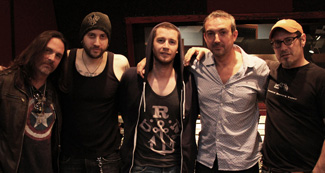
During sessions at Mission Sound (l-r): Jack Daley, Steve Wolf, Jay Picton, Mike Peden and Mission owner/engineer Oliver Straus.
Universal artist Jay Picton was in town from London, recording his debut release at Mission Sound in Williamsburg. Oliver Straus tracked an assortment of New York’s “A” team musicians for this album including Jack Daley, Steve Wolf, James Poyser of The Roots and Clifford Carter. Mike Peden produced.
And at The Buddy Project in Astoria, Julia Nunes tracked a new album with producer/engineer Zach McNees, Pipe Villaran (former lead singer of Los Fuckin Sombreros) recorded his debut solo EP with producer/engineer Kieran Kelly, and Nate Campany recorded some finishing touches for his solo album, with Kelly engineering.
Meanwhile at Vacation Island Recording in East Williamsburg, indie cult hero R. Stevie Moore “and some friends” recorded a song for a benefit compilation. Jorge Elbrecht from Violens produced the tracks and Matt Boynton engineered.
And, bouncing around, up at the Carriage House Studios in Stamford, CT, Johnny Winter has been working on a new record, his first studio album in 7 years. The record was tracked and mixed by engineer Brendan Muldowney on Carriage House’s SSL 4000 E series console and produced by Paul Nelson. Guest guitarists include Warren Haynes, Derek Trucks, Vince Gill, and Sonny Landreth.
Back in town, Avatar Studios has been hosting Ingrid Michaelson recording her upcoming album with producer David Kahne and engineer Roy Hendrickson; VHS or Beta mixing an upcoming release with Martin Brumbach engineering; Vince Giordano & The Nighthawks recording with Regina Spektor for HBO’s Boardwalk Empire, with Stewart Lerman producing/engineering; the Baby It’s You cast album recording with producer Richard Perry and engineer Frank Filipetti; and New York Yankee Nick Swisher recording a kids album with producer Loren Harriet and engineer Danny Bernini.
And as previously reported, Sear Sound hosted Sting composing and recording on the 1973 Steinway “D” grand piano, with Rob Mathes arranging and co-producing; Foreigner tracking with original frontman/producer Mick Jones co-producing, Jeff Pilson, Tom Gimble and Kelly Hansesn completing the band, and Wyn Davis of Total Access Recording engineering; and the Gipsy Kings working with engineer James Farber mixing to RMGI 1/2″ 900 tape using Sear Sound’s ATR 102. Bernard Paganotti produced and supervised the Gipsy Kings mixes from France.
Also previously reported, Manhattan Center Studios hosted the recording of a 52-piece orchestra for Tony Bennett’s Duets Album 2. The all-star team on the sessions included Producer Phil Ramone, Conductor and Orchestrator Jorge Calandrelli and Engineer Dae Bennett.
Renee Fleming was recorded singing live with a 69-piece orchestra in Manhattan Center’s Grand Ballroom and adjacent Studio 7, equipped with the 108-input Neve VR, for Steven Speilberg’s animated film Tintin.
Two video crews were present at the sessions, one for a polycom set up allowing Speilberg and composer John Williams to attend the session from LA. The second crew performed motion capture, which will allow the film’s animators to capture Fleming’s facial expressions exactly for her animated character. Todd Whitelock was the engineer on the session.
Back in Brooklyn — at Grand Street Recording — owner/producer/engineer Ken Rich has been working on new records with NYC singer Deborah Berg and Nashville singer-songwriter David Mead. And S-Curve artist Diane Birch spent a week at Grand Street with English producer Ant Whiting. The pair began production on her next record, with Tomek Miernowski engineering.
Miernowski also produced and engineered “Dress and Tie,” a single for singer/songwriter Charlene Kaye and Darren Criss of Glee. Ken Rich has also been working on The Compulsions’ newest project, with Hugh Pool co-producing. And actor/artist Michael Pitt mixed a live recording from Paris with Miernowski.
And we know there’s so much more going on out there! If you’d like to be featured in “Session Buzz,” please submit your studio news to submissions@sonicscoop.com.
In-Session: Bridges and Powerlines at The Buddy Project
May 12, 2010 by Janice Brown
/* Filed under NYC Spotlight */
ASTORIA, QUEENS: Over the winter, Brooklyn indie-rock band Bridges & Powerlines made their forthcoming record, Eve, with producer/engineer Kieran Kelly at his Astoria studio, The Buddy Project.

Bridges and Powerlines' (l-r) Peter Mucek, Andrew Wood, Keith Sigel and David Boyd
As fans of Bridges and Powerlines’ debut LP, Ghost Types, with its catchy-cool synth-pop meets indie-rock sound, we jumped at the opportunity to hear all about the making of their new album from Kelly and band bass player/vocalist Keith Sigel while getting the lay of the land at The Buddy Project.
This is the studio where Sufjan Stevens recorded most of his expansive orch-pop opus, Illinoise, a fact of recurring significance to Bridges and Powerlines as they worked through their ambitious recording plans after a year of writing and pre-production.
“The ghost of Illinoise is very palpable here,” says Sigel of The Buddy Project. Kelly adds, “Yeah, there’s something about knowing that the studio is capable of producing that record. It’s safe to say that it happened here once, it can happen again!”
Setting out to make a sprawling rock record of their own, Bridges and Powerlines had plans to build out their sound with varying degrees of orchestration, vocal harmonies and layers of sonic textures. The Buddy Project is not big, so the fact that Sufjan tracked so much of his massively orchestrated record here is not only a reassuring concept, it’s also quite an empowering one to a band on an indie budget.
“Every other day, we’d be like ‘what would Sufjan have done in this situation?”, says Siegel.
And with Kelly co-piloting, The Buddy Project became everything the band needed to produce what Siegel refers to as “the record I’ve been wanting to make my whole life.”
PRE-PRODUCTION, RECORDING & MORE RECORDING
After Bridges and Powerlines had spent several months demo’ing their new songs, they had a couple conditions in getting started with a producer. “We knew we wanted to have more time in the studio than we had on our last album,” says Sigel, “And we wanted a producer that could work with us in pre-production.”
Kelly built in the time to work with Bridges and Powerlines in their rehearsal space, advising on song structure and arrangements.
“He went over all our demos with us and was really active in pre-production — he blocked off about two months to make the record,” Sigel notes. “It was basically what every band wants and what every producer promises, but Kieran actually delivered.”
When it came time to start tracking, they utilized the studio right next door to The Buddy Project, Soundworks Recording, to cut basics to the studio’s 2” tape machine with engineer Kamilo Kratc. Soundworks, Kelly notes, will soon be directly tied into The Buddy Project and, vice-versa.
After tracking basics, the group thoroughly explored their musical and sonic options inside The Buddy Project. Renting and borrowing instruments (Sigel’s friend, ex-Cult bassist Stephen Harris, leant his Gretsch White Falcon among other guitars), hiring string and horns players and recording multiple tracks of near-everything, Bridges and Powerlines left no stone unturned in satisfying every sonic curiosity.
“At the beginning of the session, I promised myself that if there was an instrument we thought of for the record, we would have it,” says Sigel. “We decided we wanted timpanis and we found this great place, Carroll Music Instrument Rentals, all the way on the west side of Manhattan, that has an amazing inventory — every instrument you can imagine — and allows you to rent for 24 hours. We got two gigantic kettle timpanis, crash cymbals and chimes.”
Kelly adds, “Keith and I were very much of the mind to record everything we wanted, knowing that we’d pare it down later on. A couple of the songs are like 90 tracks.”

Band and crew! Kieran Kelly, second from left, and Soundworks owner/engineer Kamilo Kratc, third from left.
Accounting for some of that abundance are alternate tracks captured to a cassette tape deck, hand-held digital recorder and Fulltone Tube Tape Echo. “We tracked all the basics to 2” and simultaneously to a cassette deck so that we’d get one really dirty, warm, lo-fi track that we could potentially mix in,” says Sigel.
“It sounded really sweet, we loved it! But the cassette tape drifts; it runs at a different speed than the 2” and there were so many sync problems that ultimately made it too difficult to work with on drums. On grand piano, it was awesome — it gave us this super haunted piano sound that was amazing.
“We also tracked simultaneously to a little hand-held digital recorder because it had this bad-ass compressor on it and you could get that totally blown-out drum sound.”
String and horn sessions, led by Rob Moose (Antony and the Johnsons and Sufjan Stevens’ ensembles), were tracked at The Buddy Project, with singer/songwriter Will Stratton arranging a few of the songs and conducting. In “The Buddy Project” as collaborative studio concept, Stratton is one of the “buddies.” Kelly recently co-produced/mixed Stratton’s introspective folk record, No Wonder, and put it out through his record company, Stunning Models on Display.

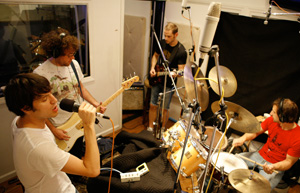
The Buddy Project live room
“Bringing in friends and talented people I’ve worked with is all part of The Buddy Project concept,” says Kelly. “Will is classically trained and wrote some of the arrangements, along with Andrew [Wood], Dave [Boyd] and Keith. When you’re working with high-level players like we were you need to have properly mapped out arrangements and you need to move through sections quickly, so it really helps to have someone conducting.”
The string quartet was “semi-close miked” and the room sound was captured off the upright piano, a unique Buddy Project room-miking technique. “I mic the piano — about 1/8” off the soundboard — and depress the sustain pedal (by jamming a drum stick or something in there),” Kelly reveals. “You run that into a really fast compressor, like an 1176, with a super-fast attack and release. And then, what you essentially have is a wood-plate; a plate reverb. And it gives you these crazy, blown out sounds.”
This room miking technique came in big on Bridges and Powerlines’ guitar and drum sounds captured in The Buddy Project live room, as well as on all the unconventional percussion, i.e. church-stomp sounds.

Bridges and Powerlines' lead singer/keyboardist Andrew Wood
“Another big technique we used was tracking all of the vocals through our Fulltone tape machine,” Sigel adds. “We would run a tape echo track that was not intended to be an echo or delay, and then line it right up with whatever we were tracking, and then mix that dirty, tapey sound in with the regular track. It does awesome things to vocals, gives them so much presence. These are the best sounding vocals we’ve ever gotten.”
As for backing vocals, Sigel mentions he tracked about half of them on his own, at home. “Kieran gave me the mic the Illinoise vocals were tracked on [Audio-Technica AT 4033] and the Manley ELOP compressor that Kanye West tracked all of College Dropout with and I went to town,” says Sigel. “I added all kinds of crazy tracks!”
This is not the first time Kelly has furnished his client with the means to record auxiliary tracks at home. His reasoning? “The records I work on are always co-producing arrangements. It’s not dictatorial; it’s not my record, it’s their record,” he explains. “ And I like everyone to be involved in the recording process. There are certain things that as a semi-literate engineer, I just would not do, whereas the artist will do these things that are so wrong that they end up adding a really nice flavor.”
As co-producer, Kelly kept Bridges and Powerlines focused but also let Sigel loose to add tracks to his heart’s content. Then it all went off to Scott Solter in North Carolina for mixing.
As fans of Solter’s work with Spoon and specifically John Vanderslice’s Cellar Door, they readily handed over their multitracks. “Cellar Door is one of my favorite sounding records, and we felt we could trust anyone who can make a record that sounds like that,” says Sigel, noting, “…Although our record sounds nothing like Cellar Door because it just has so much going on!”
Making use of another neighboring audio facility to The Buddy Project, the band went to Andreas Meyer for mastering. A mastering engineer formerly of Sony Studios, Meyer operates Meyer Media out of the same Astoria building.
THE BUDDY PROJECT SOUND
Bridges and Powerlines had 60s sounds in mind when producing Eve. “We were going for 60s, but not totally retro, more like ‘informed by…’” Sigel describes. “The Zombies’ Odyssey and Oracle was definitely a reference point. But we also really loved The National’s last record, Boxer. And another big influence was Animal Collective’s Merriweather Post Pavilion, but I wanted it to sound more analog than that.”
Wherever digital sources were used in the production, for example Reason’s Abbey Road keyboards, Kelly amped them and ran them through the Leslie or the tape machine, or one of the fuzz pedals the band brought in. Plus, The Buddy Project has a lot of hand-built and customized analog equipment used throughout the recording process.
“Almost all of the mic pre’s that I use on this record were hand-built by Jens Jungkurth, of Eisen Audio, which is based in Long Island City with Coral Sound and Exile Recording,” Kelly notes.
“Jens is a genius. He built 10 of my pre-amps and two EQs. He really works with you to give you the tonal character you’re looking for. He’s really young but I think that in 15 years people will be using his name like Rupert Neve.”
The custom analog gear is a big part of the Buddy Project recording philosophy. “Keith and I love classic records like Pet Sounds, Sgt. Pepper’s, Kind of Blue, Odyssey and Oracle, The Kinks records — and on all of those albums, there was a really high level of commitment to the technical side of things, as well as the creative side,” Kelly points out.
“Historically, records were made using custom-built gear, equipment that was built for the studio as opposed to something off the shelf. I think that’s really great and I’m trying to do that here as much as I can. So when you work here, you’re getting a sound that’s unique to The Buddy Project, unique to this time and place.”
Look out for Bridges and Powerlines new record this Fall and in the meantime, check them out at www.bridgesandpowerlines.com. For more information on The Buddy Project, visit www.thebuddyproject.com.
Midnight Youth, Angus and Julia Stone, Bridges and Powerlines At The Buddy Project
February 17, 2010 by Janice Brown
/* Filed under News */
The Buddy Project, a recording studio in Astoria, NY, recently hosted sessions with New Zealand’s Midnight Youth, winners of Vodafone’s ’09 “Best Rock Album.” Midnight Youth recorded at The Buddy Project with NYC-based producer/engineer Terence Dover.
And from Australia, brother-sister indie-folk duo Angus and Julia Stone (RCA/Nettwerk) tapped Buddy Project producer/engineer Kieran Kelly to mix their new record, Down The Way, which comes out March 30, 2010.
Kelly also tracked new music by Brooklyn-based drummer Matt Johnson (Jeff Buckley, Rufus Wainwright), Will Stratton‘s latest record, No Wonder, and produced/engineered the upcoming record by NYC indie-rock band, Bridges & Powerlines at The Buddy Project.
Other recent sessions include Brooklyn bands, La Strada, recording with producer/engineer Kyle “Slick” Johnson for for their debut LP on Earnest Jenning Record Co, and pow wow!
Records made at The Buddy Project include: Sufjan Stevens‘ Come on Feel the Illinoise, Essie Jain‘s The In Between, Elain LaChica‘s I Think I Can See The Ocean and The Spring Standards‘ No One Will Know.
Keep up with The Buddy Project on Twitter @thebuddyproject. And for studio and equipment details, visit: http://thebuddyproject.com/