Propellerhead Adds Wireless Sync-Start (WIST) to ReBirth for iPad and iPhone
September 4, 2011 by David Weiss
/* Filed under Deli Feed, Deli NYC Feed, News */
Propellerhead announced that is has released ReBirth 1.2 for the Apple iPad.
With Version 1.2, the Rebirth app adds WIST (Wireless Sync-Start Technology developed by Korg). WIST uses a Bluetooth signal to simultaneously start two compatible iPad or iPhone apps. The free update to current owners is available now from the iTunes AppStore.
With this development, ReBirth 1.2 users can perform with a friend or expand their iPad/iPhone ensemble by using two units at once, thereby expanding the ways they can create and perform music on their mobile devices. Mix and match ReBirth with TableTop, iMS20, iElectribe and other compatible apps in new dynamic ways. For more information on WIST, visit this handy link.
The 1.2 update and/or ReBirth for iPad is available here:
http://itunes.apple.com/us/app/rebirth-for-ipad/id401704148?ls=1&mt=8
And the 1.2 update or ReBirth for iPhone is here:
http://itunes.apple.com/us/app/rebirth/id368199125?ls=1&mt=8
Karma-Lab Releases Catalyst Volume 1 For The Korg Kronos
August 13, 2011 by David Weiss
/* Filed under Deli Feed, Deli NYC Feed, News */
Karma-Lab (based in Westfield, NJ) has released Catalyst Volume 1 – Creativity Xplosion!. The sound set provides 32 combis for the Kronos workstation from Korg.
For those unfamiliar with Karma-Lab, the company is a provider of software for music and sound creation. Since being founded in 1994, they have developed the KARMA features, software and sounds for a wide variety of Korg keyboards including the Korg Karma, Triton, OASYS, M3, M50 and Kronos, and its KARMA technology is covered by 11 US Patents.
Catalyst Volume 1 is $32, and includes grooves, backing tracks and sonic textures in a wide variety of styles, ranging from a mixture of Hip-Hop, Dance, Electronica, Trance & Techno categories to Ambient, Jazz, New-Age, Film Score, and World/Ethnic categories.
Each Catalyst Volume 1 combi is composed of four complete KARMA Modules and eight fully-voiced scenes for maximum variability, featuring extensive control via the KARMA Realtime Controls (8 sliders, 8 switches) and the other controllers (joystick, ribbon, vector joystick, 8 RT sliders/knobs, and 2 switches over joystick). In addition, the Kronos’s Drum Track has been programmed to add an additional complimentary percussion or drum element in every combi.
Programmed by Eric. J. Sawyer and Korg KARMA developer Stephen Kay, the set represents hundreds of hours of work. Catalyst includes a 71-page User’s Guide that provides meticulous documentation on each combi in addition to hundreds of tips and tricks on how to get the most out of each Performance.
Find out more at Karma-Lab’s Catalyst page, including video demos, audio demos, full combi list, and a freely downloadable User’s Guide.
Korg Unveils Monotribe Analog Ribbon Station, Wavedrum Mini
April 7, 2011 by Janice Brown
/* Filed under News */
At MusikMesse this week, Korg launched the new Monotribe Analog Ribbon Station, which incorporates analog synthesis, three-part discrete analog rhythm section (bass drum, snare, and hi-hat) and Korg’s Electribe-style pattern sequencing in one battery-powered unit. Analog Synth + Analog Rhythm + Step Sequencer = Analog Electribe.
Korg’s Electribe step-key interface provides a dedicated button for each of eight steps, allowing real-time, hands-on step editing of drum parts, as well as any synth part sequence played on the ribbon keyboard. Active Step editing lets users remove or re-insert individual steps, creating short loop-like effects or off-beat patterns that weave in and out of complex rhythms. Flux Mode allows the creation of sequenced synth parts that are not rigidly tied to the step grid.
The ribbon controller keyboard on the Monotribe provides three selectable playing modes/ranges. The chromatic mode (KEY) is ideal for playing melodies and bass lines, with the ribbon keyboard stepping from note to note. Users can switch to the continuous mode (NARROW) for smooth gliding between notes, just as on the monotron.
Also available is the wide continuous mode (WIDE) with a six-fold pitch range for more dramatic sweeping effects. In addition, pressing the Gate Time button will allow the gate time to be sequenced as the ribbon controller keyboard is played.
The Monotribe uses classic analog components, including the same VCF (Voltage Controlled Filter) circuit found on Korg’s MS-10 and MS-20 analog semi-patchable synthesizers. Using the audio input, any audio source can be enhanced by passing through the filter section. The Oscillator (VCO) offers a choice between sawtooth, triangle and square wave. White noise can be mixed in to the oscillator signal in any amount.
The Octave selector covers a broad range, from deep bass to piercing lead-lines. The EG (Envelope Generator) offers three presets shapes. The LFO (Low Frequency Oscillator) can be sent to the VCO and/or the VCF, creating dynamic effects. The Range switch selects Slow or Fast modulation ranges. Switching the LFO Mode to the 1-shot setting allows the LFO behave as a second envelope generator.
Korg also notes that “unlike analog synthesizers of yesteryear, which were prone to drift in pitch, the monotribe’s auto-tuning circuitry provides stable chromatic playability to keep it in tune. No warm-up time, no sensitivity to temperature changes – just the great sound of analog VCO.”
The Monotron will be available early Summer 2011 with pricing to be announced shortly. For more information, please visit www.korg.com.
Korg also debuted the new Wavedrum Mini, based on their Wavedrum series technology.
The Wavedrum Mini provides a playable pad, speaker, sounds, effects, patterns and a loop recorder, as well as a Sensor Clip to transform any object into a second sound source.
Wavedrum Mini offers 100 ready-to-play sounds, including acoustic emulating drum and percussion to modern synth sounds, to bass, tuned percussion and stringed instruments.
Additional sounds can be accessed at the same time by attaching the Sensor Clip to a table top, cup, a user’s foot or any object, transforming the object into a percussion instrument. In addition, 10 multi-effects are available, from spatial-type effects (delay, chorus, and reverb), modern effects including filters and pitch-shifters, and distortion-type effects that deliver analog-style warmth.
The Wavedrum Mini is highly portable and ready to go — it comes with an AC adapter and can also run on batteries, and has a built-in speaker and a headphone output. It will be available Summer 2011 with pricing to be announced shortly. For more information, please visit www.korg.com.
Korg Launches Kaoss Pad Quad Dynamic Effects Processor
March 26, 2011 by David Weiss
/* Filed under News */
Korg announced that it has begun shipping the new Kaoss Pad Quad (MSRP: $350), which employs new effects, functions and features that let users create their own combination of Kaoss effects with simultaneous control of up to four effects in real-time using a single fingertip on its touchpad. Any audio source can be processed: an MP3 player, a mixing board, an instrument or even vocals via the unit’s mic input.
As users tap, slide or move their finger across the X-Y touchpad interface, the effect parameters will change, producing dramatic real-time transformations in the sound. The colorful LED touchpad illuminates in an intense variety of colors, which change depending on the state of the effects, the BPM setting and hand motions on the touchpad.
Designed to be both usable and highly playable as an effect processor, the Kaoss Pad Quad allows the user to simultaneously control up to four effects from the touchpad. Each of the four effect modules – Looper, Modulation, Filter and Delay/Reverb – contains five options (plus a module kill), for a total of 1,295 combinations.
Effects are chosen directly from the front panel for easy access during live performance. By rhythmically adding successive effects, or switching effects on and off as a song progresses, the Kaoss Pad Quad can add variation and development to the structure of any song.
Another feature is the Freeze button, which offers additional versatile control of effects. For each of the four effect modules, Freeze memorizes the position at which the user was last touching the touchpad, effectively “freezing” the state that effect was last in, even after release of the finger. By touching the touchpad again while Freeze is enabled, only the “unfrozen” effects will be controlled.
In addition to more traditional effects (flanger, low/high-pass filter, delay and reverb), the Kaoss Pad Quad offers many new types of effects:
Multi-Mode Looper for looping a part of a song; the number of beats is controlled by the location touched. Three types of looping are provided: the standard Looper, the Rev Looper (Reverse Looper which plays the looped phrase backward) and the Loop Slicer, which divides the phrase and lets the loop-play only a specific portion. Additionally, users can switch between the different looper types by sliding their finger up and down the touchpad as the loop plays, producing new beats.
Vinyl Break turntable effects, which allow users to create all the standard turntable rotation effects, including scratching, slow-down/speed up, stop and more.
Ducking Comp, creating effects of a “ducking compressor,” which has become a staple in music production.
Additionally, the proprietary Auto BPM engine automatically detects the tempo/BPM of the song that’s playing or the audio source. Users can also use the BPM knob to make fine adjustments. Alternatively, the BPM can be set manually using the Tap Tempo function.
Korg Unveils New Kaoss Pad Quad, Kronos & Limited-Edition Wavedrum Oriental
January 18, 2011 by Janice Brown
/* Filed under News */
Among new products introduced at Winter NAMM last week was Korg’s new Kaoss Pad Quad, which employs new effects, functions and features that let users create their own combination of Kaoss effects with simultaneous control of up to four effects in real-time.
Each of the four effect modules – Looper, Modulation, Filter and Delay/Reverb – contains five options (plus a module kill), for a total of 1,295 combinations.
Users tap, slide or move their finger across the Kaoss Pad Quad’s X-Y touchpad interface, the effects parameters will change, producing real-time transformations in the sound. Any audio source can be processed, including an MP3 player, a mixing board, an instrument or vocals (for example) via the unit’s mic input.
In addition to more traditional effects (flanger, low/high-pass filter, delay and reverb), the Kaoss Pad Quad offers many new types of effects, including Multi-Mode Looper for looping a part of a song; the number of beats is controlled by the location touched, Vinyl Break turntable effects, which allow users to create all the standard turntable rotation effects, Ducking Comp, creating effects of a “ducking compressor,” and more.
The Korg Kaoss Pad Quad Dynamic Effects Processor will be available in February 2011 at an MSRP of $350. For more information, visit www.korg.com.
Korg also announced its new Wavedrum Oriental Dynamic Percussion Synthesizer, a limited edition version of Korg’s Wavedrum designed specifically for Middle Eastern music.
Featuring more programs than the original Wavedrum, the Wavedrum Oriental (and in this instance “Oriental” denotes Middle Eastern rather than Far Eastern) offers new, specialized algorithms and samples designed for the percussionist seeking the very highest quality Middle Eastern percussion sounds.
Find out more about the Wavedrum Oriental (available now, at an MSRP of $980) at www.korg.com.
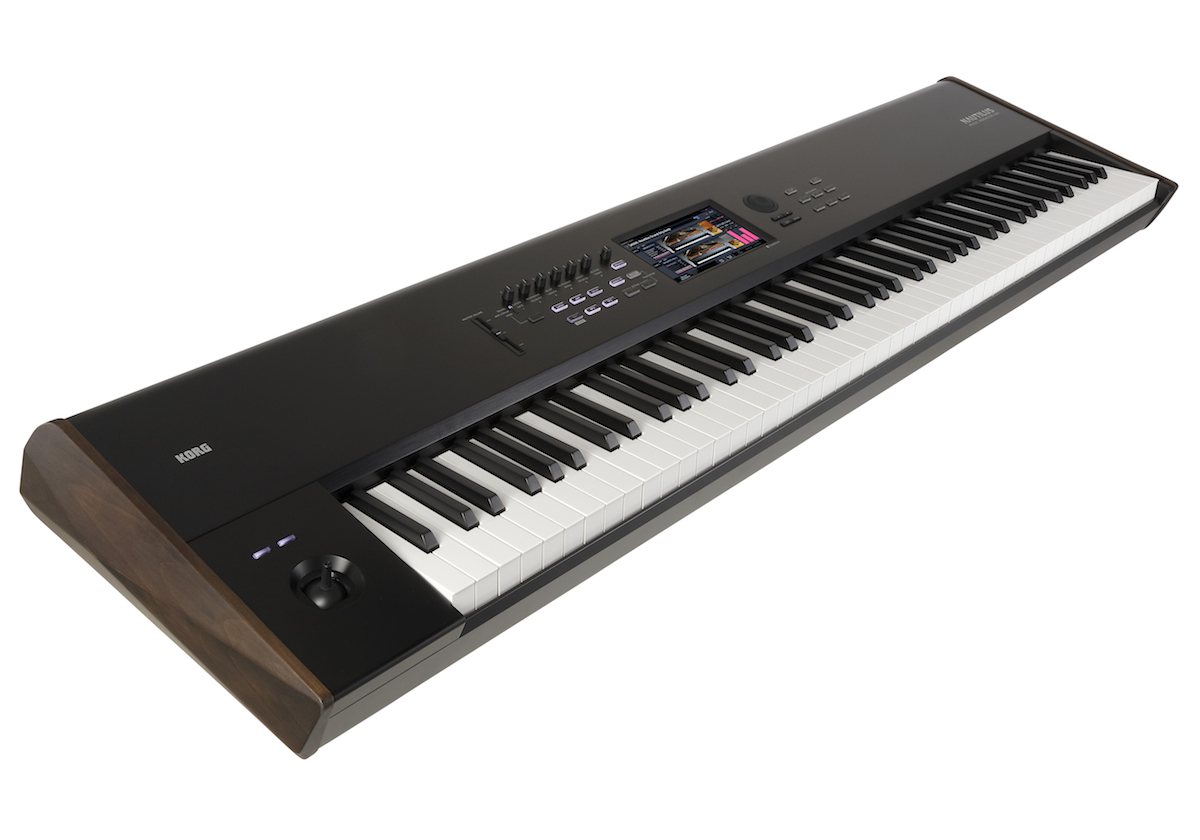
And Korg also introduced its new flagship keyboard, the Kronos Music Workstation, which unites nine distinct sound engines plus new supporting technologies to provide a “versatile, yet fully integrated instrument.
The Nine Sound Engines include:
• SGX-1 Premium Piano: VMT (Virtual Memory Technology) Piano sound engine
• EP-1 MDS Electric Piano: Multi-Dimensional Synthesis Electric piano sound engine
• CX-3 Tonewheel Organ: Tonewheel organ modeling sound engine
• HD-1 High Definition Synthesizer: Flagship PCM, sampling and Wave Sequencing sound engine
• AL-1 Analog Synthesizer: High-fidelity analog modeling sound engine
• MS-20EX Legacy Analog Collection: Analog modeling sound engine
• PolysixEX Legacy Analog Collection: Analog modeling sound engine
• MOD-7 Waveshaping VPM Synthesizer: VPM, Waveshaping, and PCM processing sound engine
• STR-1 Plucked String Synthesizer: Physical modeling sound engine
New technologies added to support these engines include Korg’s VMT (Virtual Memory Technology), allowing Kronos to take advantage of huge piano, drum, and tape-based keyboard libraries. These long, un-looped samples play back directly from the internal SSD (Solid State Drive), without needing to be loaded into RAM.
For more information on the Kronos, which will be available in March, please visit www.korg.com/kronos.
How to Make a Best-Selling iPhone and iPad App: Jordan Rudess & the Creation of MorphWiz
December 21, 2010 by David Weiss
/* Filed under Music Biz */
MIDTOWN, MANHATTAN: As if becoming a master of your craft weren’t challenging enough, now in the world of apps we must invent entirely new crafts to master.
Not surprisingly, Jordan Rudess, virtuoso mad-science keyboardist of cornerstone NY prog-rockers Dream Theater, is always up for just such a task. To that end, he’s created an ongoing series of music/media apps for the iPhone and iPad, each one more successful than the last.
With his latest effort, the mind-bending MorphWiz, he’s set a standard he may meet but never beat – it was a #1 seller on iTunes and has taken in a load of awards since then, including Billboard’s “Best Music Creation App”. Inspired by Rudess’ experience with helping to design the Haken Continuum Fingerboard MIDI instrument, MorphWiz ($9.99) is a vertical-grid-based musical instrument that allows a great deal of expressive control with real-time, highly organic, animated visual feedback.
As creative and intuitive as it is to use, however, pulling MorphWiz together was an arduous task – as the construction of most quality apps are. In this interview, Rudess took the time to break down the A-Z of how an app is born, from inspiration to conception, partnership to programming, marketing plan to a place on the iTunes store. To learn how to get your own iPhone/iPad app together, just read on.
What first got you thinking about creating iPhone apps?
Well, the light really came on as soon I realized that music was possible on the iPhone. It was one of the original piano apps I saw a couple of years ago that sparked my imagination – I just touched a key on the iPhone, it made a sound and I thought, “This is cool.”
From there, what made you go from enjoying other people’s iPhone apps to thinking you needed to create one of your own?
The iPhone world is something that exploded rather quickly, and when it became clear that you could do creative things with it, a lot started happening. I was very much on top of all the developments, I started to realize the full potential of the device and it got my mind somewhat soaring.
I started to think of a lot of creative ideas, and I reached out to some of the people doing the coolest things in the iPhone world. One company was Amidio, based in Moscow, so I reached out to them and they were interested in working with me. Funny enough, I had a trip to Russia planned with Dream Theater, so I met with their programmer Toyo Bunko, and he and I made plans to release an app which ended up being called JR Hexatone.
JR Hexatone is an app that was really a sound-sequencing app, which lent itself very much towards the whole electronica/glitchy type of movement. That came out in 2009, and was really the beginning of apps that had my name associated with it.
From there, one of the popular apps that I worked on is Bebot, which is a vertical controller in some ways similar to MorphWiz where the note is spread across the screen in vertical lines. That kind of control is something I’ve been interested in for quite a long time, and also because of my Continuum designed by Lippold Haken.
Somewhere along the line I discovered an app that was called 4D Synth, and that inspired me too. I wrote a letter to the guy who programmed it, Kevin Chartier, that started a conversation, and we decided we wanted to work together to write a brand new app that really demonstrated my vision.
Sounds like it pays to keep your eyes open, and find people who have a track record. After you connected with Kevin, what guided you to the exact type of app you would produce first?
A primary thing about MorphWiz was that it would have this kind of Bebot/Continuum note grid and vertical line control design, where each line had the ability to have some expression on them. But beyond that I wanted to have an instrument that was a combination of visual and audio. It’s been my desire to bring together the world of audio and video as one. I think they are one, and this app technology allows us to have as little separation as possible.
Kevin and I worked very hard on merging these two worlds, and we came up with MorphWiz. The idea was, “How could we morph from one sound to another, and also morph from one image to another, and have them really correspond?” The basic waveforms of MorphWiz are sine, triangle, sawtooth and square, so we gave each waveform a visual image, then experimented with how we would not only morph audio but the visuals. So when you put your hand on the playing surface of MorphWiz, you can have the waveforms morph from one to another and at the same time get a visual representation of what they’re doing.
Although MorphWiz only shows you a visual representation of the last note you hit, sonically it’s morphing every note you play independently. That’s the very deep foundation of the program – too deep for most people to even realize what’s happening. On a traditional synth, for example, if you’re bending one note, you’re going to bend them all. But with MorphWiz the idea is that every note is an independent voice and each note can be expressed on its own, in that you could play three notes, bend one and not the other, bend one up and the other down…things like that in real time.
Sounds like it helps to be ambidextrous!
Sure. You can play two notes at the same time, bending one in with one finger, and bending the other while the first is fading out.
So once you have an app concept, what kind of team and resources are actually needed to design it and test it?
That’s a good question. My company is very, very small – it basically stared out as two people. One of us is a professional programmer/musician/music lover, and the other is a professional musician — that’s me – who’s very interested in technology, controllers, and different ways to make sound and visuals. We’ve found ours is a great combination to bring apps to the world because we can successfully conceive of them, make them and then market them.
In MorphWiz’s case, I have a musical career and people know me as someone who plays a lot of interesting sound-controlling devices. That along with my other complementary careers presenting technology, educating – all of that combined with Kevin’s immense programming skills make this work.
But there’s a lot of ways people can make this work. A lot of companies have people that they can assign the tasks more easily among them so that one person does coding, the other does marketing, and the does the demo, etc… Our organization is very small, but between us we have the parameters that we need.
As far as funding is concerned, in a lot of companies someone will come up with an app, and then need money to hire a programmer from the outside to make it happen. In our case, it was a work of passion: This was something we wanted to do, and make this vision happen. Kevin has a full-time job working for the government, and every spare minute he’d program. I have my full time job working with Dream Theater as a musician, and in my spare time I’d be talking with Kevin, conceptualizing, testing, playing it, and after it’s out calling the media for interviews and going to conventions.
The reason we didn’t need any funding in the beginning was that we were almost possessed with the joy of what we were creating. So either this thing will proceed to the next level and we’ll keep having fun with it, or we’ll get funding and it will expand that way.
Can you give us a deeper look at the workflow between creative and programming – or you and Kevin, in this case?
I generally have a fairly strong vision of what I want, and as soon as I present something to Kevin, he’s generally right there with me. Kevin is not just a programmer – he loves music and graphics, and we’d have a great time online when we’d pick the visuals to represent the waveforms. We’d look at something and say, “Maybe those colors aren’t rich enough. Can you make it a little more angular? A little more opaque?” Once there’s something on the screen to look at, then we can make changes from there.
After that, how is an app actually brought to market/onto the iTunes store?
From my experience, it seemed very complicated putting things into the store. We had to make these special builds, type in a lot of information, get very accurate descriptions together, put up special graphics, make a Website, put it up on Facebook, and make sure all the bases are covered.
It’s not that easy. Apple requires you to have a full support system in place – you even need to make a video. There’s a lot of required elements that go into making the app. It takes a lot of patience. MorphWiz from start to finish was about a nine-month ordeal.
Don’t try to market your app without the assistance of YouTube!
Apparently it was worth it: Morphwhiz went to #1 on the iTunes store within a few days of its release. What do you think allowed you to attain such quick success?
Well, two things, one of which is that I think it’s a really together app. It’s an app that’s very fun for young people to play because it looks really colorful and it’s playful. There’s a lot of different patches, they all look different, and it’s a really good time. But even for a pro musician, it offers some very unique features that you just don’t find on any other instrument. So we had an app that captured all ages, all different levels, and different interests in music.
Of course, it can happen that the product is amazing and no one even knows about it. But we were very aggressive about making sure the world knew about it, contacting all the music press, putting it up onstage with Dream Theater, talking about it in every interview. It all keeps things in motion.
Six months later after MorphWiz came out, what would you identify as the challenges and rewards of creating an app? What’s easy about it, and what’s proven tougher than you expected?
There’s a lot of upkeep. If you want your app to continue to be successful, then you have to work it. I go to shows like the San Francisco MusicTech Summit, before that I was at the San Francisco App Show, and prior to that I was at the Billboard Awards where it was voted the #1 Music Creation App. I play it whenever I can in public, and I just think it’s the kind of app that can be around for a long time.
We get to upgrade it as well, and we have some cool upgrade paths for MorphWiz to go down. Just to make sure it remains vital is a big job. That’s maybe the tough part – to keep the business running and not lose the momentum.
The rewarding part is that once you do all the work, get it submitted, it’s good, and people know about it, then people buy it and enjoy it. That part’s cool.
That sounds very cool! So in short, what advice would you give to people reading this who may be thinking about their first app?
Good luck! (laughs) If it’s a music app then you have to make sure that it’s going to really sound good. I tell people, “Make sure it sounds good and looks good, even if it’s really simple.” It’s fine if it can only do one thing, but it has to be quality. If its buggy that would be a problem, but if it does what it says it does, and is entertaining/fun/useful, that’s all you need.
I would also say that there’s two level of apps, in the sense you can make something very deep, complex and powerful, or you can make something that’s very straight-ahead, and that’s OK as well. A good example of how one thing can lead to another is my newest app, SketchWiz. It’s not a music app, but it’s something that stemmed out of developing MorphWiz – it’s caught on and become a big thing in the photography area.
Ready for a Scoop? We have an app that we’re releasing at NAMM called MorphWiz MIDI. It’s a MorphWiz engine that can run any MIDI synth.
That’s juicy! Listening, everybody? Shifting gears, do you think NYC is a particularly good breeding ground for app developers, in your opinion?
Well, I don’t know. I’m from NYC, but my partner’s from Florida. I know that there’s a lot of very creative people in NYC, and programmers from NYU with a great technology education. NYC has always been a hub of creativity and technology, as well, just like San Francisco or L.A.
I’m watching the world come into the whole app thing, like Korg, which is doing some stuff now that’s kind of cool. I’m just very aware of these bigger organizations that are trying to play this game, like ReBirth coming out for the iPhone and iPad. It’s about to become a whole different animal where big companies take over. But at the same time, you have a lot of seeds coming out of New York.
On the other hand, you’ve teamed up with programmers from Moscow to Florida. When it comes to the app world, it seems like it doesn’t matter where anybody is located, as long everyone’s on the same page.
Absolutely, I didn’t even meet Kevin in person until we were six months into the project. We did everything over Skype, phone, and email. It all worked out, and we met after we submitted the app — it’s a new world out there.
– David Weiss
Korg Offers Downloadable Versions of Legacy Collection Synths
November 18, 2010 by Janice Brown
/* Filed under News */
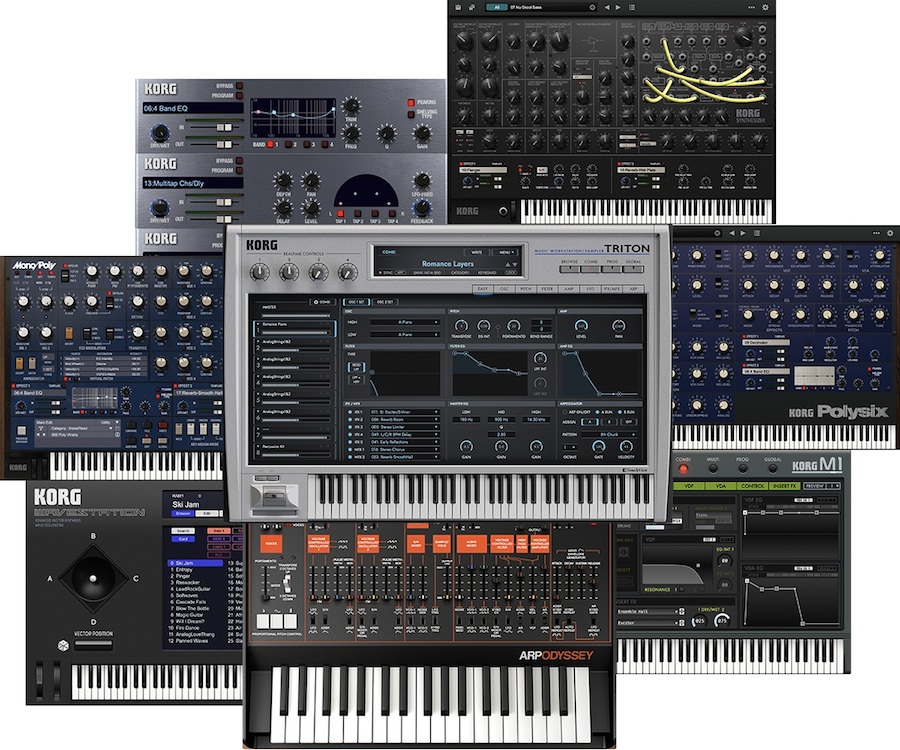
Starting in 2004, Korg introduced software creations of their most coveted synthesizers, as various titles of their Legacy Collection series. Now, each of those titles is available as a separate download at a considerable savings.
Each soft synth utilizes Korg’s proprietary CMT (Component Modeling Technology) to reproduce the sound and response of the original. CMT also reproduces the character and response curve of each parameter, for results that are faithful to the original model.
Now available for download are software recreations of the following classic Korg synths:
M1 Music Workstation – www.korg.com/LegacyM1
Mono/Poly – www.korg.com/LegacyMonoPoly
Wavestation – www.korg.com/LegacyWAVESTATION
Polysix – www.korg.com/LegacyPolysix
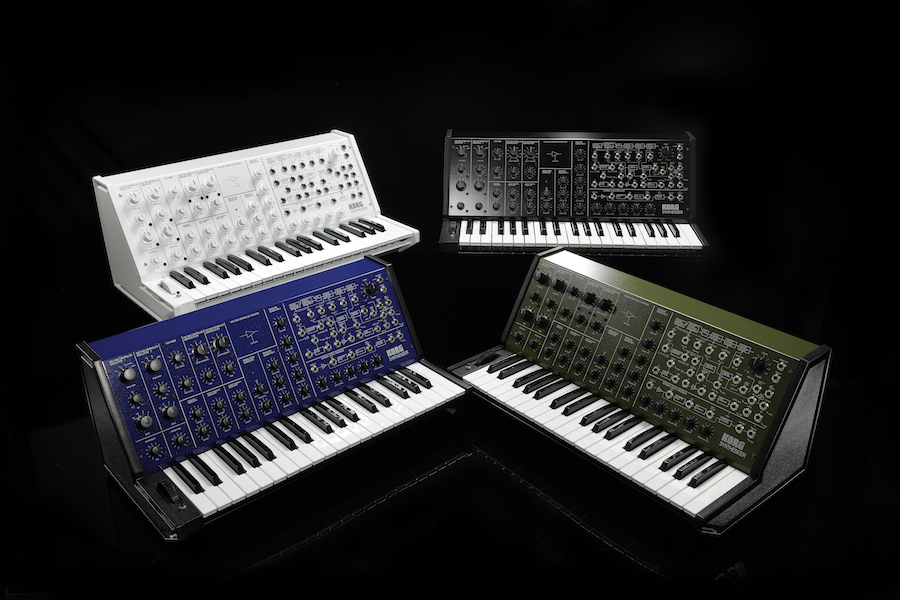
MS-20 – www.korg.com/LegacyMS20
Also available for download is the MDE-X Effects Suite. Originally part of the first Korg Legacy Collection, this suite provides 19 high-quality effects derived from Korg’s digital recorders, workstations and synthesizers, and is designed to run as a stand-alone program or as a VST, AU or RTAS Plug-in, for use with nearly any DAW.
As a bonus, a free Legacy Cell download is also available for those who purchase both the MS-20 and Polysix, along with the MDE-X Effects Suite. Legacy Cell enables combinations of the MS-20 and Polysix synthesizers to be blended with two insert effects and two master effects, and used as a single software synthesizer that provides new sounds and textures.
All synths operate as stand-alone or VST/AU/RTAS plug-in instruments and are Mac and Windows compatible. Users can pick one, grab all their favorites, or download the entire collection at a special price. Free trial downloads and details can be found at www.korg.com. All downloads are available for purchase at www.korguser.net.
Shane Stoneback: Music Production Career Construction with Sleigh Bells, Magic Kids & Vampire Weekend
September 16, 2010 by David Weiss
/* Filed under NYC Spotlight */
DUMBO, BROOKLYN/CHELSEA, MANHATTAN: Shane Stoneback would be the first person to tell you that he’s a lucky son-of-a-gun. Sure this fast-emerging producer/engineer has sharp ears, sharper instincts and a marvelously open mind, but he’s also got an undeniable knack for being in the right place at just the right time.
A quick scan of his expanding discography bears that out, with some of the timeliest artists tapping him to bring new sounds, classic styles, and hybrid approaches to their projects. Vampire Weekend, the arresting joy-noise of Sleigh Bells, updated old-skool of Magic Kids, and mystery-soaked Brooklyn duo Cults, are all his latest clients, and that’s just for starters.
To handle the heavy metal, undefinable psychedelia, and everything in between, Stoneback’s dual NYC studios are seeing an enviable level of action. He often gets things started in the raw DUMBO zone he calls Treefort Studios, then crosses the river to finish at SMT Studios in Manhattan, the SSL 4000 G+/Augspurger-endowed mushroom wood dream room he shares with engineer Brian Herman.
Able to make the most out of every opportunity that comes his way, Stoneback has gone a good distance since his formative years as a tech at Battery Studios and in the machine room of audio post HQ Sound One. Settled comfy comfy behind his big board at SMT, Stoneback caught us up on his latest adventures.
You did some recording recently with Magic Kids, we hear.
Right. I went to MemphisW for about a month to a studio owned by Doug Easley. He’s worked with Cat Power, Sonic Youth, and a bunch other great groups. Previously he had a beautiful, old-school studio with three-story-high live rooms, like at Abbey Road. It was famous, but it burned down four years ago.
Now he’s set up shop in an old insurance sales office. It’s a decent studio, but he has a Neotek board that’s like a Salvador Dali painting, because the knobs are kind of melted. We did all the principal tracking there – guitar, bass, drums – and hired this whole cast of local musicians. The talent pool in Memphis is pretty amazing, and Magic Kids is a big band with a lot of members – their network is pretty extensive, and they’re only two calls away from any instrument you can think of.
Magic Kids’ keyboardist/producer Will McElroy has these elaborate, intensive arrangements in his head. In the 1970’s you would have spent six months making this record, and we spent two months. I ended up getting really sick because I spent so much time making it. I didn’t get a lot of sleep in those two months.
They’ve definitely got a style that stands out – how would you describe their sound?
There’s nine people in this band. The Magic Kids have classic songwriting sensibilities, but with modern tools used in their creation, like lots of big 808s.
That new song you produced with them, “Cry with me Baby”, has some old skool elements, but it also doesn’t sound 100% retro…
Sounding retro was a big fear. When I start with a band, if I can I spend time with them a little bit, at a rehearsal or wherever, and talk about music, or I see what’s on their iPod when they’re not looking. These guys were listening to house music when I met them, which I thought was so odd, but it kept it from being a throwback record.
They didn’t want to make a cutesy throwback record – they avoided that at every turn. Some of the songs are super epic, on a level with Electric Light Orchestra songs. Anyway, the record is coming out in August, and you better get your roller skates on for it!
OK! Or can we just hop on our bike? In the meantime back here in NYC, you’re running not one but two facilities. Let’s take it from the top with Treefort Studios in DUMBO.
Treefort is one of those loft locker spaces. I got it three years ago for a writing room and I started to build it out when one of the kids from Vampire Weekend came in. I wasn’t done with construction, but they came out and started doing drum overdubs, and I started a good relationship with those guys.
The room is great, it’s a raw inspiring environment with books, chotchkes…people seem amused out there, but it is roughing it. I don’t have proper air conditioning, and the last few days have been brutal. But then again, Treefort is a much bigger room. There’s a lot of bands in particular I work with that want to lay down core live takes with three or four band members. They’ve been touring and they have it all locked together. You also have much more options for mic placement there. Plus I have tube organs, weird keyboards, and the room is cheaper because there’s a lot lower overhead.
We couldn’t help but notice the SSL 4000 G+ here at SMT Studios in Manhattan. Why keep it separated, instead of having everything together in Treefort?
We could never build this room in that place for a bunch of different reasons. The zoning would be difficult, and I’m not sure how long that building will last because of housing development in the area. The Treefort is awesome, but it’s collapsible. I could tear it down, put it up somewhere else, and it would be the same.
So now the package is we could have a band record at Treefort, do all the overdubs, and then mix it here in a room that’s acoustically tight with a great board. Every record we’ve mixed here has, in my opinion, been my best record. I just keep on thinking it gets better in this room.
Looking around, it certainly seems like you’ve put together what would be considered a dream facility for a lot of producer/engineers today.
This room is awesome. There’s two reasons we selected this configuration. Previously we had a baby Oxford and a pair of Tannoys that are now at Treefort. At the same time, there was a series of studios closing in the city that had an SSL G and Augspurgers, and that was how all the pop hit records were being recorded. Chung King had one, Battery had one, and there’s clearly been a vacuum for that. If they’re all closing down, then clearly there’s not a line around the block for that flavor, but if they all close down, then there’s still room for one.
Brian and I both worked at Battery, and this was the combination of console and speakers that we worked on every day. Plus, I love this board and the EQ on it – you can get rough with it and it sounds really cool. Or you can do nothing, just push the faders up, and it glues everything together better than it would in your workstation. Also, to get a Neve console of the same size would have been an enormous amount of money and this console, aside from cleaning, was in pretty good shape. I think it was in Usher’s house, so it wasn’t getting abused in a commercial facility.
People need studios. Whether they need me or some other engineer, they definitely need these environments where they can come in and have all the tools. Sitting in your bedroom, making a record, you can do that once, and it sounds awesome. But every band I’ve worked with this year – Cults is a good example – love what they’ve done in Garageband. But then they want to make it bigger.
(Take a video tour of SMT Studios hosted by Shane Himself right here)
With the different things that you’re doing, do you consider yourself to be a producer, engineer or a mixer?
I’ve been thinking about this a lot lately. I feel like we’ve all become facilitators more than anything. No two things come in the door with the same ratio of requirements – some people come in with great music and no idea of how they want it to sound and they want you to hold their hand through it. Others come in with it all ready to go, and they just want you to hit “record”. In any event, the line in the sand between producer and engineer has become very difficult to distinguish.
On the facilitator tip, I hear Derek E. Miller of Sleigh Bells is like an engineer…
The way that we met, xl recordings booked a couple of weeks at Treefort for M.I.A., so she could have some time to write and experiment. She was going to meet with a variety of people, but I believe she heard about Derek through Spike Jonze, so how awesome for him, to get cold-called from M.I.A. one day to make a song. I didn’t know who he was – he could have been Danger Mouse or this huge producer, and I could have been Steve Lillywhite for all he knew – we were both nervous around each other for a while.
We had some time to kill, and he started talking to me about compressors and the best settings for a female vocalist. Then he started playing me the Sleigh Bells record [which would become Treats, released May 11, 2010], and I immediately loved it. I said, “Put this out right now!” He said he’d be willing to go into the studio and work on it.
Some people would have stopped him from doing what he was willing to do, like going into the red digitally. That’s “wrong”, but what he and I discovered is that initially it sounds like crap, but if you go into the red further it starts to sound better. You can crank the EQ, sweep the frequencies, and make it start screaming like a guitar distortion pedal. I started to listen to Garageband, Logic and Pro Tools overloaded, they all sounded different, and we used those like tools to get the aesthetic for that. Derek has these specific things that I don’t think anyone has brought to the table as benchmarks – I think he really did want to hurt his ears at those frequencies like 4k! Like that French electronic group Justice, the way it’s filtered it hurts when it’s turned up loud, but it still sounds really cool.
Sounds like a good schooling. What were some other surprises that came up working with Derek on the Sleigh Bells record?
He was working with these vintage drum machines from the early ‘90’s, but he hated using the rock kit on the Korg or Alesis drum machines. They didn’t sound good until we rammed the fader all the way up and just knocked every frequency up as loud as every other.
We tried a lot of guitar amps, and we settled on this Korg Toneworks which is like something for a tour bus. It sounds like crap in the best possible way. Because of the circuitry, it shaves off all these frequencies so it sits in the mix right away – you could triple or quadruple the track and it doesn’t sound muddy. It sounds like the synthesizer you wish you had!
With that record, you couldn’t really do wrong. It was like going off the deep end into some uncharted territory. I liken it to the first time someone cranked a guitar amp and someone said, “You can’t do that!” and you say, “Just give me five minutes and you’ll see what I can do.” Hopefully I won’t get asked to make a record like that again, because I wouldn’t want to repeat it. But I do pull elements from it.
On a parallel tip to all this experimentation, you told us that you’re seeing a return to a more pro studio approach in recording – what do you mean by that?
There’s definitely a slew of records coming out where people are making rock albums that don’t sound bedroomy to me. Yes, there’s a good vocal sound you can get in your bedroom because you’re recording while your roommate’s sleeping, and it’s very intimate. But there’s something about a really well-recorded vocal where people scream, go off, and get the emotion out. You don’t hear the recording, you just hear the artist, you know? I feel like that will come back.
It doesn’t have to be slick with long reverbs and all that. The Raconteurs record (Consolers of the Lonely), that sounds great. The Them Crooked Vultures record, that sounds huge: it’s really thick and sounds good quiet, but it also sounds good in here cranked up loud.
You’re getting more and more credits on projects that producers would want to get the call on – Vampire Weekend, Magic Kids, the Sleigh Bells record — why is your stock going up right now?
Part of it is luck. So I’ve been in the right place at the right time a lot. That said I can still tell I get better at this each day. It was serendipitous that I met Vampire Weekend, and the initial job that I did for them was not exclusive knowledge – anybody could have done it. But I worked up a good working relationship. I was an assistant engineer in studios for years, so I got good at the boring parts: taking notes and backing stuff up. I’m a great Pro Tools editor, and a lot of people don’t want to deal with that. People will keep you around for that.
On the second Vampire Weekend record (Contra), I hammered home the facilitator thing. Rostam (Batmanglij) is a great keyboard player, a great arranger, and picked up the basics of engineering pretty quickly, but he still needed a facilitator to handle things on a day-to-day basis. We rented a marimba that was bigger than this table! We set it up, mic’d it and recorded it. Even if I had never done it before, I’d pretend I’d done it ten times.
– Interview by Janice Brown and David Weiss
Avatar Opens New Studio W
August 23, 2010 by David Weiss
/* Filed under NYC Spotlight */
HELL’S KITCHEN, MANHATTAN: Avatar Studios announced that it has opened Studio W, a new 160 sq. ft. Pro Tools/Logic writing room. Acoustically designed by renowned Avatar engineer/mixer/producer Roy Hendrickson (Avatar Studio E, Studio G), the second floor studio was launched to provide an inexpensive but functional room for songwriters/artists to work out song ideas.
Studio W gives users access to the long list of vintage analog gear available at Avatar, and is also equipped with an adjacent vocal booth to make writing, pre-production and vocal overdubs all possible.
“Technically, Studio W has everything you need to write and produce songs at a very high level,” says Tino Passante, General Manager of Avatar Studios. “Aside from the standard Pro Tools, Logic, and Digital Performer DAW’s, there is a nice array of very powerful standalone keyboard workstations from Korg, Yamaha, and Roland.
“But it turns out the strongest feature of the room is the room itself! Anyone can buy a bunch of software and an interface and get to work, but not everyone has the privilege of working in a sonically accurate acoustic environment with proper isolation and treatment. Besides providing a properly acoustically designed professional studio, we took great pains to make sure the vocal chain was of really high quality.”
With the addition of Studio W, Avatar takes advantage of its ability – increasingly unique in NYC due to it’s size and multi-floor layout — to provide clients with “all under one roof” services. “Now there’s no reason to ever leave Avatar,” Passante explains. “You can come here from the ‘idea’ stage and take it right up to mastering with Fred Kevorkian.”
– David Weiss
Korg Intros First Instrument for the iPad – iElectribe
April 5, 2010 by Janice Brown
/* Filed under News */
Korg’s Electribe Series hardware products have been a staple in the dance and electronic music world for over a decade — and now Korg has developed the instrument for the Apple iPad.
The Korg iElectribe virtual analog beatbox is a dedicated iPad musical instrument app now available from Apple’s App Store at a special introductory price of $9.99 is being offered until June 30, 2010.
According to Korg, the iPad’s 9.7″ multi touch display offers an intuitive layout that will be familiar to Electribe users. Just as on the original Electribe, users simply choose one of the eight parts (or sounds) and touch the 16-step sequencer to quickly build patterns and grooves.
The iElectribe faithfully recreates the historic Electribe’s entire sound engine – including analog synthesis modeling and PCM synthesis, along with virtual Valve Force tube modeling. The sequencer can record instrument parts as well as advanced Motion Sequencing – the recording of knob movements as part of a pattern.
The Master effect processor provides eight enhanced effect types. The iElectribe comes preprogrammed with 64 new preset patterns that allow the user to instantly create music in a wide variety of dance and electronic music styles; the user can also create up to 64 patterns of their own.
After June 30, the iElectribe will be priced at $19.99 via Apple’s App Store (inside the iTunes Store).