Countdown to AES with Dave Fridmann

September 15, 2011 by  
/* Filed under Deli NYC Feed, NYC Spotlight */

CASSADAGA, NY: In preparing for our upcoming AES presentation “The Studio As an Instrument”, we’ve made sure to ask each of our panelists about the records and producers that most influenced them.

When I posed this question to Peter Katis after our interview with him last week, among his answers he quickly mentioned fellow panelist Dave Fridmann, the iconoclast producer who has created startling and uncompromising sounds for The Flaming Lips, Elf Power, Mercury Rev, Sparklehorse, MGMT, Sleater-Kinney, Mogwai, and Weezer’s Pinkerton.

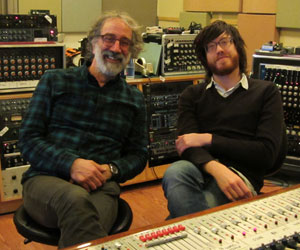
Dave Fridmann at Tarbox Road Studios, Cassadaga, NY. Photo by Justin Goetz.

“I remember hearing one of those Flaming Lips records in the early nineties and marveling at how blown-out a lot of those sounds were,” said Katis. “At the time, I was working at some “proper” studios, and they would have thought I was a crazy person if I tried anything like that. But hearing those Dave Fridmann records made me realize ‘Wow! You are allowed to do that.’”

Like Katis (and myself) a large part of Fridmann’s early education came from New York’s State University system, a public institution that’s become known for churning out unconventional and forward-thinking musicians.

Although he never graduated from SUNY Fredonia (“I guess I was too busy making records,” he says) Fridmann launched his career there.  In 1990, he and a then-floundering indie band called The Flaming Lips even rented the music department’s studios for an entire summer to record In A Priest Driven Ambulance. It would be the band’s first critically acclaimed album – and the one that would earn them a contract with Warner Bros.

Fridmann, who is plain-spoken, professional, and unexpectedly reserved for a man best-known for radical sonic treatments, becomes momentarily excited when I ask him about this experience: “It was great,” he beams. “It definitely turned out better than their past records.” It was his second credit as an engineer, but Fridmann already showed remarkable confidence.

In addition to his fearlessness in chasing after unprecedented sounds, Fridmann remembers that he also had the courage to ask the band for a credit as co-producer. “Having done basically nothing that was commercially available at the time, I think [asking for that credit] may have been the most audacious thing I did on the record. I was too stupid to even know what I was asking, but I guess that worked out for me. It often seems to.”

This collaboration would begin a long-standing relationship with The Flaming Lips. He would go on to work on each of the band’s albums (with the sole exception of Transmissions from the Satellite Heart), breaking ground with two of the most unforgettable productions of the past 15 years (1999’s The Soft Bulletin and 2002’s Yoshimi Battles The Pink Robots), and ultimately winning a Grammy for At War With The Mystics in 2006.

Critially acclaimed as one of the best albums of the 90s, "The Soft Buletin" was the Flaming Lips 9th record and a psychedelic-pop breakthrough.

When we finally got the chance to ask Fridmann what the phrase “The Studio As an Instrument” meant to him, he simply replied: “Well, what else would it be?” But despite his reputation as a trailblazer, Fridmann maintains that what he does in the studio is at least in part, reactive.

“It’s really a direct result of the bands that I work with. I’m sometimes credited-slash-blamed for changing bands’ sounds or wrecking people’s records and stuff like that, but that’s all absolute hooey.”

“I don’t do anything the bands don’t want or haven’t specifically asked me to do. The thing with the Flaming Lips or Mercury Rev is that the guys in those bands always wanted to do something crazy, interesting, or bizarre. They just had trouble finding someone who would do that for them – finding someone who would help them push the envelope of what the technology could do. I was willing, able and wanting to find those new sonic territories with them. So really, those sounds are about them, not me.”

In a 2009 interview, Wayne Coyne would remember the kind of patience that enabled Fridmann to create previously unheard textures, recalling more than two weeks spent in the studio on their first song together. Members of Weezer would similarly take advantage of Fridmann’s willingness to work obsessively toward aesthetic goals in the making of Pinkerton, the raw and impolite follow up to their smash-hit Blue Album (recorded and mixed by fellow AES Platinum Panelist Chris Shaw).  Fridmann remembers full days’ worth of takes scrapped, re-arranged, and re-imagined.

But not every sound Fridmann presents is labored-over, blown-out or intentionally mangled. Even his most raucous productions often feature lush and expansive swathes of sound, and spare, elegant moments.

“With the Flaming Lips and Mercury Rev, every time we get together they ask for something ridiculous that I’ve never conceived of and have no idea how to get,” Fridmann says.

“But then again, a lot of bands come to me because of my work with those groups. They might say ’I really love those records’ but once we start working together they’ll say ‘well I don’t want it to sound that crazy’. There are bands who are used to saying ‘I want it to sound crazy’ to a normal producer or engineer and getting a particular result. Of course, when they say that to me, they might get something completely ridiculous, that needs to be pulled back just a little bit. (Laughs)”

Fridmann produced MGMT's major label debut "Oracular Spectacular"

Whoever the client is, Fridmann still works a short ride from the campus where he began his career. And although he’s since built his own residential studio, Tarbox Road Studios, he’s now an adjunct professor at SUNY Fredonia.

“I went to college here, and I still love it here,” he says. “It’s a great place to raise a family, it’s removed from the ridiculous hubbub of the city, and we don’t have the crazy overhead of the Nashville, LA, or New York.”

As much high profile success as he’s had, Fridmann is just as proud of his independent clients, and the low cost of keeping his studio upstate allows him to stay active in that market as well.

“I think a couple things have been proven in the marketplace at this point, especially the long tail idea in terms of sales,” he says.

“The big records companies will always be there. But corporate entities have quarterly reports – They need massive sales in two weeks, or, nothing. That’s just how they operate. But, there’s been this incredible opportunity recently for independent artists, and that is still going on, I think. There are more and more small labels every year that are able to make profits and able to be successful, promoting artists who are able to sell 20,000-50,000 records, and making great music.

“There are enough niche markets at this point that you can do whatever you want to do. I think most artists will be best-served making whatever music the feel like making.  I think a lot of artists feel constrained by outside forces, and by inside forces.

They tell themselves they don’t want to screw it up, they don’t want to blow their ‘big chance’; But they’re doing themselves, and everybody involved, a disservice when they hold back and try to do something that is more reserved and doesn’t express what they want to express sonically or musically, in an attempt to mold themselves into something that is more marketable.

“I think that’s a giant waste of time. I think the Beatles proved it, I think Beck proved it, I think Alanis Morissette proved it, and I think a lot of people are continuing to prove it today: it’s just a waste of time.”

Join us at the 131st AES convention as we ask Fridmann about some of most iconic sounds, his workflow, and his thoughts on the evolution of the industry. The AES Platinum Engineers panel will take place Saturday, October 22 from 11AM – 1PM, at the Javits Center.

Justin Colletti is a Brooklyn-based producer/engineer who works with uncommon artists, and a journalist who writes about music and how we make it. Visit him at www.justincolletti.com.

NYC Studio Tour: North Brooklyn – Part 1

March 16, 2011 by  
/* Filed under Deli Feed, NYC Spotlight, SPARS Feed */

BROOKLYN, NYC: Brooklyn correspondent Justin Colletti visited with 30-some studio owners for our new neighborhood studio tour series. This first installment takes a closer look at a handful of North Brooklyn’s small to medium-size studios that are affordably-priced for indie artists, friendly to freelance engineers and operate without a traditional console.

Rough Magic
Greenpoint, Brooklyn
www.roughmagicstudios.com

Room Rate: $400/day (House engineer available)

The largest of three isolated tracking environments at Rough Magic features wood floors and 11 ft ceilings.

The Pencil Factory is an epicenter of Greenpoint’s creative culture, and the home of the rehearsal and recording studio, Rough Magic.

This multipurpose facility set up shop alongside a cadre of mastering studios, record labels and artist’s workshops in 2003, and has gone on to play host to a diverse clientele featuring names like Soulive, Talib Kweli, MGMT, The Fiery Furnaces, and Beirut.

In addition to its regular practice spaces, a room-rate as low as $400/day secures a Pro Tools HD-equipped studio capable of capturing 16-tracks of live audio as well as a full suite of instruments and front-end gear from API, Focusrite, Amek/Neve, Neumann and AKG.

The Gallery Recording Studio
East Williamsburg Industrial Park, Brooklyn
www.thegalleryrecordingstudio.com

Rates: 
$40 per hour, $350 for 10 hours (including engineer)

One of two distinct recording rooms at The Gallery

In the fall of 2006, Brian Forbes and Keith Parker began building a suite of handsome, wood-floored live rooms in East Williamsburg’s industrial park. Parker tells us that their new home-base, Gallery Recording aims to create a “warm and relaxed atmosphere that offers amongst the best bang-for-your-buck in NYC.”

To complement its ample live rooms, the Gallery’s DAW-based control room runs an 18-channel Pro Tools system and houses a respectable cache of rack gear, microphones and instruments that might best be described as “contemporary classics.”

These two attentive producer/engineers have built up a promising demo reel that includes sound samples from indie and major label artists As Tall As Lions, Rae 6 and Emily King.

Grand Street Recording
Williamsburg, Brooklyn
www.grandstreetrecording.com

Contact for rates.

Grand Street Recording. Photo by Todd Chalfant.

Grand Street Recording’s Ken Rich has had a long and varied career as producer, engineer, and bass player, working with artists like Joseph Arthur, Julia Darling, The Madison Square Gardeners, Ward White, The Compulsions, Morley, Lucinda Black, Tracy Bonham, and Laurie Anderson. Just as impressive is his studio’s wide variety of vintage instruments, amps and mics.

“We’re certainly affordable to most independent artists”, says Rich, “and the studio is very freelance engineer-friendly since the routing and patchbay are so thoughtfully set up. GSR is also a great mix room. We have a boutique collection of compressors and limiters, two classic spring reverbs, as well as Lexicon and Bricasti multi-effects, and the room itself provides a great and also accurate listening environment.”

Grand Street Drums. Photo by Todd Chalfant.

More than housing a sizable collection of some of the industry’s most coveted microphones, preamps, and compressors, Grand Street Recording is a playground for musicians, and home to a startling assortment of vintage drums and boutique basses. Rich continues:

“Our mic collection is extensive and we feel that capturing acoustic instruments is one of the things we do best. We seldom record with EQ, but rather select the correct microphone and placement for the instrument. The studio is very musician-centric as we have a huge assortment of vintage instruments that are at the disposal of all of our clients. People often get very inspired when the come in to the studio to try different instrument and amp combinations in order to create new sounds, and it is our job to capture those moments.”

“There are also really good sight-lines between the rooms so that even if people want each instrument isolated, they still feel that everyone is in the same room. The staff at GSR is friendly, knowledgeable, quick, and musical. Usually we can have a band tracking within an hour or so of the time that they walk into the doors, so we can get a lot of recording done in a day.”

The Brewery Recording
East Williamsburg, Brooklyn
www.thebreweryrecordingstudio.com

Rates: 
Studio with Engineer: $70/hr (discounted blocks: $260/4hrs, $500/8hrs, $700/12hrs); 
Studio with Assistant Engineer:  $50/hr (discounted blocks: $180/4hrs, $330/8hrs, $450/12hrs)

The Brewery control room

The Brewery isn’t the first studio venture for Andrew Krivonos and Oladipo “Dot Da Genius” Omishore. These young producer/engineers outgrew their project studios quickly, with Krivonos   sharpening his skills in his private mix room, Southfall studios, and Dot making a name for himself in his home studio by collaborating with Kid Cudi on the breakthrough single “Day N’ Nite.”

Now in a new suite on the East Williamsburg/Bushwick border, everything about The Brewery’s design shows the mark of a 21st century studio. A Control 24 digital board and front-end racks from API, Avalon, Neve, Presonus and Vintech sit in the center of the room, ready to integrate with a Pro Tools HD system or Ampex MM1200 2” 16-track tape machine.

“We strive to set the future model for recording studios in New York,” Krivonos says. ”We understand the limited recording budgets of most and want to provide big-commercial studio service at a realistic price.”

To that end, The Brewery have supplemented their already competitive rates with creative pricing packages like the “Early Bird Special” and a unique “$949 Rock Block,” that promises a whole lot of tracking at a pre-set price.

Fortunately, Krivonos knows running a studio is more than a simple equation: “The most important factor of our studio is our staff engineers. People will come back to you no matter how shitty your studio is if you can give a great product. The product — our mixes — are what keeps our clients coming back, more than anything else.”

When asked if about their emerging specialties, Krivonos says: “We do a lot of pop, rock, R&B, and hip-hop. Producers love our space for the monitoring and freelance engineers love it because of the functionality and affordability.”

Justin Colletti is a Brooklyn-based audio engineer and music producer who’s worked with Hotels, DeLeon, Soundpool, Team Genius and Monocle, as well as clients such as Nintendo, JDub, Blue Note Records, and the Metropolitan Museum of Art. Visit him at www.justincolletti.com.

Five Years Of Cantora Records: From MGMT To Bear Hands

November 3, 2010 by  
/* Filed under Music Biz */

PARK SLOPE, BROOKLYN: At Cantora Records HQ, aka The Rumpus Room, there are at least five guys jammed into a small office overlooking the BQE and the New York Harbor.

Cantora Records founders (l-r) Will Griggs, Nick Panama and Jesse Israel

This is mission control for a tight roster of bands that includes the Brooklyn-based Savoir Adore, Francis and the Lights and Bear Hands, and amid the obvious hyperactivity of the day, we’re getting a tour.

Led by a triumvirate of Will Griggs, Jesse Israel and Nick Panama, Cantora Records is an innovative indie-pop label and fully functioning creative collective with in-house recording studio, photo/video stage and roster of producer/engineer, designers and filmmakers.

These guys formed Cantora in the Spring of ’05 to put out MGMT’s Time To Pretend EP and help build the band to indie superstardom. Five years later, they’ve earned a solid reputation in the indie music scene by following the righteous road somehow still less traveled — they only sign bands they absolutely love.

We sat down with Griggs, Israel and Panama and got the whole story — read on…

From what I read, it seems Cantora started at NYU. That right?

Will: Jesse and I were at NYU — I was studying music business and Jesse was studying film — and when we all met up and started this company, Nick was still in high school in LA. But the company did actually form at NYU. We had our first powwow in Washington Square Park.

Tell me a bit about what led up to that meeting?

MGMT

Will: My cousin was a year above me at Wesleyan and my freshmen year he took me to see this band, The Management, which became MGMT. At that point they didn’t have any official releases — they were just giving out burned CDs. I brought it back and played it for everyone I knew because I just thought it was the most addictive music I’d ever heard.

Jesse and I were roommates and at that point we weren’t sure what we wanted to do — manage bands or put out records or what — but we knew we wanted to work with this band in some way. Around that time, Nick also caught wind of them out in LA and connected with us through a mutual friend.

How did it go from this idea of wanting to work with them to reality?

Will: We started helping them out here and there with shows on a casual/fan basis, but then a couple of opportunities came up that were a catalyst to making the band and our relationship more official — they were invited by Kevin Barnes and Of Montreal to open for them on a pretty substantial tour. It was at that moment when there was a real opportunity to support them — print up some CDs and some tee shirts, etc.

And that’s when you guys actually came together, organized as an actual company?

Will: Well that’s when it became clear to us that this was what the relationship with the band was going to look like. We knew they had these great songs so we got them into a studio and printed up some real CDs so they’d have something to sell on the road. It all came together really naturally. We had a buddy who was working in a studio who could help out with recording/production — our friend David Perlick Molinari, who’s now in French Horn Rebellion.

Jesse: Having an actual product made it all real and with that in place, we decided to start the record label and figure it all out as we went along.

So there wasn’t necessarily a grand plan, a real vision for how you wanted to run the label? Like contrary to what you saw going on out there?

MGMT's "Time To Pretend" EP was Cantora's first release in August '05

Nick: No, we had not the faintest idea. Even when we signed MGMT, we were unsure whether Cantora was going to be a record label or a production company, we really didn’t know. There was no long-term future grand vision that we had. There was no business plan; we didn’t fund raise. We each pulled out $600 to get tee shirts and CDs made. And we didn’t really know where it was going to lead — we were just thrilled to be working with this band and doing something that was a little outside our comfort zones.

And so you did that first release with MGMT, Time To Pretend. What was that like, watching that just totally take off?

Will: It was an unbelievable learning experience on a number of levels. It was amazing seeing it spread from friend to friend, just by word of mouth. We didn’t hire a publicist, we just put the thing out so they could sell it on the road.

Nick: And we barely put it out. There was no digital distribution or physical distribution. It was just Paypal through the website and the band on tour selling it.

Will: But it was unbelievable to see how powerful word of mouth can be when you have content that’s really compelling. I’m from Virginia and had a lot of friends at UVA and I could see they had a pocket of fans down there. And people were really enthusiastic about the music. There was an a capella group at UVA that was singing “Kids.” And there were all these little pockets of fans popping up on their own all over without much of a promotional push behind it.

Jesse: The moment when I really knew we were onto something was when they played Princeton. They’d been invited up to play one of those fratty weekend extravaganzas. So we went out there with the band and this is still at a point when they were pretty unknown. But at Princeton, this was a big deal. And when they played the song “Kids,” it was insane witnessing what happened — all these preppy Princeton kids in their seersucker shorts and pastels just LOSING their minds, going crazy over it. And we were there, with our beards and grimy clothes — totally out of place — just taking it all in. It was amazing.

Awesome. And then you got to have the experience of a major label coming into the picture…Was that intimidating at all? Did you feel you had a lot to learn, quickly?

Will: You know what, it wasn’t intimidating because we just had no context for it. It was just another opportunity presenting itself. And also the band still wasn’t thinking of themselves as career musicians. They were never in that mindset of needing to make it as rock stars or anything. They just saw it as a cool opportunity.

Jesse: They were writing songs to fit a genre and having fun with it. It was like dorm room fun to make these songs they thought were the catchiest, cheesy pop songs they could write. They’d never really taken it all that seriously.

What about Cantora? At that point, as MGMT’s popularity was growing, were you starting to look at other bands?

Savoir Adore. Photo by Shervin Lainez

Will: No, we didn’t start looking for other bands until everything with MGMT and Columbia was settled. At that point, we started looking at what had happened and saw that we actually had a real record label here!

So who was the next band you signed? And at that point, what were you looking for?

Will: The next band we signed was Savoir Adore. For me it’s about what do I get addicted to? What can I not help but share with everyone I know? I feel like if there’s one thread that ties together all the artists on our label it’s great songs, and an adventurous and forward-thinking approach.

Most of what we have on our label could definitely be called pop music in some way, but they’re all artists who are doing something new with it — a new twist, their own sound. But we spend a lot of time working on each band, so it’s really about whether or not we love it enough to spend the next many months or years working on it without any guarantee of success.

You just have to be passionate about the music, or else you’re wasting your time. If we looked at it from the perspective of ‘will this make us a lot of money?’ this would be a very different company. Not to say that the stuff we put out doesn’t have a wide appeal…

Are there other labels out there that inspire you guys and how you build your business?

Jesse: XL is a label that’s done a really good job of branding themselves and that’s something that we’ve always focused on. Obviously the music that we put out is #1, but we’ve also always felt that it’s really important for Cantora to have a presence in the music space as well. Not to just be a silent partner in an artist’s release process — but to build our brand so that as more artists come to our label, we have a built-in fan-base and a built-in brand that already means something.

Nick: I’d say French Kiss is another label that’s just killing it. They’ve been around for awhile and they’ve been able to transform themselves from this proto-pop, post-punk label to today, where they’re putting out Passion Pit, Local Natives, Antlers, Dodos, Freelance Whales, Suckers, etc.

Will: To me, a label like Merge that can be fully independent yet able to scale with a band like the Arcade Fire, and still be that label where you’re interested to check out whatever they’re putting out there. That’s the kind of label we want to be — a label whose releases audiences will check out because it’s a part of what we’re doing and they like what we’re doing.

Jesse: We’ve all experienced that on some level as fans. I was really into hip-hop when I was younger and when I was in high school, Definitive Jux, is what did it for me. If something came out on that label, I was excited about it. And part of what I think about with Cantora is how to connect with that younger me, and that excitement I would feel around Definitive Jux and everything they did.

So what do you guys actually do to build your brand, outside of just working each release?

Francis and the Lights signed to Cantora in '08

Jesse: A big part of it has been to build our brand outside of just the artists we’re working with, to cultivate the music community here in NYC and in LA, through Cantora Live and Cantora Creative.

With Cantora Live, we’ll put on a show every month or six weeks where we pick a cool venue and invite bands we really like who aren’t signed to Cantora as well as a couple who are and put on a showcase. Sometimes there’s not a single Cantora band on the bill and that’s a way to reach out to even more fans, a way for Cantora to be a part of something else that’s meaningful and cool.

And we also do a similar thing with our production company, Cantora Creative, where we’ll create video content for artists — some on our label, some not. Or this new web series we’re working on called “Show Me,” where we’re doing these :90 shorts with 10 of our favorite bands showing a band leading up to a performance.

You also have some facilities here — a recording studio and in-house producer/engineer, rehearsal space, video stage — do your artists come in and record here? How do you and your bands benefit from you having these things?

Will: Having the resources here adds to our ability to be as nimble as possible and be able to act quickly when there’s an opportunity or an idea that we think is cool.

For example, we invited Francis and the Lights to play our CMJ show a couple years ago, and they mentioned they had a couple new songs and wondered if we wanted to team up and do a single to release at the show. Because we have a studio in-house, we were able to bring the band in here and they recorded with the head engineer Albert DiFiore and we were able to turn it around in time for the show. And that was the beginning of a relationship that lasts to this day — we just put out his full-length debut this summer.

Also, with Bear Hands, we did a live video shoot here, called it the “Rumpus Session.” And we invited a bunch of friends and some press down, had tacos and beers and the band played a few new songs. We shot it and put it online. We weren’t thinking ‘how can we make money off of this?’ it was more about this being a cool way to debut some new songs.

Awesome. So, now that you’ve been at this a few years…what do you think about what’s going on in the music industry right now and what opportunities are out there for a label like Cantora?

Bear Hands' "Burning Bush Supper Club" came out Nov. 2.

Will: On the one hand, the collapse of the music industry and the lower point of entry in terms of the cost of recording and online distribution means we can have the same distribution reach as any label on earth via the Internet but the flip side to that coin is that so can everyone else!

So it means we have to be spot on about the bands we want to work with and able to continuously develop our fan-base and artists so that we can stay competitive at a time when anyone can put out a record and the market’s completely flooded. We’re playing with different approaches and different ways to create and put out content.

It’s clear that the excitement surrounding music has never been more intense than it is now — it’s just a question of how to package music and get it to people in a way that can keep a business like our growing at a time when music fans can pretty much get whatever music they want for free.

If there’s clear growth in one area of music it’s music discovery. People are thirsting for reliable sources of new music. Hopefully we can continue to establish ourselves as one of those reliable sources.

What’s coming up next for Cantora?

Nick: We just debuted the full-length from Rumspringa, Sway, and we’re excited about that. We have the new Bear Hands record, Burning Bush Supper Club, coming out on November 2. The Francis and the Lights record It’ll Be Better came out over the summer so we’re still working that. And we have a new artist, Emil & Friends — it’s fantastic, lush, dance-poppy music. Check it out!

For more on Cantora Records and their entire roster of artists, visit www.cantorarecords.com. And check out their latest release, Bear Hands’ Burning Bush Supper Club on iTunes.

EastWest Releases Dave Fridmann-Co-Produced Virtual Instrument, The Dark Side

August 18, 2010 by  
/* Filed under News */

EastWest has released “The Dark Side,” a 40 GB collection of virtual instruments — some dark and eerie, and many highly processed — mangled, distorted, or effected out of all recognition.

The Dark Side interface

Created and produced by EastWest founder/producer Doug Rogers and Grammy-winning producer/engineer Dave Fridmann (The Flaming Lips, MGMT, Mogwai, Mercury Rev), The Dark Side has been designed to work for everything from alternative to symphonic rock, film, TV, and game music production.

“The Dark Side idea came to me when I was mentoring a young alternative group about some demos they sent me. To my ears, the tracks didn’t sound tough enough for their intended market, so I told them they needed to toughen up their sound,” said Rogers. “I looked around for sounds that could accomplish this and found absolutely nothing.”

He decided to make it his next project, and partnered with Fridmann, admiring his sonically unconventional work with The Flaming Lips, MGMT and Weezer (among others). Fridmann’s “no rules” style of production was exactly what Rogers was looking for to help produce The Dark Side instruments.

In creating the collection, mass aural destruction was the name of the game. They turned traditional instruments into highly processed drums, percussion, basses, guitars, ethnic, keyboards, strings, and FX, all organized into instrument groups for easy audition and recall.

The Dark Side creators: Rogers (left) and Fridmann

Rogers and Fridmann not only tapped into a wealth of recording and producing experience for The Dark Side, they also had the gear to match, between EastWest Studios in Hollywood and Fridmann’s Tarbox Road in upstate NY.

Many individual instruments were processed through 5 or 6 effects units, some of the vintage and esoteric tube variety owned by the pair.

The more distorted and mangled Dark Side instruments are reportedly intended to be used with cleaner instruments to make them really stand out in a mix, or to disturb the senses. “With today’s brick-wall limiting,” the press release relays, “distorted instruments may be the only product trick left to make an instrument stand out in a mix, a successful production technique used often by Radiohead, Muse, Nine Inch Nails, etc.”

The Dark Side includes EastWest’s PLAY 2 software, which can operate standalone or as a plug-in inside DAW hosts that support VST, Audio Units, and RTAS.

The Dark Side is available for Mac and PC for $395 MSRP. Complete product information, demos, and ordering information is available at http://www.soundsonline.com/the-dark-side.

French Horn Rebellion: Brothers, Lifelong Collaborators

October 13, 2009 by  
/* Filed under NYC Spotlight */

WILLIAMSBURG, BROOKLYN: When brothers David and Robert Perlick Molinari were kids in Milwaukee, piano and French horn lessons opened the doors on a world of undiscovered sound. “I realized when I was 6 years old that I didn’t have to play what was on the sheet, I could write my own music,” says David. “Everything I’ve learned since then and all the technology, has aided in that exploration of what I could do to make things sound the way I want to hear them.”

Robert and David Perlick Molinari of French Horn Rebellion, on one of their many sonic quests

Robert and David Perlick Molinari of French Horn Rebellion, on one of their many sonic quests

As kids, the brothers began experimenting with MIDI programming on their Apple 2GS and Notator Logic. Computers and production became a permanent part of their songwriting process. Now living in Williamsburg, the Perlick Molinari’s front French Horn Rebellion (FHR), a dance-party-starting synth-pop duo who’ve been producing music, touring and remixing relentlessly in ’09.

We caught up with FHR on the eve of their UK tour. They’d just released the Beaches and Friends EP in collaboration with Brazilian cohorts Database, remixed a track for Kitsune Records, and were beginning a remix of a new Tigercity track “Ancient Lover.”

How do you guys tend to work on music? You both play and produce, so where does it start?

David: Robert will usually start the track, or the remix. I think because he’s younger and has less production experience, he gets less hung up on different elements of the creative process. He’s just able to dive into this visceral, almost subconscious thing.To me, that’s what the creative process is all about — getting in touch with your subconscious self, try to ride those waves and be able to blend it with the knowledge and experience you’ve gained in your life.

Robert’s able to just put material down and it’s really good, but it’s often pretty raw and needs to be developed. So I’ll work on it from there and we’ll go back and forth. When we’re remixing, he’ll also start it and then when he’s exhausted his idea, he’ll pass it off, and I’ll arrange and re-arrange, produce the idea from there.

What about your dynamic makes you such good creative partners?

David: We’re both producers and work in Logic, and we both play and sing, so that’s all key, but I think even more so, the difference in age and experience is what really helps us balance each other out. I think balance is the most important part of the creative process because that’s how you’re able to make something that hits on all these different levels. Robert will see something big, have a great big concept, but maybe not necessarily have it in him to fully get there. Like, we did a remix of Magic Magic’s song “Sleepy Lion” and Robert came up with this concept that got us started.

Robert: I thought of that part in Lion King when Simba’s roaring at the top of that rock, and I thought it’d be cool to do a Roaring Lion remix of “Sleepy Lion.” I wanted to tell the story of his journey to the top of the rock. Most of our remixes start out with a concept or an idea. And usually, if there isn’t one, the remix isn’t as good. We’ve found we need to have a story.

How do you get your remix projects?

Robert: We have a remixing agent. But, we just did a remix for Kitsune and that came through our publishers in the UK (Once Upon a Time Publishing). They’d approached Kitsune about our track “Up All Night,” and the label wanted to release it on their next compilation. Then they asked us to remix a song, called “I Can’t Talk,” by one of their new artists.  Most of our remixes simply come to us through our friends.

So, how do you actually collaborate on these projects? You both use Logic? Is there one that does beats, where the other does lyrics, vocals, etc…?

David: We both do everything. We have the same basic skill-set with different strengths and weaknesses. The best way for us to throw sessions back and forth is by using the same program, same plug-ins, etc. So we have mirror systems of Logic. Basically once we have all the audio files on each other’s systems, we don’t have to throw audio files back and forth unless we record something new. We can just attach the session file in an email with notes on what’s been updated.

And, how did the collaboration with Database come about?

David: Robert’s DJ friend, Chris Molina, turned us onto this whole electro-disco niche, which was really in-line with what we were already doing and inspired us to keep doing it, keep experimenting. One of the tracks he played for us was by Database.

Robert: It was Database’s remix of The BPA ToeJam, featuring Dizzee Rascal. We loved how clever it was, all the fake-outs, it’s not like other music; this track takes you on a journey. It plays with your expectations about where you’re going and what you’re doing. The rhythms, harmonies, melody…the way he messes with the different elements.

David: We decided to put out a single. We’d had a record out that was more rock-oriented, but we’d moved away from that, and wanted to introduce ourselves fresh, without complicating things by producing a whole record. So, we released our song “Up All Night,” and sent it out to people we liked through Myspace, including Database, to see if anyone would remix it. Database was into it, and did a remix.

And now you’ve collaborated with Database on your latest EP as well?

Beaches and Friends EP

Beaches and Friends EP

Robert: Database had this track called “Beaches & Friends,” and they thought we should work on it together. They’d remixed our track, and now we were going to work on their track. But then it turned into a bigger collaboration.

David: They sent us splits of this track they were working on, and we messed with them. Not so much in a remix style, more like we were producing and adding to it. We came up with the verse and chorus, we sang lyrics, and put that over their beat. They liked it. So we went even further with it and started to warp what they were doing even more. The track just became something else entirely through this process. After we were done, we sent them the splits of our track and they took those splits and did something completely new from that.

So your remixes and their remixes became the Beaches & Friends EP?

Robert: Well, it’s kind of mysterious because the actual song, “Beaches and Friends” isn’t on the EP. The EP is four remixes of a song that doesn’t exist. I think of it like the concept behind Edward Elgar’s Enigma Variations, which instead of being variations on a theme, is variations on an enigma; there is no theme.We encourage people to buy the whole EP because it really does all belong together. Plus, there’s a bonus track that’s like the coda.

David: The bonus track is an idea from our new record we’re working on. The whole EP is supposed to provide a segue from the old “Up All Night” and “Broken Heart” sound into the newer material.

So, outside of French Horn Rebellion, David, you also do scoring and sound design? And you produced MGMT’s Time to Pretend EP? How did you get started in producing and scoring?

David: I’ve been making music for TV, film, commercials and a variety of other creative outlets as well as producing records for years through my company, YouTooCanWoo whose website right now is in sad state of neglect because of all the recent French Horn Rebellion work. This is the company where I do all my independent production. When I decided I really wanted to pursue my childhood passion and do creative jobs as my career, I was very curious as to how to make it something that would be able to support me.  I did loads and loads of work and attempted to solve this question.

During this grand adventure my friend Will Griggs was inspired by a band called “the management” and thought I would be good to collaborate with for their debut EP. Will really wanted to help them out so he formed this new indie label, Cantora Records, to release what we were working on. After the success of that EP they were able to release other music — including this other band I’m involved with called Savoir Adore. They have a brand-new record In the Wooded Forest that is Cantora’s first album they’ve ever put out.

Through all these projects I’ve been able to get closer at cracking the code on how to make doing creative projects work as a career. And now, Deidre and Paul, of Savoir Adore, Jorge of Violens (another Cantora band), Robert, and a childhood friend of mine Zach Meyer form the core of the creative team for Youtoocanwoo projects.

Sounds like between French Horn Rebellion, your remix projects, production, you guys are finding a variety of ways to get out there?

David: We’re constantly looking for new, inspiring opportunities. And we’re always working on things that may not seem to have any logical connection to one another. But we’ve found that someone will hear or see something we do, and then the next opportunity comes. You have to be a little reckless about it. You have to have that fever. If everything’s too calculated, you’ll waste too much time and set yourself up for disaster.

It’s the same thing with the creative process: you have to first be right brain, just get those ideas out there, not try to filter it. And then the filters come in later. You just go and go, and try as hard as you can, do work you believe in…and then good things happen. And it’s only because you’re constantly saying keep going, not enough, not enough, etc.