Premier Studios Hosts Sessions with Will.i.am, Amber Riley, Wiz Khalifa

July 11, 2011 by  
/* Filed under News */

Premier Studios in Midtown has seen a plethora of action recently, with its SSL J 9072-equipped Studio A, and SSL J 9000-equipped Studio B, plus writer studios E and F hosting a number of sessions. Projects at Premier have included:

Will.i.am was overseeing sessions for Lil' Wayne at Premier Studios.

Hollywood Records artist Demi Lovato was in on a project for Disney Pictures. The song was produced by superstar producer Sandy Vee, with piano overdubs played by Mikkel Eriksen from Stargate. The session was engineered by Sam Giannelli.

Geffen recording artist Will.i.am of the Black Eyed Peas produced tracks for Lil Wayne. Engineered by Mike Cadahia with Kevin Geigel assisting.

DefJam artist Ace Hood, produced by DJ Khaled, recorded vocals and mixed. Engineered by Ben Diehl with Colin Rivers assisting.

EMI Artist MoZella, with producer Scyience, has been mixing with engineer Anthony Daniel.

DefJam artist DJ Khalid tracked and mixed with GRAMMY Award-winning engineer Chris Conway, with Colin Rivers assisting.

Cash Money artist Lil Wayne has been in doing several dates, writing and recording vocals. The sessions were engineered by Mike Cadahia, with Kevin Geigel assisting.

Atlantic Recording artist Wiz Khalifa has been in recording vocals, engineered by Josiah Hendler with Colin Rivers assisting.

Sony Epic Recording artist Oh Land recorded vocals with producer Dave McCracken. Engineered by Andros Rodriguez, with Sam Giannelli assisting.

Columbia Recording artist Amber Riley from GLEE cut vocals with producer Adam Black. Sam Giannelli engineered, and Chris Melendez assisted.

Amber Riley was onsite at Premier.

Warner Bros Recording Artist Rich Hill has been in Premier recording vocals and mixing with Engineer Ari Raskin. Kevin Geigel assisted.

Universal Motown artist Lil Twist came through to do vocals, with Ari Raskin engineering and Sam Giannelli assisting.

Sony Roc Nation artist J. Cole recorded vocals with producer Brian Kidd. Engineered by Mez, and Colin Rivers assisting.

Epic Recording artist Alice Smith mixed with Producer Scyience. The mix was engineered by Push Buttons, with Colin Rivers assisting.

Berklee College of Music visited with their Student Ensemble, directed by Eric Abreu. Engineered by Tony Black with Sam Giannelli assisting.

Shark Media GRB showed up with production team the Berman Bros. The mix was engineered by Christian Berman, with Sam Giannelli assisting.

Musical Arranger Douglas Gibson tracked a 16-piece Orchestra and Piano for an upcoming major film soundtrack. The session was engineered by Andros Rodriguez, and assisted by Sam Giannelli.

Last but certainly not least, Jamaican recording artist Joneal was in to mix. The sessions were produced by Phillip Forrestor, and the mix was engineered by Anthony Daniel.

The Postelles Get St(r)oked for Their Upcoming Debut Album

May 3, 2010 by  
/* Filed under NYC Spotlight */

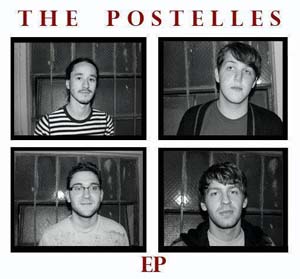
UPPER WEST SIDE: From the land of mediocre restaurants and mid-life crisis, the Upper West Side, come The Postelles. How did this foursome rise above the cultural obstacles of their upbringing, coming from a place where the Gap and Starbucks reign as supreme as in the Topeka suburbs, to make their own ear-tingling brand of rock?

There are four of them.

There are four of them.

It starts with their pure and simple influences, drawing off of resources that range from Motown to the Strokes, Buddy Holly and the Beatles. As a result, their upcoming self-titled debut due out on July 27th on Astralwerks/Capitol Records is due to get its own notice from the lo-fi, upbeat crowd.

The four-piece squad of 21/22-year-olds, Daniel Balk (lead vocals, guitar), David Dargahi (lead guitar), John Speyer (bass) and Billy Cadden (drums), co-produced the 11-track album with Albert Hammond, Jr. of the Strokes. One listen to jangly tracks like “White Nights” (available as a free download from the band’s site), and it’s no mystery why band and producer were a royal fit.

The record may have been made in two chunks – one under the supervision of Sr. Hammond, Jr., the other without – but it comes together as one big burnin’ hunka New York City rock ‘n’ roll. Appropriately, we grilled Daniel Balk about it.

Q: So the recording of this record was a “half-and-half”? Explain.

A: This is how it worked out: We did the first half with Albert and Gus Oberg, who engineered it, at Looking Glass Studios, and I think we were the last band to record there. We did five songs in 14 days, which is the way we usually record.

We learned a lot from that phase. Albert really taught us a lot about how to record. So the next half we did at Quad — eleven songs in three days. We came in at 11 AM and stayed until 4 AM every day.

Q: You said you learned a lot from Albert – like what?

A: I play guitar, and David also plays lead guitar. Albert taught us a lot about getting the right tone, like how you can change it by turning the treble down for the verse and up for the chorus. We usually just plug in and play, and we still do, but now we can do a lot more than that.

David more uses so many pedals and I don’t use any, but speaking for him he would say his favorite pedal that he learned about from Albert and Gus is the Jeckyll and Hyde overdrive pedal. If you’re going to be a lead guitarist, and want a dirty sound but not too processed, that’s the best pedal around, for sure. I know the Strokes use it, and they have some of the best sounds around.

Q: How come no pedals for you? I thought all guitarists hearted pedals.

A: It could be a little bit of laziness. But its more so that I really love the early Beatles, Buddy Holly, even the Stones, early on. If you look at them live, they don’t have any pedals. I love the sound of the guitar plugged into the amp without anything else coming in.

Dave’s doing solos, changing sounds, so he has to do that. But for me, I didn’t want to fuck around with it too much. I love that raw sound. I don’t think it’s anything too crazy. On the album, the amp I played through was a Peavey Classic from the late ‘70’s/early ‘80’s. I played a white Stratocaster, and I also played a Gretsch Penguin.

For the drum sounds, Gus and Albert spent six hours a day on drum sounds. For the song “Hold On,” we put a few napkins on the snare drum to deaden the sound, and that sounded really cool. We also spent a lot of time on bass.

Q: That’s funny, because when you think of the Strokes, their most famous records have a reputation for being lo-fi, i.e. not spending a lot of time…

A: I thought that, too. But Albert’s a perfectionist. The second time we recorded (at Quad) it was more like that – faster — but not in a bad way. It was more like we knew what we were recording.

Q: Why were you working with Albert Hammond, Jr., in the first place?

A: He saw us in a club called Sidewalk Café. He was nice enough to come in, sort of liked us, and we did a demo in his bedroom.

Albert Hammond, Jr. (Photo credit: Justin Jay)

Albert Hammond, Jr. (Photo credit: Justin Jay)

When it came time to do the album, he had never really produced anything except his own work. He said, “I’d love to do it,” and it was a no-brainer. We were good friends, and Is This It is one of my favorite records ever. The label threw out a lot of big producer names — we met a lot of people, and it didn’t feel right. We wanted to work with someone we respected and got along with also.

Q: Once everything got going, was there a deliberate sound that you’re going for there?

A: We didn’t want it to sound like a huge album — we’re not an arena rock band. We also didn’t want it to sound like a demo. We wanted to go in between, and have a retro kickback sound that no one has nowadays. We wanted to get that across.

Our big thing is recording live. We wanted to not overdub, and do all the instruments playing together, like the Strokes, the Ramones, the early Beatles.

We did do a few overdubs, naturally. We definitely heard things a few days later like “Holy shit, we have to redo that vocal!” Obviously, we didn’t do the harmonies live, because no one’s perfect.

[At this point, someone on Daniel’s end asks him if he wants a sandwich].
Yeah. Turkey, swiss, mayo.

We think harmonies really build up a song. Going back to Motown, doo wop groups – we love the way that sounds. That has to be perfect, and we’re not the Temptations.

Q: Yes, you are the Postelles. So why wasn’t Albert producing for the album’s second half?

A: We went into the first half saying we had songs we wanted to do. Then after those were recorded we got back into writing, and he was doing some touring and it didn’t work out.

It ended up perfectly, because everything we learned from him in the first half we took into the second half. We had a great engineer at Quad named Robert Dorsey, and he really helped us out a lot.

Q: What are some songs from each recording chunk where you feel like everything really came together?

A: The most fun song from the first half was “Hold On”, a slow song. I think we did one take and nailed it. We really like that, getting it done. I think it came out the best.

In the second half, I think maybe the song “Can’t Stand Still.” It came out really well – it’s the newest song on the recording. I didn’t play guitar on it. It was fun to do the vocals and not worry about the guitar.

Q: Right on – we’re looking forward to hearing the whole album when it drops in July. Until then, why do you think people are digging on the Postelles?

A: There’s a lot of bands nowadays from Brooklyn with seven synthesizers or whatever. But I think a lot of band now are doing it just to do it, because it’s cool. With us, I think people find comfort in going back to the old bands, where they just plugged in and played without backing tracks. I hope people appreciate it. I like just going up, playing, and not having to worry about all these wires everywhere. — David Weiss

In-Session: Phil Palazzolo With Nicole Atkins & The Black Sea

January 27, 2010 by  
/* Filed under NYC Spotlight */

PARK SLOPE, BROOKLYN — We recently caught up with Brooklyn-based producer/engineer Phil Palazzolo who’s been working on the new Nicole Atkins record. “I think this is her time,” he says of the New Jersey songstress and her new material. “She’s definitely due.”

Phil Palazzolo in Seaside Lounge with Tony Chick (left), bass player for Nicole Atkins & The Black Sea.

Phil Palazzolo in Seaside Lounge with Tony Chick (left), bass player for Nicole Atkins & The Black Sea.

The same could be said of Palazzolo. He’s been in-the-trenches working with bands for over a decade — producing, engineering, playing guitar/bass, touring, mixing FOH, etc — most notably engineering on Radio 4’s Gotham, Stealing of a Nation and Enemies Like This. And over the last few years, his star’s been rising.

He produced/engineered on The New Pornographers Challengers and A.C. Newman’s Get Guilty, and has been working through a whirlwind of back-to-back projects ever since, with Neko Case, Okkervil River, The Bogmen, Bird of Youth, Ted Leo and the new New Pornographers.

Early in 2010, Palazzolo started sessions with the newly formed Nicole Atkins & The Black Sea at Seaside Lounge Recording in Park Slope to make the full-length follow-up her ’07 debut LP, Neptune City. Atkins has a new band in the Black Sea, a new producer in Palazzolo, and a new sound is emerging. Read all about it:

So, how did you and Nicole Atkins come to work together?
About two years ago, she sang with a choir that backed up Feist on David Letterman. A.C. Newman from The New Pornographers was also part of that choir and got to talking to Nicole Atkins and had her come sing on the sessions for what would become his solo album, which I produced. Then, I played guitar in the A.C. Newman band and Nicole came and did backup vocals live, so I got to know her even better.
We’ve been talking about working together for a while now. She got a ton of songs together, and called me saying she wanted to get going right away. I’d just finished the Ted Leo record, and was just wrapping up mixes for the next New Pornographers record, so it was perfect timing to do the record in January and February.

Nicole Atkins & The Black Sea drummer Christopher Donofrio tracking at Seaside

Nicole Atkins & The Black Sea drummer Christopher Donofrio tracking at Seaside

How’d you get started and where are you working?
We did a week of pre-production in Seaside Lounge’s B Room. Pre-production involved finding the strongest parts of the songs and bringing them out. Sometimes that meant changing the feel and the pace of things. Then we started on basic tracks in Seaside’s A room. We just finished four days of basics and actually got to some overdubs and vocals. It’s starting to really sound like a record — we’re in that exciting phase where you can really hear it coming together.

Her last record was really lush and orchestrated, and kind of dark/melancholy. How does this record compare to that, and what would you say she’s trying to accomplish in the studio?
After getting a chance to live with her other record, I thought — yes, it is lush and it’s beautiful, but it’s also a bit disjointed. It kind of feels like it took two years to make, maybe with a little too much time passing between sessions. The new record is a little bit more fun in spots. There are some lighter and more upbeat numbers that she didn’t really have on the last record. I really want to showcase what she can do beyond the brooding Dusty Springfield-revamp type of sound.

So, is it more of a band record?
Yes, I’d say so. And she has a new band. Most of the guys are from New Jersey and play together in this other band [Sikamor Rooney]. They’re hometown guys and they’ve all known each other for a long time, whereas her other record was largely session players. Working with session players can be awesome, and we’re definitely going to bring in guests for specialty parts, but on the whole, there’s a real band making up the foundation.

So how would you say you’re working with her to realize the sound / direction for this album. Are you trying different things to figure out what it is?
Well, first I tried to get a sense of what she didn’t like about the last record and the recording experience overall. And then I listened to the songs, which were largely just fairly simple demos, some of them were actually produced in a way that sounded like a band, but not exactly what she was after.
In listening to the demos, I tried to find what I thought would tie them together and how to make them feel more like a whole record rather than a year and a half’s worth of writing and demoing in different places.

Nicole Atkins signs into "the Motown mic" - a Neumann KM86 - at Seaside Lounge.

Nicole Atkins signs into "the Motown mic" - a Neumann KM86 - at Seaside Lounge.

Is there anything different or noteworthy about how you’re recording any of the elements — vocals, drums, etc…?
Well, I’m using a lot of different approaches, song by song. I think it’s so easy to make someone like her sound incredible that sometimes you just have to have the balls to say ‘I’m going to put this through a bullhorn.” No matter what you do, she’s this incredible singer, and it doesn’t always have to be pretty. There are moments on this record where her vocal will be totally brash, like Karen O, but she’s still this amazing singer underneath and it sounds really cool.

So, you’re gritting up the sound a bit, cool. And how have you been recording her vocals?
We’ve recorded her in the booth on some songs, but on others, I plan on using the big live room space a lot more. On some tracks, you’ll picture a girl standing on a stage in a huge room when you hear her vocal.
So far I’ve been using what I call the Motown mic on her, which is a Neumann KM 86. In the first few years of Motown’s existence, they only owned KM86s because Berry Gordy got a deal on them, so everything you hear — drums, bass, vocals, guitars, strings, etc… — all were recorded with the same type of microphone.

Sidenote: All of Motown’s KM86s are now at Avatar. When they dismantled the first facility and built the “real Motown studio,” the guy who built Power Station bought everything from Motown and stored it until he built Power Station. He also faithfully recreated (in dimensions and materials) the Motown studio in one of their upstairs rooms.

That’s awesome, I didn’t realize they had all the original Motown mics. Now, will you produce this entire record at Seaside? Or will you go elsewhere for mixing?
We’ll do all the recording at Seaside and then I think we’ll mix at The Carriage House in Stamford, CT. That place has a great history [The Pixies’ Doolittle was made there] and the SSL (4048 E/G) is a great mix disk. Plus, you live there for the duration, so you’re not chained to a console thinking of all the work you have to get done in the next 10 hours, because you’re not leaving. You have time to walk away and come back with fresh ears. That’s really helpful.
If I was working in a comparably-equipped room in NYC, it would be very expensive and so we’d be pressed for time. In the last few months, I mixed The New Pornographers and the Ted Leo records at The Carriage House.

Check out Nicole Atkins & The Black Sea at http://www.myspace.com/nicoleatkins and Phil Palazzolo at http://www.myspace.com/drywallofsound.