Mastering Neutral Milk Hotel: Joe LaPorta on Sessions with Jeff Mangum
December 1, 2011 by Janice Brown
/* Filed under Deli NYC Feed, NYC Spotlight, SonicSearch News */
NOHO, MANHATTAN: It’s been a dreams-do-come-true kind of year for fans of Jeff Mangum and Neutral Milk Hotel. After an extended hiatus following the release and tour of his 1998 masterpiece In The Aeroplane Over The Sea, Mangum emerged a few months ago to announced a new Neutral Milk Hotel website, full schedule of performances, and news of the first release in over a decade – a complete box-set of the band’s recordings on vinyl.
The box set, along with pay-what-you-want MP3s of the previously unreleased songs, will be available in December. (Pre-order here.)
In Mangum’s absence, his music has gained legions of new fans over the years, transfixing listeners and leaving everyone wanting more. The new box set features the full-length albums on vinyl, as well as some lost recordings and alternate takes of classic tunes – it’s a collector’s item to be sure, but it’s also the “more” that all Neutral Milk Hotel fans have been waiting for.
To assemble this latest release – compiling recordings of varying quality from various sources – Mangum needed a mastering guru and facility accustomed to a wide variety of indie sounds and sources. His colleague/coordinator Ben Goldberg, of Ba Da Bing Records & Management, called Joe LaPorta at The Lodge Mastering – having mastered Tuneyards’ whokill with him earlier this year. But it was Mangum himself who worked through the material with LaPorta in extensive mastering sessions at The Lodge.
“He had a really clear vision of what he wanted, with regard to sonics – EQ and compression – down to how he specifically wanted to sequence and space the tracks”, says LaPorta. “If one song was a little sibilant, we’d work through it together. He was very methodical so his attendance was key.
“If he had any doubts, he would immediately let me know and I would try to give him an unbiased opinion.”
The classic Neutral Milk Hotel albums, On Avery Island and In the Aeroplane Over the Sea, are decidedly lo-fi, recorded on 4 and 8-track machines back in the mid-90s, and beloved for their imperfections, their fuzz, and their blistering, in-your-face vocals and drum sounds. While these records are part of the vinyl box set, they were not re-mastered for this latest release.
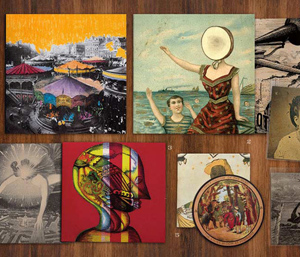
Instead, LaPorta focused on all the previously unreleased material, including the tracks making up the two 10” EPs – Everything Is, which features alternate versions of the songs from the band’s original debut EP plus bonus tracks, and Ferris Wheel on Fire, featuring eight previously unreleased acoustic recordings. He also mastered/re-mastered the music for two 7″ records (Little Birds and You’ve Passed/Where You’ll Find Me Now), and a 7″ picture disc with fold-out poster (Holland 1945/Engine).
The unreleased material came into The Lodge on a variety of formats – digitized 4-tracks, cassettes, vinyl, even home video. LaPorta took it track-by-track, enhancing the quality and – moreover – the sonic experience of the material, considering that Neutral Milk Hotel sound.
“This was a really interesting process as far as the engineering challenges were concerned,” says LaPorta. “The key in creating a final product that was cohesive and natural was making the most out of the incredibly varied source material, while still making each track sit well next to the other.
“For example, some of Jeff’s acoustic material was tracked extremely hot on his 4-track, so with all that gain and distortion, the track yielded a compressed lo-fi quality that he wanted to preserve. My inclination was to make the listener feel like they were right there with Jeff while he was recording the demo and just subtly EQ’ing it to bring out the presence and liveliness of the room and his vocals. So I kept a very light hand on compression.”
Other tracks, however, needed a complete facelift. “On some of the demos and live recordings, there was quite a bit of hiss and noise warranting some restoration work right off the bat,” says LaPorta.
“Every track posed a different challenge so it was great to have a few options to audition how well the plug-ins responded to the material in question and see which would treat it the best. Jeff had a lot of input as far as how much ‘cleaning’ up he wanted me to do. Things sometimes can get lost in that process – like the charm and the realness of the recording. Ultimately, the restoration work had to be subtle enough not to distract the listener from the actual music.”
From there, LaPorta would process the audio through an analog chain that he modified for almost every track. “Before I would start working on any song, Jeff and I would just spend some time listening to it and figuring out what was necessary. I ran some of the tracks through The Lodge’s vintage Pultec EQP 1A’s which add a lot of tonality and greater depth,” he notes.
“The Pultecs are positively superior for midrange control and perhaps the most musical EQ because of their unique shelving circuitry. Other items in the arsenal included the Avalon 2077 and the TubeTech SMC 2B multi-band compressor that was sometimes patched in at the end of the chain to ‘seal the deal.’ But it’s never one set formula.”
There were a few even more extreme cases of track revival during these sessions as well. “On some of these songs I really had to pull out all the tricks,” he says. “I had to do some of the most drastic enhancements I’ve ever done.”
For example…LaPorta salvaged a song/performance Mangum had brought in on video. “Jeff played an intimate show in what looks like someone’s apartment and he wanted to include that particular performance on the album – but it hadn’t been properly recorded,” LaPorta describes.
“It was extremely thin: the recording was basically whatever was fed into the camcorder’s tiny little mic. Here, I really had to dig in and try to bring some life and warmth while working around the limitations of the recording. I was really happy with the end result on that – it’s the B-side of Little Bird.
“Another track was pulled from a limited 7” release that only existed on vinyl”, LaPorta explains. “We used this great VPI turntable and Dynavector cartridge and mastered directly into the analog chain.”
Speaking to LaPorta about mastering Neutral Milk Hotel, we expected the unreleased full band tracks would be way raucous and loud, as on Aeroplane, and that this would be the unique challenge in mastering all this material.
“Well, the band tracks on Everything Is are a bit tamer compared with Aeroplane,” LaPorta notes to our inquiry.
“I did master one song off of the Aeroplane album, “Holland 1945”, which is included on side A of Holland Picture Disc. But yeah – the Aeroplane album is pretty loud! (laughs) I was surprised at how loud it is, compared to today’s releases. Jeff told me how they used some heavy normalization in the mastering process at the time. Personally, I think it sounds great – it’s raw and aggressively in your face! A daring aesthetic that was not very popular with indie music bands at that time.”
Only a mastering engineer who can appreciate this bursting-at-the-seams sound could do justice to the work. Having mastered records for sonic renegades like Sleigh Bells and Matt & Kim, along with plenty of bands influenced by Neutral Milk Hotel’s brand of fuzz-pop, LaPorta was the right choice.
Check out the Neutral Milk Hotel website, and hear some choice cuts as MP3s and buy the box set!And get in touch with Joe LaPorta via www.thelodge.com/mastering.
Joe LaPorta Masters Vinyl Box Set By Neutral Milk Hotel at The Lodge
September 14, 2011 by Janice Brown
/* Filed under Deli NYC Feed, News */
Mastering engineer Joe LaPorta of NYC’s The Lodge recently mastered the much-anticipated new all-vinyl box set release from legendary indie-rock band Neutral Milk Hotel.
Due out November 22, this box-set is the band’s first official release of any kind since their beloved album In The Aeroplane over the Sea came out in 1998. And Neutral Milk Hotel’s singer/songwriter and indie rock icon Jeff Mangum visited The Lodge to participate in the mastering process with LaPorta.
Look out for our upcoming feature interview with LaPorta on the mastering of this momentous release, which includes a total of 7 records – the band’s entire catalog plus 15 unreleased tracks .
According to the Neutral Milk Hotel website, the box-set will include (more specifically):
“…two gatefold 12″ records (In the Aeroplane Over the Sea and On Avery Island), two 10″ records (Everything Is EP with bonus tracks and Ferris Wheel on Fire EP featuring eight previously unreleased acoustic recordings), two 7″ records (Little Birds and You’ve Passed/Where You’ll Find Me Now), one 7″ picture disc with fold-out poster (Holland 1945/Engine), and two 24″x24″ posters.”
Every newly-released song will be available as a pay-what-you-will download via BandCamp as of November 22. And tune into the brand-new Neutral Milk Hotel website now to stream unreleased versions of “Oh Sister” and ”Ferris Wheel On Fire.“
For more on The Lodge, visit: http://www.thelodge.com
Back to the Future With Robert Schneider of The Apples in Stereo
December 3, 2009 by Janice Brown
/* Filed under NYC Spotlight */
PARK SLOPE, BROOKLYN: “I went to Disney World last year, and I thought Tomorrowland was so cool,” explains an enthusiastic Robert Schneider, lead singer/songwriter of The Apples in stereo. He’s showing me an illustration of a retro-futuristic society, one of those Atomic Age renderings of an urban skyway predicting a utopian dream-world of conceptual design — industrial and imaginative and high-tech. “And, that was when it clicked for me, this is what I want my next record to sound like!”

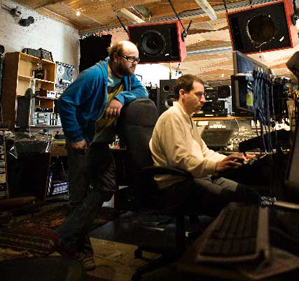
Robert Schneider with Bryce Goggin (at the computer) in Brooklyn's Trout Recording. Photo Credit: Adam Cantor (www.adamcantor.net).
We met Schneider at Bryce Goggin’s Trout Recording in Brooklyn, during mixing sessions for the new album, and had the chance to hear some of this music of the retro-future. And it was indeed conceptual, industrial, imaginative and high-tech — music to soundtrack that 60s-era utopian dream of the future. Driven by heavy R&B and disco grooves, these tracks feature space-age synths, fuzzed-out guitars, layers of futuristic flourishes and classic instrumentation, all arranged in a sprawling pop soundscape. Front and center is Schneider’s shiniest, most exuberant vocal, backed by harmonies (man and robot) galore.
As with the last Apples album, New Magnetic Wonder, the upcoming record was produced in multiple studios, on multiple computer-based systems, and then synthesized and mixed with Goggin at Trout. The multi-track, even multi-platform (Pro Tools, Cubase, Logic) process illustrates just how far Schneider has come as a record producer from the lo-fi, 4-track production approach of the early Apples records, or of Neutral Milk Hotel’s On Avery Island and In the Aeroplane Over the Sea.
Schneider’s unique perspective on music comes from his lifelong passion for pop songwriting and recording, his co-founding of the Elephant 6 Collective, producing beloved records by Neutral Milk Hotel and The Olivia Tremor Control, his recently released Robbert Bobbert and The Bubble Machine kids music album and his ongoing success with The Apples in stereo. It’s a perspective that will enlighten, encourage and inspire. Read on, friends…
So, you had this ‘Tomorrowland’ vision for the record. Were you writing in your studio, experimenting with sounds as you wrote? Was there an overall sonic objective from the start?
Most of my sonic ideas came out of listening to music I really love and I’ve been trying to only listen to stuff that I want to absorb as influences — ELO, Michael Jackson, Hall & Oates and The Bee Gees (70s Bee Gees). And, I’ve been obsessing heavily on Eye in the Sky by The Alan Parsons Project. It’s almost all I’ve been listening to the last year! It’s so futuristic and slick and it totally takes me back to my childhood when I hear it.
When I’m writing songs, though, I’m just trying to write a good song. And, I wrote most of these new songs on piano, so the futuristic thing came in on the production and in the lyrics. Writing on piano is really different for me, most of my songs have traditionally been guitar based.
What made you try writing more on piano? And how did that impact the songwriting?
I have a really raw style of guitar playing and I’ve been noticing lately that the quality of my guitar playing was improving due to lots of touring. And I don’t want my guitar playing to get slick! I’m afraid that if I start using vibrato with my left hand or picking too cleanly with my right, I’ll never be able to go back! So, I’ve been trying to not play as much because I don’t want to lose my thing. So, I moved to piano.
In the past when I’ve written on piano, it’s always been in a Beach Boys style — either these thick lush chords like Pet Sounds, post-Burt Bacharach kinda thing, or a sunny, poppy thing. But on these new songs, I was aiming for this R&B direction, rhythmically, on the piano and I came up with these Hall & Oates, ELO-inspired chugging piano riffs with like jazzy chords.
When I’m playing these songs on piano, they could be Motown songs, but then when we recorded them, incorporating the futuristic sounds in the production and backing tracks, they became these plastic-y, futuristic songs that sound nothing like Motown.
When you’re writing, do you get a bigger sense of where the song will end up, like as in the overall sound?
Yes, as soon as I’m writing, I’m hearing the arrangement in my head. I’ll be strumming it on the guitar and suddenly the whole thing is in my head — I may not hear the exact backing vocal part or guitar solo, but I’ll hear that there is one, dimly, in my mind. And then when I go to record it, it’s almost like I’m polishing it away to see what it really is.
On this record, I had this set of sounds in mind from records that I love; things that sound to me to be either futuristic or retro-futuristic R&B. Like some Kool and the Gang keyboard sounds, and this glass-tapping rhythm track from Michael Jackson’s “Don’t Stop ‘Til You Get Enough,” and these Hall and Oates piano sounds.
So, the new music is quite different for The Apples in stereo. Songs off New Magnetic Wonder, like “Energy” and “Same Old Drag” are pointing towards the new album a little bit, but this is still like two steps beyond that.
The first time I heard “Energy,” I thought it was a classic song I just hadn’t heard before. It does have this sort of retro-future, or at least classic-modern, sound.
It’s funny because when I wrote the song, Marci (my wife) said it sounded like the Coca Cola song, “I’d like to teach the world to sing…” And I agreed and joked that maybe Coke would license it. But, then Pepsi licensed it! They did this whole ad campaign around “Energy.”
Speaking of which, The Apples in stereo has done well licensing music on commercials. What do you attribute that to?
I’ve always been obsessed with writing hit pop songs. Not smash hits that sell a lot of copies, but songs that stick around. Like, I love Hoagy Carmichael and Steven Foster. Songs like “She’ll Be Coming ‘Round the Mountain,” stuff like that. These perfect pop songs that have stuck around for hundreds of years.
And I always loved the Bubblegum Movement of the 60s and 70s. Songs like “Yummy, Yummy, Yummy” by The Ohio Express and “Green Tambourine” by the Lemon Pipers, and “Simon Says” by The 1910 Fruitgum Company. These are like nursery rhyme-based pop songs, but they’re incredible songs, produced by these guys Jerry Kasenetz and Jeff Katz.
They had massive hits all over the place. It was “Bubblegum music” so it wasn’t taken seriously, but it’s actually kick-ass, rocking, awesome, psychedelic music. It’s just as good as anything from that era.
So, ever since I was young, I’ve been interested in writing hit songs, songs that your grandmother and little sister would like, as well as that would ring true for you as a hipster. Music that people could roller skate to. But making modern radio hits was never something I was interested in; I wanted to write songs that would have been hits in 1966-72.
So, now, it’s really cool that as an indie rock band, I can have hit songs on TV! I can make the records I want to make, and get big exposure through Pepsi, or some other big corporation, which is kind of amazing.
So, it’s someone at an ad agency that ends up appreciating your hit pop songs!?
Yeah, some people picked up on what I was doing, and eventually some of those people were working at ad agencies. It’s really cool that you can make a hit song that doesn’t have anything to do with pandering to the modern audience or radio. Just make the music you think is awesome. And then it can still seep into the world and everybody’s hearing it in their living room!
[Check out these South Korean schoolchildren singing "Energy" by The Apples in stereo!]
Before the Apples and Elephant 6, my friends and I would write songs and record and I thought we were songwriting and recording geniuses. And in the world, as it was in the late 80s and early 90s, there was absolutely not even one model, one way that we could expect we’d sell a record, or make any money playing.
The Elephant 6 Collective [formed by Schneider (Apples) with his high school friends Bill Doss and Will Cullen Hart (Olivia Tremor Control), and Jeff Mangum (Neutral Milk Hotel)] was us starting to try to figure out how we could get our music out into the world, make some money and, more importantly, make an impact; to try to take down the slickness that we hated about modern music at that time.
It was frustrating to think that there we were — as I saw us at the time — this group of geniuses, and me personally writing songs based on Hoagie Carmichel and the Beatles and stuff that I knew people would love. I used to wish I’d have been born in the 50s, then I could have been the right age in the 60s, and I could have had the chance.
But, when what you do rings true for the few people who do hear you, it rings REALLY true for those people. It’s not just another band, it’s like THIS is the fucking thing I love.
You were tuned into something that was unusual for people your age at that time, but sure enough, people heard it and connected with it.
Yes, and we had multiple bands on Elephant 6 so there were always a lot of records coming out, which helped to promote all of the bands. And for me, being the producer of a lot of the records, it was great, because I developed these two different paths: my path as the lead singer/songwriter of The Apples in stereo, and then my path as a producer. And these were definitely tied together, because I was equally as obsessed with making my friends music as my own.
So your work as an artist/songwriter and producer was always intertwined?
Yeah, I was recording Jeff Mangum and Bill Doss’ music, as well as my own, back in high school. On the production side, I was just as confident with other people’s music. I was always so confident in my vision, regardless of my skill.
I can remember, with Neutral Milk Hotel’s In the Aeroplane Over the Sea, Jeff Mangum was living with me at the time, and every day I’d come in and wake him up to go to the studio, and I’d be like “Wake up, Jeff, we’re making a classic record!” And I believed that. We were trying to make a classic record; I didn’t know that 10 years later people would actually hold it in that esteem. We assumed people wouldn’t even hear it.
So, we’d go to the studio and have a great day and it was all really encouraging and creative and wonderful, and then it turned out we did make a classic record.
Is there anything you took away from those Aeroplane sessions that you still use, either as an artist trying to give the best performance, or as a producer/engineer trying to capture the best performance?
I was very conscious of trying to capture some real energy in those sessions. I believed at the time, and I still believe, that recording music is like taking a photograph. When you take a picture of someone, you’re capturing the light that’s bouncing off of them onto film, but the person in the photograph is projecting all sorts of things besides the light that’s bouncing off of them. Similarly, it’s not just the sound that’s coming out of an artist, there’s all sorts of energy, electromagnetic stuff surrounding us that we’re putting out…motions and disruptions in the air and in the room, and varying levels of enthusiasm.
And the thing is that people are so tuned into other people that you can listen to one vocal track and then in a second one, they could barely sing it any differently, and it could convey a whole different emotion to you.
I was convinced at that age, that you could really capture all of that stuff on the tape machine, that the recording could convey all of that. Just like looking at a photograph from 100 years ago can make you feel happy, as if the person in the photo was smiling now. It’s that sympathetic feeling that we have for each other and music’s just like that. It’s possible to capture that. And it will resonate with people.
You hear it in old R&B records and early rock-and-roll records. You can close your eyes and really hear the people playing in the room, you can almost hear the shape of the room.
Well, you definitely captured that in Aeroplane, captured something that people can really connect to, over and over again.
Well, I was really trying on that record. And it wasn’t hard to capture that because it was just there — it was a lot of friends working together, and there was a really good feeling in the air. But it’s really nice to know that it is possible to capture that, the symbolic representation of that moment.
When a hit record makes you feel something, it’s because these are feelings that were captured onto the tape. It’s not just that it triggers some memory for you or sounds familiar, it’s that the people that made the record had these feelings and they come out the other side for you, the listener; your mind decodes all of the human, emotional information on the record, and you love it. And that’s what I want to try and bring out in records — not only the great music, but all the other information people connect with that comforts them. That’s my main goal in music, really, to try to do something that makes people feel better and even feel good.
Now you can produce music of unlimited tracks, where you were once committed to recording on 4-track and 8-track machines and only to tape. What changed that now you’re content to travel around, recording to a laptop DAW?
It was the early 90s when we started our bands and Elephant 6 and, at that time, we believed that a recording studio would suck the soul out of the music, and you’d leave discouraged because it would sound like you. It was this awful “studio sound” of that time that we heard on major label records from the 80s and 90s.
Even the lo-fi bands — stuff like Nirvana and Sebadoh — signed to major labels and started to make slick records by our standards. I thought digital was evil. So, I wasn’t recording with 4-tracks by convenience, it was like a religion. When I moved to 8-track that was like a big leap, and not all my friends were into it.
Recording studios are different now. Like I’m in one now and it’s the best studio I’ve ever worked in and the engineer is mind-blowingly talented. And the music industry that I was so “anti” at the time has now failed and everything I hated is gone. Modern recording studios are filled with vintage gear and people worship it the way they should.
So, I’m pretty pleased with the overall musical environment we’re in as far as production goes in the modern world. So, now I don’t care about whether you use a 4-track or 100 tracks on Pro Tools. For Apples, I’d rather have the 100 tracks.
Stay tuned for more info on The Apples in stereo’s new record, which will be out April ‘10. In the meantime, check out the lead single off a new record by Schneider’s new band Thee American Revolution, a ‘home recording project’ band he started with his brother-in-law, Craig Morris. Click to stream the song “Powerhouse”:
Audio clip: Adobe Flash Player (version 9 or above) is required to play this audio clip. Download the latest version here. You also need to have JavaScript enabled in your browser.