The Spirit of NYC Mastering: Get Inside the Ears of James Cruz and Zeitgeist Sound Studios
February 14, 2011 by David Weiss
/* Filed under Deli Feed, NYC Spotlight, SPARS Feed */
LONG ISLAND CITY, QUEENS: Scratch below the surface of any of today’s independent masring engineers, and most likely you’ll find a team player there. There are a lot of one-person shops dotting the NYC landscape, but these individual practitioners weren’t always flying solo.
Case in point: James Cruz, founder and sole proprietor of Zeitgiest Sound Studios in Long Island City. In another dimension – circa 2004 – Cruz was a young addition to a mastering dream team operating within the dearly departed Sony Studios. His collaborators there were some of the heaviest hitters – then and now – in the industry: Vic Anesini, Vlado Meller, Joseph M. Palmaccio, Darcy Proper, and Mark Wilder. The late, great technical genius Dave Smith, VP of Sony Music Engineering, oversaw it all.
Change being the constant that it is, in 2007, Sony Studios closed to make way for something else deemed more useful. The All Stars are now scattered across the planet, but Cruz, a longtime resident of Astoria, made it just across the river to Long Island City to found scenic Zeitgeist. Since settling in, his credits have included the last three Calle 13 albums (winners of a total of seven Latin GRAMMYS and two GRAMMYS), Mary Mary, Cee Lo, Three-6 Mafia, Natasha Bedingfield, and more.
Here, Cruz cues us in on many things mastering – why he stays in the box, how artists can make the most of their session, and the beauty of being your own boss.
Tell us about the “signal path” that got you into mastering.
Ha! If you want me to start at the top…Just about out of college I sent resumes all over town — I wanted to be a record or mix engineer. Troy Germano at the Hit Factory called me for an interview and hired me as a GA (General Assistant) in the mastering department. At the time I had never heard of mastering and knew nothing about it, but he said to give it a try and eventually I can move over to “the other side.”
This was at the time The Hit Factory was at its peak: The engineering staff consisted of Herb Powers, Tom Coyne, Chris Gehringer and Roger Talkov. At the time Roger was one of the few people in New York with a new workstation called Sonic Solutions, and he was betting on it being “the future of the business.” Roger needed to move on, I decided that I would learn the system, and I was literally learning trial-by-fire style doing sessions for Celine Dion and Jim Steinman two days later.
Soon after that Tom went over to Sterling Sound so I picked up the computer, put it in his room and said “mine.” I was doing Toni Braxton sessions with LA Reid the next week. All while still making coffee and running the library. Then I learned how to cut records from Herbie – one of the best vinyl cutters ever and learned my EQ chops from Gehringer. It was a pretty special time. I liked it so much that here I am 20 years later. I never went to “the other side.”
That sounds a little like how I got started writing about pro audio! Your mastering career led you to a nice distinction – one of the final group that made up Sony Mastering: What do you feel was special about the people that were there? And the facility, for that matter, at the time that it got shut down in 2007?
Sony was amazing. The Hit Factory was great for many reasons but Sony was amazing. It was one of the most underappreciated and under-used facilities ever. Never again will there be a place like it: You could walk in with nothing, book a production room, record, mix, master and duplicate your album. Then you could go down the hall and shoot and edit your video and do artwork, and even do a live broadcast from the soundstage.
Another thing about it was the technical staff. By far the best in the business. I could ask them for the most bizarre setups you could think of and it would be done in 30 minutes, without ever having to rent gear. The mic locker was epic.
Then there were the engineers. Of course everyone knows the juggernaut that is Vlado Meller, but on top of that was Mark Wilder, a pair of golden ears if there ever was one, and Vic Anesini who did fantastic work. It was a place where we all worked on making each other better and it was always great to have these guys to give an opinion on an EQ or compressor setting. I feel like The Hit Factory was a long training session and Sony is really where I came into myself as an engineer.
I always wondered why it was so quiet every time I was at Sony. After that, why did you decide to go solo and set up Zeitgeist, rather than joining another mastering facility?
Honestly, Sony shut down and I had no interest in working for someone else anymore. I couldn’t really see myself at Sterling or Masterdisk so I didn’t even pursue it. I figured I had already worked in two of the best spots ever and now it was time to do my own thing. I also like the idea of being completely responsible for myself and not having to answer to anyone.
So how would you describe what you’ve created in Zeitgeist – what were your objectives for the room? How did you set it up?
The most important thing for me was the vibe. Even though I’ve worked in these amazing studios, all the rooms always felt very cold and sterile – there’s really only so much you can do with a black couch and lava lamps. So first and foremost I wanted sunlight.
I also went in the complete opposite direction of the “modern mastering room” and went back to what it was originally intended to be, and that’s the best-sounding living room stereo in the world. So I did just that: I built a giant living room with tons of comfort and a front window that’s 20’ long by 8 ½’ high — I barely even need to use electric lighting anymore.
Zeitgeist is the Comfort Zone. You also mentioned to me that you master virtually 100% in the box. Why is it that?
Pristine signal flow — mastering rule Number One. When I started everything was on tape. It came in on ½” (sometimes DAT) and ended up on lacquer and/or UMatic. There was always a physical medium so there was always multiple pieces of gear, a bunch of feet of wire, patch bays etc…
Even though everything was as high quality as possible, it always imparted a sound. Sometimes it was good, sometimes it was bad. Along the way I noticed everything started to go all-digital — started with DAT then recordable CD. So I started to back off on the analog gear. I didn’t want to convert to analog, go through a bunch of stuff, then have to go back to digital. Eventually it went to all WAV files so I found no reason to ever leave the box.
I’m using very high quality mastering grade plug-ins and my signal flow is as short as possible. Do I miss analog stuff? Yes. Very much. I would much prefer to turn a knob then adjust a trackball! There are definitely some advantages to doing it this way, though, besides the signal flow. It allows me to work much faster, which benefits the client in the end. I also have a lot more flexibility than I ever had with analog stuff.
There’s always a tradeoff, in either direction. How is your workstation configured?
My workstation is the Sequoia by Magix and my main EQ is the Orange Linear Phase by Algorithmix. I can’t live without them. It runs on Windows XP and the computer was custom built by Sony’s computer genius Jim Yates.
It’s a powerhouse of a system and extremely stable. It’s so over-engineered I have seen no reason to update it yet, to be very honest. My next batch of plug-ins will probably be the Sonnox Oxford stuff – it’s not new but it is some great-sounding stuff. Universal Audio is also doing some very cool stuff with all their emulations.
Turning around to what’s coming into your system, what would you say are the trends you’re seeing in terms of the recording techniques and audio quality of the music you’re getting? How are projects evolving, and how is that affecting the way you approach your job?
Let me start here, and this is as diplomatic as possible: owning Pro Tools doesn’t make you a recording engineer, in the same way that owning a frying pan doesn’t make you a chef. That being said there are more and more projects being done in smaller project studios and fewer people are actually involved in the process. There is actually a very good article in a current magazine about the engineer becoming a loner, where in the days of the larger studios there were always other people around to give opinions and push you to be better.
That’s a major change that’s affecting the way things are done. As far as audio quality, it’s always been hit or miss. There have always been bad engineers and great engineers. As technology gets cheaper there do seem to be more and more engineers though.
On that topic, you said that client education is something you’re a big proponent of. What’s an example of a correctable mistake you often hear on the projects you get – something that people could easily fix so that you can deliver a better master?
I love for new clients to call me before the session and ask as many questions as they want. I am a big believer in one-on-one communication with the client. It benefits everybody.
The biggest mistakes I get are too much compression/limiting – see “level wars” discussions in every audio publication and message board written in the last 10 years — and the tops and tails of the tracks not being right. If your mix engineer is adding a limiter on the two-mix just to make it loud, tell him to remove it before sending it to mastering. Your mastering engineer should be able to make your track loud without wrecking all the wonderful dynamic range that makes music connect on an emotional level.
It’s also helpful to leave a second or two of air before your song. Don’t start your WAV right on the music, let it breathe a bit. Your mastering person can trim it for you. And lastly, that applies to the end of the track too: Leave some air at the end so your mastering engineer has some room to work, especially when sequencing an album. The worst, and costly, mistake is not being prepared. Call your engineer before the session and get in detail the way that things should be done, if you have any questions.
That’s some super-solid advice! Things are pretty competitive here in the NYC mastering scene, right? How are things evolving for you and your competition?
I think the smaller guys are making a pretty serious play. To be very honest, and I mean this with the utmost of respect, I don’t really see how the giant muti-room places can survive with that business model much longer. The overhead is just too high. As budgets continue to shrink and the web continues to shut down labels it’s going to be the boutique studios that will be able to keep up.
On another tip, who are some music innovators that have inspired you – be they engineers, artists, business people, chefs…?
Wow. Good one — there are so many. In no particular order: Jimmy Page, Pink Floyd, Brian Eno, Daniel Lanois, Pete Townsend, Geoff Emerick, George Martin, Brendan O’ Brien, Jim Thirwell, Jon Brion, Joe Strummer, The Talking Heads and XTC. Just to name a few.
That’s a heady mix! Finally, when you sit down to master a record – whether it’s an indie artist or major label hit – what’s the big payoff?
I love doing an attended session and playing the before-and-after for a client and seeing their face light up. That’s a lot of fun for me. When everything is complete, the client sits down and listens to the complete product, and says “YES!” that makes me very happy.
File under “What a Feeeeeeeling!” Anything else to add?
I need a vacation. It’s been way too long.
Amen!
Shane Stoneback: Music Production Career Construction with Sleigh Bells, Magic Kids & Vampire Weekend
September 16, 2010 by David Weiss
/* Filed under NYC Spotlight */
DUMBO, BROOKLYN/CHELSEA, MANHATTAN: Shane Stoneback would be the first person to tell you that he’s a lucky son-of-a-gun. Sure this fast-emerging producer/engineer has sharp ears, sharper instincts and a marvelously open mind, but he’s also got an undeniable knack for being in the right place at just the right time.
A quick scan of his expanding discography bears that out, with some of the timeliest artists tapping him to bring new sounds, classic styles, and hybrid approaches to their projects. Vampire Weekend, the arresting joy-noise of Sleigh Bells, updated old-skool of Magic Kids, and mystery-soaked Brooklyn duo Cults, are all his latest clients, and that’s just for starters.
To handle the heavy metal, undefinable psychedelia, and everything in between, Stoneback’s dual NYC studios are seeing an enviable level of action. He often gets things started in the raw DUMBO zone he calls Treefort Studios, then crosses the river to finish at SMT Studios in Manhattan, the SSL 4000 G+/Augspurger-endowed mushroom wood dream room he shares with engineer Brian Herman.
Able to make the most out of every opportunity that comes his way, Stoneback has gone a good distance since his formative years as a tech at Battery Studios and in the machine room of audio post HQ Sound One. Settled comfy comfy behind his big board at SMT, Stoneback caught us up on his latest adventures.
You did some recording recently with Magic Kids, we hear.
Right. I went to MemphisW for about a month to a studio owned by Doug Easley. He’s worked with Cat Power, Sonic Youth, and a bunch other great groups. Previously he had a beautiful, old-school studio with three-story-high live rooms, like at Abbey Road. It was famous, but it burned down four years ago.
Now he’s set up shop in an old insurance sales office. It’s a decent studio, but he has a Neotek board that’s like a Salvador Dali painting, because the knobs are kind of melted. We did all the principal tracking there – guitar, bass, drums – and hired this whole cast of local musicians. The talent pool in Memphis is pretty amazing, and Magic Kids is a big band with a lot of members – their network is pretty extensive, and they’re only two calls away from any instrument you can think of.
Magic Kids’ keyboardist/producer Will McElroy has these elaborate, intensive arrangements in his head. In the 1970’s you would have spent six months making this record, and we spent two months. I ended up getting really sick because I spent so much time making it. I didn’t get a lot of sleep in those two months.
They’ve definitely got a style that stands out – how would you describe their sound?
There’s nine people in this band. The Magic Kids have classic songwriting sensibilities, but with modern tools used in their creation, like lots of big 808s.
That new song you produced with them, “Cry with me Baby”, has some old skool elements, but it also doesn’t sound 100% retro…
Sounding retro was a big fear. When I start with a band, if I can I spend time with them a little bit, at a rehearsal or wherever, and talk about music, or I see what’s on their iPod when they’re not looking. These guys were listening to house music when I met them, which I thought was so odd, but it kept it from being a throwback record.
They didn’t want to make a cutesy throwback record – they avoided that at every turn. Some of the songs are super epic, on a level with Electric Light Orchestra songs. Anyway, the record is coming out in August, and you better get your roller skates on for it!
OK! Or can we just hop on our bike? In the meantime back here in NYC, you’re running not one but two facilities. Let’s take it from the top with Treefort Studios in DUMBO.
Treefort is one of those loft locker spaces. I got it three years ago for a writing room and I started to build it out when one of the kids from Vampire Weekend came in. I wasn’t done with construction, but they came out and started doing drum overdubs, and I started a good relationship with those guys.
The room is great, it’s a raw inspiring environment with books, chotchkes…people seem amused out there, but it is roughing it. I don’t have proper air conditioning, and the last few days have been brutal. But then again, Treefort is a much bigger room. There’s a lot of bands in particular I work with that want to lay down core live takes with three or four band members. They’ve been touring and they have it all locked together. You also have much more options for mic placement there. Plus I have tube organs, weird keyboards, and the room is cheaper because there’s a lot lower overhead.
We couldn’t help but notice the SSL 4000 G+ here at SMT Studios in Manhattan. Why keep it separated, instead of having everything together in Treefort?
We could never build this room in that place for a bunch of different reasons. The zoning would be difficult, and I’m not sure how long that building will last because of housing development in the area. The Treefort is awesome, but it’s collapsible. I could tear it down, put it up somewhere else, and it would be the same.
So now the package is we could have a band record at Treefort, do all the overdubs, and then mix it here in a room that’s acoustically tight with a great board. Every record we’ve mixed here has, in my opinion, been my best record. I just keep on thinking it gets better in this room.
Looking around, it certainly seems like you’ve put together what would be considered a dream facility for a lot of producer/engineers today.
This room is awesome. There’s two reasons we selected this configuration. Previously we had a baby Oxford and a pair of Tannoys that are now at Treefort. At the same time, there was a series of studios closing in the city that had an SSL G and Augspurgers, and that was how all the pop hit records were being recorded. Chung King had one, Battery had one, and there’s clearly been a vacuum for that. If they’re all closing down, then clearly there’s not a line around the block for that flavor, but if they all close down, then there’s still room for one.
Brian and I both worked at Battery, and this was the combination of console and speakers that we worked on every day. Plus, I love this board and the EQ on it – you can get rough with it and it sounds really cool. Or you can do nothing, just push the faders up, and it glues everything together better than it would in your workstation. Also, to get a Neve console of the same size would have been an enormous amount of money and this console, aside from cleaning, was in pretty good shape. I think it was in Usher’s house, so it wasn’t getting abused in a commercial facility.
People need studios. Whether they need me or some other engineer, they definitely need these environments where they can come in and have all the tools. Sitting in your bedroom, making a record, you can do that once, and it sounds awesome. But every band I’ve worked with this year – Cults is a good example – love what they’ve done in Garageband. But then they want to make it bigger.
(Take a video tour of SMT Studios hosted by Shane Himself right here)
With the different things that you’re doing, do you consider yourself to be a producer, engineer or a mixer?
I’ve been thinking about this a lot lately. I feel like we’ve all become facilitators more than anything. No two things come in the door with the same ratio of requirements – some people come in with great music and no idea of how they want it to sound and they want you to hold their hand through it. Others come in with it all ready to go, and they just want you to hit “record”. In any event, the line in the sand between producer and engineer has become very difficult to distinguish.
On the facilitator tip, I hear Derek E. Miller of Sleigh Bells is like an engineer…
The way that we met, xl recordings booked a couple of weeks at Treefort for M.I.A., so she could have some time to write and experiment. She was going to meet with a variety of people, but I believe she heard about Derek through Spike Jonze, so how awesome for him, to get cold-called from M.I.A. one day to make a song. I didn’t know who he was – he could have been Danger Mouse or this huge producer, and I could have been Steve Lillywhite for all he knew – we were both nervous around each other for a while.
We had some time to kill, and he started talking to me about compressors and the best settings for a female vocalist. Then he started playing me the Sleigh Bells record [which would become Treats, released May 11, 2010], and I immediately loved it. I said, “Put this out right now!” He said he’d be willing to go into the studio and work on it.
Some people would have stopped him from doing what he was willing to do, like going into the red digitally. That’s “wrong”, but what he and I discovered is that initially it sounds like crap, but if you go into the red further it starts to sound better. You can crank the EQ, sweep the frequencies, and make it start screaming like a guitar distortion pedal. I started to listen to Garageband, Logic and Pro Tools overloaded, they all sounded different, and we used those like tools to get the aesthetic for that. Derek has these specific things that I don’t think anyone has brought to the table as benchmarks – I think he really did want to hurt his ears at those frequencies like 4k! Like that French electronic group Justice, the way it’s filtered it hurts when it’s turned up loud, but it still sounds really cool.
Sounds like a good schooling. What were some other surprises that came up working with Derek on the Sleigh Bells record?
He was working with these vintage drum machines from the early ‘90’s, but he hated using the rock kit on the Korg or Alesis drum machines. They didn’t sound good until we rammed the fader all the way up and just knocked every frequency up as loud as every other.
We tried a lot of guitar amps, and we settled on this Korg Toneworks which is like something for a tour bus. It sounds like crap in the best possible way. Because of the circuitry, it shaves off all these frequencies so it sits in the mix right away – you could triple or quadruple the track and it doesn’t sound muddy. It sounds like the synthesizer you wish you had!
With that record, you couldn’t really do wrong. It was like going off the deep end into some uncharted territory. I liken it to the first time someone cranked a guitar amp and someone said, “You can’t do that!” and you say, “Just give me five minutes and you’ll see what I can do.” Hopefully I won’t get asked to make a record like that again, because I wouldn’t want to repeat it. But I do pull elements from it.
On a parallel tip to all this experimentation, you told us that you’re seeing a return to a more pro studio approach in recording – what do you mean by that?
There’s definitely a slew of records coming out where people are making rock albums that don’t sound bedroomy to me. Yes, there’s a good vocal sound you can get in your bedroom because you’re recording while your roommate’s sleeping, and it’s very intimate. But there’s something about a really well-recorded vocal where people scream, go off, and get the emotion out. You don’t hear the recording, you just hear the artist, you know? I feel like that will come back.
It doesn’t have to be slick with long reverbs and all that. The Raconteurs record (Consolers of the Lonely), that sounds great. The Them Crooked Vultures record, that sounds huge: it’s really thick and sounds good quiet, but it also sounds good in here cranked up loud.
You’re getting more and more credits on projects that producers would want to get the call on – Vampire Weekend, Magic Kids, the Sleigh Bells record — why is your stock going up right now?
Part of it is luck. So I’ve been in the right place at the right time a lot. That said I can still tell I get better at this each day. It was serendipitous that I met Vampire Weekend, and the initial job that I did for them was not exclusive knowledge – anybody could have done it. But I worked up a good working relationship. I was an assistant engineer in studios for years, so I got good at the boring parts: taking notes and backing stuff up. I’m a great Pro Tools editor, and a lot of people don’t want to deal with that. People will keep you around for that.
On the second Vampire Weekend record (Contra), I hammered home the facilitator thing. Rostam (Batmanglij) is a great keyboard player, a great arranger, and picked up the basics of engineering pretty quickly, but he still needed a facilitator to handle things on a day-to-day basis. We rented a marimba that was bigger than this table! We set it up, mic’d it and recorded it. Even if I had never done it before, I’d pretend I’d done it ten times.
– Interview by Janice Brown and David Weiss
Sonnox Oxford SuprEsser Review By Jason Goldstein
August 31, 2010 by Jason Goldstein
/* Filed under Tech & Reviews */
Unfortunately, poorly recorded vocals and instruments are all too commonplace, given today’s do-it yourself production mentality. Poor microphone choice and placement, over-compression, and room noise can wreak havoc on the quality of a recording. The job of cleaning up after a bad recording can be very tedious.
Enter the SuprEsser from Sonnox: a plug-in aimed at making the modern day mix engineer’s janitorial duties, an easier one.
TECHNICAL STUFF
The SuprEsser is a native only plug-in, that comes in RTAS, AU, and VST formats and is available for both the Mac and PC. It comes in three flavors, each adding a higher degree of resolution but at the cost of higher latency. Anywhere from 500 to an astounding 12,000 samples of delay! Soooo, unless you like doing lots of math, this plug-in should be reserved for use only on systems capable of ADC (automatic delay compensation).
WHAT IT IS/WHAT IT DOES
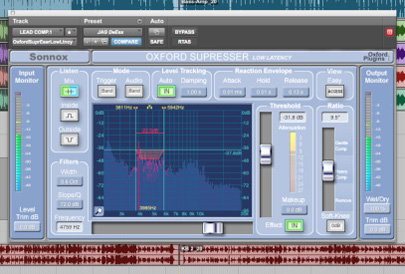
In a nutshell, the SuprEsser is a very sophisticated frequency specific compressor, which allows the user to target only those areas of the audio spectrum where a problem is occurring. This means it can be used as a de-esser, de-popper, or when used in wide band mode, as a more traditional, all-purpose compressor.
THE INTERFACE
In a word, awesome! Although the GUI has a lot going on and may seem confusing at first, in reality it is actually very easy and intuitive to use (there’s even an “easy“ view which simplifies the interface, leaving only the most basic and useful features visible).
The target frequency, threshold and amount of compression are represented both numerically, and visually on an FFT display, making the process of identifying and eliminating unwanted artifacts both quick and simple. Unlike your average de-esser, you will also find controls for attack and release as well as an auto function, which allows the amount of gain reduction to remain consistent regardless of the input level.
As if that weren’t enough you can also choose from two types of “listen” modes. One, called “inside” which is the standard mode found on most de-essers as well as an “outside” mode which allows you to hear which frequencies are NOT being affected by the processing.
SuprEsser IN USE
I was able to test drive the SuprEsser on both Pro Tools native and TDM systems as well as Logic Pro running on my laptop. As a straightforward de-esser, this one ranks among the best I have used. Dialing in just the right amount of compression was quick and easy and there was no dulling of the sound that one normally finds with this type of processor. Plosives, or pops, as they are also called, were also handled with ease.
One of the cooler uses that I have found for a de-esser is for removing unwanted hi hat leakage from snares and toms. I find it sounds much more natural than trying to using a noise gate, which tends to cut off the attack of the drum.
The SuprEsser excelled in this application as well. Being able to vary the attack and release of the compressor and not just the frequency and threshold meant I was able to remove just the right amount of hi-hat without overly affecting the sound of the snare.
Another cool feature found on the SuprEsser is the ability to mix the amount of wet and dry signals being sent to the output. This is similar to parallel compression, allowing you to apply drastic amount of gain reduction to a signal and then blending to taste.
CONCLUSION
The only drawback I could find with this plugin was the aforementioned processing delay. Other than that, the SuprEsser is a veritable Swiss army knife of compression and a welcome addition to my plugin folder.
For more information and to purchase the Sonnox SuprEsser, visit: www.sonnoxplugins.com/supresser.
Jason Goldstein is a NYC-based Grammy-winning mix engineer who’s worked with Beyonce, Jay-Z, The Roots, Ludacris, Jill Scott, R. Kelly, Michael Jackson, Mary J. Blige and more. For more on Goldstein and to get in touch, visit www.jasongoldsteinmixer.com.