Studio Sweet Spot: Luminous Velocity Productions

April 5, 2011 by  
/* Filed under NYC Spotlight */

Do you have tunnel vision, or are you constantly expanding your media universe? In East Flatbush, many disciplines are in action at Luminous Velocity, a nonstop melting pot of music and vision.

Multiple heads and monitors for multiple media, at Luminous Velocity.

Facility Name: Luminous Velocity Productions

Website: www.luminousvelocity.net

Location: East Flatbush, Brooklyn

Neighborhood Advantages:
East Flatbush is in the heart of Caribbean Culture here in NYC. The West Indian Day Parade is held annually here. We’re close to the 4 and 3 Train, and Bus Access is even closer. There’s a great variety of Caribbean food within a short walk away, and there are lots of good down-to-earth people from all walks of life.

Date of Birth: Luminous Velocity’s Studio started in the summer of 2007. We’ve grown in leaps and bounds to our present state since then.

Facility Focus: Where we shine is putting it all together, and delivering on what our clients need. Our studio handles Audio Production, Mixing/ Remixing (on-site/ remote), Composition, Mastering (Analog/Digital), and Visual Arts (3D, Video Editing, Motion/Print/Web graphics).

Mission Statement: Our mission is “Maintaining the Speed of Thought”. We work every day to create unique content, and bring the ideas of our clients and crew into reality.  Simply put, our mantra is “make stuff real”.

Clients/Credits:
Real to Myself Project (Ari Up, Anna Ozawa, Rhiannon of Subatomic Sound System) –  Recording, Production, Drum Programming, Mixing, Mastering
LaGuardia Community College /Journey To Success — DVD Production
Hezekiah Walker — Recording, Mixing
X-Calibur / “Not a Club Song” — Production, Mixing Mastering
Tommy Tunes — Dance Mixes, Training
Dijay – Hood Divas -Deck Entertainment — Recording and Mixing for No Limit Artist Rick Flair – 20 Bricks
Denver Smith — Production & Drum Programming
3X Entertainment -Fire & Brimstone Project — Production, Recording, Mixing, Mastering
Aswad Kefentse — Production, Recording, Mixing
Deuce Fever — Production, Mixing, Mastering
Full Deck Entertainment/Bounty Hunters — Production, Mixing, Mastering
DJ Dino Mileta — Recording,Arrangement, and Mixing
Akhil aka Ambition – Major – JD Mac & Lyricosiz — Production, Recording, Mastering
Hefnaz Productions — Mastering
Soul Degrees Dubplate Project — Remastering
Legal Hustle Entertainment — Production, Recording, Mixing
Rolling Big Entertainment — Production, Remixing, Programming, Mastering
Tomkevich Studios — Custom Studio Acoustic Treatment
CC Cowan — Production, Drum Programming, Mixing
Our Children’s Foundation — Custom Studio Construction
Drama Desk Awards — A/V Setup & Engineering
TSA Records — Recording, Mixing, Artist Development
many more….

Key Personnel:

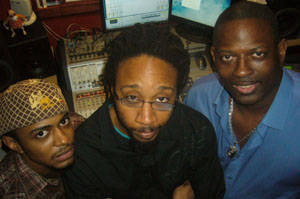
(L-R) LV's Einstein Charles, Asukaya Bailey and Edward Jackson

Asukaya Bailey (Kaya) – CEO/ Founder
Edward Jackson (Cott)– VP/Audio Production Director
Jorge Alexander Cifuentes – Art Director/ Packaging Designer
Jason Calderone – CG Director/ Lead 3D Artist
Isa Ramadan Shaaf – A/V Director, Producer, and IT Guru
Einstein Charles – Audio Producer & Musical Genius
Alana Conway – Marketing Supervisor

System Highlights:
PC Side:
•    Luminous Velocity Custom Built Intel Quad-core PC (XP/Win7) • RME Digi96/52 Adat Lightpipe Soundcard • Wacom 8.5 x 11 Tablet
• Tascam SX-1LE  Mixing Console • Event 20/20 BAS Monitors (pair) • Event Tuned Reference 5 monitors (pair) • dbx 586 Dual Vacuum Tube Preamp •  Native Instruments Maschine

Mac Side:
•    Macbook Pro • Digidesign MBox 2 • Yamaha HS50 Monitors (pair) • Native Instruments Maschine • Akai MPK-25 Midi Controller • Behringer Tube Ultragain (Vintage Series) • Alesis Midiverb 4 • Dbx PD48 Patch Bay

Modules and Keyboards:

• Yamaha Stage Piano • Akai MPC 2000 • Korg Poly61 Vintage Analog Synthesizer (Pre-Midi) • Roland Fantom 61 • Alesis QSR Rack • Korg Triton Rack with Sampler • E-Mu MP-7

DJ Station & Other Gear:

• 2 Technics SL1200 MKII Direct Drive Turntable (Silver/Black) • Vestax PMC 17A-  3Channel turntable mixer • Behringer Eurorack UB1204FX-Pro( 8 Channel Mixer) • Behringer Eurorack MX 1604A • Athena 8 Bay DVD Duplicator ver 1.35 • ART Tube Pac (Professional Tube Amplifier/Compressor)

Audio Software:

• Digidesign Pro-Tools 8 LE • Steinberg Nuendo 3.4/4.3 • Logic Studio 9 • Ableton Live Suite 8.13 • Propellerhead Record 1.5
• Propellerhead Reason 4/5• Image Line FL Studio XXL 8 • Native Instrument Komplete 7 • Native Instruments Maschine x2
• and a host of other software instruments and plugins

Graphics and Video Software:

• Autodesk 3D studio Max 2009-2011 • Autodesk Maya 2009 • Autodesk Autocad 2009 • Adobe Master Collection CS4 & CS5
• (Photoshop, Illustrator, Indesign, Flash, Dreamweaver, Premiere, After Effects) •    Apple Final Cut Studio ( Final Cut, Motion, Sountdtrack) • Corel Painter XI •    Autodesk Combustion 2008 • Pixologic Zbrush 4.0 • and other design and visualization software

Everything comes together in East Flatbush. (Click thru for the full view!)

Distinguishing Characteristics: We provide a quiet and stable environment, sizeable recording booth, great atmosphere, and wealth of knowledge to each person that graces our facility. Our best features are based as much on our people, as they are on our equipment. Our crew & setup is extremely flexible and personable. A big part of what we do is working intelligently to give each client the necessary personnel, tools, and time to get their vision/sound just right.

The building is on fire, you only have time to grab ONE thing to save, what is it?
Our 1859 Scoffield Bible – and other rare books. Hopefully some HD drives. We’d like to get as much out as two hands can carry.

Rave Reviews: People love the atmosphere, sense of humor, and above all else the sound. One person called us “MIB” (Men In Black), as they would never know that there are so many tools, toys and treasures hidden in a small unassuming building in Brooklyn.

Most Memorable Session Ever: Two sessions over this past year come to mind. The first was an impromptu session in April with Rhiannon Erbach (Subatomic Sound), Anna Ozawa(an incredibly talented vocalist/ instrumentalist from Japan), and the late Great Ari Up (R.I.P) of the Slits on Bass.

The second most memorable session was with Reggae Artist Aswad Kefentse, Shabu Bak Men Floyd & Aquah Tcherbu Beale (two classical African Percussionists from Sheps Hetep Ancestral Music), Andy Bassford (great guitarist who’s played for the Legendary Jamaican Producer Coxsone Dodd, Shaggy, and others) and Larry McDonald telling us about the good old days of recording using Stones from the Flinstones Rock Quarry. Good times…

Session You’d Like to Forget:
A few sessions have taught us to do smarter business, and to respect our craft.

Dream Session: Cott’s Dream would have been working with Michael Jackson, Portishead, Barrington Levy, Dennis Brown, Black Uhuru, Hughby Banks and the esteemed Edward Jackson senior.

Kaya’s dream session would be Burning Spear, U2, Jimi Hendrix, Ras Michael and The Sons of Negus, Augustus Pablo, The Abbyssinians, Yoko Kanno, Pink Floyd, and Muddy Waters.

For Einstein’s dream session he would like to work with Will.i.am, Timbaland, Machel Montano, Lord Kitchener, Jr. Gong, & Usher.

Asukaya Bailey (Kaya), CEO/ Founder of Luminous Velocity

“Mixology” with George Walker Petit: Real Mixers Mix in Headphones

April 3, 2011 by  
/* Filed under NYC Spotlight */

I ride the 6 train sometimes, and it’s loud.  The New York subway experience is degrading and filthy at worst, just plain noisy and jarring at best.  Part of the NYC gig.

Now hear this: George Petit Walker is phoning your head.

I also attend a neighborhood gym, and often could do without the ever-present bass thump and moronic lyric of most house dance music. Let’s consider the overly inquisitive child on the flight from JFK to LAX. Remember Bill Cosby’s “Jeffrey”Google it, it’s on YouTube. Hilarious stuff. Or the screaming infant in seat 31C.

Car horns, fire trucks at 2am.  New York is not a gentle and quiet place.  Part of why we love it?  Love it, hate it, love it, hate it, love it, hate it. Evelyn Mulwray to the white courtesy phone, please.

“Forget it Jake, it’s Chinatown.”

Be Quiet, I Can’t Hear You
The world intrudes on my focus and internal space far too often (“…dude, chill.”).  I don’t think I have A.D.D. – HEY, LOOK!  But I do miss the quiet at times. Not even quiet per se.  I lose that focus, that “peace”.  The world seems so full of external noise.  Visually, I can deal, but I am a musician and an engineer: sound helps define my life.  I can’t turn sound off, can’t ignore it.  I hear rhythm in all things, harmony everywhere.  But at some point, some times, I need to control it, at least try to attenuate/filter/regain my focus.

I remember sitting on a train with my wife, on the way to an airport at the close of our vacation.  At Kandersteg station (we were in Switzerland), a significant herd of school kids joined us, hormones a-pumping.  An uncontrollable group-howl of excitement. The look on Donna’s face was one of realization.  Realization that our peaceful vacation was rushing toward a frenzied close.  How this hurt me!

I reached into my briefcase and withdrew my trusty MP3 device and two pair of in ear monitors (IEM)’s with a splitter.  We chose Brahms.  We smiled.  Blood pressures fell, smiles appearing.  Into our own private world, our retreat, peace.

So I have IEM’s.  Lots of IEM’s.  IEM’s that fit well and…don’t fit so well.  IEM’s that sound hyped and sound flat, loud and not loud, cheap and expensive.  And this works!    I can filter out the noise when I want to, when I need to. Nothing like riding the #4 express to Union Square and listening to Tom Waits.  Surreal.  Perfect.  Tolerable.

The sanctuary of it. The sheer delight in not being forced to aurally participate in what is going on around you.  Think of the peace, the seclusion, the focus, the efficiency.

You get it, right?

Let’s move on…

Armed (Eared) and Dangerous
I got that call again back in the Fall, that call to go to Brazil.  I love that call.  “Come on down, George, we need you to engineer a couple of sessions, and while you’re here you can teach our staff a bit, play some gigs, eat churrasco, drink cachaça and unwind, breathe in Brazil.”  I love that call.  It’s kinda quiet tonight.  (hint, hint…)

I think the only bummer about the trip is the sound in their control room.  The live room is a WSDG jewel, it’s gorgeous, huge. They now have the right mics as well, the console from my old studio, a bunch of great outboard, and a kind-hearted cook (‘Neide’) that makes a “corn cake” to MURDER for, and the churrasco nearby at Jardineira is about the best on the planet.  Beats Fogo de Chao hands down.

But the sound of control room A for mixing, and the monitors…not so great.  I track in A and then move the entire session, vibe, bevvies and body count to their B room to mix, hoping that what I tracked translates well.  What a pain, and no, I am certainly not shipping my Proacs down there!  For some reason I don’t fully grok, they don’t want to fix the room, or buy new monitors!  Been to Brazil for work?  Then you know…

So I bring my “SWEG’s”.  Every time.  They save the session for me.  Every time.  My “Secret Weapon Ear Goggles”.  (music: accent here)

The Big Confession
Ok, ok…I blab, I meander.  Let’s get to the point.

Sound advice from any angle.

Look, I mix in headphones, ok?  (enter: cries of derision from the chorus…)

Ok, ok…not all the time, but often, effectively and with a smile.

Ohh, here it comes!  I anticipate sharp intakes of breath, chiding comments about lack of room interaction, the nature of stereophony, proximity of sound to (in) the head, poor frequency response, crosstalk, fatigue and discomfort, exaggerated panorama. Cries of  “INFIDEL!” (“…dude, chill.”).

Yes, it’s true.  I’ve reached the point where I feel that my headphone mixes are 100% valid and of high quality.  Yes, I do take the cans off and check the mix on monitors periodically, as often as I would switch between different sets of monitors.  Normal.

Fact is, there are many things one can learn from mixing in cans, things one can focus on microscopically, other benefits. Let’s talk about that.

Room interaction, stereophony.  Not getting into the nitty on this stuff, ok?  I am going to assume that you are already aware of (or can research) the physics of sound to the point where you understand the effects of a room and monitor placement on your work, how sound reaches your ears, etc… You should have a great and accurate room.  Agreed?  Good. We should spend a lot of time and money on acoustic design.

Acousticians — I know a few and they all deserve white lab coats. These guys and gals are Shamans…Shamen?  Shawomen?  They’re scary gurus.  We all benefit from their knowledge and ability.  But what if the room you are in was not designed by one of said gurus?  What if the sound of the room basically…stinks?  (oh no, surely not YOUR room, of course!)

How about the gear in the room?  What if the studio monitors you have to use for your job are made by…oops!  Almost got me!  Let’s just say they are — less than adequate?  Or maybe you’re just not used to them yet?  What are you going to do?  What are you going to do NOW, immediately?

Hey, what if you’re working in a home studio and you have the dreaded NEIGHBORS??

Ok, go on, lug your Genelecs around with you when you travel for work.  Better yet, lug your Gene’s AND your Hothouse monitors with the matching Hothouse amp and Kimber cables…some do in fact.  I don’t often have that luxury all the time.

Me? I “lug around” my extremely high end “SWEG’s” and their equally dangerous and sneaky “Cansamp” (someone please coin that).  They travel in a small Pelican case.  What exactly do I use?  Tell ya later…

In yo’ FACE!
Over the years, I have enjoyed studying the work of many engineers (still do), getting inside their sound and trying to learn from their approach.  I hope never to stop learning.  We all have our mentors or those from whom we have shamelessly stolen tricks or techniques. Elliot, Al, Bob, James, Bruce.  I could list 50 more.

I’ve found that by donning a great pair of ‘phones, I can really “see” what these greats are doing.  I can hear mic placement, the room, the “digi” effects added, the subtleties of the mix, and the “whys and hows” of their magic. In headphones I can hear that with a closeness and precision that beats monitors.  To get right up on the mic?  To hear the “issues”?  I go to the ‘phones.

Listen to one of Elliot’s mixes or Roger’s mixes: the panning, the detail, the precision.  Instruments are tucked into just about every little nook and cranny of the panorama and soundstage.  I can smell the room.  What about Pink Floyd mixes?  The AM radio transition in “Wish You Were Here”…stuff in the way far distance of a mix moving from ear to ear?  Headphones, baby.  Great engineers might or might not go to headphones for their work (some actually do), but when I want to get downright microscopic on mixes?  I go to the ‘phones.  Find the click, the pop, the mouth noise, the pencil hitting the music stand.  Headphones.  You want to get into this level of detail?  Get the gear.  Tell ya later.

ALL ABOARD !!
I recently read that “the majority of music is produced to be listened to in rooms with speakers”.  Wow.  As simple as that.  Hell it was in one of those “big” audio magazines!…gotta be gospel, right?  Not really…I looked up at the date of publishing and it was 2003.  These days, the largest amount of produced music is being purchased by and marketed to a generation that chooses to experience their music on various “I-boxes” using “Eargizmos”.  Come on…PLEASE argue with me.  Then go look at the literally hundreds of IEM and portable music players out there.  Every color of the rainbow, every size, models that are endorsed by Hollywood Stars!!  Somehow I doubt the Stars spent hours at the bench testing “their” products.

This is the age of personal music experience, even you audiophiles reading this probably have IEM’s…they might have cost $9000, but you have them, just so that you can debate which model is of higher fidelity.  I submit that we should be mixing at least to some degree with this in mind.  There is not one mix job that I have done in the last ten years where I haven’t gone to earbuds or IEM’s to check the relative levels and low end.

Why?  Come on, didn’t you do that with “Horror-Tones” for years?  Or that little metal speaker on the Studer two-track?  Come on, own up.  Whether or not we are supporters of the quality of the MP3 format (or lack thereof), it’s a format here to stay, at least for a long while.  Remember the big “Digital Debate”?  You still stomping your feet?  I maintain that if you are working with any genre of music that is going to be played on these little gizmos, you should work your mix on them as well.  Get onboard or get left at the station.  Adapt.  Paradigms change. Deal.

Mine is better than yours!

Cranial evolutions continue with the likes of the Focusrite VRM (Virtual Reference Monitoring) system.

Sure it is.  You like it more, it’s better.  Most likely though, you’re just used to it.  There are limitations in headphone design that will impact frequency response, comfort, accuracy and soundstage…funny, just like there are in monitors.  Open back or closed back ‘phones?  What kind of cabling?  What is your source?  Your headphone amp is at least as important as your headphones, surely.  As a caring professional, I have to assume that you do your research, test and compare, settling on gear of the highest possible quality – dictated by your budget and your needs.

The technology is pretty advanced these days.  At the top end of the food chain there is some pretty amazing-sounding equipment.  All along that level and below, manufacturers are constantly developing tools to make your headphone environment more like your “room”.  Some work, some don’t work as well. I urge you to get out there and check some of this stuff out. I bet it will change the way you look at mixing in headphones.

SPL, Focusrite, 112dB. Innovations that control speaker placement and angle, crosstalk, center level response.  It’s impressive, when it works.  And in some cases it certainly does work.  I can say that with my chosen system, I can hear clear, strong and focused low end and smooth hi’s without the fatigue that so many associate with working in headphones.  Times have indeed changed.  And what about “familiarity”?  How long did it take for you to get used to the sound of your best set of monitors so that you knew what to expect from a consumer level system after your work left your room?  Do you not tailor your work to your equipment?  Hell, I’ve heard fantastic mixes come out of rooms with only a set of mid-priced, near-field speakers, by great engineers that knew what they were doing and what to expect.  That’s called experience.

The bottom line here is that you CAN mix in headphones accurately and comfortably now. Whether you need to or not, you can.

What’s more, the idiosyncrasies of headphones can certainly aid the process.  Mixing in headphones works to differing degrees, depending on your level of experience, your equipment and its limitations, your knowledge of what you’re after and what you can expect. Basically it’s the same deal with monitors.

I’d rather mix a project with great headphones, a superior headphone amplifier that boasts such controls as Crosstalk, Speaker Angle and Center Level than mix the same project in a mediocre sounding room with marginal gear.  I believe (and I support) that there is technology available to make this possible now.  Consider getting more into it.  It’s another source of reference.

What I am using…

Fixing to mix: Another perspective on the possibilities.

Well, this is not a review.  I am actually going to write a few of those soon and get FAR more detailed on this whole headphone thing, as well as writing some reviews about other studio gear.  But for now, let’s say that I’ve compared what are considered to be the very top brands at their “flagship” level.  Way up there in the stratosphere they’re all pretty impressive, let’s be clear.

But one has certain needs, and one works with certain types of music.  I’ve settled on what I consider to be the very best combination for my needs and budget, and have found that these choices exhibit exceptional levels of sonic integrity, high quality construction and a sense of “reality” that is just staggering.  What I use has brought me new enjoyment and excitement about my work and about listening to music.  And this has been downright inspiring, and worth twice the price of admission.  I am pretty blown away.  I find it hard to take the ‘phones off these days.

My headphone monitoring system:

IEM’s: Grado GR10 and GR8
Headphones: Grado PS1000, SR325
I have been using Grado products for 20 years.  The Grado product line has a quality and sound character that is present in all their models, true continuity through the line — a LOT more on this in an upcoming review of the Grado Sound.

Amplifier: SPL Phonitor
I am incredibly impressed by this unit, it is a total gamechanger.  I can simply find no better or more flexible headphone amplifier, whether using their controls to effect Crosstalk Center Level and Speaker Angle, or just listening for enjoyment.  The quality is unbeatable (IMNSHO!!).

Thanks for reading. The next installment will be about Mentoring, Teaching and…Theft.

Oh, and if you’re that guy on the #4 train with the HUGE cans with the big ‘b’ on the side?  Could you please turn it down a bit?

Cheers !
gwp

George Walker Petit thinks a lot about mixing and many other musical things. An award-winning producer and mixer, he is based in New York City. Visit George at his Website, and keep up with him and the Drew Zingg Debut Album Project here.

The Spirit of NYC Mastering: Get Inside the Ears of James Cruz and Zeitgeist Sound Studios

February 14, 2011 by  
/* Filed under Deli Feed, NYC Spotlight, SPARS Feed */

LONG ISLAND CITY, QUEENS: Scratch below the surface of any of today’s independent masring engineers, and most likely you’ll find a team player there. There are a lot of one-person shops dotting the NYC landscape, but these individual practitioners weren’t always flying solo.

James Cruz hears here: Zeitgeist Sound Studios.

Case in point: James Cruz, founder and sole proprietor of Zeitgiest Sound Studios in Long Island City. In another dimension – circa 2004 – Cruz was a young addition to a mastering dream team operating within the dearly departed Sony Studios. His collaborators there were some of the heaviest hitters – then and now – in the industry: Vic Anesini, Vlado Meller, Joseph M. Palmaccio, Darcy Proper, and Mark Wilder. The late, great technical genius Dave Smith, VP of Sony Music Engineering, oversaw it all.

Change being the constant that it is, in 2007, Sony Studios closed to make way for something else deemed more useful. The All Stars are now scattered across the planet, but Cruz, a longtime resident of Astoria, made it just across the river to Long Island City to found scenic Zeitgeist. Since settling in, his credits have included the last three Calle 13 albums (winners of a total of seven Latin GRAMMYS and two GRAMMYS), Mary Mary, Cee Lo, Three-6 Mafia, Natasha Bedingfield, and more.

Here, Cruz cues us in on many things mastering – why he stays in the box, how artists can make the most of their session, and the beauty of being your own boss.

Tell us about the “signal path” that got you into mastering.
Ha! If you want me to start at the top…Just about out of college I sent resumes all over town — I wanted to be a record or mix engineer. Troy Germano at the Hit Factory called me for an interview and hired me as a GA (General Assistant) in the mastering department. At the time I had never heard of mastering and knew nothing about it, but he said to give it a try and eventually I can move over to “the other side.”

This was at the time The Hit Factory was at its peak: The engineering staff consisted of Herb Powers, Tom Coyne, Chris Gehringer and Roger Talkov. At the time Roger was one of the few people in New York with a new workstation called Sonic Solutions, and he was betting on it being “the future of the business.” Roger needed to move on, I decided that I would learn the system, and I was literally learning trial-by-fire style doing sessions for Celine Dion and Jim Steinman two days later.

Soon after that Tom went over to Sterling Sound so I picked up the computer, put it in his room and said “mine.” I was doing Toni Braxton sessions with LA Reid the next week. All while still making coffee and running the library. Then I learned how to cut records from Herbie – one of the best vinyl cutters ever and learned my EQ chops from Gehringer. It was a pretty special time. I liked it so much that here I am 20 years later. I never went to “the other side.”

That sounds a little like how I got started writing about pro audio! Your mastering career led you to a nice distinction – one of the final group that made up Sony Mastering: What do you feel was special about the people that were there? And the facility, for that matter, at the time that it got shut down in 2007?
Sony was amazing. The Hit Factory was great for many reasons but Sony was amazing. It was one of the most underappreciated and under-used facilities ever. Never again will there be a place like it: You could walk in with nothing, book a production room, record, mix, master and duplicate your album. Then you could go down the hall and shoot and edit your video and do artwork, and even do a live broadcast from the soundstage.

Another thing about it was the technical staff. By far the best in the business. I could ask them for the most bizarre setups you could think of and it would be done in 30 minutes, without ever having to rent gear. The mic locker was epic.

Then there were the engineers. Of course everyone knows the juggernaut that is Vlado Meller, but on top of that was Mark Wilder, a pair of golden ears if there ever was one, and Vic Anesini who did fantastic work. It was a place where we all worked on making each other better and it was always great to have these guys to give an opinion on an EQ or compressor setting. I feel like The Hit Factory was a long training session and Sony is really where I came into myself as an engineer.

I always wondered why it was so quiet every time I was at Sony. After that, why did you decide to go solo and set up Zeitgeist, rather than joining another mastering facility?
Honestly, Sony shut down and I had no interest in working for someone else anymore. I couldn’t really see myself at Sterling or Masterdisk so I didn’t even pursue it. I figured I had already worked in two of the best spots ever and now it was time to do my own thing. I also like the idea of being completely responsible for myself and not having to answer to anyone.

So how would you describe what you’ve created in Zeitgeist – what were your objectives for the room? How did you set it up?

Attend THIS. Zeitgeist's accomodating accomodations.

The most important thing for me was the vibe. Even though I’ve worked in these amazing studios, all the rooms always felt very cold and sterile – there’s really only so much you can do with a black couch and lava lamps. So first and foremost I wanted sunlight.

I also went in the complete opposite direction of the “modern mastering room” and went back to what it was originally intended to be, and that’s the best-sounding living room stereo in the world. So I did just that: I built a giant living room with tons of comfort and a front window that’s 20’ long by 8 ½’ high — I barely even need to use electric lighting anymore.

Zeitgeist is the Comfort Zone. You also mentioned to me that you master virtually 100% in the box. Why is it that?
Pristine signal flow — mastering rule Number One. When I started everything was on tape. It came in on ½” (sometimes DAT) and ended up on lacquer and/or UMatic. There was always a physical medium so there was always multiple pieces of gear, a bunch of feet of wire, patch bays etc…

Even though everything was as high quality as possible, it always imparted a sound. Sometimes it was good, sometimes it was bad. Along the way I noticed everything started to go all-digital — started with DAT then recordable CD. So I started to back off on the analog gear. I didn’t want to convert to analog, go through a bunch of stuff, then have to go back to digital. Eventually it went to all WAV files so I found no reason to ever leave the box.

I’m using very high quality mastering grade plug-ins and my signal flow is as short as possible. Do I miss analog stuff? Yes. Very much. I would much prefer to turn a knob then adjust a trackball! There are definitely some advantages to doing it this way, though, besides the signal flow. It allows me to work much faster, which benefits the client in the end. I also have a lot more flexibility than I ever had with analog stuff.

There’s always a tradeoff, in either direction. How is your workstation configured?
My workstation is the Sequoia by Magix and my main EQ is the Orange Linear Phase by Algorithmix. I can’t live without them. It runs on Windows XP and the computer was custom built by Sony’s computer genius Jim Yates.

It’s a powerhouse of a system and extremely stable. It’s so over-engineered I have seen no reason to update it yet, to be very honest. My next batch of plug-ins will probably be the Sonnox Oxford stuff – it’s not new but it is some great-sounding stuff. Universal Audio is also doing some very cool stuff with all their emulations.

Turning around to what’s coming into your system, what would you say are the trends you’re seeing in terms of the recording techniques and audio quality of the music you’re getting? How are projects evolving, and how is that affecting the way you approach your job?
Let me start here, and this is as diplomatic as possible: owning Pro Tools doesn’t make you a recording engineer, in the same way that owning a frying pan doesn’t make you a chef. That being said there are more and more projects being done in smaller project studios and fewer people are actually involved in the process. There is actually a very good article in a current magazine about the engineer becoming a loner, where in the days of the larger studios there were always other people around to give opinions and push you to be better.

It's a digitally delicious view.

That’s a major change that’s affecting the way things are done. As far as audio quality, it’s always been hit or miss. There have always been bad engineers and great engineers. As technology gets cheaper there do seem to be more and more engineers though.

On that topic, you said that client education is something you’re a big proponent of. What’s an example of a correctable mistake you often hear on the projects you get – something that people could easily fix so that you can deliver a better master?
I love for new clients to call me before the session and ask as many questions as they want. I am a big believer in one-on-one communication with the client. It benefits everybody.

The biggest mistakes I get are too much compression/limiting – see “level wars” discussions in every audio publication and message board written in the last 10 years — and the tops and tails of the tracks not being right. If your mix engineer is adding a limiter on the two-mix just to make it loud, tell him to remove it before sending it to mastering. Your mastering engineer should be able to make your track loud without wrecking all the wonderful dynamic range that makes music connect on an emotional level.

It’s also helpful to leave a second or two of air before your song. Don’t start your WAV right on the music, let it breathe a bit. Your mastering person can trim it for you. And lastly, that applies to the end of the track too: Leave some air at the end so your mastering engineer has some room to work, especially when sequencing an album. The worst, and costly, mistake is not being prepared. Call your engineer before the session and get in detail the way that things should be done, if you have any questions.

That’s some super-solid advice! Things are pretty competitive here in the NYC mastering scene, right? How are things evolving for you and your competition?
I think the smaller guys are making a pretty serious play. To be very honest, and I mean this with the utmost of respect, I don’t really see how the giant muti-room places can survive with that business model much longer. The overhead is just too high. As budgets continue to shrink and the web continues to shut down labels it’s going to be the boutique studios that will be able to keep up.

On another tip, who are some music innovators that have inspired you – be they engineers, artists, business people, chefs…?
Wow. Good one — there are so many. In no particular order: Jimmy Page, Pink Floyd, Brian Eno, Daniel Lanois, Pete Townsend, Geoff Emerick, George Martin, Brendan O’ Brien, Jim Thirwell, Jon Brion, Joe Strummer, The Talking Heads and XTC. Just to name a few.

That’s a heady mix! Finally, when you sit down to master a record – whether it’s an indie artist or major label hit – what’s the big payoff?
I love doing an attended session and playing the before-and-after for a client and seeing their face light up. That’s a lot of fun for me. When everything is complete, the client sits down and listens to the complete product, and says “YES!” that makes me very happy.

File under “What a Feeeeeeeling!” Anything else to add?
I need a vacation. It’s been way too long.

Amen!

Mute Announces New Structure Details: Label, Publishing, Management Now Combined

December 9, 2010 by  
/* Filed under News */

Following the recent announcement that Mute has reached an agreement with EMI Music which sees the company, led by Daniel Miller, return to being independent, Mute has announced details of the new structure. Under the new arrangement, the record label, publishing company and a new artist/producer management company have been brought together under the Mute name.

Mute has detailed its new structure.

Angie Somerside returns to the company as Group Managing Director, overseeing the already established record label and publishing company, as well as launching and running the new Mute artist management company. Somerside started her career at Mute as a publicist, then was at UK independent and major labels, followed by the post of General Manager at QPrime Management UK before returning to Mute.

With the launch of the new company come a number of new singings, including London five-piece S.C.U.M, and Texan singer-songwriter Josh T. Pearson and Junip, featuring José González, as the first artists to sign to the invigorated company.

Alongside the new signings, Mute’s New York office is currently working with Moby, Liars, José González, M83, The Knife, Fever Ray, Erasure, Paul van Dyk, Andy Bell, Polly Scattergood, Recoil, Maps, and A Place To Bury Strangers.

A small number of artists will remain signed to and marketed by EMI Music, with Miller continuing to work with them in an A&R consultancy role with EMI.

Andrew King continues to head up the publishing company, representing Nick Cave & The Bad Seeds, Grinderman and Liars, Underworld, Juno Reactor, and Max Richter, and Sir Bob Geldof’s catalogue. Andrew King’s background was originally in management – he has managed Pink Floyd, The Clash and Ian Dury among others. Andrew will work with Angie Somerside in developing the management company within Mute. He is also Deputy Chairman of PRS for Music.

Mute’s New York office, headed by long term General Manager, Mark Fotiadis, will work closely alongside the UK company on both publishing and management deals. In addition, Mute has opened a new office in Germany led by Anne Haffmans, a long-time marketing director at Mute.

Career Engineering: Allen Farmelo on Recording Cinematic Orchestra, & That Post-Pink Floyd Sound

November 3, 2010 by  
/* Filed under NYC Spotlight */

CHINATOWN, MANHATTAN/FORT GREENE, BROOKLYN: What headspace are you in? For a music producer/engineer/mixer like Allen Farmelo, getting your talents to that sought-after place is all about finding yourself.

Allen Farmelo settles in for a chat in Mavericks' "open concept" studio.

In the process of doing that, of course, people will find you — that explains why one of Farmelo’s fans is an artful outfit like Cinematic Orchestra, the engrossing British jazz/electronic/soul influenced outfit led by Jason Swincoe. The ever-evolving group recently called on Farmelo to engineer their upcoming release for Ninja Tune, a project that he executed in the semi-exclusive confines of Chinatown’s intriguing Mavericks Studio.

Whether working at Mavericks or mixing/mastering at his rapidly evolving Fort Greene facility, The Farm, Farmelo’s primary angle – a sound he gravitates to that he calls “Post-Pink Floyd” – and artist-centric philosophy shows how an NYC audio pro gets on the map. As his list of credits grows (The Loom, Second Dan, Cucu Diamantes, Jonah Smith, Ian Gillan, The Cabriolets, Jesus H. Christ), so does his insight on what makes today’s music, and the business of it, tick.

You’ve been working a lot with Cinematic Orchestra the last few weeks. How would you describe that workflow?
I wouldn’t say it’s improvisational, but I would say it’s a very grand project that operates on a lot of different levels and that there’s a lot of exploration happening. Jason’s done a lot of writing beforehand, and he brings in musicians to flesh out the ideas. The writing is extremely intentional, and harmonically/melodically very plotted out. He knows the goal of those songs.

He’s an amazing producer because he manages to get people to do stuff that works for the song, without telling them what to do. Is he micromanaging? No. But is he getting the micro-details he wants out of people? Yes. So I’m watching him closely and learning from him.

Cinematic’s not like the Beatles where you have the same four members, and without one of them you’re done. Jason’s brought in people he feels will contribute to that particular song in the way he thinks it will happen best. Different singers for different songs, that kind of thing. So far it’s a bit of a different-sounding record than the previous one, and I think the lineup will reflect those changes.

Things are getting experimental...Cinematic Orchetra.

So what’s it like coming into the project as an engineer? Do they let you do your thing, or is it a collaborative process?
Jason knows what he wants to hear, he is extremely good at communicating it, and he lets me achieve that. He can sometimes get right down to the gear. They were working at Livingston Studios in London, using those Coles 4038s as the overheads. He described that setup, and I did that here to get the specific sound that worked well when he tracked in England.

So sometimes he’s very specific, other times he’ll describe a vibe or metaphor to get what he’s looking for, and then the way I achieve that is up to me. Mixing the Grey Reverend record that Jason produced was a lot like that, where both Grey and Jason would articulate well what they wanted from the record. Then I sent them home, said, “Let me do this,” and then let them come back.

My first stab was good on about 70% of the material — and then fell on its face on the other! We talked about that, and they were very good at articulating what they wanted changed. So we freed up some things in the mix, found the center of the record, and let those things happen. As the record went on, I was able to take more ownership of the aesthetic. So the collaboration is very easy and open.

So is it easier to go into this project now that you’re in the same headspace? Are there traditional references to other records he’s listening to as far as the approach, or is it like you’re already aware of what he likes based on the past experience?
Jason has written amazing, amazing music that is dictating everything about what follows. The songwriting is so strong and beautiful that everybody else is just there to serve that song – including Jason. I don’t feel any references to anything outside of those songs happening at all. Instead we’re coming from the center of those songs. And when you hear them, they all have their own character, life, logic, feel, tonality and beauty that’s obvious from the get-go, even when they’re just played on acoustic guitar. You say, “That’s freakin’ beautiful. Let’s make it more beautiful.”

How do you go about taking the song further at that point?
So everything from changing a mic to subdividing a beat to figuring out how to lay a crash down is there to serve that inner logic. Jason makes sure we’re there to serve that inner logic and the inner beauty of the song, and he communicates it very easily. You have the songwriter, the vision, and the songs are giving you tons of information from that.

You don’t have to do that much to know how to get the studio to sing properly for the song, and that’s where I feel I’m trusted to make some good choices along the way. It can be something as simple as, “Wow, slow tempo – let’s raise the overheads and let the drums sing a little more,” or for more complex patterns I might think, “Let’s get things a little tighter.”

Air to breathe.

For me, setting the tone on the guitar amp is instinctively informed by the guitar pattern. Since we feel very much in tune with the music, we all kind of trust each other aesthetically and say, “OK, let’s make this happen.” There’s not a lot of discussion about this stuff. It’s kind of obvious when things are working or not, everyone’s got great ears.

The thing that’s refreshing about working with these guys is that there’s no ego to get in the way of this discussion, so it’s an aesthetic conversation at all times – a really clean and artistic conversation.

That sounds like a rewarding way to be recording. Why is this studio a fit for this band and record?
Well, Maverick’s fits any project really well, as long as you don’t need to record forty musicians here. I had thirteen here once – that worked surprisingly well. That was a big, amazing, raucous New Orleansy anti-war album. So Maverick’s can kind of do that. We did the strings for Grey Reverend’s upcoming album here – we had a quartet in the main space. I did the whole Loom record, Teeth, which was a six-piece band all playing in the room together. A lot of people come to just do drums. It’s a very versatile space, and as long as your mics are in phase, you’ll sound good. There’s really no crappy-sounding place in here. For the Cinematic record, there’s just something wonderful happening between the songs and the room sound. They match beautifully.

It feels that way. What do you think about the “open concept” (studio in the round) format here?
I’ve been on two Tape Op Conference panels with other people talking about open concept studios, so I’ve thought a lot about it. And of course the most famous reference is Lanois. The number one benefit of it is being able to speak face-to-face with the people you’re working with and not through a talkback system. The alienation of a talkback system is apparent as soon as it’s taken away. It’s so nice to pull off the headphones and talk to the person you’re speaking to.

The drawback is there’s no room for bullshit. Everyone has to be reverent to the music happening. You can’t rattle your keys, text your boyfriend, read Vogue – a lot of what normally happens in the control room can’t happen here. So if you’re not into being reverent, you have to go into the back room where there are no speakers. You’re either in or out.

I didn’t realize I was paying so much attention to what was coming out of the speakers – instead of to the musicians – until I started working in an open studio. It’s a positive for me, but not for everyone – my friend Joel Hamilton jokingly calls us a bunch of hippies that like to sit in the same room together, and he’s kind of got a point as it can be pretty touchy-feely. But the other most obvious benefit is the amount of space I have. We have one of the biggest control rooms in NYC, because we have all this space, and when we’re tracking we can subdivide it any way we want.

If we’d had a separate control room, we’d be like a lot of little studios, but instead we’re like a good midsize studio here. For a facility our size, we have a really big control room and a really big live room. They just happen to be the same space – it’s an incredible way to take advantage of small spaces.


Good things come in twos at Mavericks.

That makes sense. What guides the gear choices here?
First and foremost, we have pairs of everything in the studio: Coles 4038’s, Royer 121’s, RCA BK 5As, Beyer M 160’s, Shure SM7’s, Elux 251s, 87s, 84s, 441s…a pair of everything. The point being that we are really ready to put up a pair of anything on any source, so we are really versatile when recording drums. We can get any flavor stereo overhead and room sound we want.

We used to have a mishmash of preamps, and then came to realize really quickly that we love API, and miss the glue/consistency of having the same preamps working off of a console. So we have 16 of the API 512s. We do have other pres – the Chandler, a pair of original 1073 Neves racked up by Brent Averil…but we have far fewer flavors then we used to, and we love it. We’re thrilled to have the same preamp on everything, because when you bring up the faders it all sits together tonally. We went through the “We could have a little of everything phase” and grew out of it.

We have a lot of really interesting compressors, and a lot of really standard standbys. We have two Purple MC77s, two 1176s, and a pair of DBX 160’s that used to belong to Johnny Cash! We have a pair of Distressors. Where we deviate is the API 2500 – I mix through that 2500 almost exclusively. I have one in my studio in Brooklyn, The Farm, and I have one here that’s always strapped onto my two buss. It reminds me not to over compress and to cascade from the individual channel compressors into that bus compressor. I work with it on all the time, so I know where I’m going to land compression-wise when it comes time to mix.

And there are other non-standard compressors here. We just got the Airfield Audio Liminator Two, which is a beautiful piece of kit, and this Gyrotek Varimu Tube Compressor is stunning – handmade in Denmark. So we have a lot of neat flavors on the compression side, and again, everything is stereo. We have two of everything, so you can run any pair of mics through any pair of pres/compressors.

Do you also mix here, or at The Farm?
I used to mix here, and then I had to mix back at my place because of a scheduling thing – this was like in 2006. So I recorded a record for Rachel Z., which featured Tony Levin, and other great musicians, and due to scheduling and some technical issues I ended up with mixes done on the console here at Mavericks, some summed in Pro Tools here, and some mixed in my room in Brooklyn. When we got to mastering, there were definitely differences – and the analog summed mixes were way better – but my mixes done at home were sounding really good. They were right up there. It was weird: I went to the news stand across the street from my Brooklyn apartment and saw that Rachel’s record was charting in Billboard, then I looked up at my window where my mix room is and said, “Wow, a new era.” So I did what everyone else did: I put together a mix room.

And now my studio, The Farm in Fort Greene, is a serious mixing situation. I have a lot of outboard gear, the Crane Song HEDD which I’m using to print my mixes off a Studer A-80 1/2” machine; a fully acoustically treated room. It’s pretty ideal and I’m doing pretty much all of my mixing there. That allows me to work within the budgets that are coming my way, allowing me to offer better deals to my clients and make a living at it.

The legendary brownstones of Fort Greene, home of The Farm, beckon.

That said, mixing here at Mavericks is a wonderful experience. We’ve got the Studer two-track, the center section of the Neotek, which is modified by Purple Audio, sounds wonderful. That console is like the mid-size luxury touring sedan with a badass racing engine in it.

We hear you’re putting together an interesting new console for The Farm. What was the concept, and how is it coming together?
The concept is to have an API Legacy console built from their amazing 7600 channel strips, which each have a 550A EQ, 225L compressor and 212L preamp along with four busses, four aux sends and infinite routing possibilities.

I realized after working on the big Vision console up at NYU’s Clive Davis school and then, days after, tracking at Mavericks with all API 512 preamps that API was a sound I could very happily commit to. But I couldn’t afford, nor did I really need, nor did I want to maintain, a full-on Legacy or Vision console.

The API 7600’s all connect to the 7800 Master Module to form a true, discrete Legacy console with as many channels you want or can afford. So I bought a pair of 7600s to try on a mix session and within about three minutes I knew I’d found my channels, and when I summed through the 7800 Master Module, I knew I’d found my console. Problem was I had to get it built.

Francois Chambard of UM Project in Greenpoint came on board, and our goal was to defy the look and feel of traditional consoles – which to my eye look like either Cold War-era military equipment, a dentist’s office, or some leather bound thing you’d expect Ron Burgundy to tell you he mixed his jazz flute on. I’m a really visual guy, and none of those inspire me, nor did I really want to spend the rest of my career behind one.

Instead we found a great blend between Francois’s sense of modern design and my own fascination with the landscape, architecture and design of Iceland. It’s going to look really different, yet it has the ergonomics of my favorite consoles all bundled together with space for over twenty-four channels, eventually. I couldn’t be happier, and Francois is a bad-ass designer. There’ll be racks and diffusors to match, I’m sure.

Sounds amaaaazing. Switching gears, let’s talk about the NYC recording scene. How would you describe what’s happening here?

Drums at the end of the rainbow.

There is an incredible energy around making records in NYC right now. Specifically in Brooklyn, there’s an incredibly good, positive foundation of recording happening.

Five years ago we were in distress a little bit, we were watching the big studios close. Now Avatar is still there, Sear Sound is still there – Walter RIP – they’re booked solid. Magic Shop is still there. These amazing rooms that really held close to their missions are still operating and they’re there for us to go in and use as needed. The new era is here, and we’re all relaxing into it.

The market crash happened in 2008, which was a grim year for everyone, but we got used to it. Now it’s a community of people making records. I see NYC as a place that adapted swiftly to a new model, and everyone’s got a room with an increasing amount of gear in it. Between the bigger studio and your own space, records are being made wonderfully that way. There are fewer places to get an orchestra recorded, but a hell of a lot of places for an acoustic guitar overdub!

The big loss is community. That’s not an original thought, but I do miss the community of being with a lot of people doing what you do. Writing for Tape Op helps, being on Facebook helps – when you have status updates, you feel like you’re in a conversation. I find I have to make an effort to find people who do what I do. It’s an effort, but it’s worth it.

So there’s a lot of obstacles to overcome, but musically I think NYC is bringing together the sophistication of indie, jazz and “new” classical music with the street levelness of the rock scene – now it’s almost the norm to have a string quartet on your record. I like seeing those worlds coming together. Maybe because no one can make a living at it anymore, we’ll all play on each other’s records! That cross-pollination is really exciting: Grizzly Bear and Arcade Fire used a lot of NYC string players on their last records, and you can feel a new kind of sound emerging nationally that has a particular stamp on it that, to my ears, says “Brooklyn.”

You’re from Buffalo originally, right? How did you work your way up as an engineer in the NYC studio scene?
I’m very much a self-taught guy. I had a bit of experience working at Trackmasters in Buffalo, now called Inner Machine and owned by the Goo Goo Dolls. It’s an amazing room, designed by John Storyk, and the Goo Goo Dolls are currently packing it with amazing gear. That studio is absolutely iconic in Buffalo’s music scene, and my first time in there I was playing keyboards in my highschool jazz band. We were badass that year, and then all the great players went off to college. It’s funny, I heard that recording recently and thought, “whoh, that’s amazing.”

Anyways, that first experience in a real studio had me hooked, and I soon after got a four-track and had at it. But where I really learned was in the DIY hardcore scene of the late ‘80’s. I did a record at Trackmasters in 1989 with my band RedDog7, then helped some friends make records there. I was kind of producing, but I had no idea that’s what I was doing. We made some seriously good sounding records, actually, and I was obsessed with getting good sounds – I knew guitars, amps, drums, cymbals, strings and even obsessed over sticks and picks. My head was way up in it from an early age, and I was thinking from the player to the instrument to the mic, which I now know is the right way to think.

Then we had a band house for a while, and and then this whole basement situation with the Mackie board and DAT machines. We made deals and acquired gear, recording, doing live sound and playing gigs, and then running this little DIY studio. That’s where I really cut my teeth as a recording guy, struggling to get a decent sound outside of Trackmasters. Over time in Buffalo I had the chance to become a bigger fish in a small pond, which is a nurturing environment, but that pond got too small. It was time to move on, so I came to NYC.

What’s your take on producing? You seem to have a studied approach to that role.
My philosophy of producing is that I try not to carry around any pre-ordained philosophy, but instead to generate a philosophy for the project in collaboration with the artist. I call that “guiding principles” – a very intentional guiding philosophy I try to lock in on and externalize for the project, in case we get lost.

Could these be the coveted Guiding Principles?

For example, I’m doing a children’s record with the Brooklyn-based artist Shelley Kay, and we have two guiding principles. One is, “Fuck Romper Room”, and the other is “Playful Minimalism.” Fuck-Romper-Room is easy – that means that whenever we’re getting into the mamby-pamby kindergarten shit, hit the red STOP button. And “Playful Minimalism” means that when we’re confronted with a decision we ask: Is it playful? It is minimalist? Those two words show us the choice to make. Between two drum patterns for example, if one is more minimalist, that’s typically the one to go with, and the result comes back closer to our original artistic intentions to keep the production clean.

Another artist that I’m working with, the guiding principle is “Sincere Otherworldliness.” I’m putting him through the paces as a songwriter. He’s been struggling to get his sincerity out, and the otherworldliness is an outwardly-stated goal of his to create a sonic world that’s very different from reality, another world one can enter into. To bring those two together is difficult – if you’re too sincere, you can’t get it spacey and amazing, but if you’re too otherworldly, you can miss being right there with the listener, making it sincere. These principles are meant to be challenging.

In production it’s very hard to stop saying, “I like that, I don’t like that.” If that’s going on in the conversation, you’ll never get to the heart of the matter. If you get past “I like that, I don’t like that” and closer to stating what you want to achieve, something like a guiding principle starts to open up, and you have much more productive conversations about what’s happening.

In my work, that’s the best thing I can give to their project: an open, comfortable dialogue about things, but with structure instead of just being completely wide open. One of the functions of the producer is to help the artist specify what they’re doing, and not be all over the place. Not everyone is making their fifth record and bringing all that experience to the table. A lot of people are making their first or second, and I have to be intentional about my role, because if I don’t we get sloppy.

How did you get to be like that as a producer? It sounds like you’ve evolved in that role, just as an artist does with their music.
It’s not a new idea to find artistic growth as a producer, I don’t think. I have to attribute my own growth partly to Bob Power, one of my mentors. He always says it’s about getting to a place where you’re letting the music make decisions, and I know exactly what he means. That idea inspired me to ask, “Well, how do you get to that place?” Like most great ideas, it’s not complex, but it can be a real bugger to achieve. There are so many things that can get in the way, like ego, fear, imagined or real audiences, commercial pressure, well disguised self-sabotage tendencies – basically anything external to the actual crafts of writing, performing and recording music. For me, to get to that place where the music is speaking clearly requires a pretty intentional approach to how I talk about the work being done, and that’s where the guiding principles idea kind of came from.

More and more of us producers are doing the A&R job of developing artists and their material. If we don’t have record labels, who will do all the development work? It turns out to be the record producer in a lot of cases. It’s a big part of the job. So if I can obsess about a compressor as an engineer, I hope I can also obsess about the dialogue that’s going to shape decisions about the album as a producer. That’s been a big area of growth for me, to enter into dialogue about the work with more and more clarity. It’s really fucking hard work, but when it pays off it’s amazing. I even read books about collaborating, about creativity – whatever I can get my hands on that I think might help. Right now it’s where I’m focusing my professional growth.

That sounds like amazing guidance to be able to provide throughout the process…
Yes, although I should also state that all of that development of the guiding principles, and doing the artist and material development, happens long before we hit record. It’s like pre-pre-production. It goes on long before I’m getting things ready for the actual recording date. It’s more of trying to figure out what the vision of the artist is, and helping them shape it. I’ll say it again, it’s not easy. It’s not the easy path of just saying “I like this, I don’t like that.”

Catch a Waveform: Chinatown's Mavericks pays homage to the famed Northern California surfing mecca of the same name.

The other thing is the kind of music I’m working on can call for this kind of approach. I’ve more recently committed as a mixer/engineer/producer to this specific vibe within modern rock music that I call post-Pink Floyd. Don’t take that term too literally, but one day someone asked that inevitable question “what kind of music do you work on” and I just said it – “post-Pink Floyd.” What I meant by it is this thread of really innovative, beautiful, spacious, compassionate music.

Pink Floyd had incredible empathy, beautiful spaces, beautiful sounds, and brought in influences of jazz and classical without doing them overly in the music. The ideas they brought in were so involved in empathy – it wasn’t, “Let’s go shake our butts and hump each other and party all night long.” Instead, they were dealing more directly with the human condition, and I just wind up working with a lot of artists who seem to have somewhat similar goals lyrically and thematically. So it’s not really about Pink Floyd in particular, but if I had to point to a moment in rock history where this compassionate, open, spacious music began, I’d say “Dark Side of the Moon.”

Cinematic Orchestra exemplifies it. Radiohead and Sigur Ros exemplify it. Elbow’s got it. Peter Gabriel’s work with Lanois has it. In fact, Lanois seems to get it out of people in general – he got it out of Dylan, perhaps for the first time. I work with a lot of artist who seem to want to work towards the aesthetic that are embodied by those examples, even if those records aren’t particular influences. Cinematic Orchestra is an honor to work with, because I feel that they’re harmonically, musically, thematically within that realm. I think they’re masters of space and compassion, and I think the record they’re making is going to blow people away. But that post-Pink Floyd thing comes in a lot of flavors. In American bands I’d include The National, Grizzly Bear, Fleet Foxes, Wilco does it do a degree, and especially Band of Horses. The Loom, whose record I produced, fits under that umbrella for me, even thought they sound nothing like these other bands, really. Again, it’s not really a particular sound, but a set of harmonic and thematic threads that run through the music.

It’s a hard and awful thing to have to put into the limitations of language something you feel and know so intuitively, but I guess that’s the exact challenge I’m putting on the artists I work with when trying to get positive dialogue happening about projects. In a way, post-Pink Floyd is my own kind of guiding priciple as I try to intentionally steer my career in a specific direction. I should probably work harder on clarifying that!

That sounds like an expansive genre to hang your hat on – what else is on the Post-Pink Floyd horizon for you?
I’m currently producing two records that are definitely going to carry some of that vibe. One is with Austin Donohue, who is writing some amazingly beautiful stuff, really finding his themes. He’s the Sincere Otherworldliness guy. The other is with Diana Hickman, who I think is writing some of the most innovative material I’ve heard in a while – like Joni Mitchell and Bjork go SCUBA diving together and surface with a record. Both of them are working their asses off, doing a ton of development work with me. Those will get done this winter.

I’ve also become inspired by Iceland as a place for music and making records. It’s a very sparsely populated, lovely place that just doesn’t go to war or pollute very much, and their landscape and relative remoteness lends itself to music that is really quite unique. When people settled Iceland, they didn’t colonize anybody, and it just doesn’t have this scarred past which so many other places rife with conflict have. It’s quieter. You can feel that lack of conflict and that quiet, and a sense of expansiveness in much of the music there, even when it’s erupting like a volcano.

At least that’s what my tired NYC ears hear. I just went back there in October to the Airwaves Music Festival in Reykjavik and saw amazing bands every night. I’m talking to one in particular about working together, and I really hope it starts to happen for me over there. I’m very interested in putting my foot on that other piece of land.

– Interview by Janice Brown and David Weiss

Music Seen: Music Supervisor Hot Picks * Electric Six “Countdown to the Countdown”

August 25, 2010 by  
/* Filed under Music Biz */

Artist: Electric Six

Buckle your helmets for Da Countdown!

Song:Countdown to the Countdown

Why I Luv It: As my loyal readers already know, anytime I get an opportunity to push high quality American rock n roll, I’m gonna’ do it, so you shouldn’t be surprised that this week I’m getting behind a brand new song from a band that ain’t so brand new.

The song is “Countdown to the Countdown” by Detroit, Michigan rockers Electric Six, and it’s hot off their yet-to-be-released 7th studio album entitled “The Zodiac” (out September 28th).

This song is an absolutely inspiring and balls-to-the-wall hard-charger of a rock song, and Dick Valentine (vocals), The Colenol (guitar), Johnny Na$hinal (guitar), Smorgasbord (bass), Tait Nucleus? (synths), and Percussion World (drums) have yet again proven that great stage names and veteran skills are all it takes to write and record a hit song. (Smiley Face) OK, just kidding! These guys can write and arrange a song with the best of them too!!!!!

If you’re not aware, Electric Six rocks as hard as MC5 or The Stooges while having the comedic sensibility of Les Claypool or even Weird Al Yankovic. If you like Queens of the Stone Age, Pink Floyd, Ween, and everything rock-n-roll in between, you’re gonna’ love this song, and furthermore, you’re gonna’ love their whole catalog. Make it a point to pick up “The Zodiac” when it comes out in September because it’s one helluva’ rippin’ super-dynamic sonic journey my friends!!!

Scene I Can See it In: “Countdown to the Countdown” by Electric Six must have been tailor made for NFL Football because this tune harnesses the raw power and fierce energy of the sport just as well as any other tune I’ve heard used for similar purposes to date.

Specifically, I think this song would be a great sonic-branding tool for the coverage leading up to and on the day of the NFL Draft. NFL Network and ESPN cover collegiate NFL Draft prospects throughout the off-season and right up until the day of the draft every April. For the last couple years, NFL Network has chosen and licensed songs to support their coverage of The Draft, and one winner of a song ends up being the main sonic-brand or theme of that years draft.

Dick Valentine sez: This meeting of the Matt Millen Fan Club will now come to order.

For example, “Dreamer” by K’Naan was used by the NFL in 2009 for limited Draft coverage, and David Bowie’s “Under Pressure” has been extensively used by NFL Network over the past few years for Draft sonic-branding. “Under Pressure” plays more to the child-like emotion and nervous sensitivity in the hearts of young aspiring pro-atheletes. That’s a far cry from the pure rock fury exuded by Electric Six on “Countdown to the Countdown”, but that does not take away from the song’s undeniably strong instrumental emotion and obvious lyrical relevance to competitive professional sports.

The title “Countdown to the Countdown” (which is also the hook of the song) accurately exudes the tense, competitive emotion that every aspiring pro-athlete experiences on a daily basis. Furthermore, those words (especially the way they’re sung) put on display the immeasurable focus and hard work that each athlete puts in every day in preparation for the Draft. It’s not just the countdown, it’s “The Countdown to The Countdown”, and that is a perfect example of the serious commitment that each player makes to his sport, talent, and craft. The full song lyrics (at the end of this article) do the same just as well.

Vocal and instrumental performances are stellar on this track and they collectively hit the bulls-eye from the start of the song right up until a soaring psychedelic break at :47 in. I can see the beginning of the song being used as a backing track underneath exciting game highlights of perspective NFL Draftees. Right when the break comes in at :47 would be a perfect time for intense sweaty facial close-ups of these potential Draftee’s in a dark locker room, sitting on benches staring in to the camera lens as it pans by each player’s passionate yet stone cold face. These dramatic shots are meant to express the heart and soul of each of these players as they each individually Countdown to the Countdown of this year’s Draft.

As the break in the song builds back up to the intense rock fury of the verses and the hook, video footage could blend back in to highlight footage mixed with last year’s NFL Draftee’s having success on the field at the pro level in their rookie seasons.

The Detroit Lions of Motown take on the New York Football Giants of Yo Town on October 17!!!!!!!!!!!

Finally, I think this song is great fit for NFL Draft coverage because of the fact that it has a few distinctly unique sections that can be edited in to shorter-form chunks and used for different purposes (show bumpers, stingers, short-opens, etc) similar to my scene descriptions in the paragraph above.

Let’s all give a collective 2010 “WELCOME BACK” to NFL Football, and don’t forget to run out and buy Electric Six’s 7th studio album “The Zodiac” this September. Go Big Blue!!!!

Countdown to the Countdown

Where you gonna be when they can t control ya?
See you coming round and they gonna roll ya
Sell you in the ghetto like Detrola Cola
They start the countdown

Now you wish somebody would throw you a bone
Looking for a conflict to call your own
Well here s another song about the danger zone
It s about to go down!

35 seconds til the countdown starts
25 seconds til the countdown starts
94 seconds til the countdown starts
It s the countdown to the countdown

Time elapses
Love collapses
Over and over
Come over red rover
Our ship sails from Dover
Its cargo is time

Hey good looking with the helmet on!
Driving real fast on the autobahn
Staring at yourself up on the jumbotron
They start the countdown

35 seconds til the countdown starts
25 seconds til the countdown starts
94 seconds til the countdown starts
It s the countdown to the countdown

Can t stop listening
Can t stop watching

I need a product to use

Can t stop listening
Can t stop watching

It s called paying your dues!

Can t stop listening
Can t stop watching

Vampire movie on TV!

Can t stop listening
Can t stop watching

It s called paying your dues!
It’s called paying your dues!

Dave Hnatiuk of Autonatic Entertainment is a Music Supervisor / Sound Designer for MTV On-Air Promotions, NYC. Visit him at Autonatic Entertainment, Music Supervision Central or The Song Hunters. To be considered for a “Music Seen,” submit your track or link to Hnatiuk at submissions@sonicscoop.com.