Building a Gathering: A Look Inside the Tinderbox Music Festival
August 23, 2011 by David Weiss
/* Filed under Deli NYC Feed, Music Biz */
WILLIAMSBURG, BROOKLYN: Seems like there’s more and more music festivals in New York City, and this is a good thing.
There are too many local/regional sonic gatherings — already past and still to come this year — to list them all. Just a few include Northside Music Festival, Celebrate Brooklyn, Electric Zoo, Camelfest, Hillstock/, moe.down, The Blue Note Jazz Festival, Rock the Bells, the Dave Matthews Band Caravan, Escape to New York Festival (cut short by weather), Music to Know (cancelled outright), September’s upcoming Brooklyn Indie Music Fest, CMJ, Brooklyn Electronic Music Festival, next month’s Portishead-curated All Tomorrow’s Parties, Camp Bisco, Blip Music Festival, Summer Stage, River to River, Make Music NY, Governor’s Ball Music Festival, New York Musical Theatre Festival. Need another?
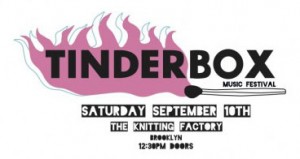
OK, here’s one more! Tinderbox Music Festival. Being held on Saturday, September 10th at the Knitting Factory, it offers a good look inside an emerging NYC festival. Now in its second year after being launched in 2010 by Founder/Director Alyson Greenfield, Tinderbox presents a diverse lineup of all-female artists. A multi-instrumentalist songwriter herself, Greenfield’s idea is to foster collaboration and connection, seriously stimulate audience eardrums, and empower female artists by donating 100% of net proceeds to guidance organization Girls Write Now, and the Willie Mae Rock Camp for Girls music and mentoring program.
Is it worth the work to be a face in this crowd? Read on for a cross-section of one of the NYC area’s music festivals, and find out from Greenfield what makes one of these tricky but highly satisfying endeavors tick.
NYC has a lot of music festivals – why did you decide to start another one? What hole do you feel like the tinderbox music festival fills – who do you benefit, who do you book, and what’s the fan experience you aspire to?
I decided to start another one because there was so much talk when Lilith Fair came back in 2010 among many women musicians I know. A lot of them were talking about how they would love to play Lilith Fair, but they were too small to play something like that.
It got me thinking about all these amazing women musicians I knew from different genres who wanted a bigger platform to share their music, but felt like the opportunity wasn’t available for them. I also wanted a bigger platform for my own music too, so I thought, “Why don’t I just try to create a space for emerging female artists to showcase their stuff?”
That was the initial idea, and then once I started getting it going I wanted to add another element so it wouldn’t just be a show, but it would give back to a community of young women that might one day want to play on the Tinderbox Music Festival stage. We then decided to give back proceeds to NYC nonprofits empowering young women through the arts, including Girls Write Now and The Willie Mae Rock Camp for Girls.
One of our big goals is to represent a wide variety of original music that current emerging artists are creating. This year some of the genres include, Indie Folk, Hip-Hop, Americana, Post Punk, Prog Rock, Garage Rock, Experimental, Cabaret Punk, Soul, Electronica, Folk Rock, and more — the fan experience Tinderbox aspires to is one that helps fans discover new music.
We purposefully put artists from different genres on the bill next to each other so we can get artists and fans together who most likely would not be on the same bill or attend the same show. Mostly it’s all about musical discovery, having fun, and walking away from the show with at least one artist fans have never previously heard of that wowed them, and who they are so excited to have discovered!
That’s a good approach to the bill. On the organizational side, starting up an annual music festival seems like a big undertaking. Why start a regular festival when you could just put on a show?
It is a huge undertaking! I don’t think putting on a show has the same weight to artists, to press, to the music industry, to fans, etc… Starting a festival, for me, meant possibility. It meant that it can keep growing in all sorts of ways, which it is starting to do: This year we have a bigger team, we are able to showcase more artists — over 20 — and we have also started a songwriting program that brings together professional female NYC musicians, some of whom played at the music festival, with young women who want to learn about songwriting.
Basically, since a festival has a bigger scope I think it allows for more things to happen than a regular show would, and it helps to actually build and sustain community. I think when it’s done right fans do feel that sense of community, excitement, and togetherness. We are still extremely small compared to many other festivals, but there is the momentum of bringing people together and building on that.
Those are good points about show vs. festival. When you put on the first one last year, what did you think it would take to pull it off? And what do you know now that you didn’t know then about running a festival?
When I started the festival I really didn’t know what it would entail! I think that’s one of the reasons I was actually able to succeed — I had no blueprint and no cynicism from ever trying to do something like it before or being burned by clubs or artists as a promoter/organizer.
I think my naiveté helped me just go for my goal instead of worrying about how something like this is “supposed” to happen. I pretty much know a million things now I didn’t know before and I’m still learning so much: From basic things to getting a business certificate and opening a business bank account to contacting booking agents, managers, clubs, sponsors, press outlets, dealing with contracts, publicity releases, managing interns and volunteers, corresponding with artists, etc…
I’ve learned that so much of this business is about negotiating. I just try to be upfront and honest and have the most positive negotiations I can have. The biggest challenges are fundraising, and scrambling to do so much with a small amount of people who are volunteering their time in between their other paid work.
Soooo, the big event is almost here! Who do you have lined up, and is there a common thread among the artists you’re booking?
I’m so excited about the lineup this year! This year something we changed was we had a Submissions Committee consisting of people in the music industry, and not people who were internal parts of the Tinderbox Team. We picked a group of people we respected, they listened to every single submission and came up with an awesomely diverse lineup.
Our headliners are indie folk artist Holly Miranda and hip hop artist MC Eternia. A lot of our lineup consists of local acts including EULA, Charlene Kaye & The Brilliant Eyes, The Debutante Hour, Kalae All Day, Mira Stroika, WYATT, Sweet Soubrette, Annie Fitzgerald, Sarah Aument, WOJCIK, Rebecca Jordan, and White Wave. This year something that’s exciting is that we also have regional East Coast acts including Miss Geo, Sarah Walk, Canyon, and Helicopria. We also have two acts traveling from farther away including Pepper Fandango from West Virginia, and Natalie Farr from New Mexico. It’s really exciting to have artists traveling to be part of the event.
Let’s welcome them to NYC with open arms! After the shows are over, what are you hoping will be the lasting result of this year’s Tinderbox?
Definitely a sense of excitement, community, and growth. I hope the festival keeps growing and I also hope we get to have more songwriting and other creative arts programs that engage artists in the community with young people. I also hope we create, build, and make things happen that I never would have guessed would happen– basically I hope we surprise ourselves in the years to come.
Well said – we like that! Finally, what are the challenges and opportunities you’re anticipating as you continue to grow Tinderbox? And are the rewards worth the pain of starting a festival on a shoestring?
I think a challenge for running a big event is always securing funding to put it on and make it happen the way you want it to happen. Another challenge could be keeping it fresh and keeping it interesting as the years go by. But I think since the festival focuses so much on innovative emerging artists, there will always be new artists to discover.
– David Weiss
Studio Sweet Spot: Luminous Velocity Productions
April 5, 2011 by David Weiss
/* Filed under NYC Spotlight */
Do you have tunnel vision, or are you constantly expanding your media universe? In East Flatbush, many disciplines are in action at Luminous Velocity, a nonstop melting pot of music and vision.
Facility Name: Luminous Velocity Productions
Website: www.luminousvelocity.net
Location: East Flatbush, Brooklyn
Neighborhood Advantages:
East Flatbush is in the heart of Caribbean Culture here in NYC. The West Indian Day Parade is held annually here. We’re close to the 4 and 3 Train, and Bus Access is even closer. There’s a great variety of Caribbean food within a short walk away, and there are lots of good down-to-earth people from all walks of life.
Date of Birth: Luminous Velocity’s Studio started in the summer of 2007. We’ve grown in leaps and bounds to our present state since then.
Facility Focus: Where we shine is putting it all together, and delivering on what our clients need. Our studio handles Audio Production, Mixing/ Remixing (on-site/ remote), Composition, Mastering (Analog/Digital), and Visual Arts (3D, Video Editing, Motion/Print/Web graphics).
Mission Statement: Our mission is “Maintaining the Speed of Thought”. We work every day to create unique content, and bring the ideas of our clients and crew into reality. Simply put, our mantra is “make stuff real”.
Clients/Credits:
Real to Myself Project (Ari Up, Anna Ozawa, Rhiannon of Subatomic Sound System) – Recording, Production, Drum Programming, Mixing, Mastering
LaGuardia Community College /Journey To Success — DVD Production
Hezekiah Walker — Recording, Mixing
X-Calibur / “Not a Club Song” — Production, Mixing Mastering
Tommy Tunes — Dance Mixes, Training
Dijay – Hood Divas -Deck Entertainment — Recording and Mixing for No Limit Artist Rick Flair – 20 Bricks
Denver Smith — Production & Drum Programming
3X Entertainment -Fire & Brimstone Project — Production, Recording, Mixing, Mastering
Aswad Kefentse — Production, Recording, Mixing
Deuce Fever — Production, Mixing, Mastering
Full Deck Entertainment/Bounty Hunters — Production, Mixing, Mastering
DJ Dino Mileta — Recording,Arrangement, and Mixing
Akhil aka Ambition – Major – JD Mac & Lyricosiz — Production, Recording, Mastering
Hefnaz Productions — Mastering
Soul Degrees Dubplate Project — Remastering
Legal Hustle Entertainment — Production, Recording, Mixing
Rolling Big Entertainment — Production, Remixing, Programming, Mastering
Tomkevich Studios — Custom Studio Acoustic Treatment
CC Cowan — Production, Drum Programming, Mixing
Our Children’s Foundation — Custom Studio Construction
Drama Desk Awards — A/V Setup & Engineering
TSA Records — Recording, Mixing, Artist Development
many more….
Key Personnel:
Asukaya Bailey (Kaya) – CEO/ Founder
Edward Jackson (Cott)– VP/Audio Production Director
Jorge Alexander Cifuentes – Art Director/ Packaging Designer
Jason Calderone – CG Director/ Lead 3D Artist
Isa Ramadan Shaaf – A/V Director, Producer, and IT Guru
Einstein Charles – Audio Producer & Musical Genius
Alana Conway – Marketing Supervisor
System Highlights:
PC Side:
• Luminous Velocity Custom Built Intel Quad-core PC (XP/Win7) • RME Digi96/52 Adat Lightpipe Soundcard • Wacom 8.5 x 11 Tablet
• Tascam SX-1LE Mixing Console • Event 20/20 BAS Monitors (pair) • Event Tuned Reference 5 monitors (pair) • dbx 586 Dual Vacuum Tube Preamp • Native Instruments Maschine
Mac Side:
• Macbook Pro • Digidesign MBox 2 • Yamaha HS50 Monitors (pair) • Native Instruments Maschine • Akai MPK-25 Midi Controller • Behringer Tube Ultragain (Vintage Series) • Alesis Midiverb 4 • Dbx PD48 Patch Bay
Modules and Keyboards:
• Yamaha Stage Piano • Akai MPC 2000 • Korg Poly61 Vintage Analog Synthesizer (Pre-Midi) • Roland Fantom 61 • Alesis QSR Rack • Korg Triton Rack with Sampler • E-Mu MP-7
DJ Station & Other Gear:
• 2 Technics SL1200 MKII Direct Drive Turntable (Silver/Black) • Vestax PMC 17A- 3Channel turntable mixer • Behringer Eurorack UB1204FX-Pro( 8 Channel Mixer) • Behringer Eurorack MX 1604A • Athena 8 Bay DVD Duplicator ver 1.35 • ART Tube Pac (Professional Tube Amplifier/Compressor)
Audio Software:
• Digidesign Pro-Tools 8 LE • Steinberg Nuendo 3.4/4.3 • Logic Studio 9 • Ableton Live Suite 8.13 • Propellerhead Record 1.5
• Propellerhead Reason 4/5• Image Line FL Studio XXL 8 • Native Instrument Komplete 7 • Native Instruments Maschine x2
• and a host of other software instruments and plugins
Graphics and Video Software:
• Autodesk 3D studio Max 2009-2011 • Autodesk Maya 2009 • Autodesk Autocad 2009 • Adobe Master Collection CS4 & CS5
• (Photoshop, Illustrator, Indesign, Flash, Dreamweaver, Premiere, After Effects) • Apple Final Cut Studio ( Final Cut, Motion, Sountdtrack) • Corel Painter XI • Autodesk Combustion 2008 • Pixologic Zbrush 4.0 • and other design and visualization software
Distinguishing Characteristics: We provide a quiet and stable environment, sizeable recording booth, great atmosphere, and wealth of knowledge to each person that graces our facility. Our best features are based as much on our people, as they are on our equipment. Our crew & setup is extremely flexible and personable. A big part of what we do is working intelligently to give each client the necessary personnel, tools, and time to get their vision/sound just right.
The building is on fire, you only have time to grab ONE thing to save, what is it?
Our 1859 Scoffield Bible – and other rare books. Hopefully some HD drives. We’d like to get as much out as two hands can carry.
Rave Reviews: People love the atmosphere, sense of humor, and above all else the sound. One person called us “MIB” (Men In Black), as they would never know that there are so many tools, toys and treasures hidden in a small unassuming building in Brooklyn.
Most Memorable Session Ever: Two sessions over this past year come to mind. The first was an impromptu session in April with Rhiannon Erbach (Subatomic Sound), Anna Ozawa(an incredibly talented vocalist/ instrumentalist from Japan), and the late Great Ari Up (R.I.P) of the Slits on Bass.
The second most memorable session was with Reggae Artist Aswad Kefentse, Shabu Bak Men Floyd & Aquah Tcherbu Beale (two classical African Percussionists from Sheps Hetep Ancestral Music), Andy Bassford (great guitarist who’s played for the Legendary Jamaican Producer Coxsone Dodd, Shaggy, and others) and Larry McDonald telling us about the good old days of recording using Stones from the Flinstones Rock Quarry. Good times…
Session You’d Like to Forget:
A few sessions have taught us to do smarter business, and to respect our craft.
Dream Session: Cott’s Dream would have been working with Michael Jackson, Portishead, Barrington Levy, Dennis Brown, Black Uhuru, Hughby Banks and the esteemed Edward Jackson senior.
Kaya’s dream session would be Burning Spear, U2, Jimi Hendrix, Ras Michael and The Sons of Negus, Augustus Pablo, The Abbyssinians, Yoko Kanno, Pink Floyd, and Muddy Waters.
For Einstein’s dream session he would like to work with Will.i.am, Timbaland, Machel Montano, Lord Kitchener, Jr. Gong, & Usher.
– Asukaya Bailey (Kaya), CEO/ Founder of Luminous Velocity
NYC PR/Marketing Merger: The MuseBox and Magnum PR Join Forces
September 16, 2010 by David Weiss
/* Filed under News */
Full-service international marketing, publicity, management and distribution agency The MuseBox (NYC) announced that they have merged with PR and Artist Development agency Magnum PR (NYC).
The combined firms will offer “360” marketing services to the music and lifestyle branding community, providing a comprehensive approach to artist development, marketing, branding, management, distribution and publicity.
The merger puts Magnum PR’s highly experienced SiouxZ together with MuseBox CEO/Founder Nadine Gelineau. Clients from both firms comprise a wide variety of artists, genres and brands, including Bill Hicks, Royksopp, Beak>, Portishead, The Prodigy, The Glitch Mob, Underworld, Calvin Harris, Sharon Jones and The Dap-Kings, The Avalanches, Martina Topley-Bird, Maroon 5, Morgans Hotel Group, Chick Corea, Orbital, Primal Scream, The Radio Dept., Wolf & Cub, OMD, The Dø, by;larm Festival, Minus The Bear, The Brian Jonestown Massacre, Twin Tigers, Badly Drawn Boy, Alpha Rev, AWOLNATION, Brooklyn Industries, Robert Randolph, TracksAndFields.com, M For Montreal, and Barefoot Wines.
The MuseBox and Magnum PR will operate together under the name The MuseBox. The company maintains offices in both NYC and Toronto.
Rob Shore: Maximizing Music Business Management
June 8, 2010 by David Weiss
/* Filed under Music Biz */
MIDTOWN, MANHATTAN: How do YOU manage? If you’re a band or solo artist working above a certain level, then you do it with a business manager like Rob Shore.
Straight from Madison Avenue, Rob Shore and his team oversees monetary matters for a diverse roster of 35 artists, including As I Lay Dying, Flyleaf, K’naan/, LCD Soundsystem, New Found Glory, Portishead, Slipknot, The XX, and Wolfmother.
Shore opened his own practice after spending 16 years – 1988-2004 – handing the business management for all the acts on Sanctuary Management. During that time, Shore saw the Power of Metal firsthand with juggernauts like Guns N’ Roses, Iron Maiden, Poison, and Dream Theater to look over.
SonicScoop got a reminder of why they call it the music biz – as in business – when we sat down with Shore.
Q: You’re quick to stress that you’re a business manager, as opposed to a creative manager. What do you mean by that?
A: Although Business Managers and Creative Managers work closely together, they’re two totally different jobs. Creative Management is 24/7, there’s a lot of guiding the artist and Creative Managers weigh in on every decision in the artist’s career. Most of these are grey areas, with no absolute right or wrong choice, like deciding which producer to use for a record, or which singles, what video director, or what record label to sign with. These are primarily a Creative Manager’s job, and none are particularly easy choices.
That’s the thing I like about business management: There’s not a lot of grey area, it’s mostly black and white. We work within the deals that have already been made, so, for example, when money is due from a merch company or publisher, the Business Manager makes sure that the funds collected and spent are contractually correct and in the best interest of the artist. The Business Manager oversees the finances of touring, merchandising, publishing royalties and keeps artists’ financial interests in their mind at all times.
Q: What are some additional differences between business and creative managers?
A: My analogy is that a creative manager is like a heart surgeon, and a business manager is like a dentist. It’s not as exciting to be a dentist — but no one calls a dentist at 4 AM to have their teeth cleaned. A heart surgeon gets called 24/7.
Unlike the Creative Manager, the role of business manager in most industries isn’t necessary, because the owners are usually the ones who look after their money. In our case, it’s often not in the interests of an artist to oversee what we do because it’s not an efficient use of their time – and can be almost impossible while on tour.
For example: Is it more important that an artist find the proper insurance, or focus on songwriting, which will probably lead to more success than making sure his insurance is in place? Both are important, but many artists find the best use of their time is to hire someone else to deal with things like insurance, so they’re free to create. This defines what we do, why we’re necessary.
Nothing we do is brain surgery, but there are tricks of the trade: every country has different touring laws for different bands, and unless you know how to minimize taxes, you’ll pay full rate everywhere you go, and it makes it almost impossible to tour on a tight budget.
Q: So, in contrast, what are some of the things that a business manager handles?
A: That includes artist royalties, merchandising, reviewing deals, and making sure the tour runs smoothly so the artist is not missing out on any revenue that’s coming to them.
We make sure that taxes are paid properly, from the IRS to foreign states. We basically protect the artist from any kind of financial situation. It’s incredibly humbling that we’re trusted with tens of millions of dollars belonging to these artists. But we’re certainly not a bank. My practice is a word-of-mouth boutique, more user-friendly and service-oriented.
Q: If I’m an artist reading this, my question would be, “At what point do I require a business manager?”
A: What usually happens is that we are brought in when a record deal is signed. The creative manager may have brought them to the record company level, but a business manager isn’t needed until there’s money to manage. So in the band’s early days, where they’re playing for $200 a night, my services probably aren’t necessary.
I’m usually brought in after manager and lawyer are in place when either a record deal or tour is about to happen. The lawyer has worked on the deals, the deals go through and entities, like a LLC or partnership are set up, depending on the individual’s need. After that, we usually get involved. The point of doing this in this way is to get bands in the right position.
It’s not a bad place to get involved. It could be two to three years into the process, when the artist is ready to go to the next level. But there’s definitely times when it would have been better for us to get called in sooner. For example, if a band has been signed, and if they’ve done a tour already, things may have gotten messy. Tours happen, funds are distributed, years go by and tax records get confusing. It’s difficult to recreate what happened in a business after the fact. That’s why I’d rather be involved from the first tour on.
Q: Can you give us some specific examples of mistakes like that made by young bands?
A: Here’s what not to do: Sometimes you go into a club and get paid $200, and they ask for the lead singer’s Social Security number, so they can say they paid someone. After two years there’s a ton of 1099’s with this guy’s Social Security number, and the perception in the eyes of the IRS is that he’s earned tens of thousands of dollars.
The reality is that 99% of those tours are losing money such that no taxes would be due. It’s important to keep track of expenses so they’re not stuck with a large tax bill. In that way, it’s never too early to set up a partnership or an LLC because it’s much easier from a tax standpoint for those things to flow through an entity. Keeping track of receipts and being organized is a good thing to do from Day One.
Another mistake made by young bands is trying to negotiate deals without the input of a lawyer or business management. These people are just licking their chops when they’re dealing with a band that’s not represented well. As exciting as it is to have a record deal it could be an albatross for many years if executed improperly.
Q: That’s very valuable. How about another piece of advice?
A: My personal pet peeve is that people don’t protect themselves with insurance. Once a crew person had an insurance policy finish on a Friday and a new one start on a Monday. He was doing carpentry work on a Saturday, got a small sliver of wood in his eye, and that ended up costing him tens of thousands of dollars for that lapse of coverage. We just make sure that all of our bands are covered for health insurance, because I’ve seen too many people – both in my personal and professional life – who were in the hospital not thinking about their health but thinking about their health bills.
In a similar vein, the majority of young band’s biggest asset is there equipment. For a minimum of cost they can purchase equipment insurance, ensuring their gear is safe from water damage, theft, you name it.
Q: Since you’re minding the money coming in, what are you seeing as the increasingly dependable streams of revenue for artists?
A: The obvious one, and the reason I lucked out having so many metal acts to manage is that in the metal genre touring and merchandise can still be very lucrative. My son’s in high school; his friends wear Slipknot t-shirts, however, that‘s not necessarily the case for a pop artist like Ke$ha.
Unfortunately, artist royalties from record sales is a 180-degree turn. In my earlier days, people would tour to sell records, and now it’s become more and more prominent that people make records to tour. The reason to tour is because that’s where profit is made, and that lends itself to merchandising. Endorsements and synch licensing are big, as well. It’s hard for an artist to make money on record sales when anyone can download their music for free.
Q: That sounds like an incredible amount of detail that you have to keep track of.
A: I have an incredible staff I work with, and we associate ourselves with great people: great insurance people, great lawyers, great tour managers; it’s a lot to keep track of, but when you work with great people it’s not as difficult.
Part of my job at Sanctuary was the survival of bands, and allowing them to live long enough to break. If RSA has a forte, it’s taking bands, and extending their life longer than other people might be able to.
I think part of this is managing tour support, for example. As record companies make less and less money, it’s tougher to get tour support out of them. So we work hard to maintain budgets, get what’s really agreed upon, and receive what’s needed to extend the band’s life.
That’s true not just for emerging bands, but ones that are perceived as successful as well. A platinum artist may want to have a baby next year, so they’d ask us what they need to live next year without touring. We might say, “The money runs out next November, so that’s when you’d have to go out and tour again.”
Q: You mentioned the intricacies of working financially outside the US, as well.
A: Most countries used to not have a clue as to how to tax bands coming in and out, but now everyone seems to be on top of it. In the US, it used to be a relatively easy process to get taxes waived, and now it’s nearly impossible. We’ve become experts on the intricacies of what the IRS really expects now, and that knowledge can make a huge difference for an artist at tax time. We have a good working relationship with people at the IRS and close ties to professionals who handle taxes with bands overseas. In many cases, the ability to minimize taxes in the US allows foreign bands to go on tour here.
Every country has their own game that needs to be played, and we know how to play the game while working within the legal limits and paying what’s owed – without paying more than necessary.
Q: We ask this a lot, but I’m particularly interested in your perspective: How do you see the music business in 2010?
A: I’m not sure if this is an answer to your question, but it is that bands can still be successful and earn a living in the music business. If my experience can inspire anybody, it’s that I’ve seen bands go from a $500 gig to a $100,000 gig in a year. I’ve seen really poor bands seriously considering taking a $50,000 publishing advance, holding out a little longer, and then landing an $800,000 publishing deal less than 8 months later.
I admire people who have the guts to stick it out. People who took a big chance on music careers, and then got to the point where a record company is willing to put hundreds of thousands of dollars into them to make them successful , then playing in front of thousands of people. I’ve seen it happen that way: People didn’t give up, and they found success. That’s an amazing process.
– David Weiss