Redefining NYC Recording: Downtown Music Adds a Neve 8014 Console
March 22, 2011 by David Weiss
/* Filed under NYC Spotlight */
SOHO, MANHATTAN: The studios of NYC are not sitting still. As evidence consider the latest sonic escalation, launched from right below Broome Street and Broadway. There, Downtown Music Studios has upped the Big Apple ante with the installation of a vintage Neve 8014 console into the control room of Studio A.
Extra musically satisfying and aesthetically amazing, this 16-channel board represents more than just a fancy bunch of faders from the year 1970. Its addition provides a focused window on NYC studio economics in 2011, shedding light on the artistic and technical demands of the sector’s current clientele, as well as the informed interplay between facilities striving to be competitive instead of repetitive.
The console has been busy since it arrived earlier this year. Early projects on it include Santigold, David Guetta, Mike Posner, Benny Blanco, and Jason Goldstein mixing SNL-borne rock stars The Lonely Island. Downtown Studios Chief Engineer Zach Hancock explained to SonicScoop exactly why this bold new board has rolled into town.
How long has Downtown Studios been going now?
The studio is approaching our third year. It’s evolved from a production space that we rented at Chung King to the full-fledged, two-room commercial recording facility that it is now.
We initially started this facility with two control surfaces, moving from two Digidesign D-Commands to just one of those, in Studio B. That’s because of the importation of an 8014 Neve into Studio A.
What led Downtown initially to the D-Command for both rooms?
For the longest time we were large format console people, and we fought passionately to prove not only to ourselves, but to the world that mixing in the box was a viable option. The move from SSL desks to mixing with a Pro Control and an HD5 was a revolutionary phase for us in the early 2000′s. Working with Tony Maserati and Vaughn Merrick, they proved that it could really be done. Implementing mixing-in-the-box with a control surface in both rooms was in part an outgrowth of my relationship with Vaughn, and his astute idea that it was the best way to work.
Part of what makes Downtown Music Studios special is that as a record label, and a publishing company. We’re generating content ourselves. We provide a commercial workspace for clients half the time, and the other half we are the client. I wanted artists and the publishing company to be able to use the space as creatively as they could.
Downtown is a brand dedicated to forward-thinking artists, and that comes out intensely in the music. Part of that is having the studio time that they need, therefore a device at the center of the workspace that isn’t proprietary. If we had a large format console that was doing the mixing, I felt that they’d have a hard time translating that at their personal spaces, or in another commercial studio.
I saw other people’s workflows following suit — mixing in the box. So that’s why we equipped studio A to what we previously had. I still believe in it, and it was an amazing opportunity to work that way for two years.
What paved the way for switching to the Neve 8014?
Something happened when Avid acknowledged to the rest of the music community that native processing was just as robust as a small TDM system. When PT9 came out, I realized all at once that so much of our workflow – editing, doing overdubs, mixing – was going to happen in personalized spaces. It was an outgrowth of the music community, an outgrowth of the robust environment the computer now provides.
I saw the opportunity to focus Studio A as a tool to record bands, and handle all the elements of a project’s tracking. I thought that if you’re going to end up doing 30 to 40% of your workflow at home editing, maybe some mixing, etc… that it would free up your budget to work at an “A” level studio to do your recording. So we picked the console that was best for that.
This Neve 8014, working in coordination with PT9 and a EuCon control surface, is the perfect implementation of the modern workflow we’re talking about. It is truly the best of both worlds, a hybrid analog digital environment. It sounds astonishing, everything works in a very elegant workflow, and people are reacting to it very strongly.
What were the criteria going in to the new console search, before you settled on this particular board?
The selection process was laborious, we looked at every option out there: SSLs, APIs, Neves of different variety. Ultimately, the most important things for us were that 1) it was not counterproductive to the way we had worked previously, and 2) that it had had the best sounding mic-pres, the best sounding EQs, and it could really bring something to the table that wasn’t there in the market before.
I’m close to people who, on paper, could be considered to be our competition. It didn’t make a lot of sense for us to be doing what they were doing. I’m really happy to see that the community of studios run by people in NYC are really good people. That wasn’t always the case.
Let’s drill down to this Neve 8014 that’s sitting in front of us. Why did it finally make the cut?
The main reason is that this console is in pristine condition, and it has the best of what we want for tracking, mixing, summing or any other in-the-box permutation of analog and digital equipment.
One of the things that we’re very mindful of is the acoustical installation in this room. It sounds like one of the best rooms I’ve ever worked in, and I’m not the only person who feels that way: Tony Maserati, Jason Goldstein, Vaughn Merrick, Ari Raskin, are serious engineers. We work out of this room for different reasons, but one is that it’s acoustically flat – Pilchner-Schoustal knocked it out of the park.
I didn’t want to get a console that would require us reworking the acoustical or mechanical infrastructure. I didn’t want to have to put in another AC unit or bulkhead, or rip apart the room to get it in, because to me the most important part of the room is the acoustics, and the ergonomics. The equipment is always within reach, and the fact that there’s not a credenza behind you is meaningful. That’s why if we had put in a 72-input console, that would have been counterproductive.
Where did you locate this particular board?
I always said I wanted an 80-series Neve. The difficulty in acquiring an 8068 is that it would have been too big a car to fit in our garage. The 8014 is really the perfect-size console, given the modern integration of the computer, and the way Studio A is layed out. We found this board in Ireland – I sent Joe Russo, who’s an amazing young tech, to Ireland to inspect it, and he spent four or five days there. We did a very thorough inspection, and decided it really was the console. Rock-It Cargo handled the logistics of getting the desk here quickly and safely.
We split a lot of hairs when it came to planning the actual switch from the D Command to the 8014. When the time arrived, we executed the plan and there weren’t a lot of surprises — it went very smoothly. The people at Neve and Geoff Tanner were kind enough to send us some documentation, and Alto Music NYC provided us with a lot of outboard gear and a new Pro Tools rig. Everybody did a really exceptional job.
You’ve been working on this board since January – how has it matched up with your vision of an ideal tracking tool?
I think that there’s an “X-factor” to the sonic architecture of the mic pres and the EQ that make you feel as though you’re listening to a record. Working in the box is transparent, and sometimes indicative of something a little bit lifeless, but this console sounds a little less like real life in a super-natural way. Ergonomically, it’s the best way to work in a tracking situation. All of your mic pres and EQs are there. It’s not arduous. It’s logistically easy to accomplish tracking.
The other thing is that the Class A mic pre really is a cut above. I think these mic pres are the best for pop and rock music. It’s a very clear, robust sound, and it has a harmonic detail in certain frequencies that are very musical. It’s difficult to explain how they sound better, but they’re famous for a reason. Having them inline, directly in front of you and your PT rig is great. You can get what you need really fast.
The artists we’ve been working with on this console have been excited about the sounds that we’ve gotten. That gives you confidence in your ability, and that’s what it comes down to: making sure the artist can create. This console has definitely augmented our ability to do that. That’s a really rewarding feeling after working so hard to acquire it.
How are you’re using the 8014 in the mix phase?

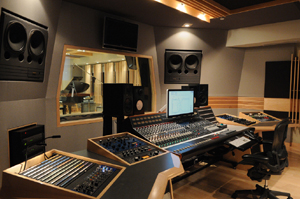
Maintaining the acoustics in the Pilschner-Schoustal designed control room were the top priority in the console switch. (Photo credit: Jung Kim)
The first thing I should note is that it’s not an inline console – it’s a split console. It’s got an interesting set up for monitor returns. We’ve integrated the monitor returns at mixdown to become inputs to the console, but with a flick of a switch they can function, as they would have when they left the Neve factory in 1970. Some engineers prefer this for tracking.
So we have, essentially, 32 inputs to the desk; 16 of those inputs have faders and 1084 mic pres and EQs etc…, and the other 16 inputs allow the room to use some of the other pieces of the installed outboard– the Chandler TG1, the Distressors, 1176, Pultec style EQs, GML EQ, tube limiters. Everything can fold down to the stereo bus.
It’s all new outboard equipment in Studio A that we thought would be the perfect complement to the console, and we made a point not just put in vintage equipment. There’s some incredible new gear, and we’ve adopted a lot of that stuff in the workflow. I think of outboard processing as an opportunity to add different spices to your mix. So we bought valve EQs that would complement the Neve – they have some color that the transistors in the console don’t have, and the dynamics that we have are different than the compressors in the desk. We wanted to have mono tube limiters and compressors that you would use in a tracking environment, and the stereo bus compressors that you would use in a tracking environment or on groups in a mix.
The automation comes from the Euphonix Artist Series Controller with EuCon, integrated into Pro Tools 9, which together works like the D Command. So we were able to get the same level of integration into this amazing analog console as we had before.
Can you explain exactly how that EuCon-to-Neve connection works?
We’ll come out of Pro Tools, and dedicate an analog output to a group of audio i.e. a “stem”, or one analog output per instrument. So that comes from Pro Tools into the desk, and then the desk functions as an analog mixer.
It goes a step beyond a summing mixer, in that you can do inserts on the console that allow you to step away from hardware inserts in Pro Tools. That requires a level of digital-to-analog conversion, then analog-to-digital, so you covert twice while you go out of the box then back in. The beauty of the Neve is that you can use the inserts on the channel fader and avoid all that conversion.
For automation, we modulate parameters in Pro Tools, volume data etc… with the Euphonix control surface. Any volume changes happen before they arrive at the console. It’s an important step in making recalls easier, more convenient for all parties involved. Most people are doing automation in the box so if you open the session the next day, the automation is there. There’s no lengthy recall, and that can save your client money. You can also bring it home, etc…
You said before that you were paying attention to where Downtown fits into the overall scene, in NYC and I guess that goes for nationally as well. Why is that so important?
One of the difficult things about owning or running a studio is that there are so many choices at hand for people. At the same time one of the incredible things about making music is you have so many choices.
For me, the challenge was to live on the side of the debate where you’re making music and loving the choices. I think it’s silly to be doing the same thing that five or six other people are doing. So it was a no-brainer for us to do something a little bit unique. But it’s not just the console – the truth is I feel that we have the best Pro Tools rigs – an HD5 system, an HD Native system and an Avid Symphony system. We take each one seriously, whether its Logic or PT. We can accommodate at a high level of integration. We have almost every plug-in you could want, and a UAD 2 card, which I’ve been raving about.
The bottom line is that the computer has always been the most important thing for us. One of the ways to find a lane is to take our expertise as computer and process people, and combine it with the best hybrid approach which we’ve been developing over the last 10 years. It’s not completely unique, but it’s not run-of-the-mill by any stretch of the imagination. It’s something that people are really excited about – the response that we’ve gotten so far is amazing.
In the last several months we’ve covered some significant console switches in NYC – the ICON was switched out for an SSL G+ at Stadium Red, and prior to that Tainted Blue traded their SSL J9000 for a Euphonix System 5. Why this increased activity?
I think that studios have always changed consoles. I read Stadium Red integrated Just Blaze into their workflow. Not only is that an amazing facility, but he’s one of the greatest producers of all time. Just Blaze has had an indelible mark on hip hop and R&B. His work is amazing. The guys at Tainted Blue I haven’t had the pleasure of meeting, but time to time you hear glowing reports of what they’re doing. I can’t tell you why they switched, but I know the System 5 is the pinnacle of post production consoles. Some people use it for music, and for post it probably is one of the best tools.
I do think that technology is at a place where for the last four or five years there was an identity crisis of how people wanted to work. The expediency of working in the box became really important, because recording budgets have scaled back. The need to make changes at the last minute possible has made a definite impact on our workflow.
Computers have gotten so good that a large-format console isn’t a need, it’s a want, whereas before you had to have one. Whether or not a studio needs an analog console is something you need to look at on a case-to-case basis. But for us, this change is exciting. It makes a lot of sense.
– David Weiss
Endless Ear and Eye Candy At AES 2010: Tech Highlights + Party Down
November 10, 2010 by Janice Brown
/* Filed under Tech & Reviews */
Well phew! We’re back from one slammin’ AES Convention — and still reeling from all the awesome audio technologies and technologists we encountered on the show floor and after-hours.
If we do say so ourselves, one of the most memorable AES parties we’ve ever attended was the one we actually co-sponsored, put on by some top-flight audio brands including Burl, PMI Audio Group, KuSh Audio, Audio Power Tools, Empirical Labs, Mojave, Audio Agent, Wave Distribution, Elysia and Cutting Edge.
The bash, held at the legendary Great American Music Hall, was all about mind-blowing music and dance featuring the totally thrilling afro-samba-funk band SambaDá who paraded around the venue Brazilian Carnival-style and then played an amazing set on stage. Not your typical AES party, and just one more reminder that it’s the people and the events that make AES such a soulful experience year in and year out.
The days were packed with demos and conversation and the show floor was happening, as exhibitors across the Moscone expressed sincere satisfaction at the amount of foot traffic. Pro Tools 9 was the big splash — they even had Butch Vig doing a demo at the booth one day — but a real abundance of hardware interfaces, controllers, consoles, microphones, outboard gear, loudspeakers and software pulled us in every direction. Discoveries abounded down every aisle, so without further ado we share with you…
The SonicScoop Buzz Worthy List
Pro Tools 9 – The mother of all debuts from the 129th AES Convention. Available on November 12th for $599, Pro Tools 9 replaces LE in the product line and is available for the first time as software-only.
Focal Monitors – the Focal SM9 Monitoring System turned heads and ears at AES listening events. It houses two independent monitoring systems within the same speaker cabinet.
The first configuration is a 3-way monitor equipped with a 1″ pure Beryllium inverted dome tweeter, a 6.5″ midrange driver, 8″ bass driver and an 11″ passive radiator. Flip a switch, and the same cabinet includes a 2-way monitor utilizing the same inverted dome tweeter and a 6.5″ midbass driver. The point of the latter is to more effectively allow mixers to check their work on a bass-challenged system for iPod, computer, TV, etc… consumer playback systems. Estimated street price upon their early 2011 release is $3595.
Universal Audio Becomes RTAS Plug-In Developer – Pro Tools users can look forward to a muuuuuch better workflow with their UAD-2 cards. UA announced that they are now an Avid RTAS developer. By combining the new Pro Tools|HD Native PCIe card and UAD-2 DSP Accelerator PCIe cards, Pro Tools|HD Native users can now run Pro Tools HD on the power of the host CPU and a library of classic analog emulation plug-ins developed by UA in partnership with Neve, Manley, Roland, Empirical Labs, Fairchild, Pultec, Teletronix, dbx, Studer, Lexicon and more.
SSL – The UK-based console maker showed it has plenty of new tricks up its sleeve at this show. At times, the new 48-input version of their AWS board, the AWS 948, was completely mobbed as attendees got their heads/hands around the versatile new board. There was also plenty of attention paid to the spankin’ new Nucleus controller, which provides a great deal of advanced DAW control options, SSL analog mic pres, Duende plug-ins and other goodies into its relatively compact footprint. Available December 2010 for $4999.
TASCAM – We got our first look at the DR-08 portable recorder. This affordable 96/24 unit is incredibly light and should be a strong asset to anyone with field recording in their job description.
Mix Sensei – One of the serious class acts of the industry, GRAMMY-winning LA producer/mixer Dave Isaac’s Mix Sensei has rolled out his series of tutorial videos including “Mixing Marcus Miller”, “Enter the Dynamics” and “Return of the Dynamics”. The new “Master Audio Concepts” downloadable lessons were scheduled to debut online during the show.
iZotope – The new Nectar vocal suite was the latest development. Highly customizable, Nectar offers dozens of vocal production styles powered by eleven processing modules.
Shadow Hills – Among the many hot products at the always-packed Vintage King booth, the upcoming Oculus monitoring system from Shadow Hills was drawing plenty of interest. For those who can keep up with the mystical genius of Shadow Hills founder Peter Reardon, it’s clear that this will be an extremely versatile monitoring tool when it hits the market in the next few months.

Shadow Hills' Peter Reardon (right) wowing us with the Oculus at the Vintage King booth. Vintage King's Jeff Ehrenberg at left.
Neumann – Another eye-raiser was the introduction of the KH120, a small-format studio monitor from none other than Neumann. Designed to work primarily as near-fields or as the rears in a multi-channel system, the new Neumann’s were a must-see reference monitor throughout AES. For those surprised by this brand extension, the company pointed out that over its 80-year history their name has also stood for mastering lathes to consoles and digital mics – it will be interesting to see how the industry responds to Neumann’s new addition.
Sonnox – this group of smart guys from the UK had no new product at the show, but are confident that their soon-to-come plug-in – still under wraps — will be a game-changer of some sort. For now, they will say only that the product is something “unique” and will be an enabler. Based on Sonnox’ track record so far, we can safely say that we believe them.
SoundToys – between Mitch’s pink hair and the preview of Juice, the upcoming analog input channel modeler, traffic was healthy at the SoundToys booth. Also, they announced the pending release of Artist Series preset expanders from Tchad Blake, Peter Wade and Morgan Page.
Audient – We got our first hands-on experience with the Audient ASP2802 eight-channel console, introduced earlier this year by the UK manufacturer and also on display at the Vintage King booth. It combines classic analog features with advanced DAW integration and control, putting a great deal of functionality and sound quality into a relatively compact package.
Burl Audio – The B80 Mothership from Burl was a true presence at AES, a multi-channel version of their B2 Bomber ADC and DAC. This motha offers up 80-channel capability, with a vast amount of AD/DA configuration options available within its card-based, 4U chassis.
BeesNeez Microphones - buzzzzzzzzz was appropriately everywhere for Australian mic manufacturer Bees Neez. The eye-catching craftsmanship and brass construction of their product line made their booth a steady center of attention throughout AES.
Cloud Microphones – The RCA-inspired microphones from Arizona-based Cloud were notable for the company’s fascinating story, beautiful look and luxurious powers of sound reproduction. The company also earns kudos for its attention to environmentally-friendly practices throughout their manufacturing and distribution processes.
Lavry Engineering – Lavry Engineering provided the first hands-on look at their LavryBlack AD11 A/D converter, which also includes a mic pre with phantom power. This cost-effective unit is ideal for portable recording as well as standard studio setups.
Two Notes Audio Engineering – people from far and yon came to the booth of Montreal-based Two Notes to check out their Torpedo VM-202 dual processor guitar/bass cabinet simulator. Designed with an exclusive tube stage simulator, the 1RU unit allows users to play two cab + microphone simulations simultaneously, and reproduce a multi microphone miking process. We found the solution to be highly intuitive in our showfloor experiments.
JBL – We appreciated getting up close and personal with JBL’s MSC1 Monitor System Controller, introduced earlier this year. A highly useful monitoring hub for the monitoring of three input stereo sources, the MSC1 provides a host of features and controls to ensure that monitoring will be as accurate as possible in your space of choice – or necessity. Now available with Mac software!
Cartec Audio – The Cartec program EQP-1A makes no bones about its inspiration, in look and sound, from the classic Pultec of the same name. On display at the Professional Audio Design booth, the hand-wired units would fit nicely into the rack of anyone who doesn’t happen to have an original Pultec available.
Telefunken – Connecticut-based Telefunken showed off the subject of their “Name the Mic” contest, the sharply titled CU-29 Copperhead. Based on a circuit that features a New Old Stock (NOS) TELEFUNKEN vacuum tube, custom audio transformer and a fixed cardioid large diaphragm capsule, the Copperhead sounded positively sumptuous in our show-room floor listening session.
D.W. Fearn – The hugely respected D.W. Fearn showed off the new 70dB VT-12 Vacuum Tube Mic Pre, designed to accommodate the low output level of ribbon and dynamic microphones. In the bigger picture, Fearn told SonicScoop that the company has had a banner year that could stand as his best in business – a strong harbinger of hope and optimism for the industry at large.
Check out some more product and fun photos below!
– Janice Brown and David Weiss
Universal Audio Intros QUAD Omni (v5.7) DSP Accelerator Package To UAD-2 Platform
October 8, 2010 by Janice Brown
/* Filed under News */
Universal Audio has released the new UAD-2 QUAD Omni (v5.7) DSP Accelerator Package, the company’s “most powerful and flexible processing hardware packaged with UA’s most complete plug-in bundle.” (video below!)
The UAD-2 QUAD Omni (v5.7) gives producers and engineers 50 UAD Powered Plug-Ins on Mac or PC — saving thousands of dollars versus buying the plug-ins individually.
The PCIe card features four Analog Devices SHARC chips to “power” the analog emulation plug-ins, including classics from Manley, Neve, Roland, BOSS, dbx, Empirical Labs, EMT, Fairchild, Harrison, Helios, Little Labs, Pultec, SPL, Teletronix and more.
The UAD-2 QUAD Omni (v5.7) DSP Accelerator Package features include:
- Flagship quad-processor DSP Accelerator Card for UAD Powered Plug-Ins on Mac or PC
- Access the world’s finest emulations of analog classics: Manley, Neve, Roland, BOSS, dbx, Empirical Labs, EMT, Fairchild, Harrison, Helios, Little Labs, Pultec, SPL, Teletronix and more
- Includes 50 plug-ins from UAD software releases up to and including v5.7, plus a $100 Plug-In Voucher redeemable from UA’s Online Store
- Save $4,000+ versus buying the plug-ins individually
- Run large, professional mixes in Pro Tools, Logic, Cubase, Nuendo, Performer and more — without taxing host computer CPU
- Available for purchase from authorized UA Dealers worldwide
For more details and to see the complete list of included plug-ins, visit the UAD-2 QUAD Omni (v5.7) DSP Accelerator Package product page. And watch the UAD-2 Platform video featuring the new UAD-2 QUAD Omni right here:
“Analog Classics” Audio Plug-Ins Bundle Highlights New Universal Audio UAD-2 DSP Accelerator
August 3, 2010 by David Weiss
/* Filed under News */
Universal Audio has just updated its UAD-2 DSP Accelerator Packages.
Now all UAD-2 SOLO, DUO and QUAD DSP Accelerator Packages will feature smaller, “greener” packaging, and include the new no-additional-cost “Analog Classics” software bundle.
The “Analog Classics” bundle features:
– LA-2A Classic Audio Leveler — Previously only available for purchase online, this plug-in is an extremely accurate emulation of UA’s electro-optical, analog compressor.
– 1176LN Classic Limiting Amplifier — Also previously only available for purchase online, this plug-in is an extremely accurate emulation of UA’s FET-based hardware unit.
– 1176SE Limiting Amplifier — A DSP-optimized version of the 1176LN,
yielding higher instance counts and its own unique characteristics.
– Pultec EQP-1A EQ — A highly accurate emulation of the classic analog EQ.
– RealVerb Pro Room Modeler — A very flexible and natural-sounding reverb plug-in.
Tainted Blue Stage II: The Story of an NYC Studio Console Switch
July 18, 2010 by David Weiss
/* Filed under Music Biz */
MIDTOWN, MANHATTAN: Hard to believe, but it’s been almost five years exactly since the storied penthouse of Quad Studios was sold and became an entirely separate facility, Tainted Blue.
Then, as now, the top-end NYC studio scene felt like a big mystery, and many a big room has gone since 2005 (Sony, the Hit Factory, Legacy A509, Sound on Sound, Clinton Recording all RIP). But at the respectfully competitive Times Square address of 723 Seventh Avenue, which houses Quad and Tainted Blue, as well as Premier Studios NY on consecutive floors, the tracking/mixing beat goes furiously on.
Today, Tainted Blue owner Andrew Koss feels wiser – and no doubt older – as the landscape continues to shift. For the world-class studios that remain, the choice of large format console remains one of the most critical decisions, and Koss just shifted gears in a surprising way: His advanced Lawrence P. Swist-designed control room no longer houses an SSL 9080J, but a newly acquired Euphonix System 5.
Tainted Blue’s switch from a flagship analog board to a digital audio mixing system raised a lot of eyebrows citywide, but as we were reminded in our latest chat with Koss: everything happens for a reason.
How do you feel the studio business has evolved since you opened Tainted Blue?
It’s certainly been interesting to watch the rise, fall and challenges of how studios are trying to restructure themselves in the city. But I also think there’s been a swing back in the last few years to larger production, larger sound. There was a run of the indie style, where minimal was cool, and you could do it in the bedroom with a laptop. But if you look at the Billboard Top 50 now, none of the tracks are like that today.
So I think maybe producers and musicians hit the wall, which I think I hit before I opened up the studio here — the frustrations and limitations of what you could do at home with a minimal setup. You start wanting more creativity, and a sound you just can’t capture without the acoustics of a live room.
The challenges have been that it’s a new generation of engineers, and new generation of producers who grew up with a very different education. The way they work is so different that you have to be able to cater to their needs. They’ve learned the software version, and then they come in and see the hardware version of the LA-2As and Pultecs.
We’re not catering towards the older generation of engineers, who really have their own spaces and their own environments that they work at, so we try to cater to the younger, next generation of engineers who are more comfortable in a digital format, and in a hipper more stylistically designed room, where the vibe is more important to them than it ever was to the older clients. It’s really the younger guys who want that exclusive, luxury feel and we’ve worked hard to provide that.
We built this as a boutique studio. And it’s a little more refined — the feeling when you’re here. Having a piano that’s always tuned and ready to go, instruments and drumkits at hand, and we don’t charge rental fees for any of this. They’re here to be used.
I think there’s more potential clients than we’ve seen in years. But it’s a different kind of project. Sure, people can do pre-production at home, and because of that, the project they bring in doesn’t require a week of studio time, they just need six hours. But there’s so many of those people, that it’s all right that we only get them for one day, instead of twelve-day lockouts. There’s plenty of that business out there — it’s just a different kind of booking.
What makes a large console format remain important in those considerations?
There’s certainly a lot of people who work in the box and don’t need the audio channel capacity that we have. But at the same time having a console like the Euphonix System 5, that can turn into a control surface makes our approach to that market that much easier.
That’s because if they want to they can work in software and the console can turn into a controller with the EuCon software. It caters to people that don’t necessarily need the large format console, and just want the control space and to be able to retain access to all our outboard gear. At the same time, having 116 audio channels and near infinite routing options for the people that want to work across the console give us the perfect blend of both of these worlds.
I think also that the live room and the gear is still appealing to a lot of producers: being able to track drums, live piano and multiple musicians at the same time will always have its place.
We also have clients who come in and just take their mix out of the box through our outboard gear — bounce it out of the box, and go home. They put it through the EQs, bus compressors, print it, and take it home and keep mixing. As much a fan as I am of plug-ins, there are some things I just can’t create without a Thermionic Culture Phoenix compressor, or an LA-2A, for example.
What did you consider leading up to your decision to switch to a Euphonix System 5 from an SSL 9080J?
The cost and upkeep of the SSL was becoming difficult for us in a business where we have to think outside of the box, and try to find ways to keep revenue coming in.
The energy cost of the SSL was extreme with two air conditioners running 24 hours a day, even in January! The other issue was that the younger clients didn’t have experience on an old J console. If they did, they used it rarely for what it could do, and it wasn’t getting the use that demanded having it here, as parts were starting to go and setup times were increasing. Now because of the System 5 and its Patchnet system, if we have six hours to work with an artist, I can zero the room out in :30, as opposed to two hours. If someone wants to come in and play their session from last night, they can come in, open up the files and it’s exactly where they left it, including all routing and outboard patching.
Of course, the SSL sounded great, and a big concern with the Euphonix was getting a console that a lot of people hadn’t tried themselves. It takes a little convincing to show them what it can do, and seeing that it’s not just a digital control surface. People see it and they think “ICON”, whereas this is a true console, with 116 audio channels, 24 group busses, 24 mix busses –and not just stereo because they can be in 7.1, 5.1 and stereo all at the same time.
I’ll bet a lot of manufacturers wanted to get their board into Tainted Blue next. Why did you settle on the Euphonix?
We looked at a few choices out there. There’s actually less digital consoles on the market that are geared towards music production/tracking/mixing. Many of them are post production video type workstations.
Then we met Jay Spears over at Euphonix and we started talking about the System 5. He took me over to Studio B at what’s now MSR Studios, and I had never seen anything like it. The Euphonix seemed to be the most out in front with the technology with a 40-bit point floating point processing system, being so modular that you could have control surface and audio tracks right next to each other, or wherever you wanted them – this as opposed to some consoles that are either in controller mode or audio mode, one or the other.
And the support was a big issue. Jay and his team took the time to show the staff my board, and physically set it up with my team which was pretty spectacular. Having a company large enough that I knew I could count on was really important, and having them understand we were taking a risk with them: We’re a big room in Manhattan, there’s not a lot of us left, and this was a major change.
You bought your System 5 right before Avid acquired Euphonix…
The merger with Avid is a huge plus for us. The integration with Pro Tools is going to go through the roof, now that Avid’s involved, so for our clients it will be a win-win. It will be everything the ICON is, and way more because of the actual audio processing. I believe you’ll see the System 5 becoming Avid’s flagship console.
I think for studio owners switching consoles is the next most-dreaded prospect to moving studios altogether. Was making the physical switch from the SSL to the Euphonix difficult?
The buyers were responsible, thankfully, for the decommission of the SSL, but we weren’t sure what spider webs we’d find underneath it. We did the decommission in two days, which was remarkably fast, and the installation of the Euphonix took about eight hours. The slow part of the process was the patch bay, because we had to sell the old patch bay with the SSL, which meant we had to rewire the audio DL’s into the wall, and add some new gear as well.
But we used that time to problem-solve issues with the room that have been here since it was built, reducing some noise and grounding problems. In Manhattan, there’s always issues with electricity, and (Tainted Blue Studio Manager) Sax took the time to reduce noise floor on the gear. It took a week to turn over, but the studio has never sounded this good, and it’s been here thirty years. I think they reduced noise in the mic lines by about 20 dB, which is pretty dramatic.
The System 5 setup itself couldn’t have been easier. Four rack pieces and it plugs into the wall! With Ethernet, it’s so easy. One DeltaLink handles all 116 audio channels i/o of Pro Tools. Two DigiLink cables and two SSL Alpha-Links handle all the outboard gear.
[See a time lapse video of the console switch at Tainted Blue right here:]
Now that the board’s in place, what are the impressions — yours and your clients’?
Since I work here all the time, for my work it’s the greatest thing that could have happened. The Euphonix computer controls our entire patch bay, and every time I open a session, all of my outboard gear is routed back to that session, so buss compressors, inserts, outboard EQ, reverbs, etc… are all brought back to where they were the last they were used. Obviously you have to move the knobs on the outboard gear, but the patching which was a such tedious aspect is now gone. I can A/B different vocal chains with the press of a button in real time. So it’s done a lot for me, before the session even starts.
Clients have been having a blast because it’s something new to play with, but also because we can contour the templates to their workflow. We know if they work out of the box, we’ll directly route Pro Tools to the monitoring section. Or if they want to use the control surface on one side and audio on the other, they can do that.
People love the EQs and dynamics of the System 5, because there so clean – “surgical” is the word I’d use. Reminiscent of an Oxford console to me, which is why we added some outboard gear with lots of sound — I went with outboard gear that’s dirty and crazy and fun.
There was a visual impact the SSL had, but I’ve been surprised about the number of people who have seen the way the room looks with the extra space, and say that it looks like 2010, not the late ‘90s. The 24’ LCD screen with Cinema Display dead center is an awesome way to work in an era when clients are hands-on now, not sitting in the back making calls but doing the editing and effects. It’s a clear, clean listening field and makes for a nice comfortable experience.
We’ve talked a LOT about gear just now. Any intangibles to take note of?
Just recently we’ve made Sax our studio manager. He’s been in the studio scene for 15-20 years now. He’s seen it since the heyday, and really knows what make studios succeed and fail. He’s working very hard on how the whole experience transfers on to the client.
In the end, the energy that clients feel coming in is so important. And while you’d think it would be intuitive that the gear is the most important factor, it’s not: the experience and how they feel while they’re here really matters. It’s so important.
Along with that, we’ve been out trying to find new ways to bring in business for us that are outside the box. Using the studio as more than just a place to record, be it for film, photos, and our “From the Penthouse” series where we’ve been doing small artist showcases here.
We’re really having a blast, and we’re sharing that with the people who come in — it’s a fun place to work. We’re excited to let people see that and have them create their music here.
– David Weiss