Roland Announces R-26 Six-Channel Portable Field Recorder

September 12, 2011 by  
/* Filed under Deli Feed, Deli NYC Feed, News */

Roland has announced a new entry into the competitive portable field recorder sector, with its new R-26.

The Roland R-26 six-channel field recorder will be available in mid-October.

Scheduled for release in mid-October with an MSRP of $599, the R-26 provides six channels of recording for mobile audio applications including location sound design, event production, legal court regarding, event videography, and musical performances.

Highlight features of the R-26 include:

6-Channels of Recording with Built-in Mics
The R-26 has both omnidirectional and XY stereo mic types built-in, plus two XLR / TRS combo jack with phantom power to connect high quality external mic or line-level devices, plus a stereo-mini jack for a plug-in powered mic providing numerous recording options.

The R-26 is equipped with Roland’s proprietary IARC (Isolated Adaptive Recording Circuit) on the inputs for the built-in mics and external inputs.  This analog circuit is completely isolated from the digital circuitry and has its own power supply, to help reduce digital noise and achieve clear sound.

Touch Panel Control
The R-26′s large touch screen provides detailed level metering and convenient fingertip control over many functions, and is equipped with a high-luminance backlight for perfect visibility in any situation. Hardware controls are ergonomically organized and clearly labeled, with large input level knobs for precise adjustments and dedicated buttons for often-used functions.

Standard Tripod Mount Threading
With the threaded rear-panel mount, the R-26 can be mounted on any standard tripod stand, which provides a clean sound away from table vibration or handling noise.

Standard AA batteries or the included AC adapter can power the R-26. Standard package components include the R-26, an SD Card, a windscreen, Cakewalk SONAR LE (for Windows), USB cable and AC power adapter.

Endless Ear and Eye Candy At AES 2010: Tech Highlights + Party Down

November 10, 2010 by  
/* Filed under Tech & Reviews */

Well phew! We’re back from one slammin’ AES Convention — and still reeling from all the awesome audio technologies and technologists we encountered on the show floor and after-hours.

SambaDá playing the awesomest AES party at Great American Music Hall

If we do say so ourselves, one of the most memorable AES parties we’ve ever attended was the one we actually co-sponsored, put on by some top-flight audio brands including Burl, PMI Audio Group, KuSh Audio, Audio Power Tools, Empirical Labs, Mojave, Audio Agent, Wave Distribution, Elysia and Cutting Edge.

The bash, held at the legendary Great American Music Hall, was all about mind-blowing music and dance featuring the totally thrilling afro-samba-funk band SambaDá who paraded around the venue Brazilian Carnival-style and then played an amazing set on stage. Not your typical AES party, and just one more reminder that it’s the people and the events that make AES such a soulful experience year in and year out.

The days were packed with demos and conversation and the show floor was happening, as exhibitors across the Moscone expressed sincere satisfaction at the amount of foot traffic. Pro Tools 9 was the big splash — they even had Butch Vig doing a demo at the booth one day — but a real abundance of hardware interfaces, controllers, consoles, microphones, outboard gear, loudspeakers and software pulled us in every direction. Discoveries abounded down every aisle, so without further ado we share with you…

The SonicScoop Buzz Worthy List

Pro Tools 9 – The mother of all debuts from the 129th AES Convention. Available on November 12th for $599, Pro Tools 9 replaces LE in the product line and is available for the first time as software-only.

Focal Monitors – the Focal SM9 Monitoring System turned heads and ears at AES listening events. It houses two independent monitoring systems within the same speaker cabinet.

The first configuration is a 3-way monitor equipped with a 1″ pure Beryllium inverted dome tweeter, a 6.5″ midrange driver, 8″ bass driver and an 11″ passive radiator. Flip a switch, and the same cabinet includes a 2-way monitor utilizing the same inverted dome tweeter and a 6.5″ midbass driver. The point of the latter is to more effectively allow mixers to check their work on a bass-challenged system for iPod, computer, TV, etc… consumer playback systems. Estimated street price upon their early 2011 release is $3595.

Universal Audio Becomes RTAS Plug-In Developer – Pro Tools users can look forward to a muuuuuch better workflow with their UAD-2 cards. UA announced that they are now an Avid RTAS developer. By combining the new Pro Tools|HD Native PCIe card and UAD-2 DSP Accelerator PCIe cards, Pro Tools|HD Native users can now run Pro Tools HD on the power of the host CPU and a library of classic analog emulation plug-ins developed by UA in partnership with Neve, Manley, Roland, Empirical Labs, Fairchild, Pultec, Teletronix, dbx, Studer, Lexicon and more.

We got a demo of the SSL Nucleus

SSL – The UK-based console maker showed it has plenty of new tricks up its sleeve at this show. At times, the new 48-input version of their AWS board, the AWS 948, was completely mobbed as attendees got their heads/hands around the versatile new board. There was also plenty of attention paid to the spankin’ new Nucleus controller, which provides a great deal of advanced DAW control options, SSL analog mic pres, Duende plug-ins and other goodies into its relatively compact footprint. Available December 2010 for $4999.

TASCAM – We got our first look at the DR-08 portable recorder. This affordable 96/24 unit is incredibly light and should be a strong asset to anyone with field recording in their job description.

Mix Sensei – One of the serious class acts of the industry, GRAMMY-winning LA producer/mixer Dave Isaac’s Mix Sensei has rolled out his series of tutorial videos including “Mixing Marcus Miller”, “Enter the Dynamics” and “Return of the Dynamics”. The new “Master Audio Concepts” downloadable lessons were scheduled to debut online during the show.

iZotope – The new Nectar vocal suite was the latest development. Highly customizable, Nectar offers dozens of vocal production styles powered by eleven processing modules.

Shadow Hills – Among the many hot products at the always-packed Vintage King booth, the upcoming Oculus monitoring system from Shadow Hills was drawing plenty of interest. For those who can keep up with the mystical genius of Shadow Hills founder Peter Reardon, it’s clear that this will be an extremely versatile monitoring tool when it hits the market in the next few months.

Shadow Hills' Peter Reardon (right) wowing us with the Oculus at the Vintage King booth. Vintage King's Jeff Ehrenberg at left.

Neumann – Another eye-raiser was the introduction of the KH120, a small-format studio monitor from none other than Neumann. Designed to work primarily as near-fields or as the rears in a multi-channel system, the new Neumann’s were a must-see reference monitor throughout AES. For those surprised by this brand extension, the company pointed out that over its 80-year history their name has also stood for mastering lathes to consoles and digital mics – it will be interesting to see how the industry responds to Neumann’s new addition.

Sonnox – this group of smart guys from the UK had no new product at the show, but are confident that their soon-to-come plug-in – still under wraps — will be a game-changer of some sort. For now, they will say only that the product is something “unique” and will be an enabler. Based on Sonnox’ track record so far, we can safely say that we believe them.

SoundToys – between Mitch’s pink hair and the preview of Juice, the upcoming analog input channel modeler, traffic was healthy at the SoundToys booth. Also, they announced the pending release of Artist Series preset expanders from Tchad Blake, Peter Wade and Morgan Page.

Audient – We got our first hands-on experience with the Audient ASP2802 eight-channel console, introduced earlier this year by the UK manufacturer and also on display at the Vintage King booth. It combines classic analog features with advanced DAW integration and control, putting a great deal of functionality and sound quality into a relatively compact package.

Burl's Rich Williams with the B80 Mothership

Burl Audio – The B80 Mothership from Burl was a true presence at AES, a multi-channel version of their B2 Bomber ADC and DAC. This motha offers up 80-channel capability, with a vast amount of AD/DA configuration options available within its card-based, 4U chassis.

BeesNeez Microphones - buzzzzzzzzz was appropriately everywhere for Australian mic manufacturer Bees Neez. The eye-catching craftsmanship and brass construction of their product line made their booth a steady center of attention throughout AES.

Cloud Microphones – The RCA-inspired microphones from Arizona-based Cloud were notable for the company’s fascinating story, beautiful look and luxurious powers of sound reproduction. The company also earns kudos for its attention to environmentally-friendly practices throughout their manufacturing and distribution processes.

Lavry Engineering Lavry Engineering provided the first hands-on look at their LavryBlack AD11 A/D converter, which also includes a mic pre with phantom power. This cost-effective unit is ideal for portable recording as well as standard studio setups.

Two Notes Audio Engineering – people from far and yon came to the booth of Montreal-based Two Notes to check out their Torpedo VM-202 dual processor guitar/bass cabinet simulator. Designed with an exclusive tube stage simulator, the 1RU unit allows users to play two cab + microphone simulations simultaneously, and reproduce a multi microphone miking process. We found the solution to be highly intuitive in our showfloor experiments.

JBL – We appreciated getting up close and personal with JBL’s MSC1 Monitor System Controller, introduced earlier this year. A highly useful monitoring hub for the monitoring of three input stereo sources, the MSC1 provides a host of features and controls to ensure that monitoring will be as accurate as possible in your space of choice – or necessity. Now available with Mac software!

Cartec Audio – The Cartec program EQP-1A makes no bones about its inspiration, in look and sound, from the classic Pultec of the same name. On display at the Professional Audio Design booth, the hand-wired units would fit nicely into the rack of anyone who doesn’t happen to have an original Pultec available.

Telefunken CU-29 "Copperhead"

Telefunken – Connecticut-based Telefunken showed off the subject of their “Name the Mic” contest, the sharply titled CU-29 Copperhead. Based on a circuit that features a New Old Stock (NOS) TELEFUNKEN vacuum tube, custom audio transformer and a fixed cardioid large diaphragm capsule, the Copperhead sounded positively sumptuous in our show-room floor listening session.

D.W. Fearn – The hugely respected D.W. Fearn showed off the new 70dB VT-12 Vacuum Tube Mic Pre, designed to accommodate the low output level of ribbon and dynamic microphones. In the bigger picture, Fearn told SonicScoop that the company has had a banner year that could stand as his best in business – a strong harbinger of hope and optimism for the industry at large.

Check out some more product and fun photos below!

– Janice Brown and David Weiss


NYC Hip-Hop’s Next Wave: Illmind On Career, Community & New Collaborations

October 12, 2010 by  
/* Filed under NYC Spotlight */

Those who know hip-hop understand that it is largely a community oriented music genre. With the help of global web agents like Okayplayer and blog sites like 2dopeboyz and HipHopDX, this community has been able to considerably expand its reach. At the forefront of this movement locally is hip-hop veteran Ramon Ibanga, Jr., better known as producer Illmind.

Illmind in the studio

A tri-state-area native, Illmind has an ear for unique beats and an enviable work ethic, the magic combo that’s gotten him in the room with some of hip-hop’s brightest figures. Since beginning his production career with underground groups like Little Brother and Boot Camp Clik, Illmind has of late found success on the mainstream level with artists such as 50 Cent and Eminem.

In his rise to the top of the producer chain, Ill is quick to credit his relationships with other prominent members of the music industry, among those most notable, G-Unit Records president Sha Money XL.

Beyond his vast work as a producer — and recent projects with Brooklyn rapper Skyzoo and Redman — Ill has been working diligently to promote his recent event-planning venture, Beats Love Alcohol Party (B.L.A.P.), while also playing the role of professor at the Clive Davis School of Recorded Music in the Tisch School of the Arts at New York University.

With his B.L.A.P. showcase, which allows producers a unique opportunity to play their catalogs directly to live audiences, Illmind has created an environment in which professionals can get together while honing their craft. These events — billed “Where the MPC Becomes the Turntable” — foster a sense of community amongst producers, new and experienced.

We had a chance to talk to Illmind about some of his recent projects, collaborations, and how he has been able to successfully utilize community and industry relationships to create opportunities for himself and for those around him. Check it out:

Where did you grow up?
Early childhood was in Newark, NJ, then moved to Bloomfield, NJ.

How did you get started creating beats? What kind of equipment did you start on? What do you primarily work on now?
I started messing with beats when I was around 12 or 13 years old. My dad is a musician and he had all sorts of equipment. I remember he had a [Roland] KR-4500 performance keyboard, and that’s what I learned MIDI and sequencing on. When I got older (around 17) I got Cubase, an Akai S20, SP-1200, and soon after a Boss SP-303. Today, I still use the SP-303 and S-20, but do everything on my Ensoniq ASR-10 keyboard.

As an Asian American, you’re an obvious minority in the hip-hop community. How would you say your Asian background has impacted your work and ability to get work?
The Asian thing has actually been a blessing, believe it or not. It’s given me the ability to overcome greater odds. The stereotypes were always there, but I think people respected me more because there were very few of us doing it. It’s still pretty rare today (Asian producers), but we’ve come a long way and there’s definitely talent out there. All I know is, people remember me more because I’m Asian.

What was it like getting started; how did you promote your beats and gain contacts?

Skyzoo & !llmind present "Live From The Tape Deck" - out now on Duck Down Records.

Back in like ’99 or 2000, I started posting my beats on various online forums, one being www.undergroundhiphop.com. People liked my stuff and I slowly got my name out there. One thing led to other things and the rest was history. Back then posting beats online was a new concept. I was literally on dial-up, uploading beats at low quality bit rates because them shits took too long if they were high quality.

After working with more underground or lesser-known emcees, what’s it like working with G-Unit?
It was life changing. I got down with D Prosper and Sha Money XL, who were both pretty much running a lot of G-Unit’s operations at that point. Sha Money XL managed me for a few years, and that was that. It was definitely a learning experience for me. I appreciate those guys so much, to this day.

Having worked with a lot of different style artists, how do you define your sound?
I can’t define my sound. What I can say is that it’s honest, musical, and inspired/channeled from a “feeling”. When I say feeling, it’s that feeling you get when you hear a song that you LOVE so much, but don’t quite know why. It’s an emotion that evokes when listening to sounds. I try to channel my inspiration from that emotion and translate it into the music that I create. I was always fascinated by music, feeling, and vision, all in one. When I’m creating music, I’m actually envisioning things as I’m going along, like places or people.

I want to shift a bit to the New York scene. How’d you get setup teaching at NYU? How was that experience?
A few years before I started working at NYU, I was teaching music production at a non-profit organization called Harlem Children’s Zone for a few years. I knew I had a passion for sharing my craft, and really wanted to take that side of me to the next level. A mutual friend of mine introduced me to the guys over at NYU. They had a position open, so I prepared for it, and got the gig. NYU is as official as official can get, so I’m appreciative of that opportunity. The kids are great and the staff is amazing. I learn something about myself every time I teach there.

B.L.A.P. (Beats Love Alcohol Party): Where The MPC Becomes The Turntable

Do NYC guys work together and collaborate often; is there a kind of NYC producers’ community?
Unfortunately, there isn’t much of that going on in NY. I think overall though, there is a sense of community amongst producers, globally. We respect each others’ crafts and continue to inspire each other. To me, if you got dope beats, you got dope beats. Doesn’t matter who you’ve worked with. I get inspired all the time.

Can you talk a little bit about the BLAP project you’ve been putting on?
B.L.A.P., which stands for Beats, Love, Alcohol, Party, Is a LIVE producer showcase that me and my team started. It’s open to ALL producers, in NYC or not. To piggy back on your last question, I started this showcase/party for that very reason. To create a platform of COMMUNITY amongst my fellow producers, whether up and coming or established.

The cool thing about my event is that it’s not your regular producer showcase. It gives producers the chance to play a large catalog of their music directly to the consumers, in a club/party atmosphere, just like a DJ would. It’s pretty addicting. If I had the choice, I would participate in my own event every month, but that wouldn’t be fair.

What local venues or studios have you been working with to promote BLAP and BRL?
Right now we’ve done showcases at Forbidden City, Katra, and PNC Radio, all in NYC. We definitely have BLAP lined up nationally in the coming months. [Last week, Illmind brought B.L.A.P. to Portland, Oregon] After that, we are taking it overseas.

New from Fortlive: "There They Go again!," produced by Slo-Mo AND !llmind!

What are you working on in the near future? Anything with local guys?
I have a lot of things going on right now. If I name them all, you might think I’m being pretentious, so bare with me, because I’m not trying to be! Me and Skyzoo have a full album dropping on Duckdown Records in October, called Live From The Tapedeck. Super proud of that project. [Watch the Skyzoo & Illmind "Speakers On Blast" music video!]

I have my first official instrumental album coming out in October as well, through [Brooklyn-based] Nature Sounds Records, called Beh!nd The Curta!n.

Also, I’m working on a handful of major placements, most of which I can’t comment on right now. I have a huge record with Redman dropping in the next month, which is his first official single to his upcoming album on Def Jam. I’m working with a brand new super group called Sun Tzu, consisting of MC Roscoe Umali, and two of the biggest pop stars in Korea right now, Drunken Tiger & Yoon Mirae. Look out for that single soon.

I just released a free project called Smokey Robotic, along with four other members. It’s pop, dance, electro, and hip-hop, which means we had a hell of a good time creating it! I’m also releasing a project with my crew, FORTILIVE, which consists of me (on the beats), MC Mushmouf and MC Slo-Mo, both from Hawaii. This is long so I’m going to stop right there, but I do have a handful of projects from some up and coming artists that I’m very excited about. Stay tuned!

— Alex Edelstein

For more on !llmind, visit www.illmind.biz and follow him on Twitter @IllmindProducer!

Universal Audio Intros QUAD Omni (v5.7) DSP Accelerator Package To UAD-2 Platform

October 8, 2010 by  
/* Filed under News */

Universal Audio has released the new UAD-2 QUAD Omni (v5.7) DSP Accelerator Package, the company’s “most powerful and flexible processing hardware packaged with UA’s most complete plug-in bundle.” (video below!)

The UAD-2 QUAD Omni (v5.7) gives producers and engineers 50 UAD Powered Plug-Ins on Mac or PC.

The UAD-2 QUAD Omni (v5.7) gives producers and engineers 50 UAD Powered Plug-Ins on Mac or PC — saving thousands of dollars versus buying the plug-ins individually.

The PCIe card features four Analog Devices SHARC chips to “power” the analog emulation plug-ins, including classics from Manley, Neve, Roland, BOSS, dbx, Empirical Labs, EMT, Fairchild, Harrison, Helios, Little Labs, Pultec, SPL, Teletronix and more.

The UAD-2 QUAD Omni (v5.7) DSP Accelerator Package features include:

- Flagship quad-processor DSP Accelerator Card for UAD Powered Plug-Ins on Mac or PC
- Access the world’s finest emulations of analog classics: Manley, Neve, Roland, BOSS, dbx, Empirical Labs, EMT, Fairchild, Harrison, Helios, Little Labs, Pultec, SPL, Teletronix and more
- Includes 50 plug-ins from UAD software releases up to and including v5.7, plus a $100 Plug-In Voucher redeemable from UA’s Online Store
- Save $4,000+ versus buying the plug-ins individually
- Run large, professional mixes in Pro Tools, Logic, Cubase, Nuendo, Performer and more — without taxing host computer CPU
- Available for purchase from authorized UA Dealers worldwide

For more details and to see the complete list of included plug-ins, visit the UAD-2 QUAD Omni (v5.7) DSP Accelerator Package product page. And watch the UAD-2 Platform video featuring the new UAD-2 QUAD Omni right here:

Avatar Opens New Studio W

August 23, 2010 by  
/* Filed under NYC Spotlight */

HELL’S KITCHEN, MANHATTAN: Avatar Studios announced that it has opened Studio W, a new 160 sq. ft. Pro Tools/Logic writing room. Acoustically designed by renowned Avatar engineer/mixer/producer Roy Hendrickson (Avatar Studio E, Studio G), the second floor studio was launched to provide an inexpensive but functional room for songwriters/artists to work out song ideas.

Avatar Studio W was designed by Roy Hendrickson

Studio W gives users access to the long list of vintage analog gear available at Avatar, and is also equipped with an adjacent vocal booth to make writing, pre-production and vocal overdubs all possible.

“Technically, Studio W has everything you need to write and produce songs at a very high level,” says Tino Passante, General Manager of Avatar Studios. “Aside from the standard Pro Tools, Logic, and Digital Performer DAW’s, there is a nice array of very powerful standalone keyboard workstations from Korg, Yamaha, and Roland.

“But it turns out the strongest feature of the room is the room itself! Anyone can buy a bunch of software and an interface and get to work, but not everyone has the privilege of working in a sonically accurate acoustic environment with proper isolation and treatment. Besides providing a properly acoustically designed professional studio, we took great pains to make sure the vocal chain was of really high quality.”

With the addition of Studio W, Avatar takes advantage of its ability – increasingly unique in NYC due to it’s size and multi-floor layout — to provide clients with “all under one roof” services. “Now there’s no reason to ever leave Avatar,” Passante explains. “You can come here from the ‘idea’ stage and take it right up to mastering with Fred Kevorkian.”

Studio W workstations

– David Weiss

Musikmesse 2010 New Tech Roundup

March 31, 2010 by  
/* Filed under Tech & Reviews */

Musikmesse 2010 — “the international fair for musical instruments, sheet music, music production and music business connections” — took place last week in Frankfurt, Germany. The show provides a global stage for MI and pro audio manufacturers, many of which had new products on display. We’ve collected some highlights here for you:

Korg Intros New Electribes, monotron Hand-Held Analog Synth and More

Updating its line of Electribe pattern-based music production stations, Korg has announced the new tube-driven Electribe-MX SD (EMX-1 SD) and Electribe-SX SD (ESX-1 SD), revitalized with new patterns and “massive” SD data storage (and available 06/10; MSRP: $750).

Korg's new EMX-1 SD

Korg's new EMX-1 SD

Korg teamed up artists from around the world — including Ninja Tune/Big Dada artists Emika and the Anti-pop Consortium — to deliver fresh beats, patterns and Electribe SX (ESX-1) samples. The addition of SD/SDHC card storage allows up to 32 GB of sound, pattern, song and sample data to be saved on an individual card.

The EMX-1 SD uses Korg’s MMT (Multiple Modeling Technology) sound engine to offer sixteen types of tone generation. The ESX-1 SD offers editing features to provide the freedom to sample and modify sounds in realtime.

Korg also unveiled its new AAA battery-powered, hand-held monotron analog ribbon synthesizer (available 08/10; MSRP: $85) said to generate thick and powerful sounds, plus a true analog filter with audio input.

The unique ribbon controller keyboard borrows from performance aspects of Korg’s KAOSS products. Simple finger motions can produce expressive effects such as vibrato and glide. When used in a band, the monotron can harmonize with another instrument – or take center stage for a monotron solo.

Check out this video demo of the monotron in action, via Moogulator:

The monotron uses the same VCF circuit as Korg’s classic MS-10 and MS-20 semi modular synthesizers. Just as on the original MS-20, the monotron’s filter can be “patched into,” allowing any external audio source to be processed by the monotron’s filter. So, users can connect a KAOSSILATOR, guitar or digital audio player to the monotron and enjoy tone-bending filter effects.

And Korg’s new microSTATION (available 07/10; MSRP: $850) features Korg’s 61-key Natural Touch mini keyboard, numerous effects, dual arpeggiators, an on-board sequencer and 16 tracks of MIDI recording power.

The microSTATION features the new EDS-i (Enhanced Definition Synthesis – integrated) engine, derived from the EDS system found on Korg’s M3 XPanded and M50 professional instruments. The effect section adds up to five Insert effects (including Korg’s proprietary “REMS” amp modeling technology) two Master effects and one Total effect.

For detailed editing of Programs, Combinations, Drum kits and Arpeggio patterns, the microSTATION is bundled with the “microSTATION Editor” and “microSTATION Plug-In Editor” software.

Also new from Korg are the PS60 Performance Synthesizer and MR-2 high-res mobile recorder.

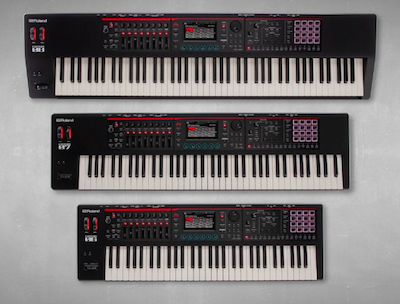
Roland Intros New GAIA SH-01

Roland unveiled several new products, including the new GAIA SH-01 synthesizer, Lucina AX-09 (keytar!) and V-Accordions.

The GAIA SH-01 features three complete virtual analog synths, 64-note polyphony, three oscillators per voice, big selection of FX (and up to 5 simultaneous), full USB DAW capability and more, for an expected street price of $650. Check out the demo vid:

Spectrasonics Announces New Features and Sounds for Omnisphere & Trilian

Spectrasonics announced version 1.3 updates (available April 20; free downloads for registered users) with new features and sounds for their Omnisphere and Trilian virtual instruments, including real-time performance sync capabilities, which allow all three of Spectrasonics virtual instruments (Omnisphere, Trilian and Stylus RMX) to be used together in unique ways.

OmnisphereThe new ‘Latch’ and ‘Trigger’ modes are ideal for Electronic Music performers since they allow real-time creation of complex, multi-layered performances with full synchronization between multiple Omnisphere, Trilian and Stylus RMX parts without the need for traditional sequencing techniques.

New performance and live remixing techniques are now possible, since any incoming MIDI data to these instruments can now be quantized in real-time — making it easy to experiment, jam and improvise with any other clocked sources without losing any synchronization.

Spectrasonics has also taken its Groove Lock technology further in v1.3 and applied it to the multi-stage envelopes in the STEAM engine. This advancement allows all of the envelopes in Omnisphere and Trilian to be ‘Groove Locked’ from external sources and will automatically create rhythmic envelope patterns by dragging standard MIDI files from Stylus RMX and dropping them on the Envelope displays, reducing the time it takes to create rhythmic envelopes.

Also included in v1.3, the Spectrasonics’ sound design team have created a ‘VIP’ Omnisphere Library for users who own both Omnisphere and Trilian. The ‘VIP’ library utilizes the core libraries of both instruments together with Omnisphere’s advanced synthesis to create new sounds. Specifically for Trilian users, the sound design team has created new “produced” multis for the electric and acoustic basses in the 1.3 update which are designed for instantly cutting through heavier rock and pop mixes.

Omnisphere has a retail price of $499, Trilian has a retail price of $299, and Stylus RMX Xpanded has a retail price of $399.

PreSonus Studio One 1.5 Update Adds Big Features

PreSonus announced version 1.5 (available 04/10) of its Studio One DAW software. Key additions include support for video playback and sync for composing to picture, major enhancements to the Browser’s drag-and-drop capabilities, the ability to draw your own automation waveforms, automation points that are locked to events, a new key-command editor, changing tempos within a event without slicing the event into separate events, and support for song and album art.

A built-in SoundCloud client enables you to upload audio files from Studio One directly to the Web. The MIDI features have been improved, including a new MIDI file player in the Browser. PreSonus has enhanced the Native Effects plug-ins and added new ones. And there’s more! Check out URL for a detailed rundown of all the new features added in this update.

Universal Audio Intros “TWIN-FINITY” Four-Channel Mic Pre/DI

Universal Audio announced its latest hardware product — the 4-710D Four-Channel “Twin-finity” Mic Preamp & DI with Dynamics (available Q3 2010; Pricing TBD). The new analog hardware boasts four channels of tone-blending mic pre’s plus true-bypass 1176-style compression and 24-Bit, 192kHz A/D conversion.

Universal Audio's 4-710 four-channel “Twin-finity”

Universal Audio's 4-710 four-channel “Twin-finity”

Based on the original 710 Twin-Finity preamp — favored by engineers including Al Schmitt (Jackson Browne, Dr. John, Diana Krall) and Matt Boudreau (The Samples, Sean O’Brien) — each of the four mic preamp channels allows for continuously variable tone between 100% tube and 100% solid-state.

Other notable 4-710D features include:

- Newly designed 1176-style compression/soft-limiting circuit per mic channel
- Eight channels of high-quality 24-Bit, 192kHz A/D conversion
- Digital output via dual ADAT optical or AES/EBU DB-25
- Monolithic balanced output stage
- Balanced send/return inserts

Sound Performance Lab (SPL) Rolls Out M/S Master, Transpressor, RackPack, More

RackPack 4

RackPack 4

On the hardware side, SPL unveiled its new M/S Master, Transpressor, RackPack 4, and RackPack Dual-Band De-Esser. The M/S Master allows for fully adjustable separation of left/right signals to middle/side signals, as well as a frequency filter, stereo width control, and inserts for external processors that allow for instant switching from L/R to M/S processing.

The Transpressor consists of both the Transient Designer and Twin Core Compressor modules, which can be used in any order. The company notes that the Transient Designer’s processing begins at the limits of compression in order to maintain the dynamics of a track or mix.

The RackPack 4 is a mounting frame and power supply for up to four modules, featuring a compact design with a lateral handle, and additional fitting system for a 19-inch rack. The Dual-Band De-Esser, RackPack’s new module, takes sibilance out of vocals with targeted processing, “Auto-Threshold” for keeping a consistent signal level in spite of varying microphone distances, and settings tailored to male and female voices.

On the software end, SPL showcased their new DrumXchanger, a plug-in said to accurately record and replace drum sounds. Included with the software are two complete Transient Designer processing stages, and a 24-bit/96 kHz SPL sample library.

Another new and exciting synth, Radikal Technologies introduced its Accelerator.

The Accelerator (available 06/10) is a polyphonic Synthesizer with eight subtractive voices, each consisting of three oscillators, two multimode filters, 6 envelope generators, three voice LFOs and one section LFO. An additional noise source with independent multimode filtering and variable signal routing has been added for more sonic flexibility.

Hear some sounds on this video demo, via Moogulator, from the show floor:

Features include:

- 3 oscillators with sweepable waveforms, time linearity modulation, phasemodulation, ringmodulation between Oszillator 2+3
- oscillator synchronisation 6 envelope generators
- 4 LFOs (3 voice, 1p art LFO)
- noise with noise filter (multimode filter 12 / 24 dB)
- independent amp EG for noise
- 2 multimodefilter per voice LP, HP, BP and
- Notch with 12/24 dB per filter switchable
- independent oscillator to filter feeds
- serial and parallel filter configurations
- arpeggiator
- step sequencer
- MIDI In, Out, Thru
- MORE!

Also, came across the awesome looking/sounding OP-1 from Sweden’s Teenage Engineering. The OP-1 is a synth/sampler/sequencer that was first introduced at last year’s Musikmesse, with a new built-in Tape feature talked up at Winter NAMM. It’s still not out yet but check out this demo and join the relative masses in waiting: