Avatar Action: Sugarland, the Michel Legrand Orchestra, State Farm Was There

October 3, 2011 by  
/* Filed under News, SPARS Feed */

Avatar Studios session action recently was fast and furious, as reported by the studio. Superstars returned, and multiple major label and indie artists tracked along with TV, film and Broadway cast recordings.

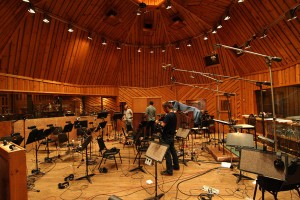
Prepping for the 52-piece 52-piece Michel Legrand Orchestra at Avatar's Studio A.

Jennifer Nettles and Kristian Bush AKA Sugarland recorded in Studio C on the Neve VRP 72-input console with producer Byron Gallamore. Engineer Tom Tapley was assisted by Bob Mallory.

Tony Bennett returned to Studio A and the Neve 8088, with Lady Gaga and producer Phil Ramone. Engineer Dae Bennett was assisted by Fernando Lodeiro and Tim Marchiafava.

State Farm made a choral recording in Studio A for a 9/11 Spike Lee-directed commercial with producer Eric David Johnson. Engineer Jonathan Duckett was assisted by Charlie Kramsky.

Joe Jackson recorded in Studio C. Engineer Elliot Scheiner was assisted by Aki Nishimura.

Bassist/singer Esperanza Spalding recorded in Studio G with engineers Fernando Lodeiro and Brian Montgomery assisted by Tim Marchiafava.  The sessions are being produced by Esperanza Spalding and Q-Tip.

Studio B and the SSL 9000 J were on duty for Dar Williams, recording with producer/engineer Kevin Killen assisted by Fernando Lodeiro.

Horn specialist Mark Rivera recorded in Studio B with producer Jimmy Bralower, and engineer Roy Hendrickson assisted by Charlie Kramsky.

Rock singer/songwriter Danielia Cotton recorded in Studio A with engineer Dave Swanson assisted by Bob Mallory.

Producer John Oddo was on point for Broadway singer/actress Christine Ebersole, recording in Studio B with engineer Roy Hendrickson assisted by Tim Marchiafava.

Legendary jazz drummer Jack DeJohnette recorded in Studio A with producer Bob Sadin, engineer Dave Darlington assisted by Bob Mallory.

Continuing on the jazzzzzzzz tip, artists Claire Martin and Kenny Barron recorded in Studio B with producer Philip Hobbs, engineer Calum Malcolm assisted by Charlie Kramsky.

Also in Studio A, the 52-piece Michel Legrand Orchestra tracked with producer Sylvain Taillet. Engineer Lawrence Manchester was assisted by Bob Mallory and Tim Marchiafava.

Another ensemble, the Manhattan Chamber Orchestra was in Studio A with producer Howard Cass, while engineer Paul Zinman was assisted by Tim Marchiafava.

Tommy Igoe led the Birdland Big Band into Avatar's Studio C.

The Birdland Big Band dug into their first studio album in Studio C. The team of producer Tommy Igoe, engineer Phil Magnotti, and assistant engineer Aki Nishimura oversaw the recording.

On the music-for-media front, score for the film Friends with Kids was recorded in Studio C with producer/composer Marcelo Zarvos, engineer Erlin Velberg assisted by Fernando Lodeiro.  The film stars Kristen Wiig, Megan Fox and Jon Hamm.

The cast album for Stage Door Canteen was recorded in Studio A with producer Hugh Fordin, and engineer Cynthia Daniels was assisted by Aki Nishimura. Meanwhile, a benefit project for Broadway Cares was recorded in Studio B with producer Lynn Pinto, engineer Andros Rodriguez assisted by Tim Marchiafava.

In Studio A, the cast album for Death Takes a Holiday tracked with producer Tommy Krasker. Engineer Bart Migal assisted by Bob Mallory and Charlie Kramsky.

Session Buzz: Who’s Recording In & Around NYC — A Monthly Report

GREATER NYC AREA: It’s midsummer…the middle of a traditionally “slow season” for recording with so many bands out on the road. But this is the city that never sleeps, and slow is a relative term. The following is but a sampling of recent sessions, and works in progress…a snapshot of what’s going on around town:

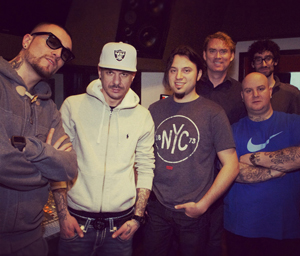
Justin Nozuka (here with band) has been recording at Germano with producer Steve Jordan, and Dave O'Donnell engineering.

Starting at Germano Studios downtown…50 Cent has been writing and recording new material with Araab Muzik producing and Ky Miller engineering, Ne-Yo was in writing and recording with Swizz Beatz producing and Moses Gallart engineering, and Justin Nozuka recorded basic tracks with Steve Jordan producing and Dave O’Donnell engineering – all in Studio 1.

In Studio 2, will.i.am continues to record new material which he’s self-producing and engineering, and Oriane recently recorded vocals with Walter Afanasieff producing and Jason Agel engineering.

Nearby at The Lodge, Mastering Engineers Emily Lazar, Joe LaPorta and Heba Kadry have been busy working on Björk‘s epic multimedia release, Biophilia, due out this Fall. The music for Biophilia – featuring a 10-song album and 10 musical iPad apps themed after each song’s scientific subject matter – was mastered at the Lodge in March by Lazar and LaPorta alongside Björk and her longtime engineer/producer Damian Taylor.

Bjork's new album, "Biophilia," was mastered at The Lodge by Emily Lazar and Joe LaPorta alongside Björk and engineer/producer Damian Taylor.

Other recent releases mastered at The Lodge include Chris Taylor’s CANT LP, Morgan Page’s new album, In The Air, Ronnie Vannuci’s (of the Killers) solo debut Big Talk – produced by Joe Chiccarelli and mixed by Alan Moulder – the new Boy & Bear album – also produced by Chiccarelli – and Large Professor’s latest for Fat Beats Records.

The Lodge also mastered Ronnie Spector’s tribute cover of Amy Winehouse’s Back to Black – produced by Richard Gottehrer – Surfer Blood’s cover of Nirvana’s “Territorial Pissings” for SPIN’s Nevermind compilation, new releases by Zechs Marquise (band formed by Marcel Rodriguez Lopez from the Mars Volta), and Junior Mance, and the new Wooden Ships album – produced by Phil Manley of Trans Am.

Over in the East Village at Flux Studios, Todd Whitelock mixed an upcoming album by jazz saxophonist and flautist Kenny Garrett in the Revolution Room. Garrett – who was a member of the Duke Ellington Orchestra, and Miles Davis’ band – will release his upcoming album via Mack Avenue Records.

And down in SoHo, The Magic Shop has been going steady…Shooter Jennings tracked for his upcoming album with engineer Brandon Mason, assisted by Brian Thorn, Burning Spear tracked and mixed for their upcoming album with Thorn engineering, assisted by Kabir Hermon, and Tom Schick was in mixing for She and Him’s upcoming Merge album.

Other recent sessions in the Magic Shop’s unique Studio A include: The American Secrets tracking and mixing songs for upcoming freecreditscore.com commercials with producer Neil McClellan (The Lodge Music creative director) and engineers Ted Young and Colin Thibadeau; The Gaslight Anthem tracking an iTunes exclusive live session with producer Jason Marcucci, and engineers Ted Young and Mike Judeh; and tracking sessions for new albums by Elliot Sharp (producer Joe Mardin/ engineer Ted Young), Lee Feldman (engineer Ted Young), Ben Carroll (producer Adam Levy / engineer Brian Thorn), The Virgins (engineer Emery Dobyns) and The Universal Thump (engineer Kabir Hermon).

The Virgins tracked new material for their upcoming Atlantic release with producer/engineer Emery Dobyns at The Magic Shop.

Meanwhile in the Magic Shop’s Blue Room, Warren Russell-Smith has been doing restoration work for the second season of Boardwalk Empire. Recent mastering sessions at the Magic Shop include albums for Rockstar Games, Anna Volgelzang, Warpaint, Nightplane (mastered by Russel-Smith) and Nâ Hawa Doumbia, Vic Varney and Pretty Good Dance Moves (mastered by Jessica Thompson).

At another studio down in SoHo – Serious Business Music – producer/engineer Travis Harrison has had a steady stream of bands in to appear on his BreakThru Radio show. In the last month, “Serious Business on BTR” has featured performances and interviews (by Harrison) with A Million Years, Fort Lean, Les Sans Culottes, El Jezel and Quiet Loudly.

Harrison has also been working on a number of album projects, including an album with a new band called The Cosmos – formed by Dougy Payne and Andy Dunlop from Travis, and Cinjun Tate from Remy Zero – a solo 7” with Doug Gillard from Guided By Voices, and a record with Rocketship Park for Serious Business Records.

In Park Slope at Seaside Lounge Recording, engineer/producer/musician Josh Clark mixed a record by Nashville native Luke Roberts, The Iron Gates at Throop and Newport, to be released by Thrill Jockey Records in 2012. Initial tracking sessions for the record went down at The Beach House in Nashville and Atlantic Sound in Brooklyn (with “Seaside Lounge” rounding out the coastal recording theme.)

On the West Side at Stratosphere, Japanese electro-rock band The Telephones tracked their new album in Studio A with producer/engineer Alex Newport, recording everything to tape on the studio’s Studer 2″.

The Telephones in Stratosphere Studio A. Photo by Yuki Shingai.

Also at Stratosphere…Ice T booked an afternoon of vocals and filming for upcoming documentary Something From Nothing: The Art of Rap. Stratosphere’s own Adam Tilzer engineered. Aaron Neville returned to record vocals with producer Matthew Ferraro and engineer Geoff Sanoff.

Daniel Merriweather was back for sessions with Dave McCracken, Amanda Ghost and engineer Chris Shaw, Florence + the Machine was in with engineer Andros Rodriguez, and Nathan Larson (A Camp, Shudder To Think) tracked and mixed music for an upcoming film, Tiger Eyes, with Geoff Sanoff engineering.

Up at Carriage House Recording in Stamford, cellist Dave Eggar (Evanescense, Coldplay) and his band Deoro finished mixes for their upcoming record in Studio A with engineer/mixer Brendan Muldowney, and art-pop songstress Rachael Sage tracked basics for her upcoming release with engineer John Shyloski.

Back in town, at Sear Sound, NYC denizen Donald Fagen tracked in Studio A on the 8038 Neve with Michael Leonhart producing and Charlie Martinez engineering for Warner Bros. Records. eONE Music was in Studio C, reportedly “classisizing” Frank Zappa songs for a new release. In this process, Zappa’s original songs were rescored for classical orchestral instruments and tracked on Sear Sound’s custom Avalon/Sear console in sessions produced by Susan Del Giorno with GRAMMY-winning engineer Silas Brown.

Producer/engineer Gary Maurer also checked into Sear to track an ensemble of 22 musicians for his upcoming HEM album in Studio C. He will reportedly return to Sear Sound shortly to mix a 24 song double album.

Red Hot Chili Peppers' tenth studio album "I'm With You" comes out August 30. Produced by Rick Rubin, Engineered by Greg Fidelman and Andrew Scheps out in LA; Mastered by Vlado Meller at Masterdisk

Further west at Masterdisk, Scott Hull mastered Sting’s three-CD box set, Sting 25 Years, featuring remixes and a previously unreleased live concert DVD with 10 tracks recorded live in NYC, produced by Rob Mathes. Also at Masterdisk, Vlado Meller mastered a Julio Iglesias two-disc “Greatest Hits” set, with songs re-recorded and re-mixed by Alberto Sanchez, the new Red Hot Chili Peppers album, I’m With You, and the Jane’s Addiction single “Irresistible Force,” and upcoming album, The Great Escape Artist.

Andy VanDette recently mastered the Spiderman Turn Off The Dark cast album and albums by Blessthefall, The Static Jacks and Barefoot Truth, and Ellen Fitton remastered Debbie Harry’s Koo Koo, and Jellybean’s Wotupski.

Premier Studios in Times Square hosted Demi Lovato working on a project for Disney Pictures – a song produced by Sandy Vee, with piano overdubs played by Mikkel Eriksen from Stargate. The session was engineered by Sam Giannelli. Will.i.am of the Black Eyed Peas produced tracks for Lil Wayne, working with engineer Mike Cadahia with Kevin Geigel assisting. DefJam artist Ace Hood, produced by DJ Khaled, was at Premier recording vocals and mixing an upcoming release with engineer Ben Diehl.

Atlantic artist Wiz Khalifa recorded vocals, with engineer Josiah Hendler, EMI Artist MoZella was in with producer Scyience, mixing with engineer Anthony Daniel, and Scyience was also in with Epic artist Alice Smith, mixing an upcoming release with an engineer by the name of Push Buttons.

Over at Avatar Studios, strings were recorded in Studio A for the upcoming Lou Reed/Metallica album with producer Hal Willner and engineer Greg Fidelman, assisted by Bob Mallory. NYC/Ireland rockers Suddyn recorded their single in Studio G on the SSL 4000G+ with producer David Kahne, engineer Roy Hendrickson and assistant Tyler Hartman. The Brooklyn Youth Chorus was in Studio A recording with producer Bryce Dessner, of The National and Clogs, and engineer Lawson White, assisted by Aki Nishimura.

Music for the upcoming film, A Late Quartet, was also recorded in Studio A with producer Alan Bise and engineer Bruce Egre. The cast albums for People in the Picture (producers Mike Stoller and Steven Epstein, engineer Todd Whitelock) and A Minister’s Wife (producer Tommy Krasker, engineer Bart Migal) were also recorded at Avatar.

And we know there’s so much more going on out there! If you’d like to be featured in “Session Buzz,” please submit your studio news to submissions@sonicscoop.com.

Avatar Studios Hosts James McCartney, Travis Barker, Regis Philbin, Roberta Flack

April 14, 2011 by  
/* Filed under News */

The rooms at Avatar Studios have been crowded this past month, with projects for everyone from global artists to talk show royalty. Top producers and engineers have been in on many of the sessions as well.

(l-r): Rebecca Arons, Regis Philbin, Ben Arons in Avatar's Studio C. (Photo credit: Ben Arons)

Studio A, with its legendary 2,496 sq. ft. live room, accommodated a duet by Tony Bennett and Sheryl Crow, produced by Phil Ramone, engineered by Dae Bennett, and assisted by Fernando Lodeiro. Elvis Costello was also in A, recording a song for an upcoming film with engineer Kevin Killen, assisted by Fernando Lodeiro.

Staying in Studio A, James McCartney recorded in Studio A with producer David Kahne, engineer Roy Hendrickson assisted by Fernando Lodeiro. Mark Ronson recorded music there for Warner Pictures’ Arthur, with engineer Vaughan Merrick, and assisted by Bob Mallory. On the drumming tip, Travis Barker recorded drums for an ad with producer James Covill, engineer James Ingram, and assisted by Bob Mallory.

Roberta Flack recorded in Studio A as well as well as the SSL 9000J-equipped Studio B with co-producer Sherrod Barnes, engineer Roy Hendrickson, and assisted by Bob Mallory.

In Studio C with its Neve VRP 72, Constantine Maroulis recorded with producers Phil Galdston and Marc Copely — engineer Lawrence Manchester was on hand, assisted by Bob Mallory. In addition Rebecca Arons recorded with Regis Philbin in Studio C with engineer Anthony Ruotolo, assisted by Bob Mallory. Also in C, Steve Reich / So Percussion recorded with producer Judith Sherman, engineer John Kilgore, and assisted by Charlie Kramsky.

On the multimedia front, Cirque de Soleil recorded in Studio C with producer Phil Ramone and engineer Roy Hendrickson, assisted by Fernando Lodeiro. Music for HBO’s “Boardwalk Empire” was recorded in Studio B with producers Stewart Lerman, Jim Dunbar, engineer Stewart Lerman, and assisted by Bob Mallory. Last but not least, music for Fox’s “Glee” was recorded in Studio G with producer Tommy Faragher and engineer Bryan Smith, assisted by Fernando Lodeiro.

Paul McCartney, Lou Reed, Bjork, Mark Ronson Recording at Avatar

March 18, 2011 by  
/* Filed under News, SPARS Feed */

We’ve got the latest on who’s been recording at NYC’s Avatar Studios most recently. Check it out:

The James Carter Organ Trio in Studio A (l-r): James Carter, Gerard Gibbs, Leonard King, Michael Cuscuna (producer)

In the legendary Studio APaul McCartney recorded a Buddy Holly tribute with producer David Kahne and engineer Roy Hendrickson, assisted by Fernando Lodeiro; Lou Reed recorded (and mixed) music for a TV commercial with producer Rob Mathes and engineer Elliot Scheiner, also assisted by Lodeiro;

Mark Ronson recorded music for Warner Brothers Pictures’ upcoming film Arthur, with engineer Vaughan Merrick, assisted by Bob Mallory; and Vince Giordano and the Nighthawks continued recorded music for HBO’s Mildred Pierce with producer/engineer Stewart Lerman, assisted by Rick Kwan.

James Carter Organ Trio also recorded an upcoming release in Studio A with producer Michael Cuscuna and engineer Jim Anderson assisted by Aki Nishimura, and an upcoming release for Kendrick Scott’s “Oracle” was recorded with Scott and Derrick Hodge producing and Joe Barbaria engineering, assisted by Charlie Kramsky.

Stanley Jordan was at Avatar recording an upcoming release with a “who’s who” of top jazz musicians that included Mike Stern, Christian McBride, Charnett Moffett, Nicholas Payton, Bucky Pizzarelli, Charlie Hunter, Russell Malone, Regina Carter and Kenwood Dennard. Al Pryor produced the session with engineer Todd Whitelock.

Kendrick Scott on drums in Studio A, engineer Joe Barbaria in background.

Meanwhile in the large, Motown-inspired and Neve-equipped Studio C, recorded for an upcoming release with engineer Damian Taylor; Kelli O’Hara recorded an upcoming release with producer Dan Lipton and engineer Lawrence Manchester; Louis C.K. and engineer Robert Smith worked on music for Season 2 of the FX show, Louie.

In the SSL 4000 G+ equipped Studio G, Hal Willner produced a “Sea Shanties” project that featured vocals by Sean Lennon, Michael Stipe and Courtney Love, all recorded and mixed by engineers Martin Brumbach and Roy Hendrickson, and more vocals for Fox’s Glee were recorded and mixed with producer Tommy Faragher and engineer Bryan Smith.

Finally, in Studio B, Isabella Rossellini recorded a voice over for an upcoming environmental documentary Home with producer Eva Ferrero and engineer Neil Dorfsman; and Renee Fleming was in for a video shoot for a Sydney Opera House performance. The session was produced by Alex Coletti and engineered by Aki Nishimura.

Seth MacFarlane & Norah Jones, Suzanne Vega and All Time Low Recording at Avatar

January 26, 2011 by  
/* Filed under News */

Family Guy creator Seth MacFarlane is recording an album of 1940s and 50s-era Broadway standards for Universal Republic Records, working with producer and arranger Joel McNeely.

MacFarlane and McNeely recently recorded for the project in Avatar’s Studio B, joined by Norah Jones, with engineer Frank Fillipetti. Rick Kwan assisted on the recording sessions.

The album is reportedly being produced using recording techniques from the 40s-50s era — MacFarlane singing live backed by an orchestra and big band all in the same room. They’ve been recording at Capitol Records Studios in Hollywood, utilizing the same microphones, mic pre-amps and signal chains (to analog tape) used in recordings made there by Frank Sinatra, Nat King Cole and Rosemary Clooney.

Naturally, when in NYC, they booked time at Avatar where the production could continue in that style with much (if not all) of the same gear.

Suzanne Vega's back in the studio, recording with producer/engineer Joe Blaney

In other recent sessions at Avatar Studios…

- Alicia Keys recorded in Studio A for an interactive Music Experience project by Sony Wonder Technology Lab with producer Chuck Fishbein, engineer Jeff “Jedi Master” Jones (also assisted by Kwan).

- Randy Travis and Kristin Chenoweth recorded in Studio G with producer/engineer Elliot Scheiner assisted by Bob Mallory.

- Suzanne Vega recorded in Studio A with engineer/producer Joe Blaney.

- All Time Low recorded in Studio C with producer David Kahne, engineer Roy Hendrickson, assisted by Aki Nishimura.

- More music for Glee was mixed in Studio G with producer Tommy Faragher, engineer Bryan Smith, assisted by Charlie Kramsky.

- Tracking sessions for the Mildred Pierce (HBO) score continued in Studio A with composer/producer Carter Burwell and engineer Todd Whitelock assisted by Rick Kwan and Fernando Lodeiro.

- Jazz pianist Cyrus Chestnut recorded in Studio B with producer Todd Barkan, engineer Katherine Miller assisted by Charlie Kramsky.

- Jazz guitarist Steve Khan mixed in Studio C with engineer James Farber assisted by Rick Kwan.

- And The Great Unknown recorded in Studio C with children for an ASCAP and America Scores (a nonprofit group that runs after-school programs) songwriting project produced by Sue Devine and engineered by Rick Kwan.

Who’s In The Studio: Avatar, NYC

November 24, 2010 by  
/* Filed under News */

Avatar Studios has been plenty busy this Fall, once again hosting sessions for all manner of media — radio tapings, music for television and video games, and album production. Here’s a rundown of recent sessions:

Prince Royce and Ben E. King recorded “Stand By Me” in Studio C and mixed it in Studio G for the Latin Grammy Awards. The session was produced by Sergio George and engineered by Roy Hendrickson, assisted by Aki Nishimura.

Elvis Costello treated an intimate audience of WFUV members to a performance at Avatar Studios.

Elvis Costello performed live in Studio A for the top donors of [our favorite local radio station!] WFUV. The performance was recorded and produced by Dave Einstein, engineered by Brian Montgomery assisted by Aki Nishimura. Click to listen to the performance on NPR.

Josh Groban’s live performance was videotaped for “Walmart Soundcheck” in Studio A. Charles Gant produced the session and Allen Sides engineered, assisted by Fernendo Lodeiro and Aki Nishimura.

Lenny Kravitz recorded in Studio C with engineer Tom Edmunds assisted by Bob Mallory.

Ricky Martin recorded in Studio G with producer Desmond Child and Hendrickson engineering, also assisted by Mallory.

Imelda May recorded with Lou Reed and mixed in Studio C. The session was produced by Tony Visconti with engineer Mario McNulty, assisted by Charlie Kramsky.

Trans Siberian Orchestra recorded and mixed in Studio B with producer Paul O’Neil and engineer Dave Wittman. And Esperanza Spalding mixed in Studio C with engineer Joe Ferla assisted by Rick Kwan.

Avatar also hosted projects for ABC, NBC, CBS and Fox within a span of a few weeks — first with Glee‘s Darren Criss into record and mix “Teenage Dream” in Studio B and G with producer Tommy Faragher and engineers Robert Smith and Bryan Smith. The episode aired on November 9 and the single hit #1 on iTunes.

ABC’s Nightline did a story called “The World on Autotune” in Studio G with reporter Jeremy Hubbard, and engineer Roy Hendrickson. The show was produced by Dan Przygoda and engineered by Hendrickson. The “Sign of the Times” segment aired on October 22.

Mike Tompkins, an a capella artist who became famous for his YouTube viral videos covering popular songs, assisted Today Show anchors Matt Lauer, Meredith Vieira, Ann Curry and Al Roker with the singing and beat boxing to make a “Dynamite” viral video. The process was recorded and taped in Studio B and the resulting video was aired on November 15. It was produced by Robin Sindler and engineered by Rick Kwan. Check it out here!

Bill Cosby recorded the winning giggle for a press event by Kraft for Jell-O’s “Give It A Giggle” tour in a session produced by Greg Lederer and engineered by Bob Mallory.

Finally, THQ recorded music for an upcoming video game Homefront in Studio A with producer Frank Di Minno and engineer Gary Chester.

Rubicon Score, Alicia Keys, Jesse Harris & Punch Brothers Recorded At Avatar

September 23, 2010 by  
/* Filed under News */

AMC’s new series Rubicon features a brilliant, subtly-suspenseful original score by Peter Nashel of NYC music production company, Duotone. And the composer/producer has been recording said picture-perfect score at NYC’s Avatar Studios, with engineer Roy Hendrickson assisted by Aki Nishimura. Tune into Rubicon Sundays at 9PM!

Punch Brothers are a Brooklyn-based bluegrass band featuring Chris Thile (mandolin), Gabe Witcher (fiddle/violin), Noam Pikelny (banjo), Chris Eldridge (guitar), and Paul Kowert (bass).

Avatar has been booked by a variety of other artists, film and theater projects of late, including:

Alicia Keys recording with engineer Ann Mincieli, assisted by Rick Kwan; Ricky Martin recording in Studio G with producer Desmond Child and engineer Christian Baker; singer/songwriter Jesse Harris recording and mixing a self-produced project in Studio C with engineer Mark Plati, assisted by Fernando Lodeiro; and Punch Brothers recording a new project for Disney with producer Joel McNeeley and engineer Frank Filipetti.

Filipetti also recently engineered on sessions for producer Phil Ramone with singer/actress Elaine Paige in Avatar’s Studio G.

The cast album for Broadway’s La Cage Aux Folles starring Kelsey Grammer was recorded in Studio A and Studio G with producer (and PS Classics co-founder) Tommy Krasker and engineer Bart Migal assisted by Bob Mallory and David Rowland.

And the score for the upcoming film, The Beaver, was recorded in Studio A with composer / producer Marcelo Zarvos, director Jodie Foster, engineer Richard King assisted by Fernando Lodeiro and Charlie Kramsky.

For more information on Avatar Studios, visit http://www.avatarstudios.net/ and follow them on Twitter — where they are known to announce last-minute deals on studio time — @avatarstudios!

Avatar Opens New Studio W

August 23, 2010 by  
/* Filed under NYC Spotlight */

HELL’S KITCHEN, MANHATTAN: Avatar Studios announced that it has opened Studio W, a new 160 sq. ft. Pro Tools/Logic writing room. Acoustically designed by renowned Avatar engineer/mixer/producer Roy Hendrickson (Avatar Studio E, Studio G), the second floor studio was launched to provide an inexpensive but functional room for songwriters/artists to work out song ideas.

Avatar Studio W was designed by Roy Hendrickson

Studio W gives users access to the long list of vintage analog gear available at Avatar, and is also equipped with an adjacent vocal booth to make writing, pre-production and vocal overdubs all possible.

“Technically, Studio W has everything you need to write and produce songs at a very high level,” says Tino Passante, General Manager of Avatar Studios. “Aside from the standard Pro Tools, Logic, and Digital Performer DAW’s, there is a nice array of very powerful standalone keyboard workstations from Korg, Yamaha, and Roland.

“But it turns out the strongest feature of the room is the room itself! Anyone can buy a bunch of software and an interface and get to work, but not everyone has the privilege of working in a sonically accurate acoustic environment with proper isolation and treatment. Besides providing a properly acoustically designed professional studio, we took great pains to make sure the vocal chain was of really high quality.”

With the addition of Studio W, Avatar takes advantage of its ability – increasingly unique in NYC due to it’s size and multi-floor layout — to provide clients with “all under one roof” services. “Now there’s no reason to ever leave Avatar,” Passante explains. “You can come here from the ‘idea’ stage and take it right up to mastering with Fred Kevorkian.”

Studio W workstations

– David Weiss

Endless Analog Demos Its Dream-Come-True CLASP at Avatar

August 5, 2010 by  
/* Filed under Tech & Reviews */

MIDTOWN MANHATTAN: Nashville-based producer/musician/inventor Chris Estes demonstrated his revolutionary Endless Analog CLASP system in Avatar’s Studio G on Monday. The session featured ace-of-bass and producer Jerry Barnes laying down some of his thick, low-end goodness to Pro Tools HD via 2” tape and the CLASP.

The CLASP hardware unit is installed between your mic pre’s, DAW and tape machine.

Since the CLASP is such a newfangled, first-of-its-kind product, there’s a lot to understand about what it does and how it works. There are several great reviews and testimonials on the system here and plenty of information to answer any and all questions you may have. But here’s the gist:

CLASP (Closed Loop Analog Signal Processor) consists of a hardware unit that is installed between your mic pre’s, DAW and tape machine (pictured), and the native Bridge plug-in (RTAS and VST), which you open on any track in your DAW session and use to control the tape transport.

These days, most recordings being done to tape are then dumped into the digital realm for editing and mixing. CLASP allows for a totally hybrid workflow, where analog recording and overdubs are done in real time, controlled with the speed and efficiency of digital, and all audio is stored in your DAW, minimizing tape usage. You can use one reel of tape to record an entire record, or several records for that matter.

CLASP essentially allows the tape machine to be used like a plug-in. You control the tape machine and switch between tape speeds stored in the CLASP right from your DAW. And you can monitor analog in repro mode. [See the CLASP connection diagram here.]

CLASP's Bridge plug-in

The elevator pitch to engineers via Endless Analog’s website: “CLASP provides sample accurate tape synchronization with zero latency analog monitoring while delivering a true analog front end recording solution for Pro Tools.”

Seeing the CLASP in action, its functionality seems instantly essential. It totally streamlines a process that needs streamlining and will allow so many more people to utilize analog tape as part of their production.

At Avatar, the CLASP hardware unit was connected via MIDI to the Pro Tools HD rig and through an Endless Analog proprietary cable to the 24-track Studer A800. Once the tape machine was aligned and synchronized to the Pro Tools session at both 15 ips and 30 ips recording speeds via CLASP, Barnes tracked a bass line and then monitored off the repro head to select his preferred speed.

During playback, Estes pointed out: “Being able to monitor in repro is a really great thing for getting drum sounds, for example, because you can make judgment calls about what tape speed you want to use for a particular song.”

Chris Estes explaining the CLASP signal/workflow

“You can have it on whatever speed and then have the drummer play, mute his headphones, and then listen off the tape in Pro Tools. And you can make decisions about levels and EQ and things like that based on what you’re hearing.

“You can have the tape rolling while the drummer’s playing and, starting with the kick drum, you can bring the level up to find the sweet spot — right where we get just the right amount of tape compression — and dial it in so when you go to do your recordings, there are no surprises.”

CLASP stores information for up to three different recording speeds. Estes relayed to the group: “In a lot of sessions we’ve done so far, people will record the drums at 30 ips, then they’ll go back and re-cut the bass at 15. Then they’ll cut electric guitars at 7½, which sounds really great if the machine is aligned properly. With this [A800] machine, you’d vari-speed it down as far as you can get it and then do an alignment for that.”

“And if you wanted to use varispeed to overdub just a Tom Fill at 15IPS and have the rest at 30?” engineer Roy Hendrickson asked.

“You’d use the sync I/O in Pro Tools and vari-speed Pro Tools up,” says Estes. “So to make the toms sound bigger you’d vari-speed Pro Tools up and do the tom fill, put it back normal, and then the toms would be huge.”

Demo group at Avatar, Jerry Barnes at right

Estes also points out you can daisy-chain up to three CLASP hardware interfaces and synchronize three 24-track tape machines for a total of 72-channels of recording. You can use CLASP with 24, 16, 8 or even 2-track machines, you can combine different machines and tape speeds for different tones. In addition to Pro Tools, CLASP also works with Nuendo and Cubase.

But there’s even more to know…here’s Estes on-the-spot rundown of CLASP’s main functions and features:

1) First of all, the CLASP is a precision measuring instrument, which functions as a sample-accurate synchronization device, so it’s able to profile the tape machine, analyze the ballistics of the machine, calculate to the sample what the latency of that machine is — taking into consideration the transport, the flutter, etc. Then, it’s telling Pro Tools to change the time stamp of the audio that’s coming into the converters.

So, while you’re recording, the meters are actually late but then when you watch the wave forms as they’re going down, Pro Tools is drawing them in relationship to the grid in the correct time. So it’s an actual time stamp, you can take the session to another studio and you don’t have to have the CLASP. You only use the CLASP when you’re cutting tracks.

2) The CLASP is seamlessly controlling the tape transport for you invisibly in the background. It works a lot like the Quick Punch mode — it looks at the track-arming status and as soon as you have tracks armed and you start the Pro Tools transport, the CLASP, analog machine and Pro Tools Quick Punch all start recording simultaneously in the background. It’s extrapolating from the Pro Tools transport and track-arming status. So even though you might have punched in late, you can peel back audio with tape now. Which is impossible otherwise.

3) You don’t have to rewind the tape until you reach the end of the reel. In this case, it’s counting down from 30 minutes (@15 IPS), so you’d only have to rewind every half-hour or so.

4) You now have latency-free analog monitoring. We’re monitoring here through the master-grade analog hardware of the CLASP, not Pro Tools.

5) CLASP compensates for the converter delay times. If you’re using Apogee 16X converters with Pro Tools, for example, that’s 62 samples of converter latency at 44.1, so you simply type in 62 samples in the offset and then everything you play is perfectly in time with where it’s supposed to be when you play it back.

After the demo at Avatar, engineer Roy Hendrickson shared his impressions with us:

“I think what Chris has done here is quite brilliant. The fact that he is getting Pro Tools to record these files into the DAW with an adjusted time stamp is genius.

“And once you’re finished using CLASP and you go back to using Pro Tools normally, there are no side effects, there’s nothing you have to change about your workflow. You don’t have to move your files and it does all those little tweaks that you’d normally have to do — like re-compensating for things like delay manually — this takes care of all that for you in a really elegant manner so you don’t have to worry. You can concentrate on the performance.”

On the Endless Analog website, Chris Estes and Endless Analog VP Amy Becker Estes ask us to: “Imagine experiencing analog tape recording as fast, effortless and timesaving as Pro Tools.” The CLASP system, which Estes started developing out of his garage in Nashville over five years ago, makes this idea – once Estes’ daydream – a reality.

Endless Analog’s CLASP system is available now from Vintage King for $7,495.

Visit www.endlessanalog.com and www.vintageking.com/Endless-Analog-Clasp for more information!

Kings of Leon Record at Avatar

June 7, 2010 by  
/* Filed under News */

This Spring, Kings of Leon recorded in Avatar Studio A, working with producers Jacquire King and Angelo Petraglia on tracks for their upcoming album. King engineered the sessions, with assistance from Bob Mallory.

Kings of Leon and crew in Avatar's Studio A

Avatar also recently hosted a Film Scoring Workshop, a joint program presented by Columbia University Film School and ASCAP. Four composers from the workshop recorded and mixed their scores to short films in Studio C with instructor/producer Alex Steyermark and engineer Jason Stasium. The shorts were submitted to the annual Columbia University Film School Film Festival, for screenings in NYC and LA.

And the music to a long-lost Broadway musical revue, Life Begins at 8:40, by Harold Arlen, Ira Gershwin and Yip Harburg, was recorded in Avatar’s Studio A with producer Tommy Krasker and engineer Bart Migal, assisted by Rick Kwan and Fernando Lodeiro.

Life Begins At 8:40 originally opened on August 27, 1934, at NYC’s Winter Garden Theatre and ran for 237 performances.  The original performance materials from the show were scattered and lost after the Broadway run, until pieces of the work were rediscovered at the Music Division of the Library of Congress and the Shubert Theater Archives in New York City.  From these pieces, the original piano-vocal score and orchestra parts were reconstructed.

Avatar also hosted JazzReach’s Metta Quintet who recorded a few tracks from their project, “Big Drums, Small World,” in Studio B with producer (and JazzReach founder) Hans Schuman, engineer Jim Anderson assisted by Lodeiro.  “Big Drum/Small World” features new commissions by prominent internationally recognized jazz composers from countries as diverse as West Africa, Israel, Cuba, Iraq, Puerto Rico, India, Spain, Brazil, China and the United States.  JazzReach is a nationally recognized New York City-based non-profit organization dedicated to the promotion, performance, creation and teaching of jazz music.

Other notable sessions recently at Avatar include: Corinne Callen, indie artist and winner of Avatar’s 2010 Pre-CMJ drawing for a free day of recording, recorded in Studio B with engineer Justin Gerrish; Teddy Thompson recorded in Studio C with producer David Kahne and engineer Roy Hendrickson; The Juilliard Jazz Ensemble recorded in Studio B with musical director and producer Carl Allen, engineer Katsu Naito assisted by Aki Nishimura.

For more on Avatar Studios, visit the website at www.avatarstudios.net.