NYC Studio Tour: Central Brooklyn Part 2

May 12, 2011 by  
/* Filed under Deli NYC Feed, NYC Spotlight */

CENTRAL BROOKLYN, NY: We New Yorkers are proud of our ability to squeeze into tight corners of this big city. But sometimes, even the most die-hard pack rats among us yearn for a little space to stretch their legs.

Come join us in exploring four Central Brooklyn studios that offer a refreshing amount of breathing room at an affordable rate in this latest installment of our NYC Studio Tour.

VINEGAR HILL SOUND
Vinegar Hill/DUMBO
www.vinegarhillsound.com
Room Rates: $400/day; $500/day with engineer

Guitarist and studio owner Justin King has developed a minor fetish for Telefunken-Elektroakustik’s remakes of classic German condenser microphones, recently purchasing pairs of ELA M 251′s, 260′s, and AK-47s along with “a host of M80′s”.

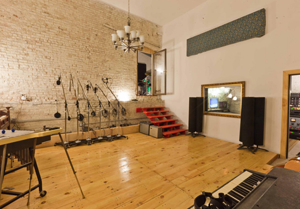
Vinegar Hill's Live Room

Despite these boutique tastes, King says he’s priced Vinegar Hill Sound with up-and-coming indies in mind: “Considering the classic analog gear, the instruments/amps we offer, and the size of the main room (over 600 square feet with 16 foot ceilings) Vinegar Hill Sound has an unbeatable 10-hour lockout rate for a studio of its quality.”

King named his studio after the small slice of Brooklyn it occupies. Vinegar Hill is a concealed enclave of old brownstones, cobblestone streets and charming brick townhouses that stood in quiet resistance through the construction of the BQE in the mid 20th century, and the building boom of the early aughts that re-shaped much of the surrounding area.

“It’s a pleasure to work in the area,” says King of this small neighborhood, which sports a name that sounds unfamiliar even to many long-time New Yorkers. “It’s located a couple blocks off the water near the Brooklyn and Manhattan Bridges. There are great restaurants, bars, coffee shops, galleries and Fulton Ferry Park all within a three-block-radius of the studio.”

This owner/operator took pains to make the studio friendly to outside producer/engineers as well: A clearly-labeled patchbay system serves as a well-organized life-line between the 24-in/40-out Pro Tools HD system and a 32-channel Toft ATB console.

Interesting in-house instruments include an antique pump organ, vintage harpsichord and a “massive, Bonham-esque” Gretsch drum-kit.

“The studio is extremely well suited for recording strings, drums, vocals – anything acoustic really,” King continues. “I think we’re capable of elevating any kind of music. It’s a serious studio at a silly price.”

GODELSTRING
Park Slope/Downtown Brooklyn
www.godelstring.com/
Room Rates: $450/day for Studio A, room only; $600/day for Studio A, with house engineer

GodelString Studio is an enterprise of many faces. After moving on from his prior studio, Brooklyn Broadcast, Joel Hamburger built a suite of three new, distinct rooms to cater to his team’s diverse clientele.

Godelstring Studio A

Studio regulars include producer/composers such as Jay Braun (Norah Jones, Jon Spencer, Cat Power), William Berlind (Burning Spear, Colin McGrath), and Sanford Livingston (Scores for Jesus Camp, and the award-winning “Underwear”) as well as Latin producer/engineer Rafael Lazaro.

“We’ve each got our own little niche, so there’s not a lot of stepping on toes,” says studio manager and engineer Dan Rosato, who plays guitar and sings in the rootsy, rollicking, indie-rock outfit Your 33 Black Angels.

Their studio is as central as Central Brooklyn gets: Built on a shady stretch of 5th Avenue near Atlantic, GodelString is sandwiched between the disparate worlds of quiet Park Slope and bustling Downtown Brooklyn. A flagship A-room hosts an Audient console that feeds a Pro Tools HD system, and features a large live room with three conjoined iso booths and a Steinway grand.

Ample B and C rooms serve as day-to-day production suites, while an expansive tech shop keeps the whole facility humming. It’s an impressive amount of space for the neighborhood, not to mention, the price-point.

SEASIDE LOUNGE
Park Slope/Sunset Park
www.seasidelounge.com/
Room Rates: $500/day in Studio A (includes engineer); $400/day in Studio B (includes engineer)

A set of heavy drapes opens in Seaside Lounge’s deep hued, wood-floored live room to reveal a hidden wall of reflective cement. “We don’t have one set, static way of doing things,” says part-owner Josh Clark. “If it’s possible and not particularly dangerous, we’ll give it a shot.“

Seaside Lounge Studio A

Operated by a handful of house engineers, both studios A and B feature Sony/MCI consoles, Pro Tools HD, and an assortment of vintage tape machines from 3M, Otari and Ampex. “We just want to capture music in the most realistic and honest way possible,” Clark continues, “So the clients we appeal to most are musicians who want to create an honest recording in a really relaxed, open environment. “

Like the other institutions that make up in today’s tour, Seaside offers a lot of space for the money. Clark tells us that as their studio grew from a single room to its current form, “we designed [the] rooms to be open and live-sounding to help reinforce [that way of working].”

And it’s paid off: A stream of distinctive and offbeat artists keeps the studio running, and keeps Seaside’s motto, “Vibe for days,” making plenty of sense.

SHADY BEAR
Kensington
www.shadybear.com
Room Rates: $350/day; $450/day with house engineer

Nestled just south of Prospect Park in Brooklyn’s Kensington neighborhood, we found Shady Bear, the personal studio of Anthony Robustelli.

Inside the Shady Bear control room

Despite an enviable John Hardy-modified MCI console and matching tape deck, Robustelli’s clients aren’t coming with just gear in mind. More than just an engineer, Robustelli bills himself as the studio’s “creative director,” an in-house player and producer who’s comfortable working songwriters through new arrangements whether they’re recording jazz, pop, or electronic music.

Whether he’s asked to play all the instruments on a session or hire top session players at friendly rates, Robustelli adds only $250 per song to the bill.

In addition to his production chops, Robustelli is proud of this Brooklyn facility’s sister studio, Shady Bear North, where he entertains artists eager to escape the city for de-compressed sessions on a quiet 30-acre plot in the Catskills mountains.

Justin Colletti is a Brooklyn-based producer/engineer who works with uncommon artists, and a journalist who writes about music and how we make it. Visit him at www.justincolletti.com.

All Hands Electric: A Brooklyn Artist Collective & Modern Musical Co-Op

May 5, 2010 by  
/* Filed under Music Biz */

GOWANUS, BROOKLYN: An artists collective and record label inspired by other artist-run labels, All Hands Electric encompasses the multiple projects of its all-Brooklyn-based artist-founders: singer/songwriter and musician Zachary Cale (Solo, Illuminations, Rope, Prudence Teacup), dance-punk musician and painter Peter La Bier (Psychobuildings), singer/composer and graphic artist Alfra Martini (Prudence Teacup) and drummer, visual artist and recording engineer Ryan Johnson (Illuminations).

AllHands_logoIn the spirit of the DIY punk labels of the 80s, the founders of All Hands Electric set out not only to release their own records, but also to develop a collective approach to producing, distributing and touring behind the records.

“We were excited about creating our own context for what we were doing,” explains Cale. “There was all this great music being made just in our circle of friends and we thought why wait around for somebody else to catch onto what we’re doing, why not just start our own label?

It’s a question every artist and many producer/engineers, studio owners and music houses have asked themselves: why not just start your own label?

We spoke to Cale about where the group efforts have been well worth it for the All Hands Electric artists.

What’s the thinking behind All Hands Electric and why did it make sense for you and your colleagues to come together in this way now?

All Hands Electric was born out of necessity, as there was so much fantastic music being made just in our circle of friends and none of us were on a label. So we set about creating our own platform, pooling our different talents and resources and it quickly took on a life of its own. I think it is easy to underestimate just how important community is for artists.  It is healthy to be around people who will challenge you as well as inspire you. As a group effort we also felt it might make it easier to cut through — if we could create a collective context for our music it would stand out in its own way.

Zachary Cale. Photo by Alfra Martini.

Zachary Cale. Photo by Alfra Martini.

Besides getting your friends/colleagues together to form the collective, what was involved in getting started?

Starting a label is actually simpler than what most people imagine. There really are no rules! Basically, we just needed to get some money together, collectively, to get that first release out. And then the second and so on…

As a true collective, we share and interchange our responsibilities. In the most general of terms I serve as the label’s main contact. I communicate with stores, distributors, and I handle the mail orders. Ryan and I both oversee production and maintain contacts with the vinyl, CD, and mastering people.

As visual artists we all contribute to the look of the label. Ryan created the logo, and directs most of the visual content, but both Alfra and Peter have contributed artwork to the label as well. Alfra designed and manages the website and blog. We all write copy and press releases. The technical stuff we learn as we go along. We all work at contacting the press (blogs, radio, mags…). It’s all quite evenly distributed.

And I see you guys are releasing vinyl LPs and 7”s. Is vinyl an essential piece of the All Hands Electric mission?

Yes, we’re all fans of the medium. When we were setting up, I’d already been a big vinyl fan for many years; I couldn’t even remember when I’d last bought a CD. From an artistic perspective too, I’d always wanted to release records on vinyl — the physical medium is more fun to work with.

Before we started All Hands Electric we did some research on where we should be pressing our vinyl and how. I think the perception is that pressing records is a lot more expensive than pressing CDs, but that’s not really true if you know where to go and what to spend money on.

All Hands Electric's 7" bundle includes releases by Rope, Psychobuildings and Zachary Cale.

All Hands Electric's 7" bundle includes releases by Rope, Psychobuildings and Zachary Cale.

Do you work with consistent facilities to master and press your vinyl?

Yes, we started off pressing vinyl with Brooklyn Phono. They’re really great and affordable and they do high quality vinyl — not the heaviest 180-gram vinyl, but the standard weight. It’s some of the best quality I’ve found of anywhere on the East Coast. We’ve worked with them quite a bit, but there are other companies out there too that are worth looking into. It takes trial and error to figure out what’s going to work best for you.

Brooklyn Phono doesn’t do 7″s, so for our recent 7” releases we went to another Brooklyn plant, EKS. Going into these places, I’m so surprised with how insanely busy they are with pressing vinyl. They can barely keep up with the amount of orders they’re getting.

How about on the mastering side? Who do you use for vinyl mastering?

We’ve gone to Paul Gold at Salt Mastering [in Greenpoint, Brooklyn]. He’s very vinyl minded. And I’d worked with both Paul Gold and Brooklyn Phono before, on a record I released in ’05 through another Brooklyn independent label, New World of Sound, run by my friend John Allen. I learned a lot about the New York underground through his label, which planted the seed to start something with my friends later on.

How about distribution — how complicated has it been to get that going?

Well, we really had no idea about how to get records into stores. It took awhile to find distributors and figure out how it all works. We’ve been fortunate to get help from outside sources, like Matador Direct, which is the domestic distribution wing of Matador, 4AD, Beggars Banquet. They also help out other smaller American labels with distribution, and they’ve worked with us to get a few of our releases into stores.

Pretty much everything we’ve released up to this point has been by the people who started the label, but now that we understand how to run this as a business, we’re excited to work with some artists outside of our circle. It’s taken a lot of time and work to get there.

Yeah, I bet! And at the same time you’ve also been producing a new album. That right?

Yes, I just recently mastered my next full-length and now I’m working on figuring out when to release it. This will be my second record on All Hands Electric, unless I put it out with another label. I think it’s good to release albums with different labels — it opens the audience for a band or performer. Also, that would allow us to bring other new acts into All Hands Electric.

What do you do to cultivate and promote the collective? Do you do All Hands Electric showcases?

Prudence Teacup. Photo by Justin McIntosh.

Prudence Teacup. Photo by Justin McIntosh.

Yes, and we’d really like to do more. There hasn’t always been a live act attached to the records we’ve released and in some of those cases, we’ve actually formed bands through the making of the record. The Prudence Teacup album we just released, for example: Alfra Martini is the singer and composer, and she recorded it herself.

The album, Where All the Little Songs Go When They Die, was created purely as a recording project, so originally there was no plan to perform the music live. But in releasing this record, we decided to put a band together for a record release show. And in doing so, we got some other shows and then we got on a short tour, opening for Rasputina. We’d only ever played the record release show and next thing we knew, we were on the road with Rasputina!

So the band is born in the studio.

That’s how it worked out in that case. And now we’ll probably make another Prudence Teacup album with the full band. It was exciting pulling it together so quickly — finding the right people and being able to go out on tour right as the album came out.

As far as recording, is there any particular methodology to how All Hands Electric produces records?

Rope. Photo by Alfra Martini.

Rope. Photo by Alfra Martini.

Well, we’re all definitely into the home studio idea. I think almost every one of our albums has been recorded either in a home studio, or in our rehearsal/recording studio, which is in the basement of my house.

We record to a TEAC 80 8-track 1/2″ tape machine that we bought for the very first All Hands Electric release by Illuminations, a band I sing and play guitar in. For that album, we recorded the basic tracks on tape and then transferred into a digital format and did the overdubs and mixing on Pro Tools with Josh Clark at Seaside Lounge Recording in Park Slope. In doing that record, Josh and I became friends and went onto collaborate on his project, Rope. All Hands Electric recently put out Rope’s first 7” single.

And how about your new record? Was that recorded in your home studio?

Yes, we did it down in the rehearsal space, tracking basics and a lot of the singing live to tape. Some of the songs are pretty stripped down in an old blues or folk kind of style — so I went for that raw, live sound — and some have bigger arrangements. So I took the analog tracks and dumped them into digital and mixed it at Vacation Island Recording [in Brooklyn] with Matt Boynton.

I like recording at home — you feel you have time to get it right without stressing out over the time/money you’re spending to get the best take. But the negative side to recording at home is that things can be more scattered and take a lot longer. When you book a room, everyone has to focus and get it done right then.

But having the rehearsal/recording space is great for the collective — it’s a resource that can be shared to record demos and basics.

Yeah and the farther we go along, it seems like a lot of the same people are playing on the records, and we kind of have a system now. For example on this new album I just finished, I brought in artists from the collective to play and help arrange the songs. And now Josh Clark is playing drums with me live, and I’m playing guitar with Rope.

Cool. Does All Hands Electric have a particular style or sound?

Psychobuildings. Photo by Joey Frank.

Psychobuildings. Photo by Joey Frank.

We don’t really have an identity as far as sound — we’re not really following any one trend. If anything we have an ear for American tradition, be it folk or punk, pop or rock, but it’s not so much that it can be considered “our sound.”

Prudence Teacup is experimental-pop with old cabaret influences mixed with some Brian Eno experimental sound sculpting. And we just released a single by Psychobuildings, which is Peter La Bier’s new dance-punk project. That’s again different than anything else we’ve put out and it’s doing really well — he just played at the Music Hall of Williamsburg.

So the Rope, Psychobuildings and Prudence Teacup are your latest releases and what’s next, your record?

Mine probably won’t be coming out until the Fall, but we’re planning on releasing a 7” single a month or two before the album comes out with the A side as a track from the album and the B side as an album outtake. It’s a good idea to calculate your release schedule. Our first year of releases, we had no idea what worked, and we released everything at the tail end of the year not realizing that everyone in the music press would be so preoccupied with their “End of the Year” lists. I think those records got a little forgotten because of when we put them out. You have to be strategic about it.

Anything else you’ve learned to take into consideration?

It’s a good idea to have MP3 codes in your vinyl releases. Also the blogs are a good resource to help generate interest, so you have to work with them.  Sending out songs ahead of time before you release your record is key if you want people to catch on and look for the album’s release. There’s some science to it, plus a lot of trial and error. Two years into having the label, things are making a lot more sense!

For more on All Hands Electric, visit www.allhandselectric.com.

Josh Clark’s Indie Recording Tips: DIY Tracking Basics

March 9, 2010 by  
/* Filed under Tech & Reviews */

By Josh Clark

So you’re a band or musician that needs to record. Cheaply. You have a rehearsal space with a reasonable level of isolation and some basic recording gear. It can be done, but as easily as it could sound great, it could also come out sounding terrible.

Josh Clark

Josh Clark

It’s hard to know what you’ll get when you’re embarking on these projects in your cramped rehearsal space for the two-hour slot you get each week while waiting for your neighbors, Head X-Plosion to finish playing their 10 minute metal opera.  There are a lot of variables and in this case the most important is experience, the one thing you’re most likely lacking.

I’ll assume you’ve already got a digital setup like Pro Tools or Cubase and know enough to get in trouble.  Most of you can get this far with few problems and have successfully recorded and combined some tracks to form a completed recording but you’re wondering why it doesn’t sound cool.

My premise is basically “if you can’t do it professionally, make it interesting and unique.”  Here’s some advice on how to do that.

Keeeeep it cheap and simple.

If you are looking for mics to buy, the best bet is to buy older, used dynamic mics as they are plentiful on Ebay or Craigslist, cheap and are usually in great working order since they need little maintenance. Old EVs are great and really anything under $100 is going to be worth it somehow.

A weird sounding dynamic is probably going to be a lot more useful than a new $200 overly bright, harsh condenser made in China. Condensers also need phantom power.  Maybe you knew that, maybe not. Now that you’ve got four “new” mics for $150, add a couple SM57s and you’ve got the important stuff.  Feel happy that you didn’t buy a $300 mic that you couldn’t sell for $150 when you realize that another works best for you.

Find a good sounding space or modify the space you’re in.

There’s so much advice on acoustic treatment and I’d guess that 50% is bull and the other 50% probably won’t apply to you.

If you’re like most of us, your space is small and covered in drywall.  If the walls are bare, spread everything out in the room so every wall has something in front of it. Grab some heavy curtains and cover a wall or get some office cubicle walls — they’re on the street in the city or on Craigslist all the time. You basically either want to absorb the sound with heavy fabric or fiberglass insulation covered in fabric, or diffuse it with items spread around the space.

Another easy and cheap treatment is regular R-11 insulation hung from the ceiling with fabric draped over it for a billowy “cloud.” Hopefully your room is a bit more manageable for recording now.

The SM57 is your best friend.

You can use it on anything and it can sound perfect. Be aware that anything closer than 6″ or so will have an increased bass boost so if you’re singing, you are best off to stand about a foot away depending on what you’re going for.

For drums, two [Shure] SM-57s about the height of a kick drum and maybe 2-4 feet in front of a simple kit in an X-Y pattern can get a really balanced sound.  Experiment. Adding two overheads for 4 in total — one over the hats/snare and one over the floor tom can really make for a great sound. You might be surprised.

Now try some of the other cheap mics you bought and see what they do.  You’re best bet with any tracking if you don’t have good monitoring (you’re probably using headphones) is to keep some distance from your source.  Really close mics can get a drastically different sound than what is being produced in the room so it’s better to start further away, like a foot or two and move in.

Skip any compression before going into the recorder.

Most people don’t have enough experience with compression, most pro-sumer compressors are junk and most home recordings I’ve worked on that used compression (going into a digital audio workstation) were quite compromised.  Play with plug-in compressors after you’ve recorded. You’re not going to need a hardware compressor for a long time.

Hopefully this is enough to help you lay some tracks down in a way that represents what you and your band want to show the world.  I always tell people to either buy cheap or buy expensive. You’ll quickly outgrow the middle of the road gear and won’t be able to resell it easily.

That’s all for now — next time I might let on why your bass tracks sound horrible and impossible to hear in the mix.

Long live tape and fun!

Josh Clark is a Brooklyn-based musician/producer/engineer and co-owner of Seaside Lounge Recording in Park Slope. Clark has recorded and/or mixed for Antietam, Federale, Beirut, The National, The New Pornographers and his own psychedelic roots-rock band, Rope. Rope’s “Montagne” is available on 7″ via www.allhandselectric.com.

In-Session: Phil Palazzolo With Nicole Atkins & The Black Sea

January 27, 2010 by  
/* Filed under NYC Spotlight */

PARK SLOPE, BROOKLYN — We recently caught up with Brooklyn-based producer/engineer Phil Palazzolo who’s been working on the new Nicole Atkins record. “I think this is her time,” he says of the New Jersey songstress and her new material. “She’s definitely due.”

Phil Palazzolo in Seaside Lounge with Tony Chick (left), bass player for Nicole Atkins & The Black Sea.

Phil Palazzolo in Seaside Lounge with Tony Chick (left), bass player for Nicole Atkins & The Black Sea.

The same could be said of Palazzolo. He’s been in-the-trenches working with bands for over a decade — producing, engineering, playing guitar/bass, touring, mixing FOH, etc — most notably engineering on Radio 4’s Gotham, Stealing of a Nation and Enemies Like This. And over the last few years, his star’s been rising.

He produced/engineered on The New Pornographers Challengers and A.C. Newman’s Get Guilty, and has been working through a whirlwind of back-to-back projects ever since, with Neko Case, Okkervil River, The Bogmen, Bird of Youth, Ted Leo and the new New Pornographers.

Early in 2010, Palazzolo started sessions with the newly formed Nicole Atkins & The Black Sea at Seaside Lounge Recording in Park Slope to make the full-length follow-up her ’07 debut LP, Neptune City. Atkins has a new band in the Black Sea, a new producer in Palazzolo, and a new sound is emerging. Read all about it:

So, how did you and Nicole Atkins come to work together?
About two years ago, she sang with a choir that backed up Feist on David Letterman. A.C. Newman from The New Pornographers was also part of that choir and got to talking to Nicole Atkins and had her come sing on the sessions for what would become his solo album, which I produced. Then, I played guitar in the A.C. Newman band and Nicole came and did backup vocals live, so I got to know her even better.
We’ve been talking about working together for a while now. She got a ton of songs together, and called me saying she wanted to get going right away. I’d just finished the Ted Leo record, and was just wrapping up mixes for the next New Pornographers record, so it was perfect timing to do the record in January and February.

Nicole Atkins & The Black Sea drummer Christopher Donofrio tracking at Seaside

Nicole Atkins & The Black Sea drummer Christopher Donofrio tracking at Seaside

How’d you get started and where are you working?
We did a week of pre-production in Seaside Lounge’s B Room. Pre-production involved finding the strongest parts of the songs and bringing them out. Sometimes that meant changing the feel and the pace of things. Then we started on basic tracks in Seaside’s A room. We just finished four days of basics and actually got to some overdubs and vocals. It’s starting to really sound like a record — we’re in that exciting phase where you can really hear it coming together.

Her last record was really lush and orchestrated, and kind of dark/melancholy. How does this record compare to that, and what would you say she’s trying to accomplish in the studio?
After getting a chance to live with her other record, I thought — yes, it is lush and it’s beautiful, but it’s also a bit disjointed. It kind of feels like it took two years to make, maybe with a little too much time passing between sessions. The new record is a little bit more fun in spots. There are some lighter and more upbeat numbers that she didn’t really have on the last record. I really want to showcase what she can do beyond the brooding Dusty Springfield-revamp type of sound.

So, is it more of a band record?
Yes, I’d say so. And she has a new band. Most of the guys are from New Jersey and play together in this other band [Sikamor Rooney]. They’re hometown guys and they’ve all known each other for a long time, whereas her other record was largely session players. Working with session players can be awesome, and we’re definitely going to bring in guests for specialty parts, but on the whole, there’s a real band making up the foundation.

So how would you say you’re working with her to realize the sound / direction for this album. Are you trying different things to figure out what it is?
Well, first I tried to get a sense of what she didn’t like about the last record and the recording experience overall. And then I listened to the songs, which were largely just fairly simple demos, some of them were actually produced in a way that sounded like a band, but not exactly what she was after.
In listening to the demos, I tried to find what I thought would tie them together and how to make them feel more like a whole record rather than a year and a half’s worth of writing and demoing in different places.

Nicole Atkins signs into "the Motown mic" - a Neumann KM86 - at Seaside Lounge.

Nicole Atkins signs into "the Motown mic" - a Neumann KM86 - at Seaside Lounge.

Is there anything different or noteworthy about how you’re recording any of the elements — vocals, drums, etc…?
Well, I’m using a lot of different approaches, song by song. I think it’s so easy to make someone like her sound incredible that sometimes you just have to have the balls to say ‘I’m going to put this through a bullhorn.” No matter what you do, she’s this incredible singer, and it doesn’t always have to be pretty. There are moments on this record where her vocal will be totally brash, like Karen O, but she’s still this amazing singer underneath and it sounds really cool.

So, you’re gritting up the sound a bit, cool. And how have you been recording her vocals?
We’ve recorded her in the booth on some songs, but on others, I plan on using the big live room space a lot more. On some tracks, you’ll picture a girl standing on a stage in a huge room when you hear her vocal.
So far I’ve been using what I call the Motown mic on her, which is a Neumann KM 86. In the first few years of Motown’s existence, they only owned KM86s because Berry Gordy got a deal on them, so everything you hear — drums, bass, vocals, guitars, strings, etc… — all were recorded with the same type of microphone.

Sidenote: All of Motown’s KM86s are now at Avatar. When they dismantled the first facility and built the “real Motown studio,” the guy who built Power Station bought everything from Motown and stored it until he built Power Station. He also faithfully recreated (in dimensions and materials) the Motown studio in one of their upstairs rooms.

That’s awesome, I didn’t realize they had all the original Motown mics. Now, will you produce this entire record at Seaside? Or will you go elsewhere for mixing?
We’ll do all the recording at Seaside and then I think we’ll mix at The Carriage House in Stamford, CT. That place has a great history [The Pixies’ Doolittle was made there] and the SSL (4048 E/G) is a great mix disk. Plus, you live there for the duration, so you’re not chained to a console thinking of all the work you have to get done in the next 10 hours, because you’re not leaving. You have time to walk away and come back with fresh ears. That’s really helpful.
If I was working in a comparably-equipped room in NYC, it would be very expensive and so we’d be pressed for time. In the last few months, I mixed The New Pornographers and the Ted Leo records at The Carriage House.

Check out Nicole Atkins & The Black Sea at http://www.myspace.com/nicoleatkins and Phil Palazzolo at http://www.myspace.com/drywallofsound.