NYC Studio Tour: Queens Recording Studios, Part I

The studio scene in Queens is often overlooked, but perhaps not for much longer. Long Island City is home to a burgeoning musical community, while Astoria has been the home of one of NYC’s busiest production facilities since 1921.

Today we take you for a tour of a few of the most active studios in Queens, stopping to focus on one of the borough’s biggest, and one of its most compact.

KAUFMAN ASTORIA MUSIC AND SOUND
www.kasmusic.com

At first glance, the music studios at Kaufman Astoria can seem intimidating to the average musician.

The halls of this landmark building are filled with history in a literal sense:

Original theatrical posters line the corridors leading to the recording studio, and remind visitors of 90-years worth of films produced here, from The Cocoanuts (The Marx Brothers’ first feature) through Men in Black III (which wrapped shooting just before our visit).

Joe Castellon, Creative Director of the Music and Sound division, says that new musicians are sometimes worried about where they fit into all this. But according to him, “you’ve got to throw that all away.”

“The most important thing is to be relaxed,” he says. “I like to make it so the musicians feel like they’re playing in their living room, or singing in the shower.”

KAS Music and Sound Studio A

And Castellon might be the perfect person to put players at ease in a production complex that spans a full city block. He walks these halls with the comfort of a man in his bathrobe, cracking jokes with brawny guys building sets for Bourne Legacy, waving at every custodian he passes.

As a producer, engineer and arranger, Castellon has used this studio to record orchestras and big-bands, rock groups and R&B singers – and not just for the films and TV shows that shoot here.

In addition to serving TV shows including Nurse Jackie and Law & Order, and hosting filmmakers like Woody Allen and Martin Scorcese, the studios at Kaufman Astoria have attracted recording projects from Alison Krauss, R.E.M., Tony Bennett, Itzhak Perlman, Chick Corea and Wynton Marsalis.

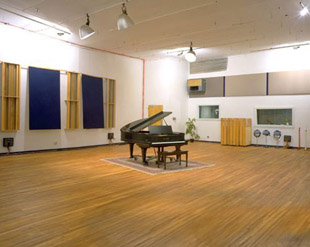
Studio A at KAS Music and Sound is a remarkable 2,400-square foot music space capable of housing a 70-piece orchestra.

“It’s one of the last studios of its kind in the city,” says Castellon, continuously smiling through owl-eyed glasses and a Frank Zappa mustache. “The main room has 2.7-seconds of reverb.”

“[Using gobos] we can re-configure it in all sorts of ways. Each section can have its own sound. You can have the strings players sounding really wet and live on one end, while the horns stay completely dry at the other end. All the things you might do with effects you can do right here in the room instead.”

Two conjoined isolation booths that tie into the room are larger than many pro studios in their own right. They’re also a shielded by a Faraday cage, which was built into the walls by the U.S. Army when it used the building throughout World War II and the years that followed. This hidden metal meshwork keeps out radio-frequency interference – and communist spies.

Unsurprisingly, the studio is at no loss for gear. Although Castellon clearly enjoys the Neve console, multiple tape machines, Pro Tools HD rig, outboard compressors and vintage microphones at the studio’s disposal, he can be dismissive of them:

“Great records are made, not by great recorders, but by great performances.”

“When you come here, you’re going to get a great recording, of course. It’ll be as good as or better than anywhere else on the planet – There’s no reason to worry about it. The other part of our job is making musicians as comfortable as possible so they can give it the best they have.”

He even makes recording great music seems like a quasi-religious experience. “That’s what really captures people,” he says. “When musicians get together and make some truth come through those speakers.”

If there’s anything here that helps make Castellon himself comfortable, it’s the listening environment:

Joe Castellon at the Neve V-60 in KAS Studio A

“It’s a true dead-end, live-end kind of control room,” he says. “There’s no reflections coming from the speaker-side of the room. The corners have deep traps that break up standing waves, and the back wall has a diffuser that makes it completely invisible to your ears.”

“When we had [blind tenor] Andrea Bocelli here I asked him: ‘Hey Andrea, can you hear that wall right behind you?’ Blind people can usually tell where they are in a room just by listening. But he said ‘no way, it just sounds like the room keeps going and going straight back.’”

“This way, you hear the sound only once – when it’s going from the speakers to your ears. There are no reflections anywhere to color the sound, so you can always trust what you’re hearing.”

Taking a tour of the building, scale starts to become apparent. The half-million square feet of production space are better described in acres (11-and-a-half of them) or, if you prefer, hectares (over-four-and-a-half of those).

We walked by soundstages the size of small town centers where film companies construct and destroy virtual cities. Other rooms showed that they could encompass a suburban high school, an entire floor of an inner-city hospital, the Cosbys’ house, an entire block known as Sesame Street.

By the time we sat back down in the control room to recap, the world had somehow become small and manageable once again. Like Castellon, the building itself seems to have a sense of humor. For all the memorabilia Kaufman Astoria has on display, only one film was honored with what I might call a “shrine”.  If you look hard enough on your next visit, you might just find an entire hallway intersection  adorned with bold and ornate set-pieces. They come from the Ishtar – a film known almost exclusively as one of the most high-profile flops of all time.

Also in Queens…

THE BUDDY PROJECT
www.thebuddyproject.com

Kieran Kelly’s Buddy Project studio is an uber-affordable personal favorite located in Astoria, Queens.

The Buddy Project, Astoria

Although its entire floorplan could make a restroom at Kaufman Astoria look like a gymnasium, The Buddy Project is a surprisingly great-sounding, absurdly budget-friendly space that comes well-appointed, featuring a Pro Tools HD system and several flavors of custom-made 500-series modules from Eisen Audio.

The live room, blessed with high-ceilings and ample natural light, is where Sufjan Stevens recorded much of his sonically-elegant Illinois – using only an Audio Technica 4033 and his own Roland VS 880 digital multi-track.

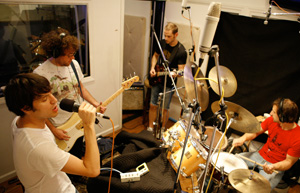
The studio comes equipped with several well-kept drum kits and a pair of iso cabs for pre-production and basics, has a more-than serviceable mic locker and acts as a great space for acoustic overdubs of any kind.

SPIN MUSIC STUDIOS
www.spinmusicstudios.com

Owned by Pete Benjamin, LIC’s Spin Studios is a multi-room, 4,000 square-foot recording facility located at the foot of the Queensboro bridge.

Studio A features 68 channel SSL 4064 G / G+ console, while Studio B houses a 52-input Amek console and is designed with a “wide-open, loft-like feel.”

A BLOODY GOOD RECORD
www.abloodygoodrecord.com

A Bloody Good record is an affordable Pro Tools HD studio in Long Island City operated by Mark Law. It features Pro Tools HD, a Dangerous summing system, two sound-treated recording booths and a surprisingly expansive control-room and lounge.

The Wild Arctic Live Room

SOUNDWORKS RECORDING
www.soundworksrecording.com

Soundworks is an Astoria studio run by Sandra & Kamilo Kratc. It features “four individually floated spaces” and a Yamaha G7 Grand piano.

THE WILD ARCTIC
www.thewildarctic.com

The Wild Arctic is an affordable Pro Tools HD studio in LIC specializing in both indie pop and punk rock.

The studio encompasses an ample live room, control room and two iso-booths. Clients include The Hold Steady, Agnostic Front, Bouncing Souls, and Kill Your Idols.

Justin Colletti is a Brooklyn-based producer/engineer who works with uncommon artists, and a journalist who writes about music and how we make it. Visit him at www.justincolletti.com.

In-Session: Bridges and Powerlines at The Buddy Project

May 12, 2010 by  
/* Filed under NYC Spotlight */

ASTORIA, QUEENS: Over the winter, Brooklyn indie-rock band Bridges & Powerlines made their forthcoming record, Eve, with producer/engineer Kieran Kelly at his Astoria studio, The Buddy Project.

Bridges and Powerlines' (l-r) Peter Mucek, Andrew Wood, Keith Sigel and David Boyd

Bridges and Powerlines' (l-r) Peter Mucek, Andrew Wood, Keith Sigel and David Boyd

As fans of Bridges and Powerlines’ debut LP, Ghost Types, with its catchy-cool synth-pop meets indie-rock sound, we jumped at the opportunity to hear all about the making of their new album from Kelly and band bass player/vocalist Keith Sigel while getting the lay of the land at The Buddy Project.

This is the studio where Sufjan Stevens recorded most of his expansive orch-pop opus, Illinoise, a fact of recurring significance to Bridges and Powerlines as they worked through their ambitious recording plans after a year of writing and pre-production.

“The ghost of Illinoise is very palpable here,” says Sigel of The Buddy Project. Kelly adds, “Yeah, there’s something about knowing that the studio is capable of producing that record. It’s safe to say that it happened here once, it can happen again!”

Setting out to make a sprawling rock record of their own, Bridges and Powerlines had plans to build out their sound with varying degrees of orchestration, vocal harmonies and layers of sonic textures. The Buddy Project is not big, so the fact that Sufjan tracked so much of his massively orchestrated record here is not only a reassuring concept, it’s also quite an empowering one to a band on an indie budget.

“Every other day, we’d be like ‘what would Sufjan have done in this situation?”, says Siegel.

And with Kelly co-piloting, The Buddy Project became everything the band needed to produce what Siegel refers to as “the record I’ve been wanting to make my whole life.”

PRE-PRODUCTION, RECORDING & MORE RECORDING

After Bridges and Powerlines had spent several months demo’ing their new songs, they had a couple conditions in getting started with a producer. “We knew we wanted to have more time in the studio than we had on our last album,” says Sigel, “And we wanted a producer that could work with us in pre-production.”

Kelly built in the time to work with Bridges and Powerlines in their rehearsal space, advising on song structure and arrangements.

Bridges and Powerlines tracking basics at Soundworks

Bridges and Powerlines tracking basics at Soundworks

“He went over all our demos with us and was really active in pre-production — he blocked off about two months to make the record,” Sigel notes. “It was basically what every band wants and what every producer promises, but Kieran actually delivered.”

When it came time to start tracking, they utilized the studio right next door to The Buddy Project, Soundworks Recording, to cut basics to the studio’s 2” tape machine with engineer Kamilo Kratc. Soundworks, Kelly notes, will soon be directly tied into The Buddy Project and, vice-versa.

After tracking basics, the group thoroughly explored their musical and sonic options inside The Buddy Project. Renting and borrowing instruments (Sigel’s friend, ex-Cult bassist Stephen Harris, leant his Gretsch White Falcon among other guitars), hiring string and horns players and recording multiple tracks of near-everything, Bridges and Powerlines left no stone unturned in satisfying every sonic curiosity.

“At the beginning of the session, I promised myself that if there was an instrument we thought of for the record, we would have it,” says Sigel. “We decided we wanted timpanis and we found this great place, Carroll Music Instrument Rentals, all the way on the west side of Manhattan, that has an amazing inventory — every instrument you can imagine — and allows you to rent for 24 hours. We got two gigantic kettle timpanis, crash cymbals and chimes.”

Kelly adds, “Keith and I were very much of the mind to record everything we wanted, knowing that we’d pare it down later on. A couple of the songs are like 90 tracks.”

Band and crew! Kieran Kelly, second from left, and Soundworks owner/engineer Kamilo Kratc, third from left.

Band and crew! Kieran Kelly, second from left, and Soundworks owner/engineer Kamilo Kratc, third from left.

Accounting for some of that abundance are alternate tracks captured to a cassette tape deck, hand-held digital recorder and Fulltone Tube Tape Echo. “We tracked all the basics to 2” and simultaneously to a cassette deck so that we’d get one really dirty, warm, lo-fi track that we could potentially mix in,” says Sigel.

“It sounded really sweet, we loved it! But the cassette tape drifts; it runs at a different speed than the 2” and there were so many sync problems that ultimately made it too difficult to work with on drums. On grand piano, it was awesome — it gave us this super haunted piano sound that was amazing.

“We also tracked simultaneously to a little hand-held digital recorder because it had this bad-ass compressor on it and you could get that totally blown-out drum sound.”

String and horn sessions, led by Rob Moose (Antony and the Johnsons and Sufjan Stevens’ ensembles), were tracked at The Buddy Project, with singer/songwriter Will Stratton arranging a few of the songs and conducting. In “The Buddy Project” as collaborative studio concept, Stratton is one of the “buddies.” Kelly recently co-produced/mixed Stratton’s introspective folk record, No Wonder, and put it out through his record company, Stunning Models on Display.

The Buddy Project live room

The Buddy Project live room

“Bringing in friends and talented people I’ve worked with is all part of The Buddy Project concept,” says Kelly. “Will is classically trained and wrote some of the arrangements, along with Andrew [Wood], Dave [Boyd] and Keith. When you’re working with high-level players like we were you need to have properly mapped out arrangements and you need to move through sections quickly, so it really helps to have someone conducting.”

The string quartet was “semi-close miked” and the room sound was captured off the upright piano, a unique Buddy Project room-miking technique. “I mic the piano — about 1/8” off the soundboard — and depress the sustain pedal (by jamming a drum stick or something in there),” Kelly reveals. “You run that into a really fast compressor, like an 1176, with a super-fast attack and release. And then, what you essentially have is a wood-plate; a plate reverb. And it gives you these crazy, blown out sounds.”

This room miking technique came in big on Bridges and Powerlines’ guitar and drum sounds captured in The Buddy Project live room, as well as on all the unconventional percussion, i.e. church-stomp sounds.

Bridges and Powerlines' lead singer/keyboardist Andrew Wood

Bridges and Powerlines' lead singer/keyboardist Andrew Wood

“Another big technique we used was tracking all of the vocals through our Fulltone tape machine,” Sigel adds. “We would run a tape echo track that was not intended to be an echo or delay, and then line it right up with whatever we were tracking, and then mix that dirty, tapey sound in with the regular track. It does awesome things to vocals, gives them so much presence. These are the best sounding vocals we’ve ever gotten.”

As for backing vocals, Sigel mentions he tracked about half of them on his own, at home. “Kieran gave me the mic the Illinoise vocals were tracked on [Audio-Technica AT 4033] and the Manley ELOP compressor that Kanye West tracked all of College Dropout with and I went to town,” says Sigel. “I added all kinds of crazy tracks!”

This is not the first time Kelly has furnished his client with the means to record auxiliary tracks at home. His reasoning? “The records I work on are always co-producing arrangements. It’s not dictatorial; it’s not my record, it’s their record,” he explains. “ And I like everyone to be involved in the recording process. There are certain things that as a semi-literate engineer, I just would not do, whereas the artist will do these things that are so wrong that they end up adding a really nice flavor.”

As co-producer, Kelly kept Bridges and Powerlines focused but also let Sigel loose to add tracks to his heart’s content. Then it all went off to Scott Solter in North Carolina for mixing.

As fans of Solter’s work with Spoon and specifically John Vanderslice’s Cellar Door, they readily handed over their multitracks. “Cellar Door is one of my favorite sounding records, and we felt we could trust anyone who can make a record that sounds like that,” says Sigel, noting, “…Although our record sounds nothing like Cellar Door because it just has so much going on!”

Making use of another neighboring audio facility to The Buddy Project, the band went to Andreas Meyer for mastering. A mastering engineer formerly of Sony Studios, Meyer operates Meyer Media out of the same Astoria building.

THE BUDDY PROJECT SOUND

Bridges and Powerlines had 60s sounds in mind when producing Eve. “We were going for 60s, but not totally retro, more like ‘informed by…’” Sigel describes. “The ZombiesOdyssey and Oracle was definitely a reference point. But we also really loved The National’s last record, Boxer. And another big influence was Animal Collective’s Merriweather Post Pavilion, but I wanted it to sound more analog than that.”

Kieran Kelly in The Buddy Project control room.

Kieran Kelly in The Buddy Project control room.

Wherever digital sources were used in the production, for example Reason’s Abbey Road keyboards, Kelly amped them and ran them through the Leslie or the tape machine, or one of the fuzz pedals the band brought in. Plus, The Buddy Project has a lot of hand-built and customized analog equipment used throughout the recording process.

“Almost all of the mic pre’s that I use on this record were hand-built by Jens Jungkurth, of Eisen Audio, which is based in Long Island City with Coral Sound and Exile Recording,” Kelly notes.

“Jens is a genius. He built 10 of my pre-amps and two EQs. He really works with you to give you the tonal character you’re looking for. He’s really young but I think that in 15 years people will be using his name like Rupert Neve.”

The custom analog gear is a big part of the Buddy Project recording philosophy. “Keith and I love classic records like Pet Sounds, Sgt. Pepper’s, Kind of Blue, Odyssey and Oracle, The Kinks records — and on all of those albums, there was a really high level of commitment to the technical side of things, as well as the creative side,” Kelly points out.

“Historically, records were made using custom-built gear, equipment that was built for the studio as opposed to something off the shelf. I think that’s really great and I’m trying to do that here as much as I can. So when you work here, you’re getting a sound that’s unique to The Buddy Project, unique to this time and place.”

Look out for Bridges and Powerlines new record this Fall and in the meantime, check them out at www.bridgesandpowerlines.com. For more information on The Buddy Project, visit www.thebuddyproject.com.