The SonicScoop Year in Review: Top NYC Music Business News and Trends of 2010

December 29, 2010 by  
/* Filed under Music Biz */

THE FIVE BOROUGHS: 2010 has been busy all right. For anyone involved in New York City’s expansive business of music – producer, publisher, entrepreneur, engineer, artist, and many more – the environment remains fast-paced, ultra-competitive and constantly changing.

Northern Lights' WSDG-designed 5.1 audio mix suite

With 2011 looming, SonicScoop looked for the news, trends and topics that stood out to us over the past 365 days.

In audio post, it was grow or die in the uppermost echelon. The biggest facilities, including hsr|ny, Nutmeg, and Sound Lounge made serious expansions into audio and/or video:

Sound Lounge opened an ADR Stage and multiple studios.

Nutmeg Post added a strong team and facility when it soaked up Soundhound.

The big post house Mega Playground built out audio capabilities.

Northern Lights added a 5.1 audio mixing suite.

Video house Click3X reversed the trend and added their own audio suite.

Celebrating 35 years in business, hsr|ny continued to expand as a full-service video and audio post facility.

Large and mid-sized recording/tracking/mixing studios kept making capital improvements and expanding:

Premier Studios took over the 8th floor at 723 7th Avenue.

Engine Room opened up its penthouse studio.

Stadium Red expanded with a new studio for Just Blaze and a mastering suite.

The remarkable Electric Lady celebrated turning 40.

Platinum Studios added Augspurgers to Studio K.

Sear Sound set up the Moog-centric Studio D.

Tainted Blue swapped out its SSL for a Euphonix (nee Avid) System 5.

And props to Electric Lady for marking its 40th Anniversary.

Converse (yes, the shoe company) has an interesting business plan for the Rubber Tracks studio it’s going to open in Williamsburg in 2011: no-cost recording.

Advanced smaller studios – independent and within larger facilities — and producer rooms also opened up at a peppy pace:

Chris Theberge’s Music Works arrived on the Upper West Side.

The former One Point Six in Williamsburg was reborn as Three Egg Studios.

Manhattan Center Studios launched The Fuse Box with Public Enemy’s Brian Hardgroove.

Brian Hardgroove is building up the Fuse Box.

Avatar opened up its Studio W writing room.

Sisko’s Min-Max Studios opened up in midtown.

Marc Alan Goodman announced an ambitious new expansion for Brooklyn’s Strange Weather, then blogged about the buildout – step by step – for SonicScoop.

Guitarist Justin King moved his Vinegar Hill Sound from Portland, OR to DUMBO, Brooklyn.

Avid capped off a furious year of reinvention and new products with the release of Pro Tools 9.

Music houses and composers still had a ton of TV, film and video game work to go after and win:

Joel Beckerman of Man Made Music continued to make NYC a TV music powerhouse.

Composer Peter Nashel turned ears everywhere with his work for shows like Rubicon.

The Rubicon ensemble tracking in Avatar Studio C

Outfits like Expansion Team scored for networks such as the Biography Channel.

Tom Salta understands how to get chosen to score for games like Prince of Persia and Red Steel 2.

Production music and synch licensing remained a solid business, especially for those who got in at the right time or had a smart approach.

NYC’s Kingsize Music was acquired by 615 Music.

And later on Warner-Chappell (NYC) bought up 615 Music.

NYC’s Videohelper released the “Scenarios” music search tool.

Jingle Punks continued to grow.

Mechanical licensing experts RightsFlow kept progressing.

One of NYC’s most controversial music business plays, peer-to-peer file sharing network Limewire, appeared to be finally finished.

Tracking, mixing and mastering at NYC’s established facilities did a relatively healthy volume of A-level and independent work throughout the year:

will.i.am produced a new Black Eyed Peas record at Germano Studios.

The Black Eyed Peas, Rivers Cuomo and Kanye West were at Germano Studios.

Neon Indian, Beach House, Matt and Kim, Bear Hands and more were mastered at The Lodge.

MSR Studios handled Kid Cudi, Evanescence and Broadway Cast recordings.

Lenny Kravitz, The Dirty Pearls, “Glee”, and Vampire Weekend were all at Avatar.

Joe Lambert Mastering worked with Moby and Ninjasonik.

New software and hardware happiness abounded:

We elected many items “Buzzworthy” at AES, from Universal Audio, Focal, SSL, Burl, Shadow Hills, Izotope, Sound Toys, Lavry Engineering, Telefunken and more.

Propellerhead released Reason 5.

NYC suffered losses when beloved people and places left us:

Recording icon Walter Sear passed away.

Walter Sear's spirit continues to thrive at Sear Sound.

The great hip hop/jazz experimentalist Guru was gone before his time.

Clinton Recording Studios hosted its last session.

Brick and mortar music retail took another hit when Fat Beats shuttered its last stores.

Baseline Studios, home of Just Blaze and countless Jay-Z hits, closed.

Chung King Studios started off 2010 with a bang by suddenly vacating Varick Street.

NYC-based producers, mixers, engineers and artists became businesses in their own right:

Producer Chris Coady worked on some hugely acclaimed records this year, including Beach House Teen Dream and Delorean Subiza, as well as records with Hooray for Earth, Zola Jesus, Smith Westerns, Cold Cave.

People like Allen Farmelo developed their distinctive sound.

Shane Stoneback is in the right place, right time.

Choice songwriter Claude Kelly made a business of hits.

Shane Stoneback’s career took off via work with Sleigh Bells and Vampire Weekend.

Mixer Mark Saunders embraced multiple aspects of the biz from his studio at Beat 360.

Dream Theater’s Jordan Rudess took his iPad/iPhone app MorphWiz all the way to #1.

Joel Hamilton continued down an immersive production path, working on records with Blakroc, Dub Trio, The Parkington Sisters and Blakroc.

And John Agnello brought his classic production and engineering technique to new records for Kurt Vile, J Mascis, Shayna Zaid And The Catch and Dead Confederate (among others).

The studio scene got a lot more socialicious and FUN:

Flux Studios was always hosting something in the East Village, like Alto and Dangerous converging for a schooling from Fab.

Two fiesta types plus (r) introspective Stadiumred artist Jeremy Carr. SonicScoop says: HAVE FUN AND PROSPER IN 2011!

Digital Music NY was one of many popular business-based meetups.

Stadium Red partied down post-CMJ.

20dot20 mixed advertising and music.

And the Connectors connected a LOT of people.

What big stories would you include? And what do you see next in 2011? Don’t be shy – leave a comment and let us know!

– Janice Brown and David Weiss

Joel Hamilton’s Immersive Path: Producing Like A Method Actor, Recording in South Africa and Dub For Disney

May 26, 2010 by  
/* Filed under NYC Spotlight */

WILLIAMSBURG, BROOKLYN: Joel Hamilton is a hard guy to pin down. Paging through his discography, career highlights jump out from all corners of the map. Although his mixes often feature direct, powerful central elements against backdrops of wide, immersive ambience, his production style is best defined by his adaptability.

Joel Hamilton at the Neve 5316 in Studio G.

Joel works across genres to create records with unique sonic stamps. If a common thread runs through his discography, it’s the prevalence of artists with distinct, singular voices. Often referenced are the unmistakable thumbprints of Elvis Costello, Tom Waits and Marc Ribot.  He’s gone from gritty to pretty with Dub Trio, Matisyahu, Sparklehorse, Jolie Holland, and thanks to a newly released Blakroc record, he’s crossed paths with true hip-hop heavyweights like RZA and Mos Def.

We caught up with Joel by Studio G‘s Neve 5316 and found him fresh off a two-week recording stint in rural South Africa.  Already back into the swing of life as an in-demand NYC producer/engineer, he told us about tracking sessions beneath a bullet-ridden chalkboard in the Nkomazi countryside, long days in the studio with a haunting “mermaid choir,” and pumping out dub tracks for Disney.

The new Blakroc record has been doing pretty well. A lot of Rock/Hip Hop crossovers in the recent past saw Rock artists bringing in Hip Hop elements. Jay Z made some news last summer when he came to this neighborhood for a Grizzly Bear show, and made some comments about modern rap growing stale.

It’s funny you bring that up. Damon Dash had been Jay Z’s producer and partner for years and he was Executive Producer on the Blakroc sessions. If we had the idea to get RZA on a track, he was the guy who could pull out the Rolodex and make it happen. At one point, he basically named all these people and said “Me, Jay, Rick, we’re all getting out of Hip Hop.”

I was a huge Hip-Hop fan from the early days. There were parallels with Hardcore at the time. They shared this urgent “revolution now”, kind of vibe that’s common to street music. The idea with Blakroc was about going around the Hip Hop idiom in a lot of ways. It used to be so authentic, but it’s been xeroxed so many times that it barely resembles the original art form. There’s a lot of great stuff out there, but when it comes to the mass-market stuff you’d hear on the radio, it has none of the soul anymore. It’s been emasculated in a lot of ways.

Emasculated by sheer machismo?

(Laughs) Weirdly, yeah. But to me that is emasculation. If you have a real cause with some substance, that’s about as masculine as you can get. It’s that kind of genuine focused passion that gives people the strength to walk into Rwanda or go into the hood and do a needle exchange program in the early 80s. There’s a kind of power that comes when you’re there trying to do something that actually makes a difference.

Speaking of…you’ve just come back from recording in Africa with TRIAD Trust. Tell us a little about that.

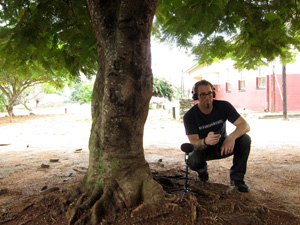
Recording rehearsal under some trees outside the Hamilton setup as a studio for the week in Kamhlushwa, Nkomazi, South Africa.

At a fundamental level, TRIAD Trust is an AIDS awareness program that does medical outreach. The way it’s implemented is really genius. I’m not a complete 16-year-old utopian. The concept that you should be as destitute as the people you’re trying to help is ridiculous. But so many non-profits will have their heart in the right place, and then you walk into the office and they have marble counter-tops and the Park Avenue address, and you think “Do you really need that to save the world?”  That kind of bums me out a little bit. There was none of that at TRIAD.

When I was being introduced to them, I was shown simple point-and-shoot videos and photos that were unbelievably compelling. There was one in particular that stuck out. It was a picture of a kid playing soccer. He had a left sneaker on his right foot, and no sneaker on the other foot. The reason was as simple as this: He was right handed and wanted the sneaker on the stronger leg. What he had to work with was one sneaker, and he put it on the leg that could kick better. That just spoke volumes about the attitude over there.

There are some very modern areas in South Africa with well developed infrastructure. I saw some of your photos, and the Nkomazi region, where you were was definitely not one of them.

Absolutely. It was in the middle of nowhere, even by South African standards. Let’s put it this way: South Africa has the highest incidence of HIV and AIDS in the world, and we were in the section that has the highest incidence in South Africa. Over 50% of males won’t see their 30th birthday. It’s not that it’s “the hood”. Nobody’s smoking crack. It’s not the “bad area”. You can’t even call it “poor”. There are just no resources.

So what was the goal of this trip and these recordings? Is there an album that came out of it?

It’s not finished yet, but I have roughs that I made, literally in a hut. We wanted to challenge the notion of “album” a bit. There are some elements akin to an NPR documentary, with interviews and other real-life snippets for context. But you don’t want to take that too far into “field recording” territory. I didn’t want to drop in as the white guy and say “Alright! Now Hold Up Your Spears and Smile! *click*” (Laughs) That’s not what I was there to do.

They’re savvy kids, and they want to feel valued as artists. We do have some material that’s very traditional, but that’s just one facet of who they are. If you’re a young American, that doesn’t mean the” Star-Spangled Banner” defines who you are. These guys and girls know western music. They’d also love to make something akin to an Alicia Keys record. You’ve got to respect that too.

So what direction did you end up taking them in? More towards punching and overdubs, or more toward…

It’s different for each person. One girl named Nomvula could sing a song four times and just kill it on every pass. Any one of those takes could have been “the one.” There were other performers where we’d punch every fourth word. Either way, it would come out in a way that would establish the mood we were trying to convey. That was the most important thing.

So you’re not going in there with any specialized recording dogma. “We must follow this set of rules because we’re in Africa, trying to keep it real.”

That’s a mistake in New York, Baltimore, San Francisco, and Africa (Laughs).

I’ve heard you talk about taking a dogmatic approach to recording: “Overdubs are evil”, “Rhythm guitars must be doubled” or whatever it may be. Do you think there’s any room for that in recording process?

You’re totally baiting me so hard right now, because you know! (Laughs).  Short answer: No. I wouldn’t put my shoes on your feet and expect them to fit you just because they feel good on me.

Long answer? Maybe, if your definition of success is getting the 10 million dollar contract and having 19 Grammy-winning records in a row. If you already have that track record, and you’ve found artists who want to follow the path you’ve laid out and go through the standard industry channels, then go for it. Maybe it’ll work if you apply your formula to someone else. But the problem is, at a certain point, even that fails.

So there’s no formula, but you do have to trust your instincts. I can definitely hear bold moves in your mixes, especially with Dub Trio, but I can’t say you have an overbearing sonic stamp.

Joel Hamilton and The Parkington Sisters at Avatar Studios, NYC. Photo by Nate O. Johnson.

Production-wise I’m more interested in creating an environment where people can realize their vision. They filter it through me and I help them get rid of the things that they don’t need.  A lot of producers feel like they impart something through the filtration process, but I try not to. If you were draining a pot of pasta, and your colander was flaking off shards of metal into your linguini, you’d throw it out!

Do I have a sonic bull’s-eye in my mind? Yeah, sure, but it’s different for each record. I might leave something behind when making production choices, but it’s best when you don’t try to.

What have you been working on most recently? Anything we should look forward to?

The Parkington Sisters. Definitely. No one’s heard of them yet, and they’re amazing. They’re five sisters:  A string quartet and a multi-instrumentalist, with beautiful five-part harmonies.  It’s hard to compare it to anything else. If you could mute the rhythm section on Beck’s Sea Change, and just be left with the most beautiful shimmering orchestral moments and add a choir of mermaids, it might be a little like that. It’s a record that doesn’t just come out of the speakers, it occupies the room. It’s very melancholy and beautiful.

Although that’s so far removed from some of the heavier records you’ve worked on, listening to them it’s clear you’re just as comfortable with them as with anything else. What does it take to jump from style to style so effectively?

If you don’t have a concrete idea of what “a record” should sound like, you can be kind of like a method actor. I like things that live way outside of the center, so I feel like I can operate at the extremities really well whether it’s supposed to be really heart-wrenchingly beautiful or totally savage.

When I listen to my favorite records, I don’t picture a singer in the studio wearing headphones. Instead, they create their own world and hold you there. If there’s a unifying approach I have for making any record, that’s it. I want it be as if we’re creating a real, unusual physical space that you can actually visit and live in for a little while.

Speaking of unusual worlds, you just did a reggae track for Disney.

Yeah, with Matisyahu. We did a remake of the song “Circle of Life” from the Lion King soundtrack.

Wow.

Yeah. (Laughs)

It was hard to figure out at first. We were sitting around with the band, with our heads in our hands, giggling awkwardly about how incredible the original is, and trying to figure out how the hell we were going to make it cool. I think an important thing in making it work is that we barely referenced the destination or who was paying for it. All we could do was try to make something we thought was great. For a little while we weren’t sure if they were even going to use it because there’s a straight up Dub section at the end. There were a lot of moves there to make it sound a bit more sinister, with a classic Radio One/King Tubby kind of vibe.

The truth is, commerce is built into art whether you like it or not. The best way to make a record recoup is to make it good, and to do that you have to separate the money and the creative process by a thousand foot wall. So, in a way, to safeguard the investment, you have to safeguard the creative process.

You’re a new Father. Congratulations. What’s it like trying to strike a balance between work and family in a profession that insists on odd hours and “just one more take”? Do you have any rules for making it work?

Sure, I have a great one: Set a precedent with the client. If you establish that you’ll be working until 10pm and you stay until 11pm, you’re a hero. If you set no precedent, then you’re an asshole when you walk at the door, no matter what time it is. It’s crucial. So many things that happen in the studio are so easily avoided by just having one conversation over tea before walking in the control room.

It’s also good to remember that it’s pointless to do 700 takes into the same mic and the same pre, unless I hear it getting better every single time. Otherwise it’s futile, and you’ll gain more by stopping than pushing on. In the end I don’t have a firm stance on the number of tracks or takes or days.

You have a lot of great hardware here at Studio G and I know you keep your Studer and Neve in the signal path at all times. Still, you seem to have really embraced digital. You’re always working in Pro Tools, and do a fair share of processing there too. Do you ever wax poetic for the old days?

Hamilton's Wall of Sound

When I started out I only had 16 tracks. It’s funny to think that sounds so renegade now, like we were going 100 miles an hour without a windshield, taking the bugs in our teeth. It’s kind of bullshit to romanticize that. I don’t understand how having more colors on the palette means you have to put them all on the canvas.

There are ten million restaurants here in New York. It doesn’t mean I have to eat at all of them for lunch. Choose something! Some of the plug-ins are good too. I think about them just like you’d think of any other piece in the rack.

Speaking of the rack, are there any new toys in here you’ve been loving?

Here’s one: the Tyme Sefari. It’s a voltage-controlled sampler and delay. You can use it to create a tempo locked-delay, and then alter elements of the delay based on what’s happening in the track. I like to do a lot of analog morphing of sounds based on tempo or mood.  I might use it as a pre-delay feeding a reverb.

If you were to put a band pass filter into the side-chain of a gate, when the chord changes and you pass the threshold, it’ll a fire dancing rhythmic delay in the background, which might only come during the chorus. You don’t hear it as an “effect” so much but it can really give a track energy and movement.

So you do some things that aren’t really meant to be heard?

Definitely. Oh yeah, tons.

That’s so different than say, a Steve Albini. I remember an interview where he said the opposite: “I don’t get the idea of something that’s so quiet you don’t even hear it.  Why not mute it?”

Sure.  And some people like black and white movies. There’s something to be said for that aesthetic, but I choose a more immersive path. I’m not a documentary recordist. There are elements on most of these records that are the equivalent to the frame around the painting, or the lighting on a stage. I like the idea that you’re signing about things that are melancholy or aggressive, there are ways to give the listener emotional cues that match that.

Walking out of the studio an aluminum baseball bat leaning against the doorframe caught my eye, “The Big Boomer”, ostensibly present for giving would-be gear-thieves emotional cues to the cranium. I looked at him with a quizzical smile. Joel laughed and shrugged it off: “This neighborhood wasn’t always filled with pretty indie rock girls. That’s why.” — Justin Colletti

Find out more about Joel Hamilton at www.joelhamiltonrecording.com and Studio G HERE, and find him on the Tape Op Message Board. Also, for more information on TRIAD Trust, visit www.triadtrust.org.