2012 Winter NAMM Tech Highlights
January 26, 2012 by Bo Boddie
/* Filed under Deli Feed, Deli NYC Feed, Tech & Reviews */
While Anaheim is most famous for attracting hoards of children to Disneyland each year, this past weekend the “adults” of the music world got to take over for a long weekend.
The enormous Anaheim Convention Center was absolutely packed with virtually every gear and instrument manufacturer that one could imagine. As I had never been to a Winter NAMM show this was a great treat for me, and I had an awesome day walking around and chatting with representatives from some of my favorite companies. My only complaint was the fact that, pathetically, my legs were sore the next day!
This year at NAMM there were quite a few big announcements from some major players in the audio world, along with the typically exciting spread for musicians, so without further ado… let’s discuss:
In the past ten years, Universal Audio (UA) has a come a long way, not only continuing to make their classic hardware products, but also creating one of the best lines of plug-ins that’s out there right now. They’ve really embraced the DAW age, and in the process have created what most engineers and producers now consider an essential part of their creative toolset. This year there was a lot of buzz surrounding UA’s release of their first foray into the world of multi-channel audio interfaces: Apollo.
The Apollo interface is feature-packed: Offering 18×24 inputs and outputs, it will work at sample rates up to 192 kHz and connects to the user’s CPU via either Firewire 800 or Thunderbolt. Perhaps the most exciting aspect of Apollo’s functionality is that it is also loaded with either the UAD DUO or QUAD DSP cards, so you’ll also be able to run the full complement of UAD plug-ins when using the interface.
Apollo can also be completely software controlled, and UA has built a fantastic software interface that works seamlessly with most DAWs. For the first time, UAD users will be able to use their coveted plug-ins with near zero latency! Not only that, but you are now able to track with as many DSP-powered plug-ins as you like, and you also have the option to print the processed tracks as you record; with less than 2 ms of input latency. The system is naturally instantly recallable, and in the demos that I saw, is very solidly incorporated with the user’s choice of DAW.

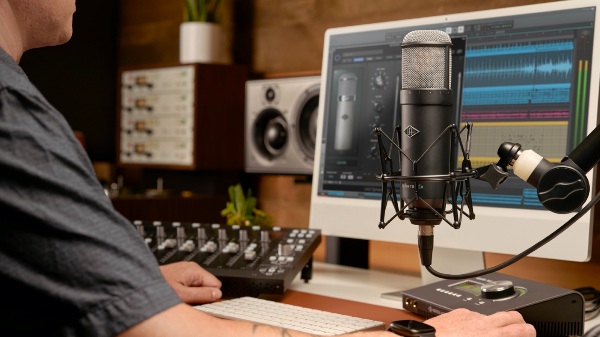
Apollo w/ laptop. Available in both DUO CORE ($1,999) and QUAD CORE ($2,499) processing in this first quarter of 2012.
In addition to the Apollo interface, UA also announced a new Direct Development partner for their UAD-2 platform: Sonnox. As with other third-party developers like Brainworx and SPL, this partnership means that Sonnox will be able to directly create software for the UAD platform, and to sell these plug-ins via UA’s online store.
I was also assured by Lev Perrey, UA’s Director of Product Management, that AAX and 64-bit versions of all of the UAD plug-ins are a top priority, and that they should be ready by the end of the year.
Slate Pro Audio / Slate Digital
I was excited to see some big surprises here! Steven Slate was on hand to announce three big new products, two of which were completely unexpected. First of all, the new Raven X1 Production Console was introduced.
The Raven is a unique console and control surface solution for DAW users. It is, essentially, a monitor and cue section loaded into a 32-channel frame. Along with racks for favorite gear, the Raven also ships with 4 Avid Artist Mix controllers pre-loaded, as well as an LCD monitor, metering, and a unique set of laptop-style monitors built into the surface. This is definitely a cool (and more cost effective) alternative to Avid’s D-Control and Command control surfaces.
While price is still TBD on the Raven, and the model on the show floor was just the prototype, Slate Pro Audio assures the first consoles will start shipping in 60 days.
Next up from Slate was the new Siren D3 Monitoring system. The Siren is a 1,000 watt 3-way monitor speaker with a phase-linear DSP-powered crossover. The coolest thing about these monitors is that the user can alter the crossover settings remotely using an iPhone app; different speaker response characteristics can be easily emulated by changing the way the crossover works. This feature essentially gives the user several different types of monitors all in the same package.
Last but not least was Slate’s new tape emulation plug-in, called the VTM (Virtual Tape Machine). Although tape emulations have been a bit de-rigueur over the past few years I’m definitely excited to hear what this one sounds like. The VTM models two machines, a 16 track 2”, and a 2 track 1/2”, and according to Slate, every aspect of the machines’ characteristics were gone over. In fact, Slate’s CTO, Fabrice Gabriel went as far as to say that the algorithm they used was “bloody” in its complexity: sounds good to me!
Pricing/availability on the Siren D3 and Slate Digital VTM plug-in have not yet been announced. Stay tuned!
Over at Dangerous Music, the major news was their brand-new monitor controller called the Dangerous Source.
Dangerous designed the Source with portability in mind, incorporating the components and build quality of their other monitor controllers into a smaller box. This is a desktop or rack installable unit providing monitor control for up to two pairs of speakers and headphones with digital, analog and USB sources. Especially notable here is that this is a “Dangerous”-ly well-crafted product at a sub 1k price point!
The Source has two headphone outs, a USB-in for use of Dangerous’ superior D/A converters in place of a traditional I/O interface, and multiple digital and analog inputs (including an 1/8’ in). An especially interesting feature, which you’ll be hard-pressed to find in another small-footprint monitoring solution, is the inclusion of four monitor outputs that can all be used at the same time if desired; users can monitor on two sets of different speakers, or incorporate a subwoofer as a supplement to one set of speakers. The Source will begin shipping in the 2nd quarter of 2012.
Perhaps the biggest news Moog had at NAMM this year was the introduction of the Minitaur, a new analog synth based on their classic Taurus foot pedals. I got to spend some time with it and it sounds incredible! Equally appealing is the Minitaur’s low price: $679.00 MSRP.
The Minitaur has a small footprint, but really sounds enormous; definitely a great addition to the Moog line.
Cyril Lance, a senior engineer at Moog was nice enough to show me some of the other newer Moog products as well, including the Anamoog iPad app, their 500-series Ladder Filter, and the Cluster Flux Moogerfooger pedal. As per usual with Moog products, all three designs sound incredible and are incredibly musical in their orientation and usability. A really inspiring visit!
Line 6 debuted a surprising new product this year called the StageScape M20d. The StageScape is an all-in-one digital mixer for live sound, targeting bands and musicians who want great sound and ease of use.
The most remarkable thing about this product is the touchscreen interface and GUI. All functions of the mixer can be accessed by a 7” color touchscreen that controls easy-to-use software; all mixing is done using a graphical representation of instruments on a stage. For the technically uninitiated this makes the live sound mixing process incredible simple; just orient what’s on the screen to match what you see in front of you and you have the beginnings of a solid live mix.
Of course, the user can go deeper, incorporating easy-to-use effects and recording capabilities as well. There are 12 mic pres/inputs built-in, as well as 4 line inputs, 4 monitor outputs, USB, and two main speaker outs. Additionally, the StageScape can also be controlled by iPad!
As noted above under the Universal Audio heading, one of the more notable pieces of news with Sonnox this year is that their full line of plug-ins will now run on the UAD Powered Plug-Ins platform. However, this is definitely not the only news. Sonnox is one of the first plug-in developers to offer their full line of products in not only 64-bit code, but Avid’s AAX format as well! This is great news, as these plugs are so well-loved and used!
Additionally, I got to see a demo of the Sonnox Fraunhofer Pro-Codec. Although it isn’t brand-spanking new, I have to say that it is an invaluable tool! The Pro-Codec allows the user to hear their mix in multiple codec formats in real-time within the DAW; you can instantly hear exactly what an mp3 or m4a version of your material will sound like. Definitely a unique piece of software and great to have around!
Shure’s news this year is on the wireless front, specifically with their new ULX-D Digital Wireless system. Given that the FCC has shrunk the bandwidth available for wireless networks, new efficiency is needed, and the ULX-D is Shure’s answer. The ULX-D system converts incoming signal digitally, and broadcasts the digital signal to the receiver. This system not only allows for greater accuracy, but allows a full 14 streams per channel, maximizing the narrow bandwidth currently available.
The ULX-D1 sports a rugged build, and uses lithium-ion batteries which provide a 12-hour life per charge. Click for more details and pricing.
Additionally this year, Shure is getting into the professional open-backed headphone market with two offerings, the SRH-1440, and SRH-1840. Open-backed headphones are prized because of their naturalistic sound, depth of field, and wide imaging characteristics.
Sennheiser also has a wireless offering this year, but on the more affordable end of the spectrum with their XS Series. Designed for ease-of-use, the XS series offers true diversity reception, 8 frequency banks with 12 coordinated channels each, up to 10-hour operation using AA batteries, and a scan function which easily identifies all available frequencies.
The XS series comes in several different configurations (Instrument, Vocal, Presentation), all around the $400.00 range which makes it a powerful and affordable solution for most budgets.

XS Wireless line includes two systems for vocalists (like the one pictured here) and one instrument set for guitarists.
On the live and installed sound tip, Harman introduced a new version of HiQnet system configuration and control protocol. The new Crown HiQnet Band Manager 2 is a simplified version of the software designed for smaller systems, giving musicians, DJs and venues control and monitoring for Crown Audio’s XTi 2 product lines. Users will be able to manage up to eight XTi 2 amplifiers via intuitive USB interface. Click for more details.
Lexicon’s news was that its PCM Native Effects and PCM Native Reverb plug-ins will now available individually. Starting in February, the 14 PC- and Mac-compatible plug-ins, including Pitch Shift, MultiVoice Pitch, Chorus, Resonant Chords, Stringbox, Vintage Plate, Concert Hall and Chamber, will be available individually at prices ranging from $199 – $699 a pop.
So Much To See
Beyond what I’ve outlined above I was able to see a myriad of other wonderful offerings, including Peavey’s Auto-Tune guitar, some stellar mic amp and summing options from Phoenix Audio, and Arturia’s fantastic new analog synth – the MiniBrute.
I also saw some great offerings from Blue Microphones for musician-recordists and discriminating consumers, including the Spark Digital iPad mic, the Mikey Digital iPhone mic and interface, and the new Tiki USB mic.
Looking forward, I am hoping to give more in-depth reviews of some of these new products in the near future, and in the meantime, I’ll be bathing my aching legs in Epsom salts!
Bo Boddie is a Grammy winning engineer/producer and composer who has worked with Santana, Everlast, Korn, Reni Lane, and many others. He just completed work on Imperial Teen’s second release on Merge Records, as well as composition work on HBO’s 3rd season of Hung.
Universal Audio Unveils Apollo Audio Interface With Realtime UAD Processing
January 19, 2012 by Janice Brown
/* Filed under Deli Feed, Deli NYC Feed, News */
Today at Winter NAMM, Universal Audio (UA) announced a brand-new hardware interface product called Apollo which the company considers to be the culmination of 10 years of analog and digital audio development.
Apollo is a high-resolution audio interface that combines UA’s analog design heritage with its UAD Powered Plug-Ins in a recording system for Mac and – by summer ’12 – PC.*
With Apollo, producers and performers can track through UAD Powered Plug-Ins in real time, via a professional 18 x 24 FireWire/Thunderbolt-ready audio interface that delivers class-leading 24-bit/192 kHz sound quality.
According to the UA product announcement…
Apollo is, first and foremost, a well-built, high-resolution audio interface, featuring premium mic preamps and top-end converters to deliver the lowest THD and highest dynamic range in its class. Its Core Audio and ASIO* drivers ensure compatibility with all major DAWs, including Pro Tools, Logic Pro, Cubase, Live, and more. Moreover, Apollo’s Console application and companion Console Recall plug-in (VST/AU/RTAS) provide control and recall of all interface and UAD plug-in settings within individual DAW sessions, even months and years later.
Apollo also features onboard UAD-2 DSP Acceleration. This onboard processing allows for recording through UAD-2 Powered Plug-Ins — with nearly instant sub-2ms latency — so that music producers can quickly monitor, audition, and “print” audio using a wide range of popular analog emulation plug-ins from Ampex, Lexicon, Manley, Neve, Roland, SSL, Studer, and more.** In this way, Apollo’s sonic character and tonal options are virtually limitless. The onboard UAD-2 processors are also available for mixing and mastering, offloading processing from the host computer.
Apollo offers compatibility with Intel’s new Thunderbolt technology, as found on the newest iMacs, MacBook Pros, and MacBook Airs. Available via a user-installable Thunderbolt Option Card (sold separately), Thunderbolt provides lower latency, reduced audio buffer size, improved performance at high sample rates, and greater UAD plug-in instances versus FireWire.
Apollo incorporates numerous design hallmarks from classic UA analog gear, including its fast, easy workflow. Dedicated front-panel controls are present for all the most common features, including preamp gain, channel selection, mic pad, +48V phantom power, low cut, monitor level, and dual headphone controls.
Apollo’s connectivity includes 4 digitally controlled analog mic preamps, 8 balanced line inputs and outputs, dual front-panel JFET DIs, digitally-controlled analog monitor outputs, 8 channels of ADAT, 2 channels of S/PDIF, word clock I/O, FireWire 800 (standard), and a Thunderbolt expansion bay.
The Apollo High-Resolution Audio Interface will be available in both DUO CORE and QUAD CORE processing formats (with either two or four Analog Devices SHARC processors, respectively). Apollo will be shipping in the first quarter of 2012, with an estimated street price of $1,999 (DUO processing model) and $2,499 (QUAD processing model). Apollo’s Thunderbolt Option Card will be shipping in the first half of 2012, with an ESP of $499.
Apollo is compatible with Mac OS X 10.6 and 10.7; Windows 7 support coming Summer 2012. **Individual UAD Powered Plug-In titles are sold separately at http://www.uaudio.com/store
Click to learn more about Apollo and see it in action!
Review: Universal Audio UAD Ampex ATR-102 Plug-in
January 17, 2012 by Geoff Sanoff
/* Filed under Deli Feed, Deli NYC Feed, Tech & Reviews */
If you make your living recording and mixing music, no matter how much you may love working with tape, the budgets for many a project will simply not allow you to use it – either because of the cost of the tape itself, or the cost imposed by the workflow that tape demands.
Universal Audio created their UAD Ampex ATR-102 plug-in for the UAD platform to address this modern-day problem. This plug-in runs on a UAD-2 card, and can be used in VST, AU or RTAS plug-in formats.
The UAD ATR-102 is modeled after the famous 2-track Ampex ATR-102 tape deck that’s been in constant use in studios all over the world since it was first introduced in 1976.
According to Universal Audio’s marketing department, the ATR-102 is “considered by many engineers to be the best sounding tape machine for final mix down.” And the resale price of these specific machines would tend to bear this claim out. Last time I checked, a refurbished ATR-102 was selling for over $10,000!!
If it Looks Like an ATR-102 and Sounds Like an ATR-102…
Universal Audio has (again) done a fabulous job of creating a convincing visual replica. Clearly this is a selling point on the plug-in emulations market, and I am open to the suggestion that the authentic looking graphics may well help fool my ears into thinking that that which looks like a tape machine also sounds like one.
And yet, I think one of the appeals of plug-in emulators is that they present us with a familiar set of parameters. The learning curve feels faster because our brains already have an idea of how something should work, and we – the users – can anticipate the results, even to the point of convincing ourselves that something sounds like the real thing when it doesn’t. It at least kind of acts like the real thing, right?
With that in mind, I’d like to believe that if the UAD ATR-102 were a 100 miles away from sounding like the hardware, I could tell the difference. The moment that convinced me that this plug-in is, in fact, shockingly close to the hardware, was when I changed the head stack setting from 1” to 1/2”. I’ve never used a 1” ATR-102 before so I don’t have a point of reference for it. I have, however, spent plenty of time with the 1/2” ATR-102. The minute I engaged the 1/2” head stack setting on this the plug-in, my jaw dropped. I was hearing that familiar smoothness with a slight roll-off on the low, low end, that has served so many, so well.
I’d go as far as to say that this plug-in sounds about as close to the real thing as any two Ampex 102’s are likely to sound to each other after 40 years of modifications, repairs and day to day usage.
Features/Functions (But Wait! There’s More…)
As with UA’s Studer A800 plug-in, the UAD ATR-102 can operate in an automatic calibration mode, leaving the user to select between 4 tape speeds (30ips, 15ips, 7.5 ips, 3.75 ips), 4 tape formulations per tape speed, 4 record levels per formulation (+3,+6,+7.5,+9), 3 head stack widths (1/4”, 1/2” and 1”), 3 input options (repro head, sync head, input) and 2 pre-emphasis EQ settings (AES or, NAB & CCIR).
If that’s not enough, and you prefer not to use the plug-in’s auto-calibration feature, you can adjust all parameters that exist on a real world machine (well… almost all, no azimuth screw – what’s up with that, UA?:-)). When you want a little less over-biasing than the auto-cal provides, just turn a virtual screw. You can adjust record, sync and playback equalizations (hi and low) as well.
AND, if you are a sucker for 10khz tones like I am, then you’ll revel in this plug-ins’ calibration mode which provides you with the ability to do an alignment from scratch using the tones generated from the UAD ATR-102’s built-in oscillator function. (I expect someone to find a cool, unintended use for this.)
So thoroughly does the UAD ATR-102 break out the functions used in the calibration process, that even if this thing didn’t sound as good as it does, it would still have a future as a teaching tool at recording schools the world over. Institutes of higher learning may not have the money to buy a fleet of vintage ATR-102’s, but they can certainly afford this plug-in and a few UAD-2 cards.

Features include adjustable Wow, Flutter, Hiss, Hum, Crosstalk, and (L/R) Tape Delay. Click to enlarge.
And yet, that’s not all…
With this plug-in you get a complete set of Ginsu knives AND Universal Audio has thrown in a mode allowing the UAD ATR-102 to be used as a tape delay so you can enjoy the sound of your alignment with the delay times of your choice.
In addition to the functions you want from your analog tape deck, Universal Audio has also included features that electrical engineers have tried very hard to eliminate from their analog designs. Want more cross talk? You got it! (This is really cool) How ‘bout some wow? Not into wow? Maybe some flutter? Ok, just tape hiss? NO PROBLEM, it’s included, unless you turn it off.
And, in response to popular demand and common modification, the UAD ATR-102 now includes the transformerless mod, should you choose to be as pristine as possible in your plug-in’s signal path.
Seriously, there are a plethora of screws to turn and buttons to press with this plug-in. With some software, I would say that too many options is as frustrating as too few. It can be confusing and annoying to search for the one parameter you want to tweak among the many you have no use for. The familiarity of the interface avoids this problem for me, as I’m sure it will for many potential customers. Even if you don’t understand what half of the stuff does, however, UA’s eminently useful presets and auto-calibration features will have you up and running quickly.
In Use
For the record, I have a long-standing relationship with UA. As a gear-nerd reviewer I have a vested interest in saying nice things about their software. But saying nice things and actually using a product every day to mix records are two different things. If my work doesn’t make my clients happy they let me know, and my reputation potentially suffers. So I am extremely critical in my evaluation of new tools for my own arsenal… and this one has more than made the cut.
In fact, I’ve put the ATR-102 plug-in on every mix I’ve done on my home system since it was released (that’s about 4 months of mixes), including Eytan and the Embassy‘s new single “Everything Changes,” P.T. Walkey‘s forthcoming record Thriller, and mixes on an upcoming solo release by James Iha – formerly of The Smashing Pumpkins and currently of A Perfect Circle.
Primarily, I’ve just been using the ATR-102 plug-in as the last insert on my mix bus. I’ve tried it on bass and vocals as well as on piano – all with satisfying results. I’ve played with it as a parallel bus processor too, but the biggest impediment to using and overusing the UAD ATR-102 is the fact that it’s a processor hog with substantial latency. If you are working in Pro Tools as I am, then you can’t run many of these both as inserts and on parallel busses if you are also working at lower sample rates. The maximum delay compensation of Pro Tools 9 is fairly low relative to what this plug-in requires. [Ed. note: According to UA, delay compensation improvements in Pro Tools 10 greatly benefit UAD users.]
As a mix down processor I’ve explored most of the tape types, speeds and head stacks. I thought I’d use the 30 ips setting more, but I almost always end up at 15 ips, often using the UAD ATR-102’s default starting alignment: 456 at 15ips on 1” tape at +6 nwB/m. It makes me wonder whether after all these years I should have been printing to 15 ips more often, even if you can’t turn the hiss off of a 1/2” machine like you can on a plug-in.
The transformerless option is a particularly nice inclusion on this piece given how much it affects the low end. Take it out when you really want to hear maximum bass at all frequencies, and keep it in when you want to move the bass from your bowels to your solar plexus.
The processor intensity and latency make me less likely to use the UAD ATR-102 as a tape delay. I have many other delay options, and while this one is really cool and sounds great, it’s not always worth the cost in latency and processing. With that said, because of its remarkable breadth of parameters, you can make some pretty unique and realistic sounding delay effects with this plug-in.
I recently enjoyed using the wow, flutter, and cross talk settings to create a “tape being eaten” effect on a mix for James Iha that I’ve never before been able to accomplish in the box.
Constructive Criticism
Other than the processor usage and latency, the only other bee in my bonnet with the UAD ATR-102, which is my critique of UA’s design philosophy in general, is that there are no numeric values given for individual parameters. With so much packed into the graphics of this plug-in, that would be a welcome addition.
I get why UA avoids numbers on their emulations: those numbers aren’t there in the real world, so why put them on a plug-in? And not having those numbers also forces the more OCD among us to adjust by ear rather than numeric value.
But, some of the mappings from mouse to knob/screw on this plug-in just aren’t comfortable, and this makes the lack of numeric values all the more frustrating. I can’t tell if some of the things I have been confused by are issues of plug-in resolution or personal dexterity. For example, after being thwarted by mousing on the Playback Output knob, I turned to my MC Mix control surface to make adjustments only to notice the displayed playback output levels moving in non-linear increments, going from 0 to -.33db to -.76db to -1.24 db.
You just can’t see the screws well enough to control them in subtle ways, or even tell if that degree of resolution is supposed to be there. If there were numeric values, this would be a moot point. And it would be one way to allow the user to quickly compare settings.
If UA doesn’t want to start showing parameter values per se, I would love to see this plug-in (and their Studer 800 as well) given some kind of memory settings so we could at least easily a/b (or in my case a/b/c/d) things while making adjustments. Being able to quickly compare alignments would be a real help given that the differences between settings on a tape machine are often quite subtle and are therefore easy to quickly forget.
To conclude, after using this product almost daily since its release, it got me thinking that the end of a certain analog fetishism seems closer than ever before. Given how close this sounds to the original, I just can’t imagine shelling out $10k for the real McCoy.
While I love the fact that each piece of vintage gear is unique its own way, supplies the user with its sonic fingerprint and has no latency, I will not miss paying for repairs, downtime, or tape. And I certainly won’t miss having to do alignments or worry about getting into the nicer studio with the tape machine just to do a mix recall.
Universal Audio’s Ampex ATR-102 Mastering Tape Recorder Plug-In runs on the UAD Powered Plug-Ins platform and sells for $349 on the UA Webstore. Click for more details.
Geoff Sanoff is a GRAMMY-winning NYC-based producer/engineer and musician who’s worked with Fountains of Wayne, School of Seven Bells, Obits, Nada Surf, Aaron Neville, Sarah Brightman and the Sheepdogs (among many others). Contact Geoff through Just Managing.
Happy Holiday Deals From Alto NYC, Universal Audio, SoundToys, Moog and More
December 2, 2011 by Janice Brown
/* Filed under Deli NYC Feed, News */
If you’re in the market for some new studio-enhancing component or other (and who isn’t), now might be a good time to buy! There are a bunch of holiday-oriented sales going on in December – here are the ones we know about so far (updated from the top):
Moog Stocking Stuffer Sale
In 1998 Bob Moog released the first MF-101 Lowpass Filter to the world. This month, Moog Music celebrates the production of serial number 10,000! In honor of this milestone and as a thank you to the customers who made it possible, Moog is offering a $50 mail in rebate on all Moogerfooger purchases.
Just in time for the holidays, buy a Moogerfooger from an authorized Moog Dealer and Moog Music will send you a check for $50. Offer available from November 14 through December 31, 2011. Click for more info!
Moog also has special holiday prices on various fashions for all you synth nuts, i.e. the must-have Voyager Oscillator hoodie, the Moog Modular Tee, or the Moog onesie! Check out the complete collection here.
TELEFUNKEN Elektroakustik Holiday Sale
- Purchase an AR-51 and get a new M81 dynamic mic for free.
- Purchase a CU-29 Copperhead between December 5 – December 31 and receive a free R-F-T flight case.
Contact your local Telefunken reseller for further details.
SoundToys Bundles
From now until December 25, customers who buy the SoundToys Native Effects bundle will get the Devil-Loc Deluxe plug-in ($129 value) for free. The offer also applies to the TDM effects bundle. Click for more info and to purchase!
Alto Music NYC
Our favorite NYC music technology retailer (and tech advisor) Shane Koss filled us in on a bunch of deals he has going, including:
- Elektron Sale – 15% off all units
- Waves Signature Series Plug-ins (Eddie Kramer, CLA, JJP, etc.) – All $279
- Universal Audio LA2A Leveling Amplifier (New Factory Repack) - $2299
- Universal Audio 1176LN Limiting Amplifier (New Factory Repack) - $1599
- Universal Audio Solo 610 (New Factory Repack) - $649
- Digidesign Pro Tools Used Accel Card PCI With New Flex Cable - $699
- Focusrite ISA One Analog (New Factory Repack) - $379
- Novation LaunchPad Hardware Controller for Ableton Live (New Factory Repack) - $119.99
- 35% off Rob Papen products
(And for even deeper discounts, contact Shane and say you are from NYC!)
Universal Audio
UA is running a huge Holiday sale on UAD plug-ins, offering 10 – 60% off on over 50 of the popular classic hardware-emulating plug-ins. Visit the UAD store for more details and to purchase!
Antelope Audio
Antelope launched its OCXmas Promotion, offering substantial discounts on its most accessible products including the Isochrone OCX master clock and the Zodiac digital to analog converter (DAC).
Through December 31st, authorized Antelope Audio dealers are offering the Isochrone OCX at $1,095 — a $300 discount from its regular street price of $1,395, and the Zodiac at $1,295 — a $400 discount from the price of $1,695.
U.S. dealers participating in OCXmas include audioMidi.com, Sweetwater.com, and VintageKing.
EastWest, SoundsOnline
EastWest is running a Buy-One-Get-One-Free promotion plus special pricing on Hollywood Brass and Strings.
The buy-one-get-one promotion allows customers who purchase any of 19 qualifying product (The Dark Side, Symphonic Choirs, Symphonic Orchestra, Pianos, Fab Four and more) by December 31, 2011 to choose a second product of equal or lesser value, free of charge. The Hollywood Series Holiday Special allows customers purchase EastWest’s flagship Hollywood Series products; Hollywood Strings and Hollywood Brass, for up to 30% off the retail price.
Customers can take advantage of these promos at www.soundsonline.com. Soundsonline.com is also offering customers 30% off all Zero-G titles until December 31, 2011.
FXpansion
FXpansion is offering price reductions across its software instruments line, including:
DCAM: Synth Squad (analog-modelled soft synths) — now available for $99
Geist (sampling drum machine) — available for $149
BFD Eco – 80% off
Additionally, a large selection of sound expansions for BFD products, Geist and DCAM: Synth Squad are currently at half-price. Visit the FXpansion webshop for more details.
Vintage King Holiday Gift Away
Vintage King is partnering up with a bunch of awesome audio manufacturers (UA, SSL, Royer, Grace Design, Chandler, Metric Halo, etc.) to “gift-away” hardware, software, DVDs and services. Check out the full list and register to win HERE.
SonicScoop – Win the 2Q Talkback Remote System
It’s not exactly holiday-themed, but we do have a great giveaway going on right now, with a new product we reviewed last month – the 2Q Talkback Remote System, designed by NY studio wiring and systems integrator/installer, Mike Donahower. Click for more info and to enter!
SM Pro Audio: V-Machine 2.0, Soft Synths
SM Pro Audio announced limited time pricing of $299.99 for its desktop V-Machine 2.0 VSTi plugin player. Regularly selling for $599.99 (street), the compact V-Machine is designed for musicians, DJs, engineers, and producers on-the-go. The special sale pricing is available only in North America and exclusively at www.vmachineusa.com.
Also on sale at a special introductory price is the all-new Classic Keys Collection, a bundle of plug-ins designed for use with the V-Machine. This collection of keyboard sounds features six top VST instruments, including Applied Acoustics Lounge Lizard Session electric pianos, GForce Minimonsta & Virtual String Machine analog synth & string machines, GSI VB3 & Key Performer tonewheel organ & synth/keys/organ toolkit, and SonicProjects OPX analog synth.
When purchased with the V-Machine, the Classic Keys Collection can be had for $149.99 (50% savings). Current V-Machine owners can purchase the bundle for $199.99.
We’ll continue to post Holiday deals as we discover them!
Made in NY: Fink Analog Audio
November 23, 2011 by Justin Colletti
/* Filed under Tech & Reviews */
From a distance, you might mistake Dennis Fink for a trucker, a contractor, or a retired lumberjack. He’s a tall bear of a man who wears clean, faded blue jeans and beat-up work boots, with a thick shock of grey-blond hair that reaches his collar.
If you never spoke to him, it might surprise you to hear he has two advanced degrees: a Masters in electrical engineering, and another one in business administration. But up close and in person, Fink has a soft voice, an easy smile, and an unpretentious kind of intelligence that’s uniquely American.
“During times of economic downturn,” Fink says, “the thing you really want to spend money on is the development of products. On innovation and engineering. That way, once the economy comes back again, you’ve got some new product out to whet the whistle. Some guys don’t get that.”
Fink has seen his way through plenty of business cycles in the audio world firsthand. He’s even worked alongside two generations of Bill Putnams – First, with Bill Putnam Sr. at UREI, Fink wired up some of the most highly regarded professional tools of the day, and then again with Bill Putnam Jr. at Universal Audio, he helped bring iconic vintage designs to a new mainstream market.
Today, Dennis Fink is at work on his own line of pro audio processors, and his modus operandi is cramming far more classic tools into a single 2RU box than you’d ever expect.
Two years ago, Fink Analog Audio hit the scene with the CS2-FA.
To put it simply, it’s a tube/FET dual-channel-strip. To put it bad-ass-edly, it’s two full-fledged 610-style preamps, two classic 1176 opto compressors, and two Pultec EQPs all in one 2RU box.
Oh yeah, and somehow, it’s made right here in New York and New Jersey and can be had for well under $4,000.
“I priced it out at some point,” says Fink, “and we figured out that if you were going to buy all those pieces separately, out on the open market, it would run you somewhere around $14,000.”
When pressed, Fink contends that he’s not just offering “lite” versions of these circuits so that he could cram them all into a small box and meet a pre-set price point. I ask him point-blank if he’d put his version of the 1176 from the CS2-FA up against a real one, by itself.
“Absolutely,” says Fink. “I would absolutely do that.”
And so he has, more or less.
After introducing the CS2 and then the CS1, Fink decided to try his hand at a stand-alone version of the classic 1176. But then he thought to himself, ‘I’ve got some extra room in here – Why don’t I just throw in an LA-2A while I’m at it?’ And so he did.
The resulting LC1-76LA is essentially two of the most iconic limiter/compressors ever designed, wired together in one box. Or at least, Fink’s version of them.
Of course, there are some differences. Most notably, Fink’s take on the 1176 sports a tube signal path that leaves it sounding a little more open, perhaps a little less aggressive, and with a slightly smoother top-end than the original. By default, it’s wired first in series with the unit’s LA2A-style compressor, but there’s a switch to change that.
“Using a fast limiter in front of a slow limiter is a classic recording chain,” says Fink. “A lot of great American recordings in the 60s, 70s and 80s were done like that.”
“But the cool thing is, with a single switch you can change the order. So instead it can first go into the LA2, the slower limiter, and then into the 76, the faster limiter. That’s a classic British limiter chain from the same period. With that chain you can hit the slow limiter at around 2-3 db [of gain reduction], just to set the overall level, and then you can just crush things following it. ”
“There’s also a third position that will give you two separate limiter/compressors – an independent 1176 and an independent LA2A, or at least, my version of them.”

Dennis Fink helped recreate the reissue 610 and the solo 610 for Universal Audio before starting Fink Analog Audio
This year, Fink also announced two more multi-channel units. Because his tube version of the 1176 compressor and his 3-tube take on the 610 preamp were built to work on small pre-fab cards, Fink realized he had the opportunity to create a couple more products at a negligible R&D cost.
Pretty quickly, the PA4 and LM4 were born. They’re Fink’s 4-channel versions of his preamp and compressor designs. Since they were already built to be compact, he says there was no need to dumb the circuits down to make all four work together in the 2RU chassis.
It sounds like a great idea from a designer’s perspective, but I asked Fink if in a digital age, he thinks buyers will really be attracted to a 4-channel analog compressor.
“Sure,” he says. “I mean, it’s basically four 1176s in a box. If you were in a live front-of-house situation it would be great on your buses. If you were doing a mixdown session, even in a small studio, and wanted to try some real analog compressors on drums, you could put these in the chain and print them all in one pass.”
“But there’s also still a whole bunch of high-end, working studios that just can’t have enough limiters. When you’re talking about 32, 48, 64 tracks on a large-format console, they need as many channels of great analog compressors in their stable as they can get. And can you imagine how much space it would take up to have four actual 1176s in the rack compared to one 2RU box?”
For a big guy, Fink gets how much power there is in keeping things compact.
The full line of Fink Analog Audio processors is available through Alto Music NYC, and at select retailers throughout the country. Product prices range from roughly $2,500-$3,800, and Fink says discount pricing is available on the CS2-FA through the end of 2011.
Justin Colletti is a Brooklyn-based producer/engineer who works with uncommon artists, and a journalist who writes about music and how we make it. Visit him at www.justincolletti.com.
Universal Audio Clinic Featuring Vaughan Merrick at Alto NYC, 11/17
November 10, 2011 by Janice Brown
/* Filed under Deli NYC Feed, News */
On Thursday, November 17, Alto Music NYC will host a Universal Audio clinic led by Grammy-winning recording/mix engineer Vaughan Merrick (Amy Winehouse, Mark Ronson, Jason Mraz).
See and hear the UA analog hardware and UAD-2 Powered Plug-ins in action, including the recently released Ampex ATR-102 and MXR Flanger/Doubler plug-ins.
(If you’re thinking about getting into the world of UAD Powered plug-ins, or want to upgrade or add to your system, or just want to hear the latest and mix with some audio friends, you should come to this event!)
The clinic will be hosted by Universal Audio’s Bruce MacPherson, at Alto NYC’s 29th Street studio/showroom.
Space is limited so please RSVP to shane@altomusic.com.
Full Coordinates:
Universal Audio Clinic
Thursday, Nov. 17, 6PM
@ Alto Music NYC
146 W. 29th Street, Suite 4RW
RSVP to shane@altomusic.com
Universal Audio Releases UAD-2 Quad Omni 6 DSP Accelerator
October 22, 2011 by David Weiss
/* Filed under Deli Feed, Deli NYC Feed, News */
Universal Audio has announced the release of the new UAD-2 QUAD Omni 6 DSP Accelerator Packages.
Now the flagship product in their UAD-2 line, the QUAD Omni 6 DSP Accelerator Packages is available in either PCIe card or Satellite FireWire unit formats, and gives producers and engineers all 53 UA-developed plug-ins up to and including UAD software v.6.0, for a highly cost-effective alternative to buying the plug-ins individually (a $5000 savings, according to the company).
The Omni packages also feature full compatibility with the newly announced Avid Pro Tools 10. All UAD-2 DSP Accelerators now share this trait moving forward.
The UAD-2 QUAD Omni packages feature four Analog Devices SHARC chips, which drive analog emulation plug-ins including Ampex, Lexicon, Studer, SSL, Neve, Manley, Roland, BOSS, dbx, Empirical Labs, EMT, Teletronix, and more. A $100 Plug-In Voucher redeemable from UA’s Online Store Fully compatible with Avid Pro Tools 10 is also included.
Review: Studer A800 Multichannel Tape Recorder Plugin for UAD-2
October 20, 2011 by David Weiss
/* Filed under Podcast */
This week on I/O, Eli and Geoff review the Studer A800 Multichannel Tape Recorder plugin for UAD-2, from Universal Audio, and then share some examples of this deep plugin in action.
Input/Output Podcast: UAD Studer A800 Plugin Review by SonicScoop
The Studer A800 Multichannel Tape Recorder plug-in for UAD-2 (Mac and PC) is authenticated by Studer, and was modeled by Universal Audio’s team of DSP engineers and AES magnetic recording expert Jay McKnight over a 12-month period. It models the entire multitrack tape circuit path and electronics of a popular A800 machine from Allen Sides’ collection at Ocean Way Studios, along with the sounds of multiple tape formulas.
Geoff and Eli’s review is accompanied by example tracks of the plugin in action.
First is an excerpt of “Love You Dearly”, a track from PT Walkley’s Ghost of Chivalry EP in which Eli Janney swapped the original drum recorded on tape with a different drummer not recorded on tape. He then used the Studer A800 plugin to simulate the tape sound with great results.
Listen to the clip here:
Audio clip: Adobe Flash Player (version 9 or above) is required to play this audio clip. Download the latest version here. You also need to have JavaScript enabled in your browser.
Next, Geoff Sanoff used the Studer A800 plugin for a project with the Chicago band Bottomless Pit. Hear it applied on the song “Winterwind” from their album Blood Under the Bridge, recorded by Geoff live at the Knitting Factory Brooklyn, November 13, 2010 using the club’s Avid Venue console via firewire to a MacBook Pro.
There are 3 groupings of Bottomless Pit mixes:
1) The plugin is applied on individual tracks (tracks 2-4 below)
2) The plugin is applied on just the drums, and (tracks 5-8 below)
3) The plugin is on the mix bus both with and without it on individual tracks, and with no plugin at all (tracks 9-11 below)
Input/Output Podcast: UAD Studer A800 Plugin Review by SonicScoop
Universal Audio Announces New Development Partnerships with API and Thermionic Culture
October 20, 2011 by Janice Brown
/* Filed under News */
Universal Audio (UA) has just announced new development partnerships with API and Thermionic Culture, with plans to co-develop new plug-ins for the UAD platform.
With these new partnerships, UA will be able to bring software emulations of coveted API and Thermionic Culture products to a growing population of engineers and producers worldwide who are using UAD-powered products on Mac and PC.
“We’re thrilled to welcome our new partners to the UA family,” says Matt Ward, President of Universal Audio.
“The legendary API signal processors and high-quality boutique products of Thermionic Culture both have something unique to offer UAD customers. We’re looking forward to the products that develop from these partnerships.”
We are too!
Universal Audio Announces UAD Software v6.0, Ampex ATR-102 Mastering Tape Recorder Plug-In, More
September 1, 2011 by Janice Brown
/* Filed under Deli Feed, Deli NYC Feed, News */
Universal Audio has today launched a major software update – UAD v6.0 – and a brand-new plug-in…
The Ampex ATR-102 Mastering Tape Recorder – considered by many engineers to be the best-sounding tape machine for final mixdown – is now available as a faithful plug-in emulation on the UAD-2 Powered Plug-Ins platform.
Considered a perfect complement to the workhorse Studer A800 Multichannel Tape Recorder Plug-In, the officially sanctioned Ampex ATR-102 plug-in provides the final, cohesive analog polish and punch for any in-the-box mastering session, without the ongoing maintenance and calibration of a physical tape machine. According to the product announcement:
“Impeccably developed over a nine-month period in the renowned UAD engineering tradition – and incorporating presets from noted ATR-102 users Chuck Ainlay, Richard Dodd, Buddy Miller, and Mike Poole – the ATR-102 Mastering Tape Recorder Plug-In faithfully replicates the unique dynamics, frequency response, and saturation characteristics of the original hardware.
“Scrutinized and fully authenticated by Ampex Corporation, the sound of the ATR-102 plug-in for UAD-2 is virtually indistinguishable from its analog cousin.”
Available for purchase via UA’s Online Store, the Ampex ATR-102 Tape Recorder Plug-In sells for $349. Click for more information on the ATR-102 Mastering Tape Recorder Plug-In.
The Ampex ATR-102 Tape Recorder Plug-In is available as part of the new UAD Software v6.0 release (free to download HERE), which also includes the new Brainworx bx_digital V2 EQ and SPL Vitalizer MK2-T direct developer plug-ins, as well as Pro Tools compatibility enhancements and Mac OS X Lion support.
First, for Pro Tools users, UAD software v6.0 adds many new features to streamline integration of their UAD plug-ins into their DAW experience, including:
• UA-developed RTAS plug-ins, replacing current VST-to-RTAS Adapter
• Full support of all Pro Tools control surfaces, including customized control layouts
• Fully automatable plug-in parameters, with values and ranges displayed in automation lanes and on control surfaces
• Plug-in names clearly displayed in the Pro Tools Mix and Edit windows
• Plug-ins sorted by category in the Pro Tools plug-ins menu
• Quick installation process
• Many other workflow improvements
And, the Brainworx bx_digital V2 EQ plug-in and the SPL Vitalizer MK2-T plug-in – now available with UAD v6.0 – are significant not only in their sonics but also as the first UAD plug-ins to be developed in their entirety by outside software engineers (in this case SPL and Brainworx) as part of a new UAD-2 SDK (software development kit). According to UA:
“The bx_digital V2 EQ offers three modes – M/S Mastering, M/S Recording, and L/R Stereo – with a unique “SixPack” Master Section, 11-band EQ with Shifter EQs to 22 kHz, and built-in M/S De-Esser, Dynamic EQ, and extensive metering options. An included bx_digital V2 Mono plug-in provides the same Mastering EQ-quality sound for mixing applications. For many engineers, this incredibly smooth-sounding processor is simply the ultimate software equalizer.
“The SPL Vitalizer MK2-T is an authentic emulation of the popular tube-based Vitalizer hardware unit, a longtime staple of top mixing and post-production engineers. Offering a patented technology for greater perceived loudness and clarity without unnatural artifacts, the Vitalizer provides independent Bass and Mid-Hi processing that works in both the time and frequency domains to effectively unmask overlapping sounds. As both a fixative and an enhancement tool, the Vitalizer MK2-T is a mixing must-have.”
Available for purchase via UA’s Online Store, the Brainworx bx_digital V2 EQ sells for $329, and the SPL Vitalizer MK2-T sells for $249.
UAD Software v6.0 is available as a FREE download for Mac and PC users worldwide. Click to download.